
The AI Assisted Coding Jobs Market Is Exploding — Here’s What You Need to Know
AI assisted coding jobs are one of the fastest-growing categories in tech right now. Here’s a quick snapshot of where to find them and what to expect:
Top platforms to find AI assisted coding jobs:
- Remote Vibe Coding Jobs — curated remote roles for AI-native developers
- LinkedIn — 9,000+ AI programmer listings, 500+ new posts per day
What the market looks like in May 2026:
| Experience Level | Salary Range |
|---|---|
| Entry-level (1-2 years) | $70,000 – $100,000 |
| Mid-level | $100,000 – $150,000 |
| Senior AI-first developer | $150,000 – $400,000+ |
| Freelance / contract | $100 – $300/hr |
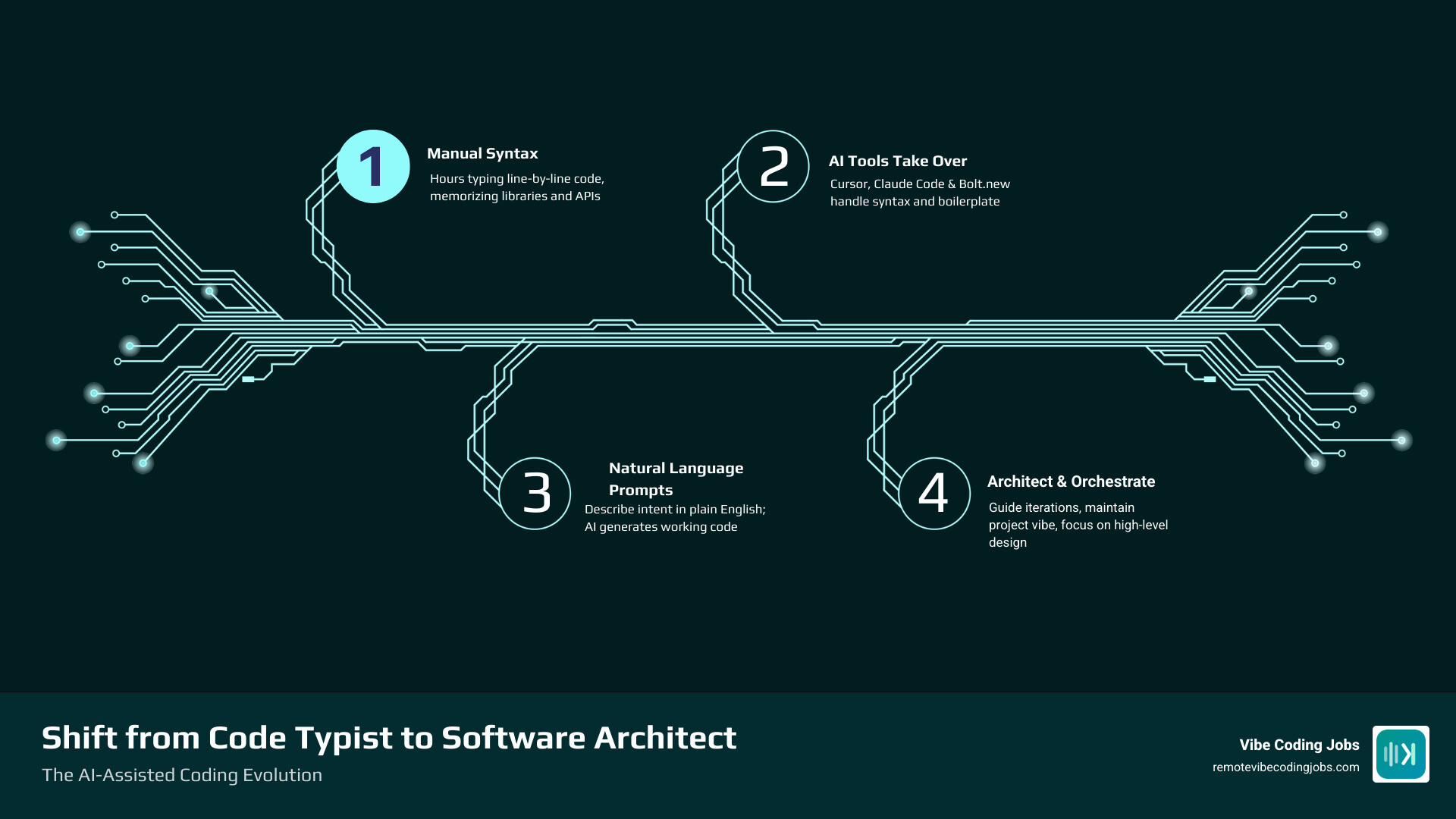
The rules of software development are being rewritten fast. Developers who once spent their days typing syntax line by line are now directing AI tools like Cursor, Claude Code, and Bolt.new to do the heavy lifting — and companies are paying a premium for people who can do this well. The AI-assisted coding market is projected to grow from $3 billion to over $10 billion in the coming decade, and the hiring surge is already here.
This shift even has a name: vibe coding. The idea is simple. Instead of being a “code typist,” you become a software architect — describing what you want in plain language and guiding AI to build it. Elite engineers like Andrej Karpathy have publicly championed this approach, and Fortune 500 companies are now writing it directly into job descriptions.
The demand is real. The roles are varied. And the window to get in early is still open.
I’m the RVCJ Editorial team at Remote Vibe Coding Jobs, where we track and curate global remote AI assisted coding jobs for developers building with tools like Cursor, Claude, Copilot, Windsurf, and Replit. In this list, we break down the top roles, tools, salaries, and platforms so you can find the right opportunity faster.
The Rise of Vibe Coding and AI Assisted Development
The tech world is currently obsessed with “vibe coding.” While it sounds like a Silicon Valley buzzword, it represents a fundamental shift in how software is created. We are moving away from the era of manual syntax mastery and into an era of intent-based development. In this new world, your ability to articulate a vision and maintain the “vibe” of a project is more important than your ability to remember the specific parameters of a library function.
In May 2026, ai assisted coding jobs aren’t just for traditional engineers. They are for anyone who can act as a software architect, using natural language to manifest complex digital products. This evolution is detailed extensively in our AI-Assisted Development Career Guide, which highlights how the barrier to entry for high-level development is lowering, even as the ceiling for what we can build is rising.
Defining the AI-Native Workflow
An AI-native workflow is built on prompt engineering and iterative feedback. Instead of staring at a blank screen, you might start with a high-level prompt in a tool like Cursor. The AI generates a structure, and you act as the “human-in-the-loop,” auditing the output for logic errors, security vulnerabilities, and architectural consistency.
This isn’t a “set it and forget it” process. It requires high-level orchestration. You are the conductor, and the AI is your orchestra. You need to know when the violins are out of tune—meaning you must still understand the fundamentals of code to debug and refine what the AI produces. For more on how this looks in a daily professional setting, check out our guide on Vibe Coding Career: Remote Jobs, Benefits & Application Tips.
Why Companies are Hiring Vibe Coders
Why are companies so eager to hire “vibe coders”? The answer is simple: velocity. Developers using AI-assisted workflows report productivity increases of 2x to 5x within the first month of consistent practice. This allows startups to ship MVPs in days rather than months and enables established firms to clear massive backlogs of technical debt.
Furthermore, these roles are inherently suited for the modern workforce. Most ai assisted coding jobs are remote-friendly and async-first. Companies realize that if a developer can build an entire platform using natural language prompts, they don’t need to be sitting in a cubicle in San Francisco to do it. You can explore these flexible roles further at AI Coding Jobs: Remote Opportunities.
Top Roles in the AI Assisted Coding Jobs Market
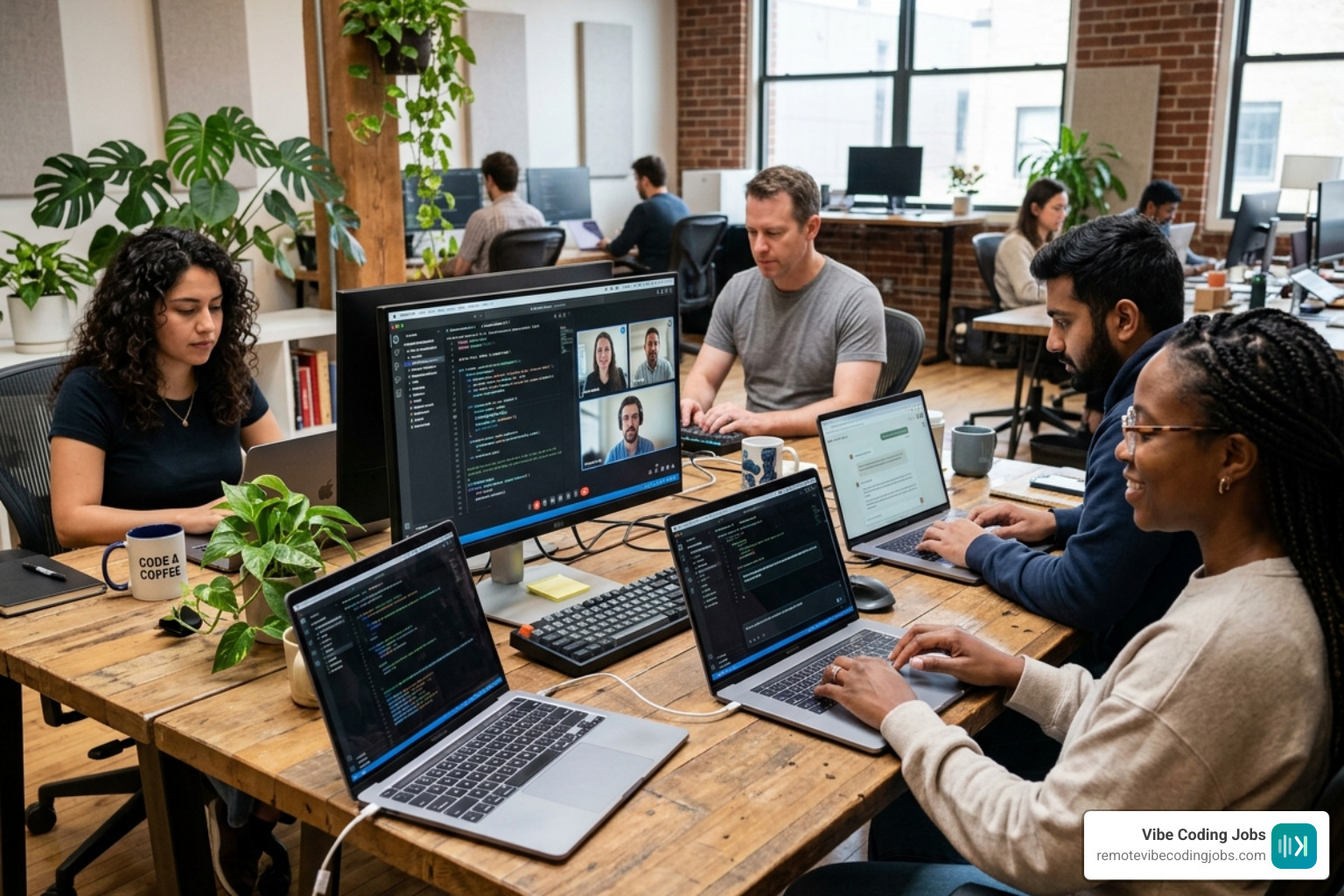
As we look at the landscape in 2026, several distinct roles have emerged. We are seeing a move away from generic “Full Stack Developer” titles toward more specialized AI-native designations.
- AI-First Developer: These engineers prioritize AI tools for every task, from writing unit tests to refactoring legacy Java code.
- Creative Technologist: A hybrid role that combines product design with rapid AI prototyping. They often use tools like v0.dev to turn a “vibe” into a functional UI.
- AI Systems Architect: Senior professionals who design the guardrails for how an entire organization uses AI, ensuring that the code generated across teams is secure and scalable.
Entry-Level AI Assisted Coding Jobs
If you are just starting out, don’t be intimidated. There are thousands of entry-level ai assisted coding jobs available. Many companies are hiring “Junior Agentic Engineers” or “Junior Vibe Coders” who may not have a CS degree but possess a killer portfolio of AI-built projects.
Employers are looking for “portfolio-first” candidates. If you can show a live, working application that you built and deployed using Claude and Cursor, that often carries more weight than a diploma. We’ve compiled a list of these pathways in our resources for Entry-Level AI Coding Jobs & Future Job Market and AI Coding Jobs: Entry-Level Opportunities.
The Future of AI Assisted Coding Jobs in Specialized Fields
The impact of AI isn’t limited to web apps. Specialized fields like medical coding are being transformed. In healthcare, AI is being used to navigate the complexity of ICD-10 coding. However, human expertise remains irreplaceable for clinical intuition and compliance judgment.
We are also seeing a massive rise in “Technical Auditing” and RLHF (Reinforcement Learning from Human Feedback) roles. Companies like Snorkel AI and OpenAI hire experts to rank and repair AI-generated code. For example, a Senior Software Engineer in AI Code Ranking can earn over $100/hr just by reviewing and justifying which code snippet is more efficient.
Essential Tools and Skills for AI Assisted Coding Jobs
To land these roles, you need to master the 2026 tech stack. It’s no longer just about knowing Python or JavaScript; it’s about knowing which AI tool to apply to which problem.
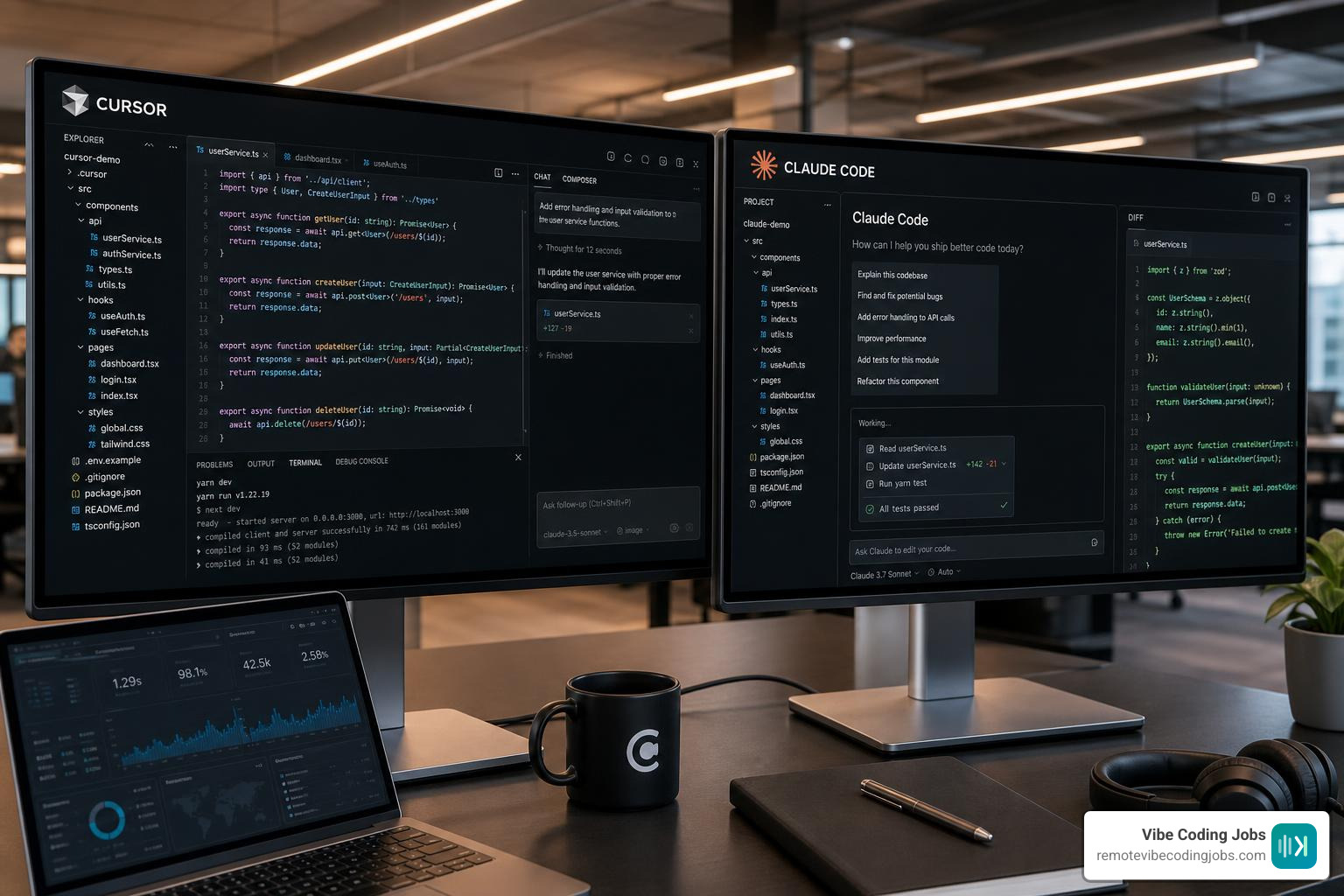
- Cursor: Currently the gold standard for AI-integrated IDEs.
- Claude Code: A powerful terminal-based agent that can execute complex refactors across entire repositories.
- Bolt.new & Lovable: These are “prompt-to-app” platforms that allow you to build full-stack web applications in a browser.
- Windsurf: An emerging favorite for its deep context management and “agentic” capabilities.
Mastering the AI-Native Tech Stack
While the AI writes the code, you still need to understand the underlying languages. TypeScript and Python remain the “lingua franca” of ai assisted coding jobs. You’ll also want to familiarize yourself with visual app builders like v0.dev and integration platforms like n8n.
Knowing how to manage “context windows” and maintain a SKILL.md or ARCHITECTURE.md file is now a core requirement. These files give your AI agents the context they need to stay on track. You can see how top companies evaluate these skills in our review of Best Companies Hiring AI Developers: Employer Reviews.
Soft Skills for the AI Era
In the age of AI, soft skills are actually hard skills.
- Critical Thinking: You must be able to spot when an AI is “hallucinating” a logic flow.
- System Design: AI is great at writing functions but often struggles with the “big picture” architecture.
- Navigating Ambiguity: AI-native roles are and change weekly. You need to be comfortable with not having a 50-page spec sheet.
If you’re wondering how to bridge the gap between your current skills and these new requirements, our guide on How to Get a Vibe Coding Job is a great place to start.
Salary Trends and Market Growth for AI Assisted Coding Jobs
The compensation for these roles is, frankly, staggering. Because vibe coders can do the work of three traditional developers, companies are happy to pay a premium.
| Role | Traditional Salary (2024) | Vibe Coding Salary (2026) |
|---|---|---|
| Junior Developer | $65,000 | $90,000 |
| Senior Engineer | $140,000 | $250,000+ |
| Freelance Contractor | $60/hr | $150 – $300/hr |
Beyond base pay, many of these roles—especially at places like Google or OpenAI—include significant equity packages. Even contract roles, such as specialized AI Code Ranking positions at $100.5/hr, offer better-than-average rates for remote work. For a deeper dive into these numbers, see our report on Vibe Coding Salaries: Trends, Comparisons & Expectations.
Compensation by Experience Level
- Junior ($90k – $110k): Usually focused on rapid prototyping and internal tool building.
- Senior ($150k – $400k+): These roles, such as a Senior Staff Software Engineer for Gemini Code Assist, require deep expertise in both traditional architecture and generative AI optimization.
- Freelance ($100 – $300/hr): Expert vibe coders are increasingly moving to solo-consultancy, charging high hourly rates to build custom agentic workflows for businesses.
For those interested in the more technical side of AI implementation, our Remote Machine Learning Engineer Jobs: Your 2026 Guide provides additional salary benchmarks.
Global Demand and Remote Flexibility
While San Francisco and New York remain major hubs, the “vibe” is global. LinkedIn currently shows over 9,000+ AI Programmer jobs in the US alone, with a massive percentage being fully remote.
Frequently Asked Questions about AI Assisted Coding
Do I need a CS degree for AI assisted coding jobs?
No. While a degree can help with foundational theory, the market in 2026 is moving toward skill-based hiring. If you have a strong portfolio of projects built with AI and can pass a technical “vibe check” (showing you can guide an AI through a complex task), many companies will hire you regardless of your educational background.
Will AI assisted coding replace traditional developers?
It’s an evolution, not a replacement. Think of it as a multiplier. A developer who refuses to use AI will likely be replaced by a developer who does. The human remains essential for strategy, business logic, and creative problem-solving. It is “humans with AI vs. humans without AI.”
What are the best platforms to find vibe coding jobs?
We might be biased, but we built RemoteVibeCodingJobs specifically for this purpose. We filter out the “traditional” noise to find companies that actually want you to use Cursor and Claude. Other great resources include specialized tech communities and industry-specific job boards that focus on the future of AI development.
Conclusion
The era of manual coding isn’t over, but it has certainly changed. AI assisted coding jobs offer a path to higher pay, more creative freedom, and the ability to build things that were impossible just a few years ago. Whether you are a senior engineer looking to 5x your output or a newcomer looking to break into tech, the “vibe coding” movement is your biggest opportunity in a decade.
At RemoteVibeCodingJobs, we are dedicated to helping you navigate this shift. We aggregate the best remote roles at async-first companies that embrace the future of development.
Don’t just code—vibe. Find your next AI assisted coding job today.