
The Rise of Async Remote Engineer Roles in 2026
Async remote engineer roles are one of the fastest-growing categories in tech hiring right now — and if you want to ditch the endless Zoom calls and own your schedule, you’re in the right place.
Here’s a quick look at what’s available and who’s hiring:
| What You Want to Know | Quick Answer |
|---|---|
| What are they? | Engineering jobs where work is done independently, communication is written-first, and real-time meetings are rare or optional |
| Who’s hiring? | Remote-first companies, AI-driven startups, global HR platforms, health tech, and SaaS companies |
| What roles are in demand? | Backend, full-stack, frontend, and AI/agentic workflow engineers |
| Top languages/tools | Python, Node.js, Go, Elixir, React, TypeScript, PostgreSQL |
| Where to find them? | LinkedIn and specialized boards like Vibe Coding Jobs |
| What do they pay? | $53,000–$198,700/year for full-time; $50–$100/hour for contract roles |
| How many jobs exist? | Thousands of fully remote and async-specific roles globally |
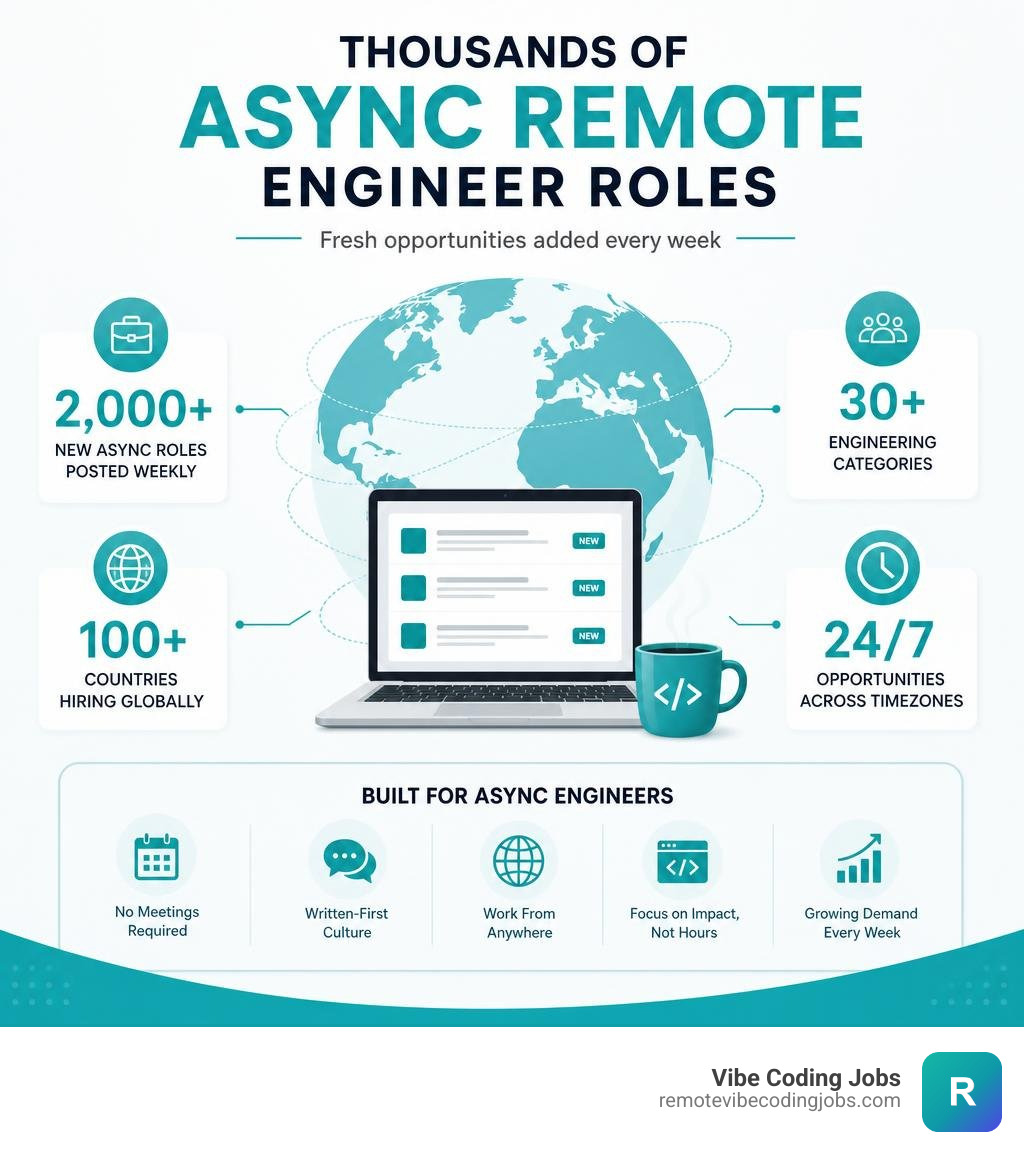
The demand is real. Platforms are adding thousands of new remote jobs per week, and async-first companies are specifically restructuring their teams to eliminate unnecessary meetings and prioritize deep work.
This isn’t just a lifestyle trend — it’s a structural shift in how engineering teams operate globally.
We are RVCJ Editorial, the team behind Remote Vibe Coding Jobs, covering async remote engineer roles, AI-assisted development, and remote hiring trends for engineers building with tools like Cursor, Claude, and Copilot. With experience tracking thousands of async-first job postings and the companies behind them, we’ll walk you through exactly what to look for — and where to find it.
What is an Async Remote Engineer Role?
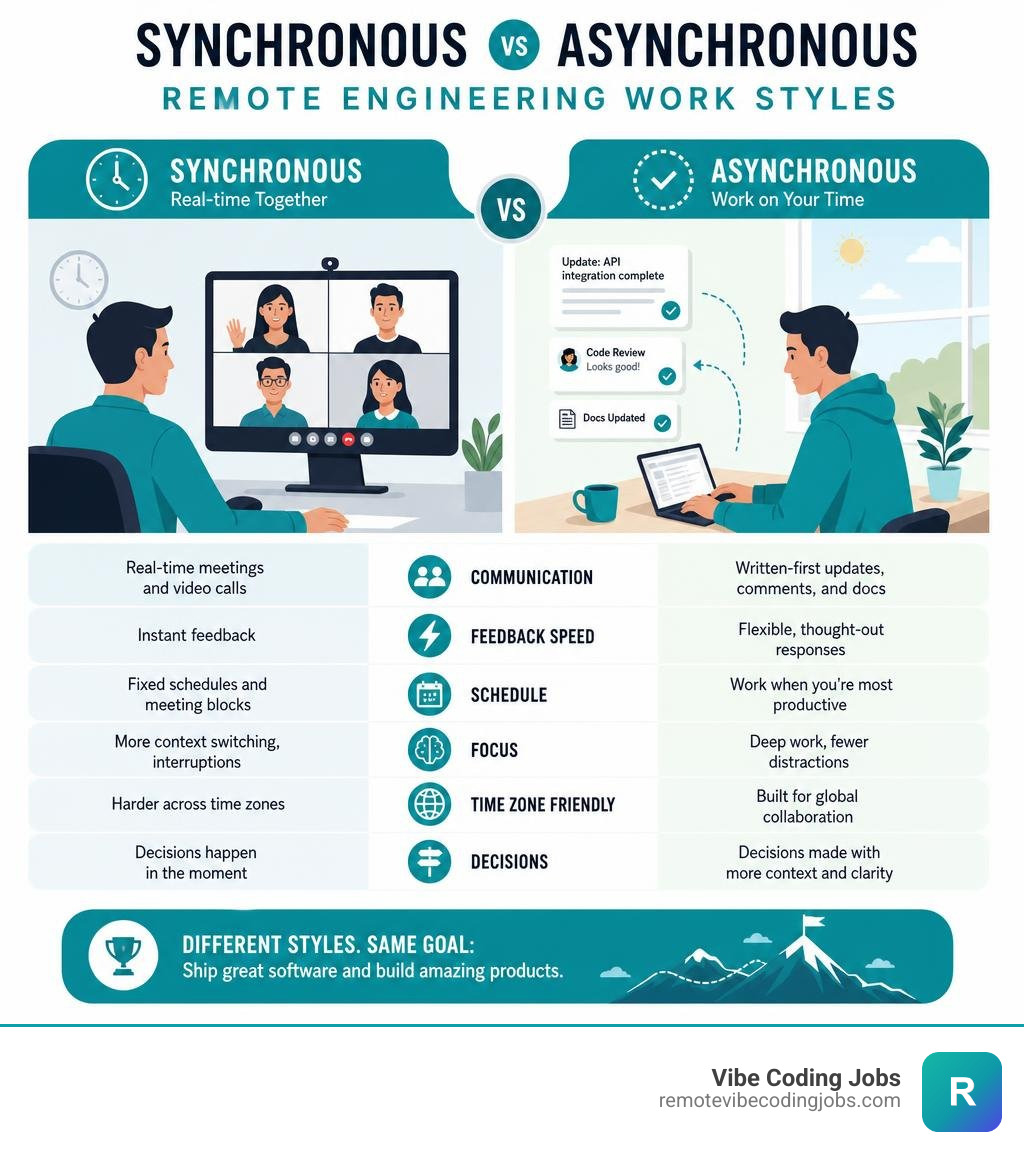
An async remote engineer role is a software engineering position designed from the ground up to operate without the requirement of real-time, synchronous presence.
In traditional remote or hybrid setups, you are still expected to be “at your desk” during specific core hours (usually 9-to-5 in a specific timezone). Your day is broken up by daily standups, ad-hoc Slack huddles, and status update meetings. If you do not reply to a direct message within five minutes, people assume you are slacking off.
In an asynchronous remote setup, the focus shifts entirely from presence to output. You are evaluated on the code you ship, the documentation you write, and the problems you solve — not the hours you spend sitting in a virtual meeting room.

This structure relies on several core pillars:
- Calendar Control & Autonomy: You decide when to log on, when to write code, and when to take a break. If you work best at 2:00 AM, that is your choice. This level of control is detailed further in our guide on Async First Remote Developer Jobs: Flexible Hours.
- Written-First Communication: Because your teammates might be sleeping halfway across the world, everything must be documented. Decisions are made in public GitHub issues, RFCs (Request for Comments), and Notion docs, rather than behind closed doors in a Zoom call.
- Radical Transparency: Information is default-open. Anyone on the team can read about why an architectural decision was made, what the product roadmap looks like, and how the database is configured.
| Feature | Synchronous Remote Setup | Asynchronous Remote Setup |
|---|---|---|
| Core Hours | Required (e.g., 9 AM – 5 PM EST) | None (Work when you are most productive) |
| Daily Standups | Live video call every morning | Written slack/GitLab update submitted anytime |
| Communication Style | Ping-and-wait, immediate reply expected | Detailed, thoughtful, written-first messages |
| Documentation | Often outdated or non-existent | Living, breathing, mandatory single source of truth |
| Timezone Constraints | Strict (Must overlap with the main office) | Global (Teammates spread across all continents) |
Top In-Demand Async Remote Engineer Roles in 2026
The shift toward asynchronous engineering has changed the tech stacks and frameworks that companies prioritize. In 2026, we see a massive demand for languages and frameworks that support highly scalable systems, concurrent processing, and rapid AI integration.
Startups and enterprise-level companies alike are looking for developers who can build robust backend services using Python, Django, Go, and Elixir, while utilizing React and Next.js on the frontend. A major emerging trend in 2026 is the integration of AI & algorithmic systems directly into the software development lifecycle, meaning engineers must know how to build autonomous agentic workflows and reliable verification loops.
Let’s look at the specific types of async remote engineer roles dominating the market:
Senior Backend Async Remote Engineer Roles
Backend engineers are the backbone of any async team. Because backend systems require deep, uninterrupted focus to design complex database schemas and scalable APIs, they are a perfect fit for asynchronous workflows.
Companies hiring for senior backend roles look for expertise in:
- Languages: Python, Node.js, Go, or Elixir.
- Infrastructure & Databases: PostgreSQL, Redis, Docker, Kubernetes, and cloud services (AWS/GCP).
- Workflow Patterns: Message queues (RabbitMQ, BullMQ) and event-driven architectures that mirror the asynchronous nature of the team itself.
For instance, modern backend roles focus heavily on implementing algorithmic logic, scoring systems, and PostgreSQL data models without requiring developers to sit through daily status updates. You can see how companies structure these engineering departments by reviewing Async First Remote Developer Jobs: Roles & Teams.
Other notable backend opportunities leverage an Elixir and Phoenix stack to build global employment tooling asynchronously, highlighting the high degree of autonomy expected of senior backend developers.
Full-Stack and Frontend Async Remote Engineer Roles
Frontend and full-stack developers in async environments are no longer just building static UI components; they are designing the interactive layers of complex, distributed products.
In 2026, the trend has shifted toward agentic workflows — using autonomous AI agents as a default execution layer. This means frontend and full-stack engineers are building reusable UI primitives that can handle automated tasks, while using strict verification loops (automated tests, visual regression checks, and guardrails) to ensure AI-generated assets perform flawlessly.
Key technologies for these roles include:
- TypeScript, React, Next.js, and Node.js.
- State management and API integration layers.
- AI-assisted development tools (Cursor, Claude, and v0).
If you are looking to build enterprise-scale data platforms, many roles focus on combining React/TypeScript frontends with high-performance Golang backends.
For engineers who want to build critical financial infrastructure, billing and transaction platform development can be managed with a written-first, radically transparent async culture. You can learn more about how this culture operates by reading Async First Remote Developer Jobs: Culture, Workflow & Communication.
Essential Skills and Tools for Async Engineering Success
To thrive in an async remote engineer role, your technical stack is only half the equation. Because you do not have a manager looking over your shoulder or a daily meeting to keep you on track, your soft skills and tool mastery must be top-tier.

The Async Soft-Skill Stack
- Written Communication: This is your most important technical skill. You must be able to explain complex technical architectures, write clear pull request descriptions, and leave constructive code reviews that do not require a follow-up call to clarify.
- Self-Discipline & Autonomy: You must be a self-starter. When you run into a blocker at 10 PM and your teammate is asleep, you need the resourcefulness to research alternative solutions, pivot to another task, or write a comprehensive ticket describing the issue so it can be solved asynchronously.
- Proactive Documentation: If it isn’t documented, it doesn’t exist. You must get comfortable updating internal wikis, writing clean READMEs, and keeping project boards up to date.
To dive deeper into how these communication patterns work, check out our resources on Async First Remote Developer Jobs: Communication & Workflow and Async Remote Developer Jobs: Flexible Communication.
The Async Tech Toolset
To keep everyone aligned without meetings, async teams rely heavily on a specific suite of tools:
- Version Control & CI/CD: GitHub and GitLab are the primary workspaces. Pull requests are treated as the main communication channel for code changes.
- Knowledge Management: Notion, Slite, or Confluence serve as the single source of truth for product specs and engineering guidelines.
- Project Tracking: Linear, Jira, or Trello are kept updated in real-time so anyone can see the status of a feature without asking.
- Asynchronous Messaging: Slack or Tandem, but used with the understanding that replies are not instantaneous.
How to Find and Apply for Async Remote Engineer Roles
Finding a true async role requires looking in the right places. Standard job boards are often flooded with “remote” jobs that are actually hybrid or require you to live in a specific city for weekly meetings.
Here are the best strategies and platforms for finding genuine async remote engineer roles:
- Filter on Specialized Remote Platforms: Look for platforms that specialize entirely in listing companies that don’t care about your timezone, focusing on async-first cultures.
- Use Advanced Search on Major Boards: On LinkedIn, you can find over 2,000+ Async jobs in United States – LinkedIn by using specific keyword filters like “asynchronous,” “written-first,” and “no standups.”
- Look for AI-Native Boards: If you enjoy “vibe coding” (using tools like Cursor, Claude, and Copilot to speed up development), specialized curation platforms like Remote Vibe Coding Jobs filter daily listings specifically by tech stack, remote culture, and AI tools.
- Target Async-First Companies Directly: Many of the best companies don’t post everywhere. You can find curated lists of these organizations in our directory of Async First Companies Hiring Developers: Find Your Dream Remote Job.
Frequently Asked Questions About Async Remote Engineering
What are the typical salary ranges for async remote engineer roles?
Compensation for async roles varies based on your location, experience, and the company’s pay philosophy (localized vs. global flat rates).
- Full-Time Employees: Typical salaries range from $53,300 to $119,850 USD for mid-to-senior backend and frontend roles at global startups. High-end, enterprise, or staff-level roles can reach $198,700 USD or more.
- Contractors & AI Trainers: For engineers looking for contract flexibility, hourly rates typically range from $50 to $100 per hour, with highly specialized positions (such as AI model training and complex algorithmic design) paying up to $150 per hour.
How do async engineering teams handle urgent production bugs?
“If there are no meetings, what happens when the server melts down?” This is the most common question engineers ask.
Async teams handle emergencies through structured on-call rotations using tools like PagerDuty or Opsgenie. Instead of pinging random people on Slack, the automated monitoring system alerts the designated on-call engineer. The incident response plan is thoroughly documented beforehand, allowing the on-call developer to follow a step-by-step runbook to resolve the issue without needing to hop on an emergency Zoom call with ten other people.
Is “vibe coding” or AI-assisted development common in async roles?
Yes, it is becoming the standard. In 2026, async-first companies are leading the adoption of AI-assisted development (often called “vibe coding”).
Because async work values output and working software over hours spent typing, tools like Cursor, Claude, and GitHub Copilot are highly encouraged. Using AI to generate initial prototypes, write unit tests, and draft documentation allows async engineers to move incredibly fast. This matches perfectly with the independent, execution-focused nature of asynchronous teams.
Conclusion
Switching to an async remote engineer role is one of the best moves you can make for your career, your productivity, and your mental health. By cutting out the constant interruptions of synchronous meetings, you gain the deep focus time required to build truly great software.
If you are ready to take control of your calendar, work from anywhere in the world, and build the future of tech on your own terms, explore our guides on Async First Remote Developer Jobs: Flexible Culture and Explore the ultimate benefits of async-first remote developer jobs.
Your next meeting-free coding session is just an application away!