
Why Remote NYC Async Work Is the Next Big Shift for Developers
If you’re exploring remote NYC async opportunities, here’s a fast answer to get you oriented:
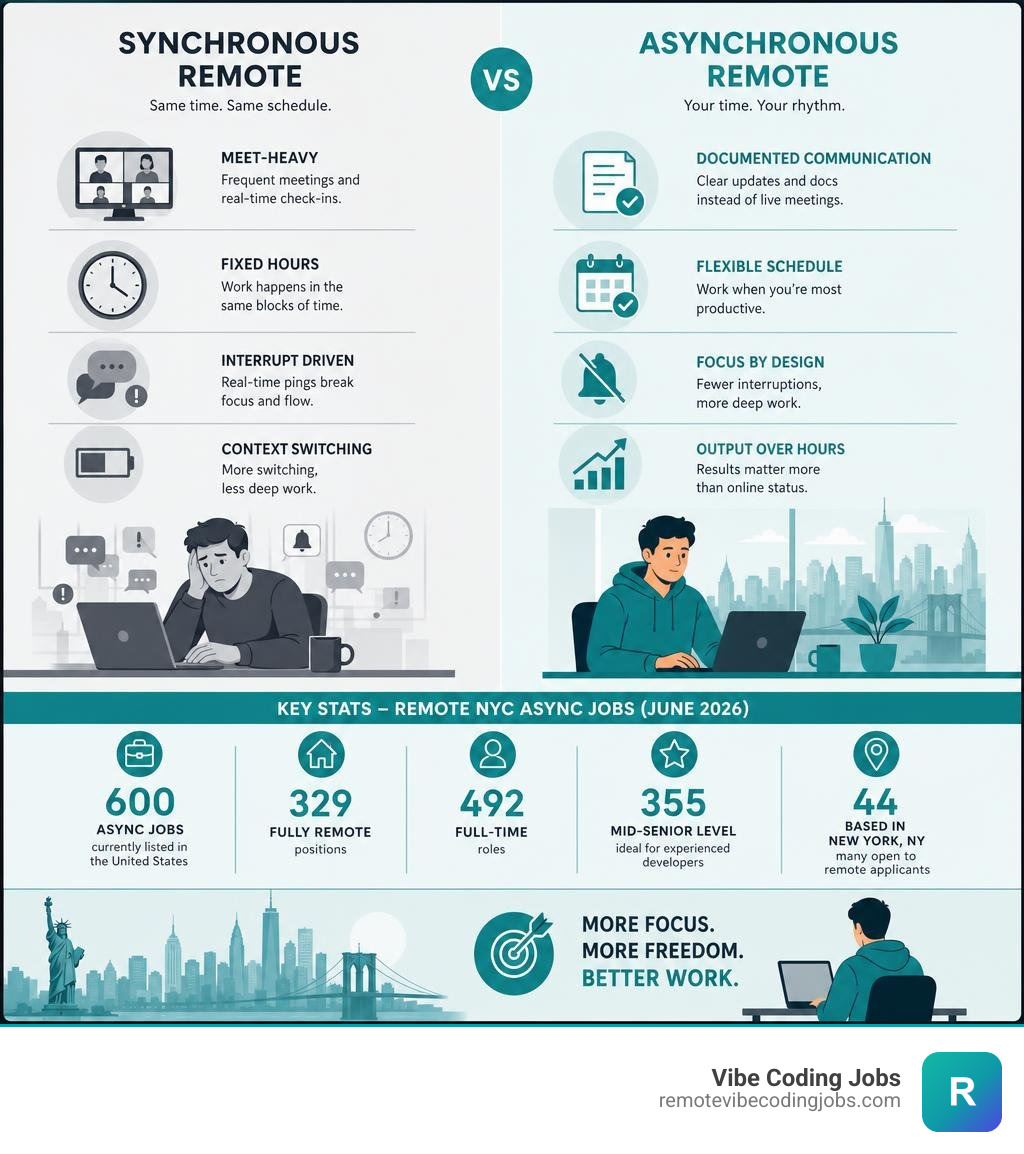
Top async remote job facts for NYC-based developers (June 2026):
- There are 600 async jobs currently listed in the United States
- 329 of those are fully remote positions
- 492 are full-time roles
- 355 are mid-senior level — ideal for experienced developers
- 44 are based in New York, NY — many open to remote applicants
The old deal — commute in, sit at a desk from 9 to 5, answer Slack pings on someone else’s schedule — is breaking down fast. For developers who ship with AI tools like Cursor, Claude, or Copilot, that model doesn’t just feel outdated. It actively slows you down.
Async work is different. It means you decide when you work. No waiting on someone to reply. No back-to-back standups eating your best thinking hours. Just output.
And the numbers back this up. One analysis found that solo async founders log roughly 55 hours of deep work per week, compared to just 22 hours in a typical synchronous team environment. That’s not a small gap — it’s a completely different way of building.
New York has always had a dense tech ecosystem. But the rise of async-first companies means you no longer need to be in Midtown at 9am to access those opportunities. The remote NYC async job market is real, growing, and increasingly tilted toward senior engineers who know how to write clearly, ship independently, and communicate without constant meetings.
We’re RVCJ Editorial, the team behind Remote Vibe Coding Jobs — we cover async culture, AI-assisted development, and remote hiring trends, and we’ve tracked the remote NYC async market closely as it’s evolved from a niche perk into a primary hiring filter for async-first companies. In this guide, we’ll walk you through everything you need to find and land the right role.
Remote nyc async terms to learn:
Remote vs. Hybrid vs. Async: Redefining the Modern Workspace
To understand why the shift to asynchronous work is so significant, we first have to look at how we structure our workdays. Many teams that claim to be “remote” or “hybrid” have simply digitized the bad habits of the traditional office. They’ve replaced physical shoulder taps with constant Slack pings and boardroom meetings with exhausting Zoom marathons.
True asynchronous work is a complete redesign of how a business operates. It prioritizes autonomous progress over real-time presence.
| Feature | Remote (Synchronous) | Hybrid | Asynchronous (Async-First) |
|---|---|---|---|
| Primary Location | Anywhere (Home/Co-working) | Split between home and office | Anywhere (Optimized for location independence) |
| Core Hours | Fixed (e.g., 9 AM – 5 PM) | Fixed on office days, flexible-ish remote | No core hours; work when you are most productive |
| Communication Style | Instant messaging, constant Zoom calls | Mixed (in-person meetings + digital pings) | Written-first, batched updates, documented decisions |
| Coordination Overhead | High (constant alignment meetings) | Very High (managing desk schedules + digital syncs) | Minimal (work is unblocked by clear documentation) |
| Deep Work Hours | Low (fragmented by interruptions) | Low to Medium | High (uninterrupted 4-hour blocks are the norm) |
| Digital Distraction | High (expectation of immediate replies) | High | Low (established response SLAs, e.g., 24 hours) |
In a synchronous remote environment, developers are often treated as on-call support for their own projects. Every Slack notification demands immediate attention, costing an average of 23 minutes to regain focus after a single interruption.
In contrast, async-first teams design processes so that work flows continuously without requiring two or more people to be online at the exact same moment. This dramatically reduces coordination overhead and context switching, allowing engineers to dedicate their best mental energy to building.
Why Tech Professionals are Pivoting to Remote NYC Async Roles
For tech professionals living in or around New York City, the appeal of a remote NYC async model goes far beyond skipping the morning subway rush. New York is a high-energy, city, but trying to squeeze that lifestyle into a rigid 9-to-5 box often leads to burnout.
The async model introduces timezone flexibility that respects individual human biology. Studies show that people have different genetically predisposed chronotypes. Some of us do our best work at 6:00 AM, while others don’t hit their cognitive peak until 11:00 PM. Async work respects this, allowing developers to align their coding blocks with their peak brain hours. The result is better sleep health, improved mental well-being, and significantly higher code quality.
Furthermore, async work is the ultimate enabler of location independence. As explored in The next frontier after remote work is async – Levels.io, async allows you to decouple your location from your working hours entirely. You can live in Brooklyn, work for a team based in Europe or California, and never have to wake up in the middle of the night for a status update. It allows you to avoid peak crowds, book travel during cheaper mid-week windows, and enjoy a lifestyle that feels “full of Sundays” rather than waiting for Friday evening to finally breathe.
The Asynchronous Advantage for Small Teams and Solo Founders
The productivity multiplier of async work becomes incredibly obvious when looking at small, agile teams and solo founders. In traditional environments, adding more people to a project increases coordination costs quadratically (a concept known as Brooks’ Law). More people mean more meetings, more alignment docs, and more opportunities for miscommunication.
Solo founders and lean, async-first product teams bypass this bottleneck entirely. By eliminating the “sync tax,” they are able to redirect every ounce of energy toward shipping. To dive deeper into how this model protects your time, check out our guide on Async First Remote Developer Jobs Benefits.
According to Rakesh Roushan in The Asynchronous Advantage: How Solo Founders Out-Ship 20-Person Teams – Rakesh Roushan, the secret weapon of high-output solo builders is a highly structured async operating system. Instead of constant back-and-forth messaging, they operate on a few core principles:
- Batched inputs: They check communications in fixed windows (e.g., three times a day) rather than leaving chat apps open constantly.
- Document-first culture: Every idea, feature request, or technical decision is written down clearly before any action is taken.
- Defaulting to action: They make decisions independently and ship incremental updates, using the live product as the ultimate alignment tool.
This approach dramatically accelerates the Build-Measure-Learn feedback loop, especially when paired with modern AI-assisted development tools.
Building with AI-Native Substrates and Async IDEs
In 2026, the intersection of async work and AI-assisted development (often called “vibe coding”) is where the most exciting tech progress is happening. AI tools are no longer just fancy autocomplete extensions; they have become the substrate of the entire development workflow.
With tools like the open-source, agent-first ZYKJShadow/Async IDE, the developer’s role has shifted from manual syntax typing to high-level system architecture and decision-making. Async IDEs place the AI agent at the center of the workspace, running autonomous Think-Plan-Execute-Observe loops. Because the tool operates locally and handles the heavy lifting of drafting code, developers can focus on taste, edge cases, and architectural integrity.
This shift has enabled services like Asyncdot: Your Ideas, Built in Days. No Team Required. to emerge. By utilizing a battle-tested tech stack and AI-native workflows, senior engineers can build and validate complex software, mobile apps, and custom AI agents in a fraction of the time it would take a traditional development agency. The code is written in tight, rapid iteration cycles where senior human judgment guides the AI substrate, proving that you don’t need a massive team to ship robust, production-ready systems.
Navigating the Remote NYC Async Job Market
If you are looking to transition to this way of working, the job market is rich with opportunities, but it requires a different search strategy than traditional roles.
Let’s look at the current landscape of the United States async job market as of June 2026:
- 600 total active async positions listed nationwide.
- 329 of those are fully remote async roles, offering complete geographical freedom.
- 492 are full-time positions, proving that async is not just for freelancers or part-time contractors.
- 355 are mid-senior level positions, indicating that companies trust experienced engineers to manage their own time and output.
- 111 of these listings are concentrated at major async-first organizations like MCI, showing that larger enterprises are also adopting these workflows at scale.
For a detailed look at the types of roles and companies leading this shift, see our breakdown of Async First Remote Developer Jobs Companies Roles.
How to Land a Remote NYC Async Developer Position
Landing a role in a remote NYC async environment requires demonstrating that you can thrive without a manager hovering over your shoulder. Because async teams rely heavily on written communication, your application process starts the moment you submit your resume.
Here are our top tips for standing out in the async job market:
- Treat Your Resume as a Technical Spec: Clear, concise writing is the number-one filter for async companies. Avoid corporate buzzwords. Instead, write bullet points that clearly explain what you built, how you built it, the tools you used, and the measurable impact it had.
- Highlight Independent Execution: Show that you can take a vague product requirement, design a technical solution, write the documentation, and ship it to production with minimal oversight.
- Demonstrate AI-Assisted Proficiency: In 2026, companies want to see that you know how to leverage AI tools to multiply your output. Mentioning your experience with tools like Cursor, Claude, or custom agent workflows is a major plus.
Excellent examples of companies hiring for these kinds of roles include:
- Early-stage, high-impact teams looking for a Founding Fullstack Engineer at Oversee to build AI-powered e-commerce platforms using TypeScript, Next.js, and advanced LLM integrations.
- Established platforms looking for roles like the Staff Software Engineer, Async Team at Gusto, where the focus is specifically on building the background infrastructure, APIs, and tooling that keep distributed developer teams highly productive.
To learn more about preparing your portfolio for these specific roles, explore our comprehensive resource on Async First Remote Developer Jobs.
Implementing an Async Operating System: Tools, Culture, and Metrics
Transitioning a team from synchronous habits to an async-first operating system is a cultural challenge, not just a technical one. It requires changing how you measure progress and how your team interacts daily.

To build a successful async culture, we recommend focusing on three core pillars:
1. The Async Tool Stack
Throwing more communication tools at your team won’t solve collaboration friction. Instead, you need structured platforms that turn daily rituals into searchable knowledge. Platforms like Async Team — structured meetings + a process engine for distributed teams help teams run sprint poker, retrospectives, and daily check-ins asynchronously. By using structured workflows, you eliminate unnecessary meetings and ensure that decisions are recorded in a central, searchable database that compounds in value over time.
2. Cultural Practices and Response SLAs
To reduce the anxiety of “always-on” digital culture, teams must establish clear communication agreements. This includes:
- Defaulting to writing: If a decision needs to be made, start with a written proposal, not a calendar invite.
- Establishing response SLAs: Give team members a generous window (e.g., 24 hours) to reply to non-urgent messages. This allows them to close their chat apps and focus on deep work.
- Documenting outcomes: Every ad-hoc synchronous discussion must end with a written summary shared with the wider team.
For a deeper dive into setting up these communication protocols, read our guide on Async First Remote Developer Jobs Communication Workflow.
3. Clear Performance Metrics
In an office, managers often rely on “presence” as a proxy for productivity. In an async team, presence is invisible. You must measure what actually gets delivered. Teams can track metrics such as:
- PR cycle time: How quickly code goes from draft to merged.
- Documentation updates: The frequency and quality of contributions to the internal knowledge base.
- Task completion rates: Consistent delivery against agreed-upon sprint goals.
By focusing on output rather than hours spent at a desk, you build a high-trust culture that dramatically improves employee well-being, work-life balance, and long-term retention. To optimize your team’s day-to-day operations, check out our insights on Async First Remote Developer Jobs Workflow Productivity.
Frequently Asked Questions about Async Work
What is the difference between remote and async work?
Remote work simply means you do not work in a physical office building. You can still be bound to synchronous hours, constant meetings, and immediate-response expectations. Async work means you work without needing to be online at the same time as your colleagues. It prioritizes autonomy, deep work, and written-first communication, allowing you to choose your own hours.
How do async teams maintain collaboration without constant meetings?
Async teams collaborate through detailed written documentation, recorded video walkthroughs (like Loom), and structured process tools. When synchronous meetings do happen, they are highly structured, kept to a minimum, and used primarily for social bonding or complex brainstorming where real-time interaction is genuinely valuable.
What are the best tools for managing an async workflow?
A great async stack typically includes:
- Knowledge management: Notion, Slite, or GitHub Wikis for documentation.
- Task tracking: Linear, Jira, or GitHub Issues.
- Asynchronous updates: Loom for video walkthroughs and structured ritual platforms like Async Team.
- Development: Local-first, agent-friendly environments like the Async IDE.
To get a complete overview of how these tools fit together, check out our comprehensive Async First Remote Work Guide.
Conclusion

The shift toward remote NYC async work is not a temporary trend; it is the natural evolution of how modern software is built. By decoupling work from rigid schedules and physical locations, developers can reclaim their deep work hours, design a lifestyle that supports their well-being, and build high-quality software alongside powerful AI-assisted tools.
If you are ready to ditch the traditional 9-to-5 and find a company that values your output over your screen-time, we are here to help. At RemoteVibeCodingJobs, we curate daily listings of remote “vibe coding” jobs at async-first companies, filtered by tech stack, culture, and AI tools.
Take the next step in your career and explore our curated list of Remote Jobs NYC opportunities today.
Looking to expand your horizons? We also track the best async opportunities across other major tech hubs:
- Find nationwide roles with Remote Jobs US.
- Explore international options with Remote Jobs Europe and Remote Jobs London.
- Browse our directory of Async First Companies Hiring Developers Find Your Dream Remote Job to find your perfect match.