
Remote Prompt Engineer Jobs Are One of the Fastest-Growing Opportunities in AI
Remote prompt engineer jobs are in high demand right now — and the market is moving fast.
Here’s a quick snapshot of what’s available today:
| What You Want to Know | The Short Answer |
|---|---|
| How many remote prompt engineer jobs exist? | 112+ fully remote roles in the US (out of 477 total) |
| How fast is the market moving? | 46 new jobs posted in the last 24 hours |
| What’s the salary range? | ~$35,000 to $500,000+ depending on level and company |
| Who’s hiring? | AI startups, tech giants, healthcare firms, federal contractors |
| What skills do you need? | Python, LLMs, prompt design, RAG, agentic workflows |
| Are there entry-level options? | Yes — contract, freelance, and AI trainer roles available |
This is not a niche skill anymore. Prompt engineering has become a core function at companies building with LLMs — from scrappy AI startups to large healthcare systems and federal contractors.
The roles span a wide range. Some are deeply technical, requiring MLOps pipelines and vector databases. Others focus on writing, evaluation, and model behavior. Many are fully async and work-from-anywhere by design — a natural fit for indie hackers and developers who value autonomy over office politics.
The catch? The market is noisy. Job titles vary wildly, salary data is scattered, and not every “remote” role is truly location-independent.
This guide cuts through that noise.
We’re the RVCJ Editorial team at Remote Vibe Coding Jobs — we cover AI-assisted development, remote hiring trends, and career guidance for developers building with tools like Cursor, Claude, and Copilot, making us well-positioned to help you navigate remote prompt engineer jobs in 2026. Read on for a clear breakdown of the landscape, the skills that matter, and how to land a high-autonomy role that fits your stack.
The Landscape of remote prompt engineer jobs in 2026
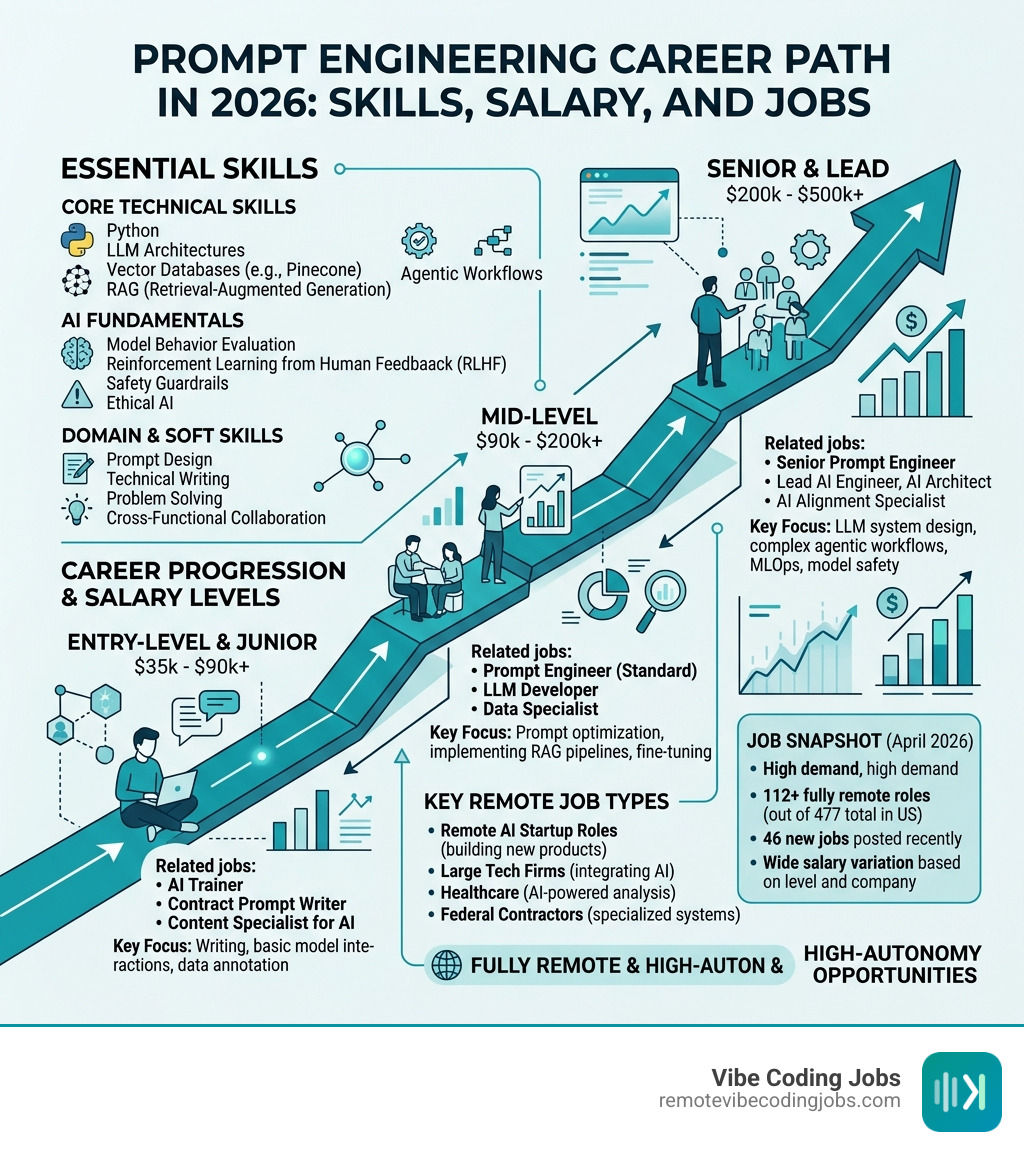
As of April 2026, the market for prompt engineering has matured from a “viral trend” into a cornerstone of the modern tech stack. We are seeing a massive surge in volume. Across the United States alone, there are roughly 477 active Prompt Engineer positions, with 112 of those being 100% remote. That means nearly a quarter of the market is currently open to those of us who prefer the home office (or the beach) to a cubicle.
The role itself is evolving. It’s no longer just about “whispering” to a chatbot. Modern remote prompt engineer jobs involve complex LLM design, AI alignment, and Reinforcement Learning from Human Feedback (RLHF). You aren’t just writing sentences; you’re building the logic that governs how an AI reasons, interacts with data, and maintains safety guardrails.

If you are looking to Browse Remote Prompt Engineer Jobs on RemoteVibeCodingJobs, you’ll find that the updates are relentless. We see over 30,000 remote jobs updated daily across our categories, with 46 new prompt-specific roles appearing in the last 24 hours alone.
Salary Expectations in 2026
The compensation for these roles is as varied as the tasks themselves. Here is how the current market breaks down:
| Experience Level | Typical Salary Range (Annual) | Common Benefits |
|---|---|---|
| Entry/Contract | $35,000 – $125,000 | Flexible hours, paid assessments |
| Mid-Level | $130,000 – $180,000 | Health, 401k, Equity |
| Senior/Staff | $250,000 – $500,000+ | High equity, performance bonuses |
Whether you are a seasoned developer or a specialist in AI alignment, you can find the Latest AI Engineering Roles that match your financial goals.
Essential Skills for High-Autonomy AI Roles
To land the best remote prompt engineer jobs, you need more than just a creative imagination. The industry has shifted toward “vibe coding”—a style of AI-assisted development where you use tools like Cursor and Claude to build at 10x speed. But to steer these tools effectively, you need a solid technical foundation.
The Technical Core
Most remote listings, such as the Anthropic Prompt Engineer Claude Code Ddc2Ae37, emphasize a mix of traditional programming and AI-specific techniques:
- Python & TypeScript: These remain the languages of choice for building AI pipelines and integrating LLMs into production environments.
- RAG (Retrieval-Augmented Generation): Knowing how to connect an LLM to external data using vector databases is a non-negotiable skill in 2026.
- Agentic Workflows: Companies are no longer building simple chatbots; they are building “agents” that can execute tasks. Understanding agent-to-agent coordination is key.
- Systematic Evaluation: You must be able to move beyond “it looks good to me” and implement rigorous testing frameworks to measure model accuracy, bias, and performance.
Top AI Models to Master
You should be intimately familiar with the behavior, quirks, and prompting techniques for the leading models:
- Claude 3.5 & 4 (Anthropic)
- GPT-5 (OpenAI)
- Llama 3 (Meta)
- Gemini (Google)
The focus has shifted from simple “few-shot” prompting to “chain-of-thought” reasoning and structured output generation. If you can prove you can make a model consistently output valid JSON or follow complex business logic, you’re ahead of 90% of the applicant pool.
Top Companies and Opportunities for Remote Prompt Engineers
The beauty of remote prompt engineer jobs is that they exist in almost every sector. We aren’t just talking about the big tech hubs in San Francisco or New York—though they do hold a significant share of the market.

Who is Hiring?
- AI Startups: These are the highest-velocity roles. Companies like PromptQL are looking for Staff Engineers who can handle everything from infrastructure to safety mechanisms. These roles often come with massive equity upside.
- Healthcare Systems: Organizations like UnitedHealth Group (Optum Tech) are hiring AI Engineers to build enterprise ML platforms. This involves using prompt engineering to turn complex healthcare data into actionable insights.
- E-commerce & Marketing: Companies like Postscript are hiring Senior Prompt Engineers to optimize SMS marketing, focusing on metrics like revenue per subscriber and sentiment analysis.
- Federal Contractors: Firms like ICF work on federal projects that require US citizenship and Public Trust clearance. These roles often pay well (up to $223k) but have stricter location requirements (US-only).
Check out roles like the Hirevector Remote Prompt Engineering Specialist Fbd9847C to see how specialized these positions have become. If you’re ready to jump in, you can Explore High-Autonomy AI Roles on our platform today.
Finding Entry-Level remote prompt engineer jobs
Don’t let the “Senior” titles scare you off. There are plenty of ways to break into the field.
- Micro-credentials & Grading: Some universities and platforms hire specialists to grade AI-related coursework. For example, the Brandeis University Temporary Micro Credential Grader Industry Focused Prompt En 79D09254 is a great way to build a resume.
- AI Trainers: Many companies hire “AI Prompt Writers” or “Trainers” on a contract basis. These roles often pay between $35k and $125k and involve evaluating model responses for correctness and human alignment.
- Paid Assessments: Some platforms require you to pass a “Prompting Exam.” Once you pass, you get immediate access to paid work.
How to Stand Out in the Remote AI Job Market
With thousands of people applying for every high-profile AI role, you need a “unique angle.” At Remote Vibe Coding Jobs, we always tell our community: Show, don’t just tell.
Build a “Prompt Portfolio”
A resume isn’t enough anymore. You need a GitHub repository or a personal site that showcases:
- Sample Prompts: Show the “Before” and “After” of a prompt you optimized.
- Evaluation Frameworks: Explain how you tested your prompts for reliability.
- AI Tools Used: Mention your experience with LangChain, LlamaIndex, or Opencall Ai Prompt Agent Developer 7D2Ce92E.
- Vibe Coding Projects: Show code you’ve generated using Claude or Cursor, proving you can manage the “human-in-the-loop” workflow.
Navigating International remote prompt engineer jobs
While many roles are US-centric, the “work-from-anywhere” dream is alive. Many startups are “async-first,” meaning they don’t care where you are as long as the work is top-tier. Roles like the Hirevector Ai Prompt Agent Developer 33E8F329 often look for global talent.
When applying internationally, be aware of “geo-fencing.” Some federal or healthcare roles block foreign IPs for security. Always check if a “remote” role is “Remote US” or “Remote Worldwide.”
Frequently Asked Questions about Prompt Engineering
What is the typical salary for a remote prompt engineer?
The range is wide. Contract AI writers might start at $35/hour, while Senior Prompt Engineers at established companies earn between $135,000 and $155,000. At the extreme high end, Staff AI Engineers at venture-backed startups can command $250,000 to $500,000 when you factor in bonuses and equity.
Do I need a computer science degree for these roles?
It depends on the “flavor” of the role. For “AI Prompt Writer” or “Content Specialist” roles, a background in linguistics, philosophy, or writing is often enough. However, for “AI Engineer” roles, most companies prefer a Bachelor’s in CS or a related field. For elite research roles, a PhD in Physics, Engineering, or Finance is frequently requested.
What tools are most commonly used in prompt engineering?
- Orchestration: LangChain, LlamaIndex.
- IDEs: Cursor, VS Code (with Copilot).
- Evaluation: Freeplay, Weights & Biases.
- Libraries: PyTorch, TensorFlow, and various Python-based NLP tools.
Conclusion
The era of the “Indie Hacker” prompt engineer is here. Whether you want to lead AI architecture at a healthcare giant or build agentic workflows for a boutique startup, remote prompt engineer jobs offer the ultimate combination of high pay and high autonomy.
At Remote Vibe Coding Jobs, we believe the future belongs to those who can “vibe code”—using AI to amplify their own creativity and technical skill. The market is moving fast, but the opportunities have never been better.
Ready to find your next role? Start your search today at RemoteVibeCodingJobs and join the community of developers building the future, one prompt at a time.