
Why AI Assisted Remote Dev Is the Default in 2026
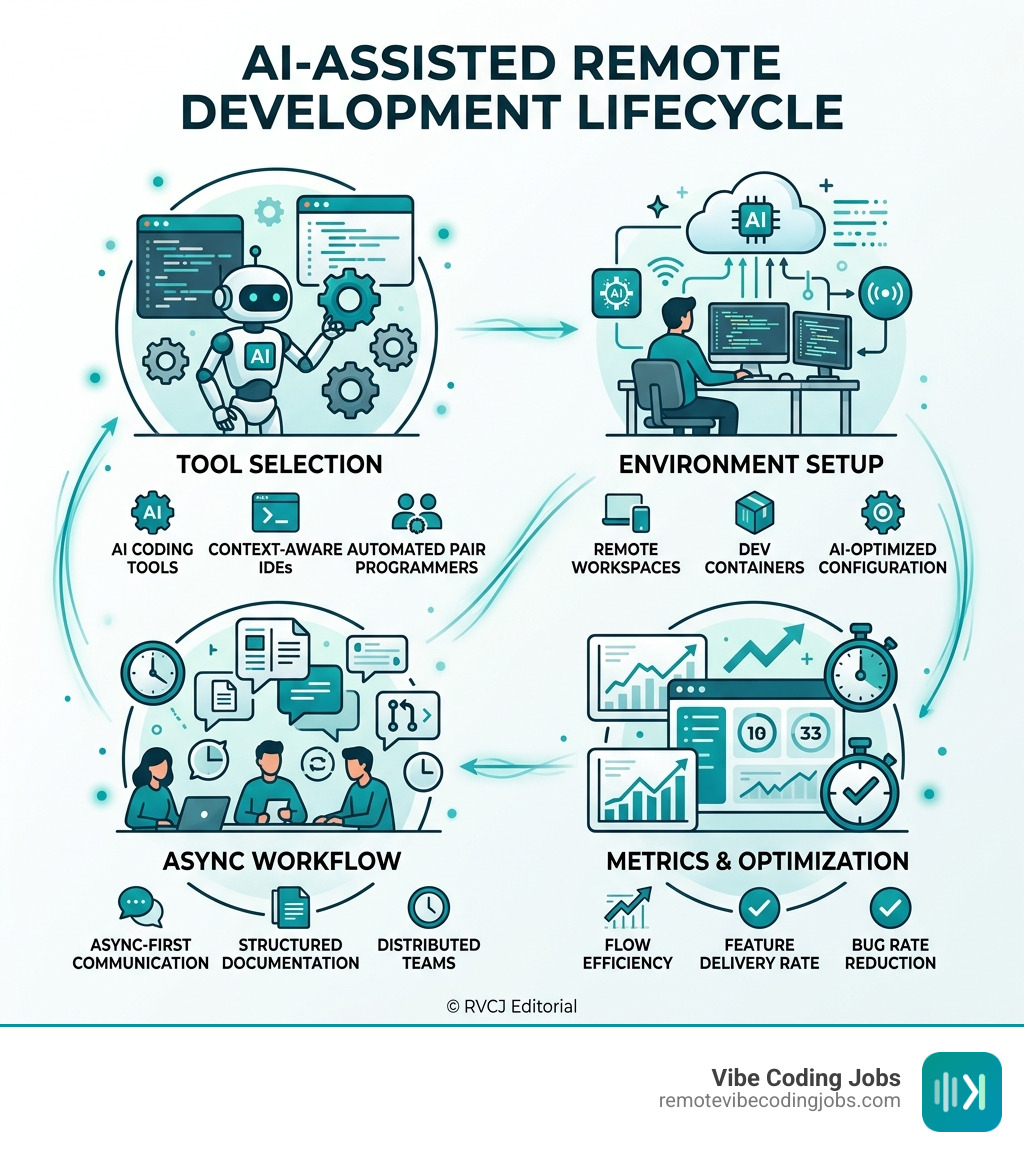
AI assisted remote dev is the new baseline for how software gets built — and if you’re looking to optimize your setup, here’s the short version:
Quick setup checklist for AI-assisted remote development:
- Pick your AI coding tool — Claude Code, Cursor, GitHub Copilot, or Windsurf
- Configure your remote environment — SSH, Dev Containers, or cloud VM with AI context baked in
- Use async-first communication — document everything, minimize synchronous meetings
- Build structured prompting habits — not magic prompts, but repeatable systems
- Track real metrics — flow efficiency, bug rate, and features shipped per sprint
The numbers back up what developers are already feeling on the ground. Developers using AI tools ship 55% faster and report a 40% drop in cognitive load. That’s not a marginal gain — it’s a fundamentally different way of working.
But speed alone doesn’t explain why so many teams are going all-in on this model. The bigger shift is cultural. Remote teams that build around AI tools — with async workflows, pre-configured environments, and structured handoffs — consistently outperform those that just bolt AI onto old habits.
The challenge isn’t access to tools. It’s knowing how to set everything up so the tools actually work together, across time zones, devices, and codebases.
That’s exactly what this guide covers.
We are RVCJ Editorial, the team behind Remote Vibe Coding Jobs — we cover AI assisted remote dev workflows, async culture, and career guidance for developers building with tools like Cursor, Claude, and Copilot. This guide draws on our hands-on experience tracking what actually works for remote AI-native teams in 2026.
Defining AI Assisted Remote Dev in 2026
By April 2026, the term “vibe coding” has transitioned from a niche meme to a multi-billion dollar industry standard. AI assisted remote dev isn’t just about having a chatbot open in a browser tab; it’s about a deep, structural integration where AI agents and human architects work in a continuous loop.
The statistics are staggering: the AI development tool market has surged toward a $10 billion valuation, and for good reason. Companies are seeing a 20% growth in software developer roles through 2027, but the nature of those roles has shifted. We aren’t just “writing code” anymore; we are orchestrating systems.
This evolution has led to AI Assisted Development Career Growth Opportunities that didn’t exist two years ago. The “vibe” refers to the high-level intuition and architectural direction a human provides while the AI handles the heavy lifting of syntax and boilerplate. If you’re still wondering What is Vibe Coding, think of it as the shift from being a bricklayer to being the architect who uses a 3D printer to build the house.
Mastering AI Assisted Remote Dev Onboarding
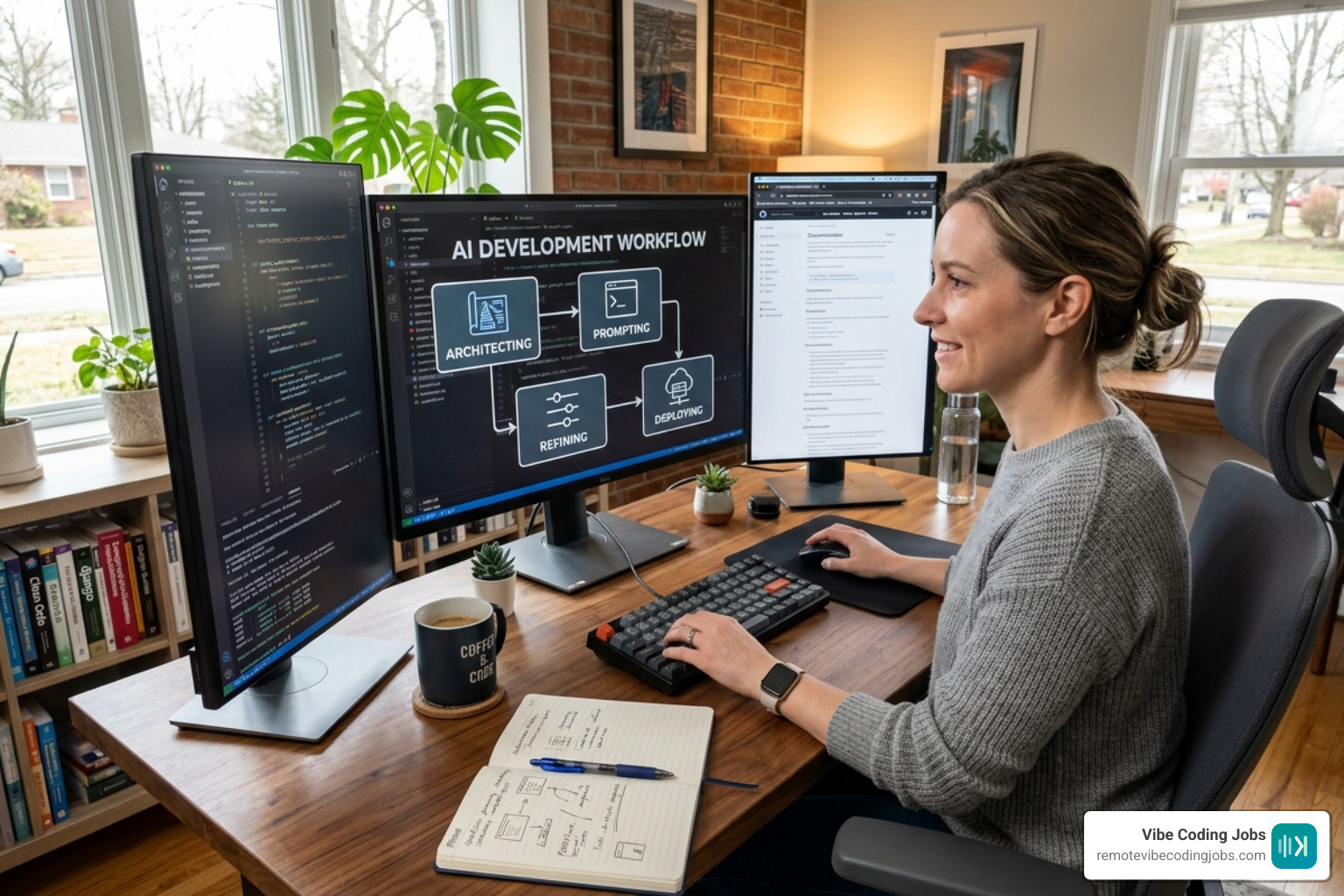
The first 30 days in a remote role used to be a slog of reading outdated wikis. In 2026, we use AI to “download” the codebase.
We recommend a technique called recursive prompting. Instead of asking “How does this work?”, you ask your AI assistant (like Claude or Cursor) to explain a specific component as if you just joined the team. Then, you ask it to explain the unclear parts of its own explanation. This helps you build a mental map of the system piece by piece.
Tools like Code assistant · Ona are game-changers here. They provide pre-configured environments where the AI already has the context of your team’s specific tools and access controls. However, the “human” element remains critical. Before you let an AI agent ship a major refactor, you must validate the strategy with a senior engineer. This isn’t a sign of weakness; it’s diligent Remote Developer Jobs AI Tools Workflow management. AI is excellent at outlining plans, but humans are still the masters of project-specific nuance and “tribal knowledge.”
Building the New Developer DNA for Remote Teams
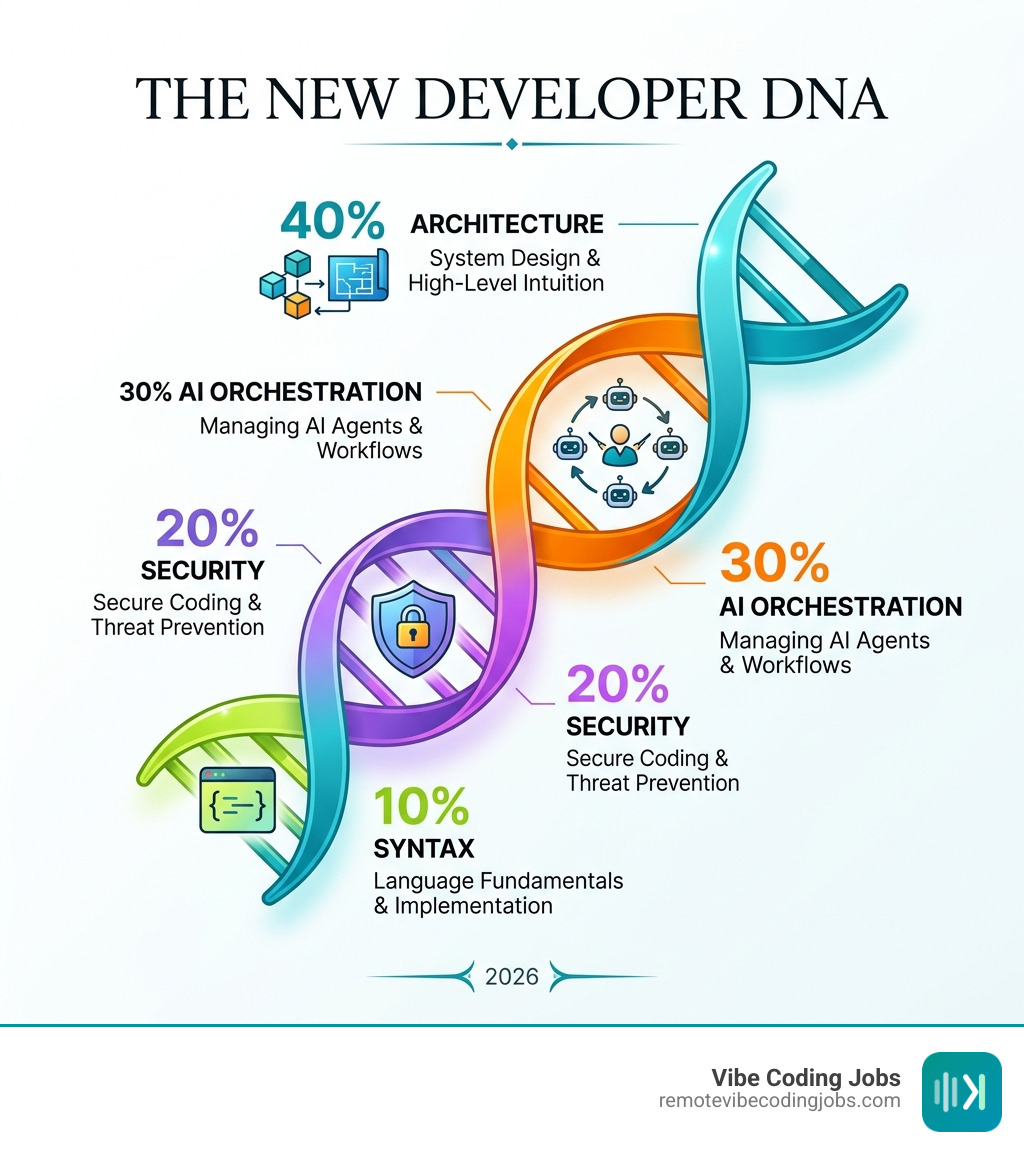
What makes a successful remote developer in 2026? It’s no longer just about knowing React or Python. It’s about the “New Developer DNA.” This includes:
- MLOps Literacy: Understanding how to deploy and maintain the models your code relies on.
- AI Ethics & Governance: Knowing how to spot algorithmic bias and ensuring data privacy.
- Automation Fluency: A “vibe coder” doesn’t do the same manual task twice. If it can be automated with a AI Coding Tools for Vibe Coding, it should be.
- Security-First Thinking: With ransomware attacks rising by 38% in 2025, writing secure code is a non-negotiable trait.
This shift in skills has directly impacted the Vibe Coding Salary Range Remote Experience Location. Senior developers who can effectively lead AI-augmented teams are seeing compensation packages that reflect their 10x productivity leverage.
Tools for Seamless AI Assisted Remote Dev Collaboration
Remote work lives or dies by the quality of its handoffs. In the age of ai assisted remote dev, we have moved beyond simple Git commits.
Features like Claude Code Remote Control: Complete Feature Guide allow us to transfer entire AI coding sessions between machines without losing context. Imagine starting a refactor on your laptop during a commute and handing off the exact “state” of the AI’s memory to a high-powered cloud VM for testing.
We also see teams using Devassistant.ai | Your AI Co-programmer to maintain a “living” history of architectural decisions. When a developer in London signs off, the developer in San Francisco can step in with full context preservation. This creates a “follow-the-sun” model that actually works because the AI acts as the persistent thread of logic. To see this in action, check out how to Enhance productivity with AI + Remote Dev using VS Code’s latest remote tunnels and agent modes.
Managing High-Performance AI Developer Teams
Managing a team of “10x” AI-assisted developers requires a total rethink of traditional management. You aren’t managing “hours worked”; you are managing “outcomes achieved.”
The TCO (Total Cost of Ownership) Reality Hiring a remote AI developer isn’t just about the salary. You have to account for the “AI Tool Budget,” the cost of high-compute remote environments, and the potential rework if an AI-generated feature isn’t properly vetted.
| Model | Pros | Cons | Best For |
|---|---|---|---|
| Freelancers | Low overhead, specialized skills | High risk of “flaming out,” context loss | Short-term prototypes |
| Agencies | Managed risk, pre-vetted AI talent | Higher hourly rates | Scaling existing products |
| Outsourcing | Massive cost savings (up to 70%) | Time zone/cultural gaps | Enterprise maintenance |
Many of the Best Companies Hiring AI Developers now prefer a hybrid model: a core team of senior architects managing a fleet of AI-augmented remote contractors.
Security is the biggest hurdle. With the average cost of a data breach crossing $4.45M, we must ensure that AI tools aren’t leaking proprietary code into public LLM training sets. Successful managers insist on network isolation and “zero-trust” architectures where AI inference stays within the company perimeter.
Measuring Success and Productivity Metrics
How do you know if your ai assisted remote dev setup is actually working? You stop counting lines of code.
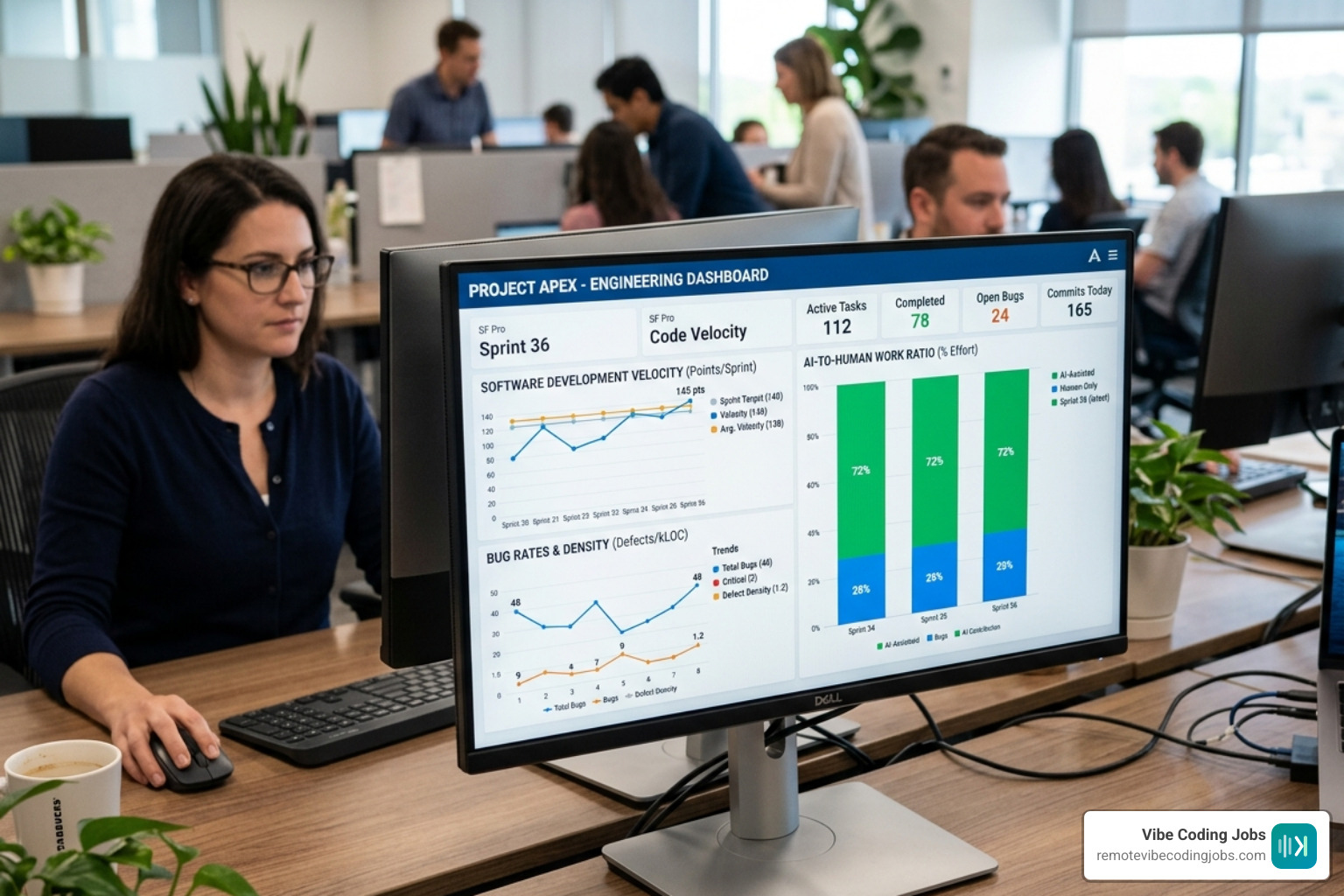
Instead, we look at Flow Metrics. We aim for 80% efficiency — meaning the time a ticket spends in “active work” vs. “waiting for review.” Because AI can generate tests and documentation instantly, the traditional “bottlenecks” should disappear.
We also track:
- Bug Rates: We want <5% post-deployment bugs. Speed is useless if it creates technical debt.
- Feature vs. Revenue Lift: Are the 10x more features we’re shipping actually moving the needle?
- NPS (Net Promoter Score): Does the team feel empowered or overwhelmed by the AI?
The Best Companies Hiring AI Developers Remote Positions use real-time dashboards to monitor these “vibe” levels. If you’re applying for these roles, companies are looking for Remote Coding Jobs No Leetcode Practical Skills Projects — they want to see what you’ve built with AI, not how well you can reverse a binary tree on a whiteboard.
Frequently Asked Questions about AI Assisted Remote Dev
What are the current salary ranges for remote AI developers in 2026?
The market has bifurcated. Developers who resist AI tools are seeing stagnant wages, while “AI-fluent” professionals are in high demand.
- Senior AI/ML Developers: $150,000 – $250,000+ per year.
- Freelance Vibe Coders: $100 – $300 per hour, depending on their ability to ship complete products solo. Check our full breakdown on Vibe Coding Salary Range Remote Experience Location for more details.
How do you vet developers for 10x productivity with AI tools?
We look for “Workflow Audits” rather than coding tests. We ask candidates to show a project and explain their prompting logic. Did they use a structured system for context management? Do they have a library of “custom instructions” for their AI? We dive deep into their How to Get a Vibe Coding Job Skills Portfolio Networking to see if they truly understand the code the AI generates.
What are the biggest security risks in AI-assisted remote development?
The “copy-paste” vulnerability is real. Developers might inadvertently paste sensitive API keys or PII (Personally Identifiable Information) into a public LLM. Furthermore, as AI Agents Replacing Apps becomes more common, the attack surface for “prompt injection” grows. Secure teams use isolated perimeters and E2E encrypted tunnels for all remote AI sessions.
Conclusion
The era of the “code typist” is over. In 2026, the most successful developers are those who embrace ai assisted remote dev as a partnership. It’s about finding the right “vibe” — the balance between machine speed and human strategy.
At RemoteVibeCodingJobs, we don’t just list jobs; we curate opportunities at companies that “get it.” We look for async-first cultures that value your ability to orchestrate AI tools for massive impact. Whether you’re a seasoned architect or a rising “agentic engineer,” the future of development is remote, AI-powered, and faster than ever.
Ready to find a team that speaks your language? Find your next role at RemoteVibeCodingJobs.