Coding with the Machine: How to Future-Proof Your Career
The 2026 Guide to AI Coding Jobs: What They Are and How to Land One
AI coding jobs are software engineering roles where developers use AI tools — like Cursor, Claude Code, or GitHub Copilot — to write, review, and ship code faster than ever before.
Here’s a quick snapshot of what you need to know right now:
| Category | Key Facts |
|---|---|
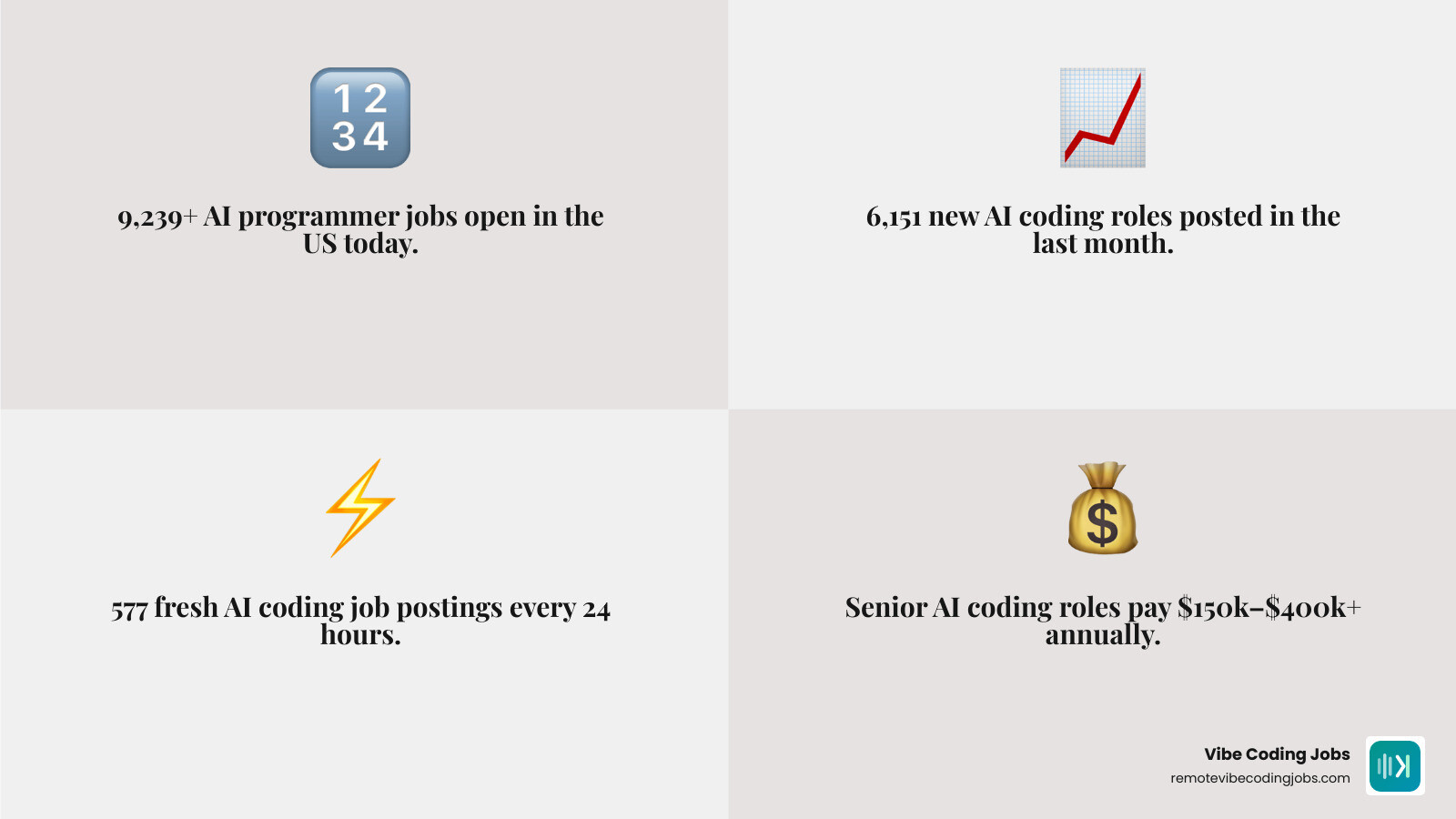
| Total US listings | 9,239+ AI programmer jobs open today |
| Posted last month | 6,151 new roles |
| Posted last 24 hours | 577 new roles |
| Remote roles available | ~2,295 (24.8% of listings) |
| Biggest experience segment | Mid-Senior (4,693 roles) |
| Entry-level salary range | $70,000 – $100,000/year |
| Senior salary range | $150,000 – $250,000+ (top roles: $400,000+) |
| Top hiring cities | San Francisco, New York, San Jose |
| Key skills employers want | Python, TypeScript, LLM integration, AI tool fluency |
The market is moving fast. Demand isn’t slowing — it’s accelerating. Developers who learn to work with AI tools are getting hired, promoted, and paid significantly more than those who don’t.
This isn’t a niche trend anymore. It’s the new baseline for modern software work.
I’m the RVCJ Editorial team — we cover AI coding jobs, remote developer hiring, and AI-assisted workflows for engineers building with tools like Cursor, Copilot, Windsurf, and Claude. We’ve spent years tracking the vibe coding job market and curating remote roles for AI-first teams, so everything in this guide is grounded in real job data and hands-on industry experience.
Let’s break down exactly what these roles look like, what they pay, and how to land one.
What AI Coding Jobs Actually Are in 2026
By May 2026, the term ai coding jobs has evolved from a futuristic concept into a massive segment of the tech economy. These roles aren’t just about building AI models; they are about using AI to build everything else. Whether you are an AI programmer, an AI/ML developer, or a product engineer, the core of your day-to-day work now involves “agentic workflows”—where you act as the conductor of a digital orchestra of coding agents.
How AI coding jobs differ from traditional software engineering roles
In the “old days” (pre-2024), a software engineer spent hours manually typing out boilerplate code, debugging syntax errors, and scouring documentation. Traditional engineering was about the how—the specific implementation of every line of code.
Today, ai coding jobs focus on the what and the why. While you still need a deep understanding of computer science, your role has shifted toward orchestration. You spend more time on prompt design, system architecture, and high-level code review. Instead of writing the code yourself, you guide AI copilots to generate it, then verify that the output meets the security and performance standards of the system. This shift has led to massive productivity gains, allowing one “AI-first” engineer to do the work that previously required a small team.
Why “vibe coding” is becoming standard developer behavior
You might have heard the term “vibe coding” floating around Twitter or LinkedIn. It’s not just a meme; it’s a legitimate methodology for modern development. Vibe coding refers to AI-assisted development where the engineer uses natural language specs to describe a feature, and the AI handles the heavy lifting.
Developers report a 2x to 5x productivity increase within the first month of consistent vibe coding practice. It allows for rapid prototyping at a speed that was impossible two years ago. However, it’s not “coding without thinking.” It requires intense human oversight to ensure the “vibe” translates into technically sound, scalable code. For a deeper look into how this is reshaping professional paths, check out our AI-assisted development career guide.
The biggest benefits for employers and developers
For employers, the math is simple: shipping speed. Companies can now launch products in weeks rather than months. This high leverage means they are willing to pay a premium for developers who can master these tools.
For developers, the benefits are even better. Beyond the higher salary upside, there is a significant reduction in “grunt work.” You get to focus on the creative aspects of problem-solving while the AI handles the repetitive tasks. It’s about becoming a “10x engineer” not by working 10x harder, but by using 10x better tools.

Where the AI Coding Jobs Market Is Growing Fastest
The demand for ai coding jobs is exploding. As of May 2026, there are over 9,239 AI Programmer jobs listed in the United States alone. The velocity is staggering—over 6,000 of those were posted just within the last 30 days.
AI coding jobs by experience level, location, and work setup
The market is currently dominated by Mid-Senior level positions, which account for 4,693 of the available roles. However, there is a growing surge in entry-level growth market opportunities.
| Work Setup | Percentage of Listings | Typical Location Hubs |
|---|---|---|
| Fully Remote | 24.8% | N/A (Global/US-wide) |
| Strictly On-Site | 57.3% | San Francisco, NY, San Jose |
| Hybrid | 17.9% | Tech Hubs & Satellite Offices |
While major hubs like San Francisco (556 jobs) and New York (511 jobs) remain the heart of the industry, the number of remote-first companies is rising as firms realize that “vibe coders” can be effective from anywhere.
Salary ranges for AI coding jobs from beginner to senior
If you are looking for a reason to pivot into ai coding jobs, the compensation data is the ultimate “hook.”
- Entry-level vibe coders (1-2 years experience): $70,000 to $100,000.
- Mid-Senior AI-first developers: $150,000 to $250,000+.
- Top-tier Senior/Staff roles: Frequently exceed $400,000 in total compensation.
Even the contract market is lucrative. Specialized roles for ranking and evaluating AI-generated code can pay as much as $100.50 per hour. If you’re curious about how entry-level pay is scaling, read more about AI coding jobs entry-level future.
Why demand keeps climbing in 2025-2026
The surge isn’t a bubble; it’s a structural shift. Enterprises are moving past the “experimentation” phase of AI and are now building internal automation and custom coding agents. There is a massive developer shortage for those who actually know how to use an AI-native stack. You can see the real-time data on this trend through scientific research on current AI programmer openings and stay updated on AI coding jobs market trends growth training.
The Skills, Tools, and Workflows Employers Now Expect
To land one of these ai coding jobs, you can’t just say you’ve used ChatGPT. Employers are looking for “AI tool fluency”—the ability to use specialized IDE assistants and CLI agents to maintain a high-velocity workflow.
Core technical skills for winning AI coding jobs
While the AI writes much of the code, you must be proficient in the languages it generates. Python, TypeScript, and Go are the “Big Three” in the AI world. You also need to understand:
- APIs and LLM Integration: Knowing how to hook into OpenAI, Anthropic, or local models.
- Distributed Systems: AI apps often require complex backend infrastructure.
- Enterprise Foundations: Proficiency in SAML, RBAC, and OIDC for secure integrations.
AI coding jobs now favor developers who can supervise tools well
The most valuable skill in 2026 is tool judgment. This means knowing when to trust the AI and when to intervene. Employers want to see that you have a “human-in-the-loop” philosophy. This involves context management (giving the AI the right files and info) and rigorous verification. You are no longer just a “coder”; you are a “code auditor.”
The workflow stack behind modern vibe coding
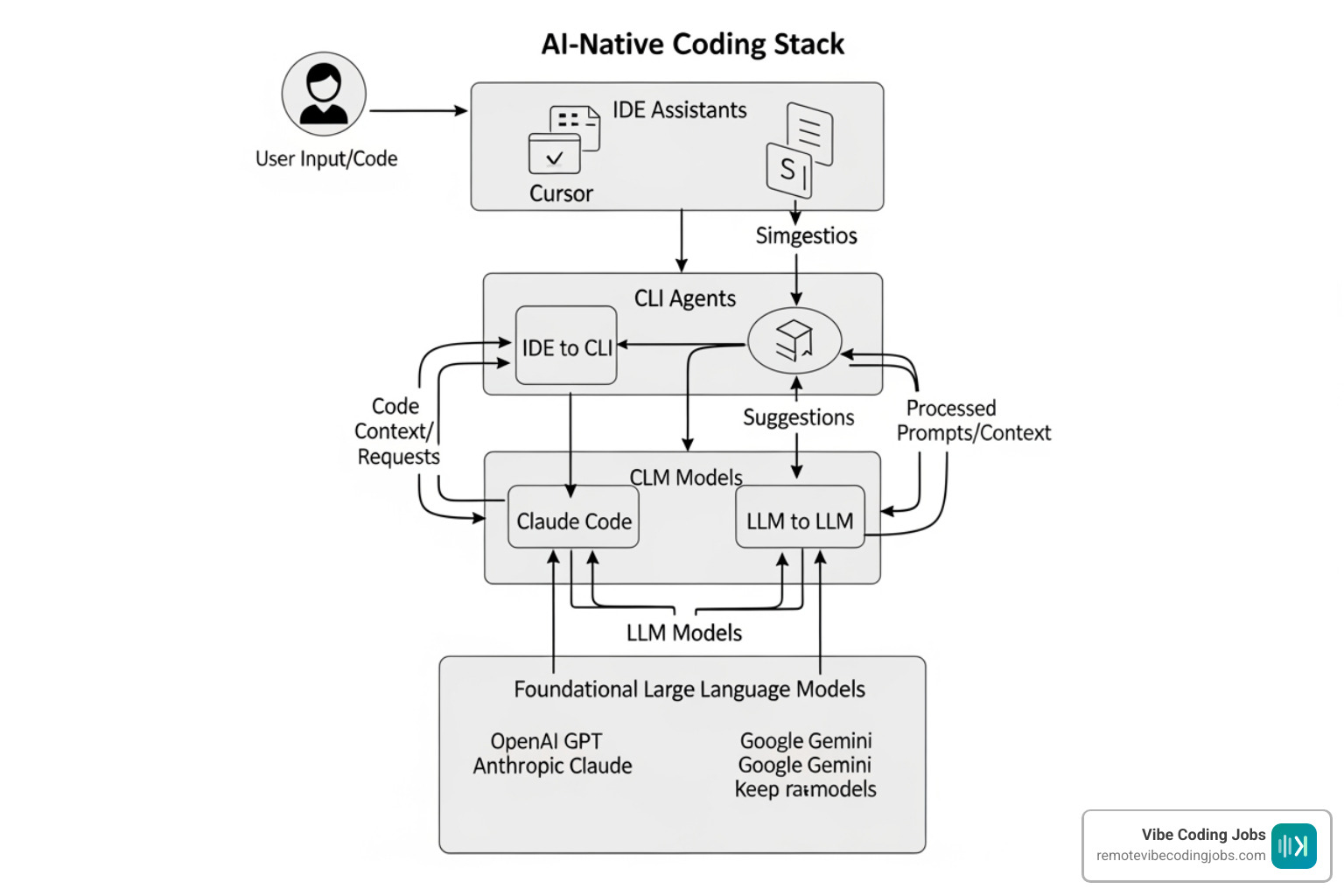
The modern stack is AI-native. This includes:
- IDE Assistants: Cursor, Windsurf, or JetBrains with full agent integration.
- CLI Agents: Tools like Claude Code or Bolt.new that can execute terminal commands and run tests autonomously.
- Observability: Monitoring AI-generated code for performance regressions.
For a full breakdown of the hardware and software requirements, see our guide on remote AI developer jobs AI tools.
Top Career Paths and Real AI Coding Jobs to Watch
The career paths in this field are diversifying. We are seeing a split between those who build the AI tools and those who use them to build products.
Real examples of AI coding jobs at frontier AI companies
Frontier companies are currently the biggest spenders.
- OpenAI: They are actively hiring for roles like Applied AI Engineer, Codex Core Agent and Software Engineer, Codex for Teams. These roles focus on making AI a “proactive teammate” that can predict tasks and delegate work. Base pay for these roles ranges from $230,000 to $385,000, plus significant equity.
- Go: They are looking for Software Engineer, AI to integrate machine learning into professional audio systems.
Startup and platform roles building the future of AI development
Startups are moving even faster. Take Kilo Code, for example. Despite being less than a year old, they process over 6 trillion tokens per month. Their Call for Engineers highlights the need for “high agency” developers who can build complex IDE extensions for JetBrains using PSI and async patterns. They even host in-person hackathons in places like Malaga, Spain, to find the best talent.
Emerging job titles beyond software engineer
We are seeing the rise of “Product Engineers” who focus on the end-user experience of AI, and “Eval Engineers” who specialize in benchmarking model outputs. If you want to see how these titles are evolving, check out AI-assisted development career growth job market opportunities.
How to Break In and Land AI Coding Jobs Without Falling Behind
The barrier to entry is changing. While a CS degree is still valuable, “proof of work” is becoming the primary currency in the vibe coding world.
Can beginners and non-CS degree holders get AI coding jobs?
Yes. In fact, some argue that why junior developers outperform seniors in the AI age is because juniors have fewer “old habits” to unlearn. They embrace the AI-first workflow from day one. If you can show a GitHub portfolio full of shipped, AI-assisted projects, you are a strong candidate. Beginners should focus on AI coding jobs for beginners to find their first break.
What the interview process looks like for AI-first roles
Expect the interview process to be different. Instead of a whiteboard challenge where you struggle to remember syntax, you might be asked to:
- Solve a complex system design problem using an AI assistant.
- Debug a piece of code that an AI “hallucinated.”
- Explain your reasoning for choosing a specific prompt or context for a task.
Best places to find high-quality openings and apply faster
General job boards are often cluttered. For curated, high-vibe roles, you should use specialized resources.
- LinkedIn: Great for sheer volume (check out 1,000+ Ai Programmer jobs).
- RemoteVibeCodingJobs: We aggregate the best remote, async-first roles specifically for AI-fluent developers.
- Company Career Pages: Check OpenAI, Anthropic, and Kilo Code directly.
For more tips, see our list of remote AI developer jobs boards openings.
Frequently Asked Questions About AI Coding Jobs
Are AI coding jobs replacing traditional developers or changing the role?
They are changing the role. The “traditional” developer who refuses to use AI is being replaced by the developer who uses AI to be 5x more productive. It’s about augmentation, not replacement.
Which ai coding jobs pay the most in 2026?
Senior Applied AI Engineers at frontier labs (OpenAI, Anthropic) and Lead Product Engineers at high-growth AI startups currently command the highest salaries, often exceeding $400k total compensation.
Are remote AI coding jobs still available if most listings are on-site?
Yes. While about 57% of jobs are on-site (mostly in SF/NY), there are still over 2,200 fully remote ai coding jobs available in the US market right now.
Conclusion
The future of software engineering isn’t about competing with the machine—it’s about coding with it. By mastering the “vibe coding” workflow and staying current with tools like Cursor and Claude, you aren’t just keeping your job; you’re supercharging your career.
The ai coding jobs market of 2026 offers higher pay, more creative freedom, and the chance to build at the speed of thought. Whether you’re a seasoned pro or just starting out, now is the time to build your AI-native portfolio.
Ready to find your next role? Check out the latest AI coding jobs remote career growth opportunities and join the ranks of the modern developer.