
Why Are Developers Shifting to Async-First Remote Work in 2026?
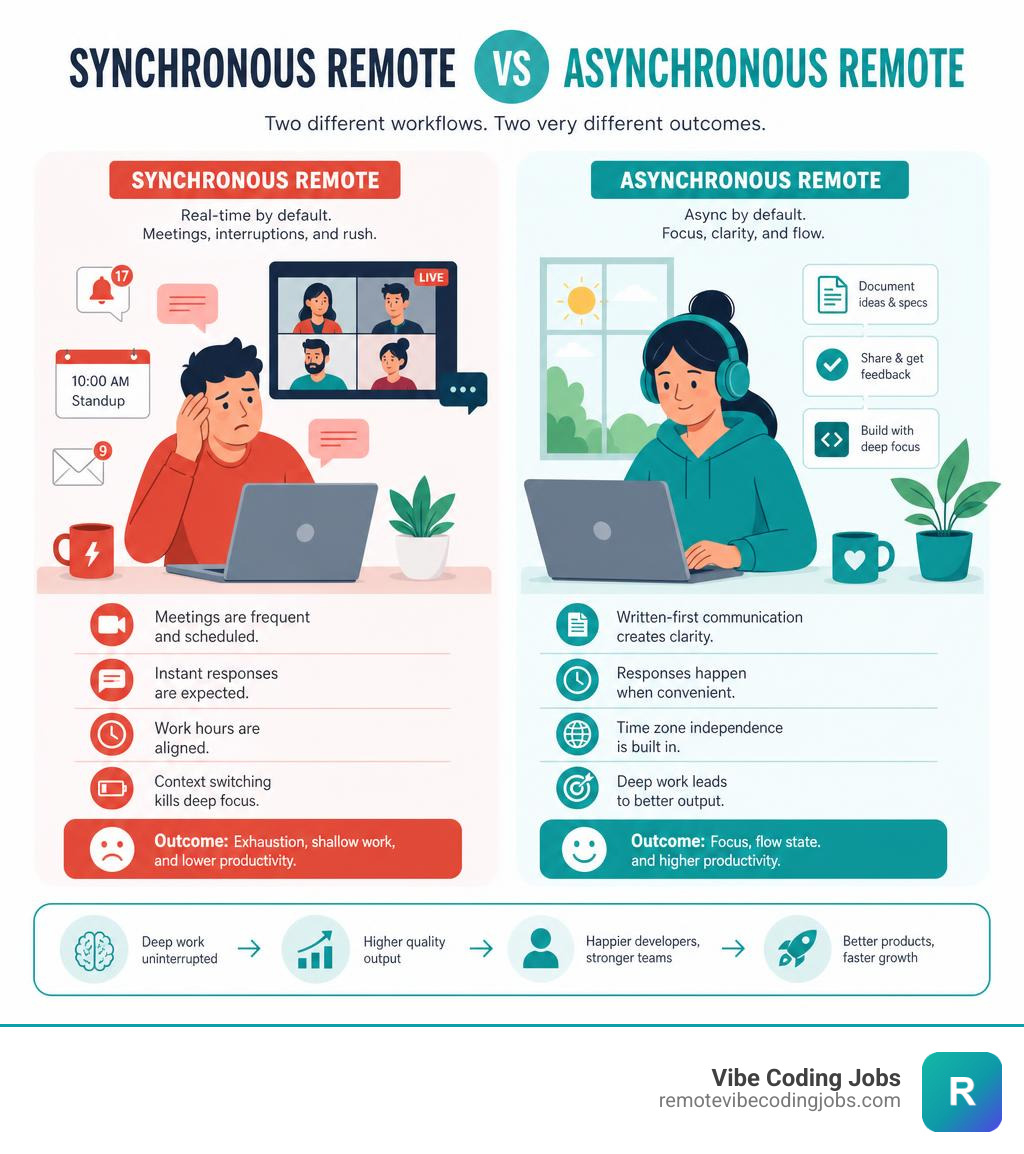
The remote work landscape has shifted dramatically. A few years ago, “remote” simply meant you didn’t have to commute to a physical office. However, developers quickly realized that working from home while being subjected to eight hours of back-to-back Zoom meetings, constant Slack pings, and immediate-response expectations is just an office in disguise. It is exhausting, and it is highly unproductive.
In 2026, the elite tier of remote software engineers is no longer settling for simple “remote-friendly” arrangements. Instead, we are seeing a massive migration toward async-first remote work.
An async-first culture is built on three core pillars:
- Written-first communication: Decisions, ideas, and project specs are documented thoroughly in RFCs, GitHub issues, or collaborative docs before anyone writes a single line of code.
- Documentation over meetings: Live meetings are treated as a last resort—an expensive tool used only when written collaboration has reached its limits.
- Complete timezone independence: Teams are distributed globally, and engineers are trusted to manage their own schedules. No one is expected to wake up at 3:00 AM for a synchronous daily standup.
This setup is the ultimate catalyst for developer flow state and what we call “vibe coding”—the modern workflow of AI-assisted development. When you are leveraging advanced AI tools like Cursor, Claude, Copilot, and Windsurf, your primary job is no longer typing out boilerplate code. Your job is reasoning, architecting, and directing AI systems. This requires deep, uninterrupted blocks of focus. If your flow state is shattered every twenty minutes by a Slack notification demanding an instant reply, your productivity plummets.
The data back this up. According to Gallup research, remote developers experience a 35-40% productivity increase compared to their office-based counterparts when they are given the autonomy to work without constant interruptions. This productivity boom is a major reason why the remote workforce continues to expand, with over 32.6 million Americans working remotely, representing roughly 16% of the total workforce.
By eliminating the “always-on” anxiety of synchronous remote setups, async-first companies allow developers to do their best work on their own terms. To understand how this impacts your daily output, explore our guide on Async-First Remote Developer Jobs: Productivity Benefits.
Which Job Boards Specialize in Async-First Remote Developer Roles?

If you search for “remote developer jobs” on a massive, generalist job search engine, you will likely be met with thousands of listings that require “occasional office visits,” “core working hours in Eastern Time,” or “frequent team alignment calls.”
To find companies that truly respect your autonomy, you need to look where async-first employers actually post. Specialized platforms have emerged to filter out high-meeting, low-autonomy roles, prioritizing developer lifestyle and modern AI-assisted workflows over traditional corporate structures.
Remote Vibe Coding Jobs
We built Remote Vibe Coding Jobs specifically to solve this problem for the modern developer. We maintain a highly curated catalog of approximately 1,000 active remote developer roles, emphasizing quality over quantity.
Every single listing on our platform is hand-reviewed by a human to ensure zero spam. We don’t just scrape the web; we actively vet companies for culture-first signals. When you browse our board, you can filter specifically for:
- Async-first cultures that prioritize written documentation.
- No-leetcode interview processes that value practical building over academic trivia.
- 4-day workweeks that protect your work-life balance.
- AI tool integration, highlighting forward-thinking companies that actively encourage you to use Cursor, Claude, Copilot, and Windsurf to accelerate your delivery.
If you want to skip the corporate red tape and find teams that work the way you do, check out the Vibe Coding Companies Hiring in 2026: Top Async-First Roles.
Curated Async-First Directories
Another excellent avenue for job seekers is dedicated async directories. These platforms do not operate like traditional job boards; instead, they function as directories of companies that have proven, 100% asynchronous DNA.
These directories focus heavily on employers that offer truly remote roles with zero timezone or country restrictions. This means you can work from Spain, Japan, or Colombia without worrying about matching a US-based team’s 9-to-5 schedule. By focusing your job search on verified async-first companies, you completely avoid the “hybrid bait-and-switch” listings common on mainstream platforms.
Developer-Focused “Zero BS” Job Feeds
For engineers who want a streamlined, no-nonsense application experience, developer-focused “zero BS” job feeds are highly valuable. These platforms are built with a zero-tolerance policy for recruiter middle-men, third-party staffing agencies, and vague job descriptions.
These feeds often feature AI-enriched listings from verified, remote-only companies. Instead of navigating complex applicant tracking systems (ATS) that require you to upload your resume and then manually re-type your entire work history, these boards provide clean, direct-apply links that put your application straight into the hiring manager’s inbox or the company’s direct application portal.
AI-Native Remote Job Channels
The rise of generative AI has created a new class of developer: the AI-native builder. Specialized job channels have emerged to connect these builders with forward-thinking remote teams that work with AI, not against it.
These platforms are highly progressive, making salary transparency a core feature by requiring upfront compensation ranges on every single listing. They are ideal for developers who integrate AI tools into their daily coding workflows and want to work for companies that treat AI proficiency as a superpower rather than a form of cheating. To learn more about how AI is reshaping remote engineering, read our analysis on Remote Developer Jobs: AI Tools, Productivity & Collaboration.
How Do Specialized Async Boards Differ From High-Volume Remote Job Boards?

When you are looking for a remote role, it is tempting to go where the volume is highest. However, there is a massive structural difference between niche, curated job boards and high-volume, generalist aggregators.
The largest general remote job boards host over 100,000 remote job listings across all industries. While that number sounds impressive, the reality for developers is often disappointing. Because these platforms rely on automated web scrapers to keep their volume high, their listings are frequently outdated, mislabeled, or outright fake. You might spend hours tailoring your resume for a “fully remote” role, only to find out during the first recruiter screen that they actually expect you to be in an office in Chicago three days a week.
The economics of these platforms also dictate their quality:
- High-Volume Boards: These platforms charge employers around $299 to post a single job. While this fee filters out low-quality, fly-by-night listings to some extent, the sheer volume of postings means your application is highly likely to get lost in an ATS black hole alongside 500 other applicants.
- Niche Async Boards: Platforms like ours focus on deep curation. We manually review every role, verifying that the company actually operates asynchronously, offers genuine timezone flexibility, and supports modern developer workflows.
Niche boards protect your time by providing direct application links, verified salary data, and clear culture signals upfront. This allows you to apply to fewer jobs while achieving a much higher response rate because your values align perfectly with the employer’s operational model. For a deeper dive into finding high-quality, transparent employers, check out our guide on No BS Tech Companies Hiring Remotely: Find Your Dream Job.
| Feature | Niche Async Boards (e.g., Remote Vibe Coding Jobs) | High-Volume General Boards |
|---|---|---|
| Curation Quality | High (Manually reviewed & verified) | Low (Automated scraping, high spam) |
| Spam Levels | Zero spam | Moderate to High |
| Culture Filtering | Async-first, 4-day week, No-Leetcode, AI-friendly | Basic “Remote” tag only |
| Application Process | Direct-to-company / Direct-apply links | Often redirects through complex ATS or agencies |
| Salary Transparency | Highly prioritized / Upfront | Often hidden or vague |
| AI Tool Support | Specifically tagged (Cursor, Claude, etc.) | Rarely mentioned |
What Culture Filters and Signals Should You Look For on These Platforms?
In 2026, filtering jobs by tech stack alone (e.g., React, Python, Postgres) is no longer sufficient. If you want to protect your peace of mind and secure a high-autonomy role, you must learn to read between the lines of a job posting.
When evaluating opportunities on async-friendly job boards, look for specific culture filters and operational signals that indicate a company’s true commitment to asynchronous work.
Async-First and Flexible Communication Tags
First and foremost, look for tags or language pointing to written-first communication. A true async-first company will explicitly mention things like:
- “Strong written communication is our primary skill.”
- “We document decisions in RFCs and GitHub Issues before we build.”
- “Slack is used for non-urgent chatter; Slack threads are strictly organized.”
- “We do not have daily standups; we use weekly written updates instead.”
These signals prove that the company has built systems to support asynchronous collaboration, ensuring you won’t be dragged into endless meetings. To understand how these communication dynamics play out in practice, read our deep dives on Async-First Remote Developer Jobs: Asynchronous Communication and Async-First Remote Developer Jobs: Flexible Communication.
Flexible Hours and 4-Day Work Weeks
Another critical signal is how the company measures performance. You want to work for employers that evaluate your output and results, not your inputs or desk presence.
Look for postings that mention flexible hours, core-hours overlap of four hours or less, or a 4-day workweek. These companies understand that software engineering is a creative, problem-solving discipline that cannot be measured by green Slack status dots or hours spent sitting in a chair. Learn more about how to find these high-autonomy roles in our guide on Async-First Remote Developer Jobs: Flexible Hours.
AI Tool Integration and Vibe Coding Support
Progressive, modern tech companies do not fear AI; they embrace it. When reviewing job descriptions, look for companies that explicitly encourage the use of AI coding assistants.
If a job posting mentions that the team uses Cursor, Claude, Copilot, or Windsurf as part of their standard developer setup, it is a massive green flag. It tells you that the company values efficiency, modern workflows, and developer flow state. They want you to build fast and think deeply, which is the exact definition of vibe coding. For more on how to identify these forward-thinking teams, explore Async-First Remote Developer Jobs: Culture, Tools, Salary.
How Can You Verify if a Company Is Truly Async-First Before Applying?
Employer branding can be incredibly deceptive. Because “async-first” has become a highly attractive buzzword for top-tier engineering talent, many companies claim to operate asynchronously in their job postings when their actual day-to-day reality is highly synchronous and meeting-heavy.
Before you spend your valuable time applying, you should perform some basic due diligence to verify their claims. To learn more about evaluating developer workflows, read Async-First Remote Developer Jobs: Workflow & Productivity.
Green Flags of True Async DNA
There are several undeniable indicators that a company is genuinely async-first:
- Publicly Accessible Handbooks: Companies like GitLab and Doist publish their entire operational handbooks online. If a company’s handbook is public and details exactly how they handle communication, response times, and decision-making, you can trust their async claims.
- Clear Response Time Guidelines: True async companies have explicit policies regarding communication latency (e.g., “We expect responses to non-urgent Slack messages within 24 hours, not 24 minutes”).
- Tool Stack Transparency: They rely heavily on asynchronous collaboration tools like Notion, GitHub Issues, linear workflows, and Loom videos, rather than defaulting to a Zoom call for every minor question.
Red Flags to Watch Out For
Conversely, be on the lookout for these warning signs:
- Vague, Contradictory Language: Watch out for job descriptions that claim to be “async-friendly” but also mention “always-on environments” or “constant real-time collaboration.”
- High-Meeting Interview Processes: If the interview process requires multiple synchronous panel interviews, live whiteboard coding tests, or demands that you be available for a 5-step synchronous loop over a single week, their internal culture likely mirrors this high-meeting overhead.
- Lack of Documentation: If you ask a recruiter or hiring manager during an initial call, “Where is your team’s engineering documentation kept, and how are decisions made?” and they cannot give you a clear, structured answer, they are not async-first.
Leveraging Community Referrals
One of the most effective ways to verify a company’s culture is through community-driven channels. According to GitLab’s Remote Hiring Report, 42% of remote developer hires come through community referrals.
Before applying, reach out to current or former developers at the company via developer communities, GitHub, or LinkedIn. Ask them simple, direct questions:
- “How many hours of meetings do you have per week?”
- “Are you expected to be online during specific hours, or can you truly set your own schedule?”
- “Does the team actually document decisions, or does everything happen in ad-hoc Zoom calls?”
Getting first-hand accounts from fellow engineers is the single best way to bypass marketing fluff and uncover the ground truth.
Frequently Asked Questions About Async-First Job Boards?
Which remote job board has the best developer jobs?
It depends entirely on what you value in your career. If you are looking for modern, high-autonomy, and AI-friendly roles, curated niche platforms are far superior to massive legacy aggregators. For culture-first, AI-assisted, and async-first roles, Remote Vibe Coding Jobs is the premier choice. We actively filter out low-autonomy, high-meeting corporate roles in favor of true flow-state environments, saving you from sorting through thousands of irrelevant listings.
Are remote job boards worth paying for?
For candidates, absolutely not. All reputable remote job boards are completely free to browse and apply. You should never pay a fee to access job listings or submit an application. For employers, however, paying to post on curated boards is highly beneficial. Premium posting fees filter out low-quality, spammy employers, ensuring that only serious companies with active budgets and high-quality remote setups are listing roles.
How do I avoid fake remote job listings?
The best way to avoid fake listings is to stick to curated, hand-reviewed job boards like Remote Vibe Coding Jobs where every post is verified by a human. Avoid massive, uncurated aggregators that scrape listings automatically. Red flags of fake or low-quality listings include:
- Vague job descriptions that don’t name the actual tech stack or company.
- Requests for payment, bank details, or complex “assessments” before you have even spoken to a human.
- “Remote” roles that list a specific physical office location and require occasional in-person attendance.
How Do You Take the Next Step Toward Your Dream Async Role?
Transitioning to an async-first role requires a slight shift in how you present yourself as a developer. Because async teams rely heavily on written communication and self-discipline, your resume and portfolio need to reflect these specific competencies.
To optimize your profile for async-first employers, make sure to highlight:
- Your Written Communication Skills: Mention your experience writing clear technical documentation, RFCs, and detailed pull request descriptions. Show that you can explain complex technical concepts clearly in writing.
- Your Autonomy and Self-Discipline: Highlight your experience working across distributed timezones, managing your own schedule, and delivering projects independently without constant oversight.
- Your AI Tool Proficiency: Don’t hide the fact that you use AI. Progressive async-first companies want to hire “vibe coders” who know how to leverage Cursor, Claude, and Copilot to build software at 10x speed. Frame your AI usage as a core engineering skill that multiplies your output.
By applying early on niche, curated boards, you put your profile in front of hiring managers who are specifically looking for high-autonomy, modern developers.
Ready to escape the meeting-heavy grind and find a role that lets you focus on what you do best? Browse remote developer jobs on Remote Vibe Coding Jobs today, and take your first step toward true timezone independence and flow-state engineering.