
Why Is Culture Fit the New Priority for Remote Engineers?
In the early days of distributed work, the primary challenge for software engineers was simply finding a company that would let them work from home. Today, in June 2026, the landscape has completely shifted. Remote work is no longer a rare perk; it is a standard operating model. However, this shift has revealed a massive divide between companies that are “remote-first” and those that are merely “pseudo-remote.”
For a remote software engineer, company culture and communication style dictate daily quality of life far more than a tech stack or a base salary. A high salary cannot compensate for the mental exhaustion of back-to-back Zoom meetings, and a modern tech stack is useless if you are micromanaged through digital surveillance tools.
To understand why culture fit has become the ultimate priority, we have to define what these terms actually mean in a distributed engineering team:
- Company Culture: This is not about virtual happy hours, Slack trivia channels, or the mission statement on the company website. True culture is defined by the behaviors that are rewarded, tolerated, or penalized when nobody is watching. It is how a team handles a production outage, how they allocate technical debt, and whether they respect personal boundaries.
- Communication Style: This is the operational mechanism of the culture. It dictates how information flows through the organization. Is it synchronous (real-time, meeting-heavy, Slack-dependent) or asynchronous (written-first, documented, pull-request-driven)?
The hidden cost of synchronous meeting overload is a major driver of developer burnout. When engineers are forced to sit through daily standups, sprint planning sessions, backlog grooming, and ad-hoc syncs, their “maker’s schedule” is shattered into 30-minute fragments. This makes it impossible to achieve the deep focus required to solve complex architectural problems or engage in high-velocity “vibe coding” (AI-assisted development).
The data highlights how difficult it is to find this information upfront. Only 27% of remote job seekers say they can reliably find information about company culture and communication style before applying. This lack of transparency leads to disastrous hiring decisions: over 60% of remote engineering candidates cite ‘poor communication or toxic culture’ as the top reason for rejecting or leaving a remote role.
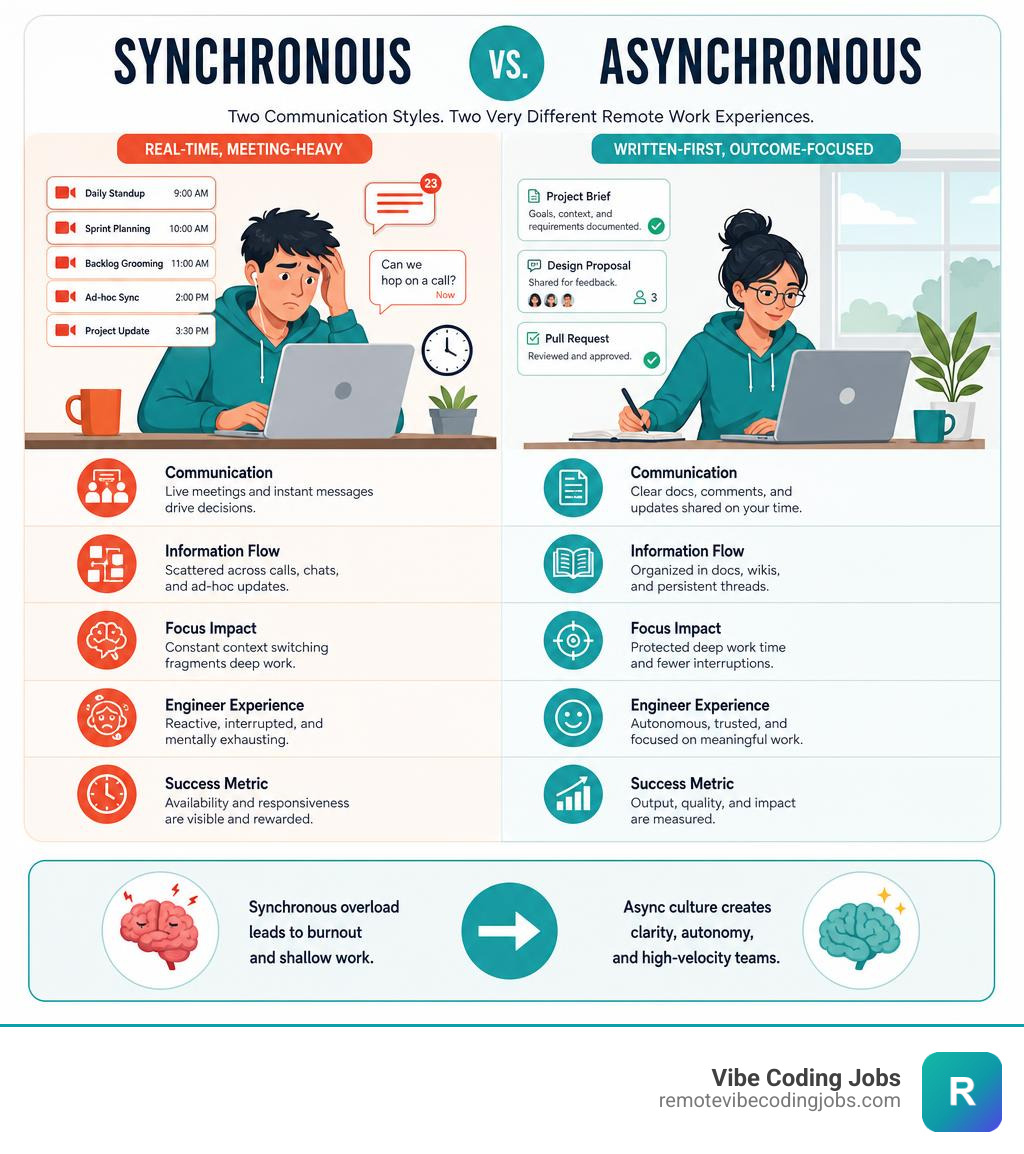
When a company operates with a synchronous-first mindset, remote engineers often feel like second-class citizens. Decisions are made in ad-hoc huddles, and remote developers are left to piece together requirements from fragmented Slack threads. Conversely, an async-first culture protects deep work blocks, prioritizes written clarity, and judges engineers on their output rather than their green “active” status on Slack.
How Do Specialized Platforms Filter Remote Engineering Roles by Culture?
Because traditional job search methods fail to capture these nuances, a new class of specialized platforms has emerged. These sites move beyond standard keyword matching to evaluate team values, operational routines, and communication styles.
| Platform Type | Example Filters | Target Audience | Data Sources |
|---|---|---|---|
| Values-Based Search | Psychological safety, EQ > IQ, flat hierarchy, open source | Engineers seeking deep alignment on team dynamics and ethics | Direct, structured company self-reporting |
| Review-Aggregated | Work-life balance scores, meeting load, async-first tags | Candidates looking for verified, employee-sourced culture data | Scraping and analysis of Glassdoor, Blind, and community reviews |
| Async-First / Vibe Coding | Async-first, Cursor/Claude toolchains, low-meetings, high autonomy | Modern developers prioritizing rapid AI-assisted execution and deep work | Curated daily sourcing, strict vetting of communication practices |
These platforms recognize that matching an engineer with a team requires looking at the operational environment. If you want to find a team that lives its values, you need to use platforms that categorize companies by how they actually work.
At Remote Vibe Coding Jobs, we built our platform to address this exact need. We specialize in aggregating remote “vibe coding” (AI-assisted development) roles at strictly async-first companies. By focusing on teams that embrace modern AI workflows (like Cursor and Claude), we naturally align with high-autonomy, low-meeting engineering cultures. When developers are empowered to build and iterate rapidly using AI, the need for synchronous oversight disappears.
To explore how these tools, cultures, and salaries intersect, check out our guide on Async First Remote Developer Jobs Culture Tools Salary. If you are ready to find companies that have already built their engineering pipelines around these principles, browse our curated list of Async First Companies Hiring Developers Find Your Dream Remote Job.
Values-Based Filtering
Values-based search engines allow developers to filter companies by over 40 distinct cultural and operational values. Instead of searching for “React Developer,” you can search for teams that prioritize “Fosters Psychological Safety,” “EQ > IQ,” “Safe to Fail,” or “Minimal Meetings.”
These platforms provide direct access to comprehensive team profiles. Instead of reading a generic job description, you can see a detailed breakdown of how a team handles code reviews, how they plan their roadmap, and what their daily routines look like. This level of transparency helps you find engineering teams that share your values and work style.
Review-Aggregated Culture Profiling
Another highly effective approach is review-aggregated culture profiling. Rather than relying on what companies claim in their recruitment marketing, these directories build culture profiles using real, anonymized employee feedback from platforms like Glassdoor and Blind.
These profiles score companies on specific dimensions such as work-life balance, management trust, and compensation. Most importantly for remote workers, they explicitly tag and filter companies that practice “Async-First” communication and maintain a “Deep Work / Low Meetings” environment. This allows candidates to explore verified profiles and open roles that match their preferred operational style.
Vibe Coding Jobs
We designed Vibe Coding Jobs to serve the next generation of software engineers. The rise of AI-assisted development (vibe coding) has changed what it means to be a productive developer. When you can generate, test, and deploy code at unprecedented speeds using LLMs, traditional corporate structures—like daily status updates and rigid sprint cycles—become major bottlenecks.
We curate daily listings specifically for developers who want to work in high-trust, async-first environments. We filter out companies that rely on micro-management, constant meetings, and digital surveillance. Instead, we focus on teams that prioritize developer autonomy, written documentation, and modern AI toolchains. We also provide a free playbook and a streamlined application process to help you land these highly sought-after roles without the usual job board friction.
How Do Traditional Job Boards Fail at Culture and Communication Filtering?
Traditional job boards like LinkedIn, Indeed, and even legacy remote-specific aggregators are fundamentally unequipped to handle culture and communication filtering. Their business models are built on volume, not curation. They rely on keyword matching, which is easily gamed by recruitment marketing teams.
If you search for “async” or “flexible hours” on a general job board, you will likely get thousands of results. However, when you read the job descriptions, you quickly realize the terms are used as buzzwords. A company might list “flexible hours” but include a requirement that all developers must be online and active during core hours of 9 AM to 5 PM EST.
This has led to the rise of “remote-friendly” companies that are actually “pseudo-remote.” These organizations have not changed their office-first, synchronous communication habits; they have simply moved them to digital platforms. In these environments, you are expected to:
- Be constantly active on Slack, responding to messages within minutes.
- Attend hours of daily Zoom meetings that could have easily been written updates.
- Participate in real-time “huddles” where critical architectural decisions are made without documentation.
This synchronous pressure creates a highly stressful environment for remote developers, who must constantly balance the demand for visible “presence” with the need to actually write code.
The value of avoiding these platforms is clear: job seekers who use curated remote job boards with culture filters report 35% higher satisfaction with their final role compared to those using general aggregators.
To understand how different team structures impact remote roles, read our analysis of Async First Remote Developer Jobs Roles Teams. By focusing on curated platforms that prioritize operational transparency, you can bypass the noise of traditional job boards and find companies that truly support a distributed engineering workflow.
What Key Culture and Communication Signals Should Candidates Look For?

When evaluating a remote engineering role, you must look past the recruitment marketing and identify concrete operational signals. A healthy remote environment is built on clear structural pillars that protect your time, your focus, and your mental well-being.
The impact of these practices on hiring is significant: remote-first companies that publish culture and communication details in job postings see a 40% reduction in time-to-hire for engineering roles. When companies are transparent about how they work, they attract highly aligned candidates much faster.
To help you navigate these communication styles, we have put together an Async First Remote Developer Jobs Flexible Communication guide, as well as our comprehensive Async First Remote Work Guide.
Async-First vs. Sync-Heavy
The most critical distinction to make is whether a company is async-first or sync-heavy.
- Sync-Heavy Signals: The team relies on daily standups, real-time Slack discussions to resolve blockers, and frequent ad-hoc meetings. If you miss a Slack message, you are viewed as unresponsive.
- Async-First Signals: The team uses status updates written in GitHub or Notion, records video walkthroughs (like Loom) instead of scheduling meetings, and establishes clear expectations around response times (e.g., “respond within 24 hours”). Async-first companies actively protect your deep work blocks so you can focus on building.
Written-First Documentation
A company’s documentation quality is the truest indicator of its remote maturity. In a physical office, information can spread through casual conversations. In a distributed team, if it isn’t written down, it doesn’t exist.
- Look for: Publicly accessible handbooks (like GitLab’s public handbook or PostHog’s), structured RFC (Request for Comments) processes for architectural decisions, and detailed written specifications for tasks.
- Red Flags: Teams that make major product decisions in undocumented Zoom calls or rely on “tribal knowledge” passed down verbally from senior developers.
High Trust vs. High Control
High-trust organizations focus on outcomes, not hours. They trust you to manage your own schedule and deliver high-quality work.
- High-Trust Signals: Flexible working hours, clear ownership of projects, and a focus on pull request quality and shipping velocity rather than active Slack status.
- High-Control Red Flags: The use of activity-tracking software, mandatory screen-sharing hours, or rigid “core hours” that leave no room for personal flexibility.
How Can You Verify a Company’s True Communication Style Before Applying?
It is easy for a company to claim they have a “high-trust, async-first culture” in a job posting. Verifying those claims requires a structured approach during your research and the interview loop.
First, you must analyze public employee reviews. When reading Glassdoor or Blind, do not just look at the overall star rating. Filter the reviews by the “Software Engineer” role and sort by recency. Look for patterns in the “Cons” section. If multiple developers mention “constant meetings,” “micromanagement,” or “burnt out from late-night alerts,” pay attention.
The data shows that peer reviews are a highly reliable indicator of quality: companies with Glassdoor ratings of 3.5 or higher receive 2.5x more qualified remote engineering applicants than those below that threshold. Candidates know that consistent, positive peer reviews are hard to fake.
Second, check the company’s engineering blog. A healthy engineering culture values sharing knowledge. If a company has an active, deeply technical blog where engineers write about architecture, postmortems, and scaling challenges, it is a strong green flag. It shows they value written communication and technical transparency.
Third, evaluate the interview process itself. The interview is a direct reflection of how a company communicates daily:
- Green Flag: The company uses async take-home projects or trial tasks with clear written instructions and structured feedback.
- Red Flag: The company insists on multiple rounds of high-pressure, live-coding Zoom calls with little preparation material.
Finally, when you get to the interview stage, ask targeted questions to the hiring manager and your potential peers.
High-Impact Interview Questions to Ask:
- “How many hours of meetings does a typical engineer on this team have per week?”
- “If I need to step out for a doctor’s appointment at 2 PM, what is the protocol? Who do I need to notify?”
- “Can you walk me through how the team made its last major architectural decision? Was it decided in a meeting or a written document?”
- “What is the team’s policy on Slack response times? Is there an expectation of immediate replies?”
- “How does the team handle production incidents? Can you describe the process of your last blameless postmortem?”
- “What percentage of engineering time is allocated to technical debt versus shipping new features?”
By asking these specific, operational questions, you force the interviewer to move past generic HR talking points and describe how the team actually works on a daily basis. For a look at companies that consistently pass these culture checks, read our guide on Async First Remote Developer Jobs Top Companies.
What Are the Limitations of Relying Solely on Culture Filters?

While culture filters are incredibly powerful, relying on them blindly carries risks. You must balance your cultural preferences with logistical and professional realities.
- The Compensation vs. Culture Trade-Off: Many of the companies with the highest compensation packages (especially in cutting-edge fields like AI safety and research) also have highly intense, sync-heavy work environments. You may find a company with a perfect 5.0 work-life balance score, but their salary bands might be significantly below market rate. You must decide what trade-offs you are willing to make.
- Outdated or Biased Data: Employee reviews on Glassdoor and Blind can be outdated. A company that had a fantastic culture a year ago may have undergone a massive reorg, layoffs, or a shift in leadership that completely changed the daily work environment. Additionally, reviews suffer from selection bias—people are most likely to leave reviews when they are exceptionally happy or highly disgruntled.
- The Scaling Challenge: Startups often claim to have “flat hierarchies” and “complete autonomy.” While this works well for a team of 15 developers, it often breaks down as the company scales past 100 or 300 people. A culture that was highly async and flexible can quickly become chaotic and meeting-heavy if the company fails to implement structured communication pipelines as they grow.
- Logistical Constraints: A company might have a perfect async-first culture, but if they have strict timezone restrictions (e.g., “must overlap 4 hours with PST”) or cannot hire in your country due to tax and legal limitations, the culture fit becomes irrelevant. You must always run culture filters in parallel with your core logistical requirements.
Frequently Asked Questions About Culture-Filtered Remote Jobs?
Are remote job boards free for software engineers to use?
Yes, the vast majority of curated remote job boards are completely free for job seekers. These platforms generate revenue by charging employers to post their open roles or access candidate databases. While some legacy sites charge subscription fees to access hand-screened listings, specialized platforms like Vibe Coding Jobs are entirely free for developers, offering open access to job listings, playbooks, and resources.
Can developers without prior remote experience get hired at async-first companies?
Absolutely. While prior remote experience is a plus, async-first companies care far more about your communication skills and autonomy. You can compensate for a lack of remote experience by highlighting your written communication skills, showing examples of clear documentation you’ve written, and demonstrating proactive project management during your technical interviews.
How does Vibe Coding Jobs help engineers find the right culture fit?
Vibe Coding Jobs filters out the noise of traditional job boards by focusing exclusively on companies that embrace async-first communication and modern AI-assisted development (vibe coding). We screen listings to ensure they offer high developer autonomy, minimal meeting overhead, and a focus on shipping code rather than tracking hours. This ensures you only apply to companies that respect your focus and time.
Ready to Find Your Next Async-First Engineering Role?
Finding a remote engineering role that respects your focus, protects your deep work blocks, and values your output over your screen activity is not an impossible task. By moving away from crowded, generic job boards and leveraging specialized, culture-first platforms, you can find teams that match your preferred way of working.
Settling for a “pseudo-remote” role that drains your energy with constant meetings and micromanagement will quickly lead to developer burnout. If you are ready to take control of your work environment, explore our curated, daily-updated listings of high-autonomy, async-first roles.
Explore Async First Remote Developer Jobs Benefits Communication Teamwork and find a team where you can focus on what you do best: building great software.