
Are Vibe Coder Career Paths Legit — or Just Hype?
Vibe coder career paths are legitimate and growing fast. Here’s a quick snapshot of where things stand in June 2026:
| Career Stage | Typical Role | Salary Range |
|---|---|---|
| Entry-level | AI-First Developer | $70K–$100K |
| Mid-level | Product Engineer | $100K–$150K |
| Senior | AI Systems Architect | $150K–$250K+ |
| Freelance | Vibe Code Specialist | $100–$300/hr |
Key facts:
- The vibe coding job market grew +340% year-over-year to 1,842 active listings by April 2026
- 73% of roles are fully remote
- Roles mentioning AI skills pay 28% more on average than traditional equivalents
- No CS degree required — a strong portfolio beats credentials
A year ago, “vibe coding” was barely a job category. Today, companies from early-stage startups to Fortune 500s are posting roles with titles like AI-First Developer, Creative Technologist, and Product Engineer — and explicitly asking for AI tool proficiency in the job description.
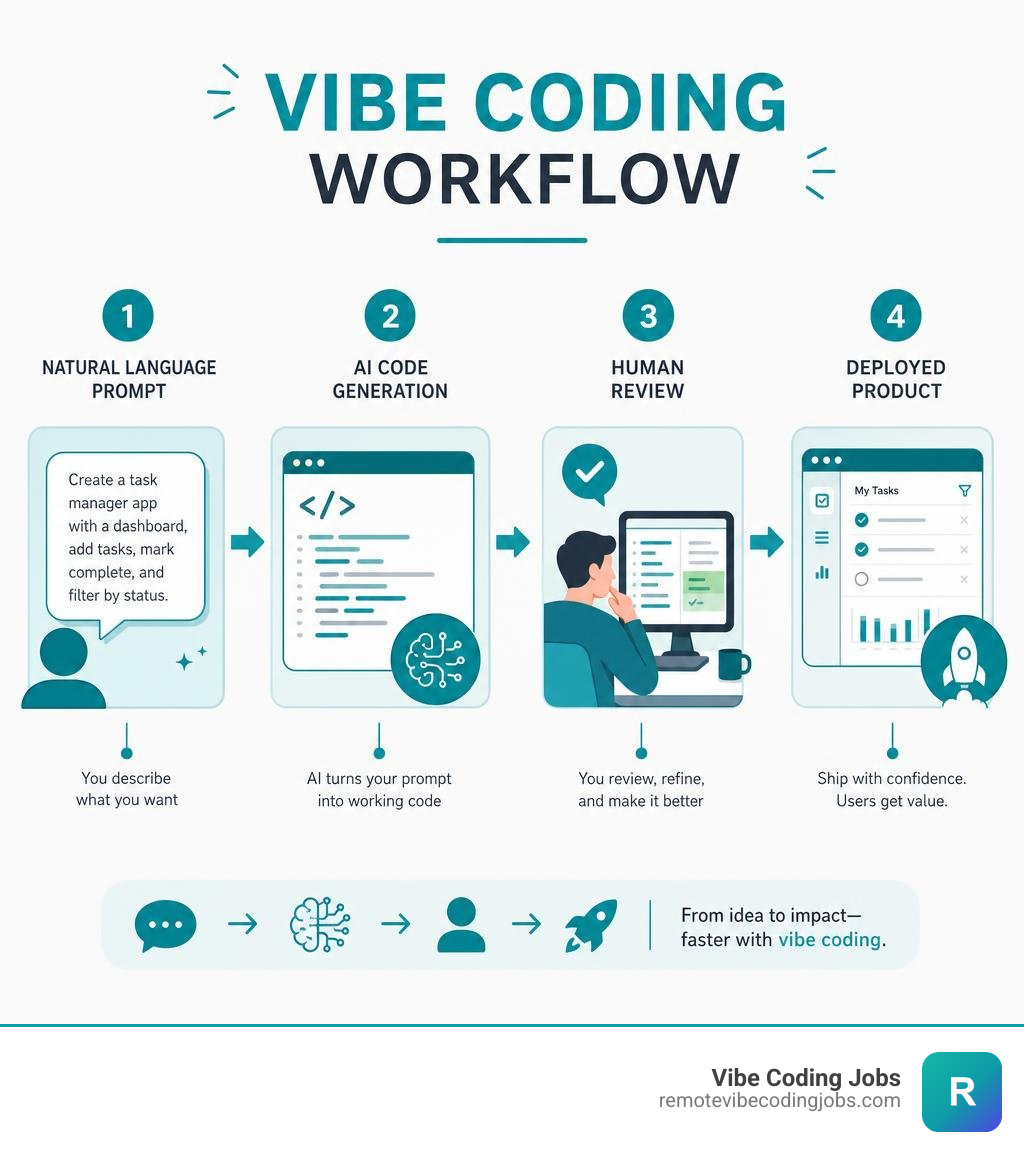
The term itself was coined by AI researcher Andrej Karpathy in February 2025. The idea: instead of manually typing every line of code, you describe what you want in plain language and let AI tools like Cursor, Claude Code, or Bolt.new generate the implementation. You focus on what to build and why — the AI handles the how.
That shift sounds simple. But it’s reshaping who gets hired, what skills matter, and how much developers earn. It’s also sparking real debate about whether this is a durable career path or an over-hyped trend heading for a crash.
This guide cuts through both the hype and the fear to give you a clear picture.
I’m the RVCJ Editorial team — we cover AI-assisted development, remote hiring trends, and career guidance for engineers building with tools like Cursor, Claude, and Copilot, with a specific focus on vibe coder career paths and where they’re heading. We track the remote vibe coding job market daily, so the data and insights here reflect what’s actually happening in hiring right now.
What is Vibe Coding and How Does It Differ From Traditional Development?
To understand where vibe coder career paths are heading, we first need to define what vibe coding actually is — and what it isn’t.
Traditional software development is heavily syntax-driven. Developers spend a significant portion of their day typing code, managing imports, resolving compiler errors, and manually writing boilerplate code. In this model, typing speed and syntax memorization are highly valued.
Vibe coding, on the other hand, shifts the developer’s primary tool from a keyboard typing raw syntax to natural language prompts. Instead of writing a complex React component or a Python backend routing system by hand, a vibe coder describes the desired “vibe,” layout, and functionality to an AI model. The AI then generates, edits, and integrates the code.
This does not mean vibe coders don’t need to understand code. While they aren’t typing every semicolon, they must possess strong software fundamentals to guide the AI, spot logical errors, and ensure the generated code integrates seamlessly into the larger system.
The Shift from Code Typist to Software Architect
As Andrej Karpathy famously pointed out, this shift changes the very nature of software engineering. The modern vibe coder acts less like a construction worker laying individual bricks and more like a general contractor or software architect.
By offloading routine code generation to AI, developers can focus on high-level architecture, user experience, and product design. The job changes from fighting syntax to managing system flow.
Here is how a vibe coder’s daily workflow differs from a traditional developer’s:
- Traditional Developer: Spends 4 hours writing boilerplate API endpoints, 2 hours debugging package dependencies, and 2 hours on system design.
- Vibe Coder (AI-First Developer): Spends 1 hour designing the system architecture, 2 hours prompting AI agents to build and link the endpoints, 3 hours validating and debugging edge cases, and 2 hours refining the user experience.
The Reality of Vibe Coder Career Paths in 2026
If you are looking to transition your career, you are likely asking: Is anyone actually hiring for this?
The answer is a resounding yes. According to our internal tracking data, the market for AI-fluent developers has exploded. By exploring the Vibe Coding Remote Career Path, you can see how companies are actively restructuring their engineering departments around smaller, highly leveraged teams.
This trend isn’t just limited to specialized job boards. If you search for Vibe Coding Jobs on Indeed, you will find an increasing number of mainstream postings seeking candidates who can demonstrate 2x to 5x productivity gains using modern AI toolchains. The geographic distribution of these roles is heavily skewed toward remote work, with 73% of active listings offering fully remote or async-first arrangements.
Salary Expectations Across Vibe Coder Career Paths
Because vibe coders can ship features at a fraction of the traditional time, their market value is incredibly high. Companies are willing to pay a premium for developers who can orchestrate AI tools to deliver products faster.
Based on data from our Vibe Coding Salary Guide, here is what the compensation landscape looks like in June 2026:
- Entry-Level / Junior ($70,000 – $100,000): Often transitioning from other fields, these builders use AI to quickly spin up functional frontends and simple backends.
- Mid-Level ($100,000 – $150,000): Developers who understand architecture and can manage multi-agent workflows to build production-grade applications.
- Senior / Staff ($150,000 – $250,000+): True “orchestrators” who design complex systems, review AI-generated code for security, and maintain the overall mental model of the codebase.
- Freelance / Contract ($100 – $300+/hour): High-end consultants who specialize in rapid prototyping or rescuing legacy codebases that have been poorly patched together by AI.
How to Future-Proof Your Vibe Coder Career Paths
As AI models become more capable, basic prompt engineering is quickly becoming commoditized. To build a lasting career, you must focus on skills that AI cannot easily replicate.
To stay ahead of the curve, focus on developing these high-value skills:
- System Design & Architecture: Understanding how databases, APIs, and frontends talk to each other.
- Validation & Security: Knowing how to audit AI-generated code for potential vulnerabilities and performance bottlenecks.
- Domain Expertise: Combining software building skills with deep industry knowledge (e.g., healthcare, finance, or logistics) to build tools that solve hyper-specific problems.
- Product Thinking: Understanding what users actually want and prioritizing features that drive real business value.
Is Vibe Coding a Sustainable Career or a Doomed Trend?

Despite the impressive salary figures, there is a vocal contingent of skeptics in the engineering community. If you browse tech forums, you will find threads like The vibe coder’s career path is doomed on Hacker News arguing that vibe coding is a short-term trap.
The core argument of the skeptics is simple: AI is excellent at generating the first 80% of an application, but terrible at the last 20%. When an AI-generated codebase grows to tens of thousands of lines of code, it can quickly become an unmaintainable mess of technical debt — a phenomenon some call the “vibe coding hangover.”
Navigating the Complexity Ceiling of AI-Generated Codebases
When you rely entirely on AI to write code, you run the risk of losing the “mental model” of your application. If you don’t understand how the underlying code works, debugging a complex, state-dependent bug becomes nearly impossible.
Furthermore, the testing burden increases exponentially. Because AI can generate hundreds of lines of code in seconds, vibe coders often spend more time writing automated tests and debugging edge cases than they do prompting the model.
To survive in this career path, you must learn to use AI on a short leash. Successful vibe coders do not let AI run autonomously; they review every pull request, maintain rigid documentation, and enforce strict architectural patterns to prevent their codebases from hitting a complexity ceiling.
Essential Skills for Succeeding in Vibe Coder Career Paths

Succeeding as an AI-first developer requires a completely different cognitive toolkit than traditional software engineering.
While a traditional developer might spend years mastering the syntax of C++ or Rust, a vibe coder must master context architecture — the art of structuring project files, rules, and documentation (such as .cursorrules files) so that AI models can generate highly accurate code on the first try.
Additionally, vibe coders must develop strong aesthetic intuition (understanding color, motion, and user narrative) and product thinking to ensure that what they build is actually delightful to use.
Traditional Engineering vs. Vibe Coding Skills
To illustrate the difference in skill sets, let’s look at how traditional engineering requirements compare to modern vibe coding requirements:
| Skill Area | Traditional Software Engineer | Vibe Coder (AI-First Developer) |
|---|---|---|
| Primary Tool | IDE (VS Code, IntelliJ), Terminal | Cursor, Claude Code, Bolt.new, Windsurf |
| Core Coding Languages | TypeScript, Python, Go, Rust (Deep syntax mastery) | TypeScript, Python (Read and validate rather than write from scratch) |
| Problem Solving | Writing custom algorithms and data structures | Prompting, debugging, and system integration |
| Development Speed | Days to weeks per feature | Hours to days per feature |
| Key Bottleneck | Typing speed, syntax errors, boilerplate | Context-window limits, AI hallucinations, testing |
How Companies Hire and Interview for AI-First Roles
The rise of vibe coding has broken the traditional tech interview. Companies are realizing that asking candidates to write sorting algorithms on a whiteboard (LeetCode) is useless when an AI can do it in two seconds.
Instead, progressive companies are adopting live prototyping interviews. In these sessions, you are given a vague product brief and 45 minutes to build a working feature using the AI tools of your choice. Hiring managers are looking at your ability to guide the AI, your debugging strategies, and your high-level engineering judgment.
To prepare for these interviews and stand out in the job market, we highly recommend reading our guide on How to Get a Vibe Coding Job.
Transitioning from Traditional Roles to Vibe Coding
One of the most exciting aspects of the vibe coding revolution is that it lowers the barrier to entry for non-traditional builders. Designers, product managers, and career changers are finding that their domain expertise is a massive advantage.
- Designers can now bypass the engineering bottleneck and implement their designs directly.
- Product Managers can build functional MVPs to test hypotheses without waiting for engineering resources.
- Career Changers can leverage their previous professional experience (e.g., in healthcare, sales, or teaching) to build highly targeted software solutions.
For inspiration, check out this Case Study Career Changer Lands First Tech Job Via Vibe Coding to see how a non-technical builder successfully navigated this transition. If you are ready to start your own journey, follow our step-by-step Career Changer Beginner Path to Vibe Coding in 2026.
Frequently Asked Questions about Vibe Coding Careers
Will vibe coding replace traditional software engineering jobs?
No. Vibe coding is not replacing software engineers; it is evolving the role. While routine coding tasks are being automated, the demand for developers who can design systems, ensure security, and solve complex business problems is higher than ever. It’s not AI replacing developers — it’s developers who use AI replacing those who don’t.
Do I need a computer science degree to become a vibe coder?
Absolutely not. In the vibe coding era, a practical portfolio of live, shipped applications with real users is infinitely more valuable to employers than a university degree.
What are the best AI coding tools to learn in 2026?
The industry standards for professional vibe coding are Cursor (an AI-first code editor) and Claude Code (a terminal-based agent). For rapid web application prototyping, tools like Bolt.new, Windsurf, and Lovable are incredibly popular.
Conclusion
The software development landscape has permanently changed. Vibe coder career paths are not a passing trend — they represent the logical evolution of how humans build software. By offloading syntax to AI and focusing on architecture, product design, and real-world problem solving, developers are becoming more productive than ever before.
At RemoteVibeCodingJobs, we are dedicated to helping you navigate this transition. We curate the best remote, AI-first developer roles at async-first companies that value shipping speed and engineering judgment over traditional credentials.
Ready to take the next step? Learn more about what is vibe coding and start building your AI-first portfolio today!