
Anthropic Life Sciences Jobs: What You Need to Know Before You Apply
Anthropic life sciences jobs sit at one of the most exciting intersections in tech right now: frontier AI models meeting real biological discovery. If you want the quick picture, here it is:
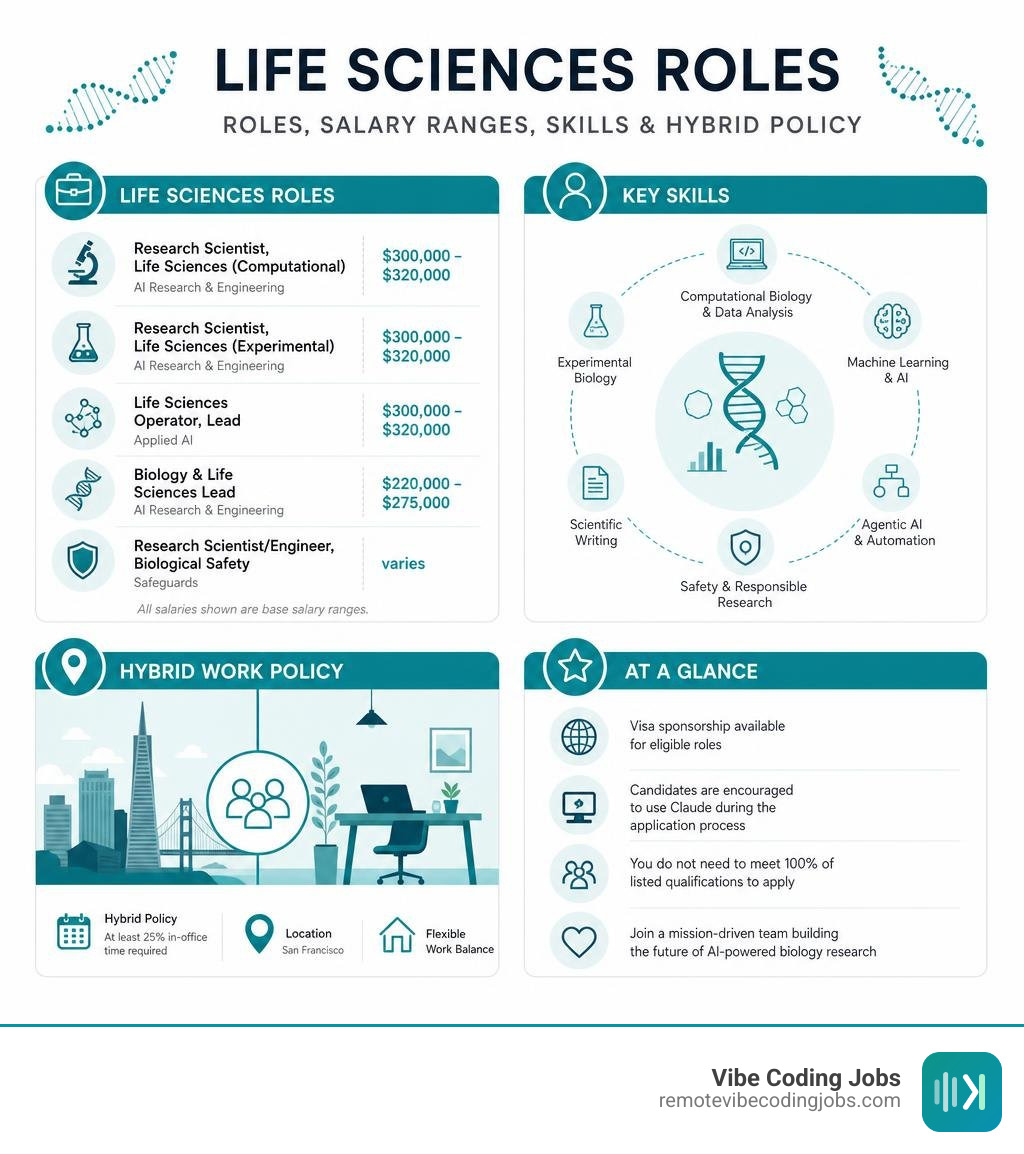
Open Life Sciences Role Categories at Anthropic (July 2026):
| Role | Department | Base Salary |
|---|---|---|
| Research Scientist, Life Sciences (Computational) | AI Research & Engineering | $300,000 – $320,000 |
| Research Scientist, Life Sciences (Experimental) | AI Research & Engineering | $300,000 – $320,000 |
| Life Sciences Operator, Lead | Applied AI | $300,000 – $320,000 |
| Biology & Life Sciences Lead | AI Research & Engineering | $220,000 – $275,000 |
| Research Scientist/Engineer, Biological Safety | Safeguards | varies |
Key facts at a glance:
- All core research roles are based in San Francisco, with a hybrid policy requiring at least 25% in-office time
- Visa sponsorship is available for eligible roles
- Anthropic actively encourages candidates to use Claude during the application process
- You do not need to meet 100% of listed qualifications to apply
Anthropic is hiring founding members for its Life Sciences team — a small, high-impact group whose mission is to turn Claude into a superhuman biology research assistant. This is not a traditional biotech job. It blends wet-lab science, computational biology, LLM post-training, and agentic AI workflows into a single role. The team is building from scratch, which means early hires will shape how AI and biology intersect for years to come.
I’m Dominic Zijlstra, cofounder of Adaptify.ai and a former data scientist and DevOps engineer — and I’ve spent years at the intersection of automated systems and technical hiring landscapes, including tracking Anthropic life sciences jobs as AI-assisted research roles become some of the most competitive in the industry. In the sections below, I’ll break down every role, qualification, and application tip you need to land one.
The Mission of Anthropic Life Sciences Jobs
At its core, Anthropic is structured as a Public Benefit Corporation (PBC). This isn’t just a legal footnote; it fundamentally shapes how we look at scientific breakthroughs and commercialization. The mission of the Life Sciences team is to transition AI from a simple text generator into an active, reliable partner in scientific discovery.
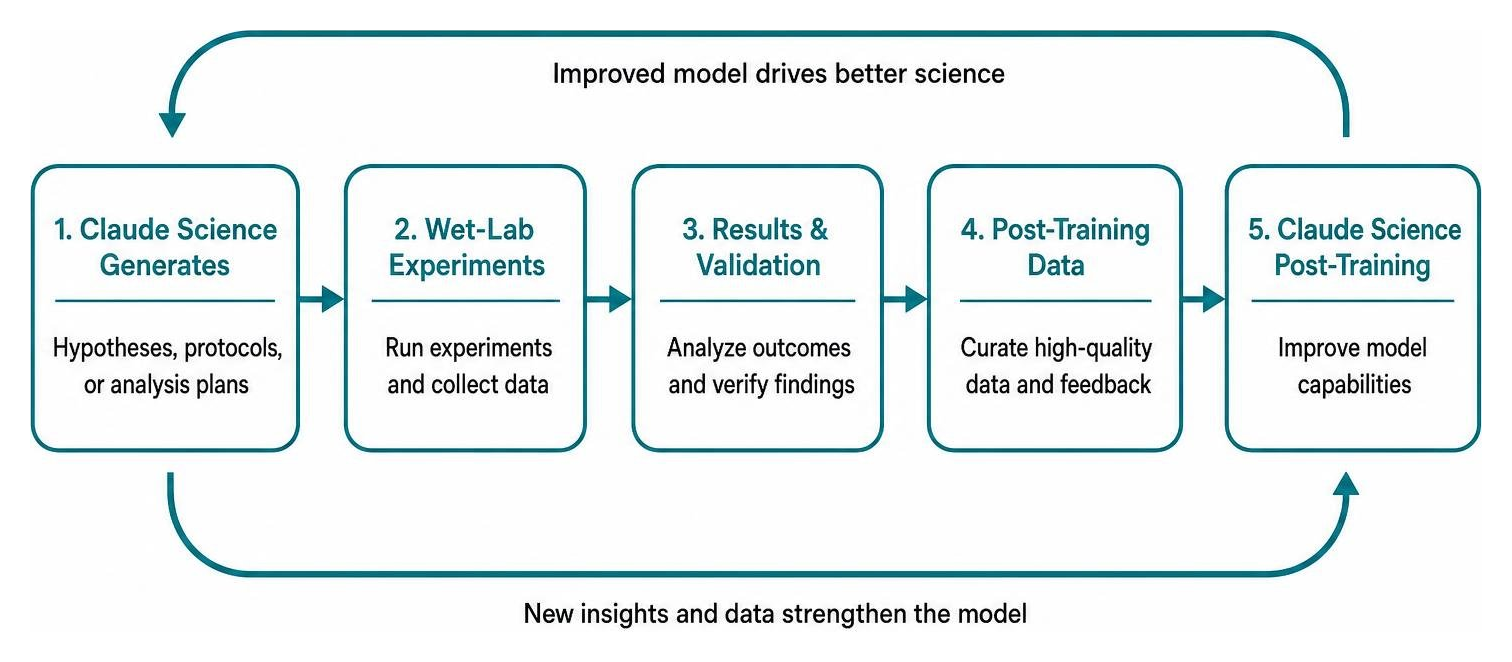
Rather than viewing AI as a pure software engineering exercise, Anthropic treats AI research as an empirical science—much like physics or biology. The goal is to build “Claude Science,” a dedicated AI workbench designed to collapse the traditional research cycle and accelerate therapeutic discoveries. By joining this team, you are not just writing code to optimize click rates; you are helping build a system that can design experiments, run bioinformatics pipelines, and make sense of petabyte-scale biological data.
This approach sits alongside other pioneering organizations in the ecosystem, such as those featured in the BioLM Company Profile, which are pushing the boundaries of biological language models to revolutionize therapeutic design.
Building Claude as a Superhuman Biology Assistant
To turn Claude into a superhuman research assistant, the Life Sciences team focuses on building robust agentic workflows, designing complex evaluation benchmarks, and implementing Reinforcement Learning from Human Feedback (RLHF) specifically tailored for scientific reasoning.
A major focus of these roles is post-training. You will help curate high-quality Supervised Fine-Tuning (SFT) datasets and build reinforcement learning environments that reward models for generating verifiable, accurate scientific hypotheses. The ideal outcome is an AI agent that can query biological databases, execute computational pipelines, interpret complex figures, and write lab protocols with minimal human supervision.
If you are excited about creating these kinds of autonomous, science-focused systems, we recommend you Explore AI-assisted biology roles on RemoteVibeCodingJobs to see how modern developers are using “vibe coding” (AI-assisted development) to build the next generation of scientific applications.
Safeguarding the Frontier of AI and Biotech
With massive capability comes significant responsibility. Because frontier AI models are becoming exceptionally capable at processing biological data, Anthropic places a heavy emphasis on biological safety and the mitigation of bio-harms.
The safeguards division builds specialized biology and chemistry classifiers to monitor and restrict the generation of hazardous materials (such as CBRN-E threats). For example, in models like Fable 5, advanced safety classifiers are deployed to detect potentially harmful queries and automatically trigger safe fallbacks to models like Opus 4.8. Balancing this strict safety posture with high-utility scientific assistance is one of the most critical challenges the team faces.
This focus on safety and precision is mirrored across the industry. For instance, the Revalia Bio Company Profile highlights how modern biotech startups are balancing advanced computational platforms with rigorous safety and experimental validation.
Key Roles and Responsibilities in Anthropic’s Biology Team
The Life Sciences team at Anthropic operates as a founding group bridging wet-lab (hands-on experimental) and dry-lab (computational) environments. It is a highly cross-functional team where traditional boundaries are blurred: researchers do significant engineering work, and engineers frequently act as first authors on scientific publications.

Research Scientist, Life Sciences (Computational)
As a Computational Research Scientist, you will act as the bridge between core machine learning researchers and experimental biologists. This role is highly technical and requires a deep understanding of both computational biology and modern LLM infrastructure.
Key responsibilities include:
- Developing robust bioinformatics pipelines and data infrastructure to handle petabyte-scale sequence, genomic, and proteomic datasets.
- Building agentic tools that allow Claude to interface directly with external biological databases and run computational analyses autonomously.
- Designing and implementing evaluation benchmarks that measure the model’s ability to perform complex biological reasoning.
If this sounds like your area of expertise, you can check out the official Anthropic Research Scientist, Life Sciences (Computational) job listing to learn more about the technical stack and application details.
Research Scientist, Life Sciences (Experimental Biology)
If your strength lies in the physical laboratory but you have a passion for machine learning, the Experimental Biology track is designed for you. This role focuses on translating AI-generated hypotheses into real-world validation.
Key responsibilities include:
- Designing and executing high-throughput functional screens and wet-lab experiments to validate model predictions.
- Partnering directly with computational scientists to ensure that laboratory data is returned fast enough to immediately inform the next round of model training.
- Using Claude and internal agent frameworks to plan experiments, write protocols, and feed failure cases directly back to the model-improvement teams.
To apply or read the full breakdown of this hybrid wet/dry-lab role, view the Research Scientist, Life Sciences (Experimental Biology) @ Anthropic posting or check out the general Research Scientist, Life Sciences at anthropic – United State | Visa Sponsorship Jobs page.
Biology & Life Sciences Lead
The Biology & Life Sciences Lead is a strategic, high-level role responsible for positioning Claude as a global force multiplier for scientific research.
Key responsibilities include:
- Forming and managing strategic partnerships with top-tier pharmaceutical companies, biotech startups, and academic institutions.
- Leading cross-functional research initiatives that combine LLM capabilities with cutting-edge drug discovery pipelines.
- Translating high-level scientific needs into concrete engineering and training objectives for the AI research teams.
This leadership role aligns closely with the work being done at companies like Insilico Medicine, which you can read about in our Insilico Medicine Company Profile, where AI is integrated directly into end-to-end drug discovery.
Life Sciences Operator, Lead
The Operator Lead is an execution-focused role designed for individuals with an entrepreneurial, startup mindset who know how to bring complex projects across the finish line.
Key responsibilities include:
- Managing the day-to-day operations of cross-functional life sciences projects, ensuring tight alignment between research, engineering, and product teams.
- Translating ambiguous scientific questions into highly structured, testable research plans with clear milestones.
- Utilizing Claude Science to explore therapeutic hypotheses and streamline operational workflows.
If you have a strong track record of taking ideas from concept to results in a biotechnology setting, you can find the application page at the Job Application for Life Sciences Operator, Lead at Anthropic.
Qualifications and Skills for Anthropic Life Sciences Jobs
Anthropic looks for a rare mix of deep domain expertise and computational fluency. However, they explicitly state that about half of their technical staff had no prior machine learning experience before joining. What they care about most is your demonstrated ability to solve hard empirical problems and your capacity to learn quickly.

Technical Requirements for Anthropic Life Sciences Jobs
While a PhD in molecular biology, computational biology, bioinformatics, genomics, or computer science is highly preferred for research roles, practical capability is the ultimate metric.
Key technical competencies include:
- Programming & ML Fluency: Strong proficiency in Python and familiarity with standard machine learning development practices. You should be comfortable writing clean, maintainable code to orchestrate pipelines.
- Biological Databases: Deep familiarity with major biological databases (such as UniProt, PDB, Ensembl, and NCBI), including their data schemas, API access methods, and common failure modes.
- LLM Post-Training: Experience or strong theoretical knowledge of Supervised Fine-Tuning (SFT) data curation, Reinforcement Learning from Human Feedback (RLHF), and RL from verifiable rewards.
This combination of biological knowledge and agentic software development is highly sought after. For a practical example of how these skills are applied to real-world healthcare products, take a look at the C the Signs Lead Senior AI Developer (Agentic Healthcare Application) job profile.
Mindset and Culture Fit
Anthropic’s company culture is built on several core principles that guide how team members collaborate:
- Act for the Global Good: We prioritize the long-term societal impact and safety of our models over short-term commercial gains.
- Hold Light and Shade: We maintain a realistic, nuanced view of AI—celebrating its massive potential while remaining deeply clear-eyed about its risks.
- “Big Science” Approach: We believe the highest-impact breakthroughs come from single, highly cohesive teams working together on large-scale efforts, rather than fragmented individual projects.
- Simplicity First: We don’t build a spaceship if a bicycle does the job. We value simple, elegant solutions that work and iterate from there.
This balance of mission-driven alignment and deep technical execution is common among high-performing AI teams. You can see similar expectations outlined in the Medfar Clinical Solutions Generative AI Prompt Engineer Job description.
Compensation, Benefits, and Hybrid Work Policy
Anthropic offers some of the most competitive compensation and benefits packages in the AI industry, backed by total funding of $180.2B, including a massive $13.0B Series F round led by Lightspeed Venture Partners in 2025.
Salary Ranges and Equity Packages
Because Anthropic values top-tier talent, they offer highly transparent, top-of-market base salaries along with generous equity packages:
- Research Scientist (Computational / Experimental): $300,000 – $320,000 USD per year.
- Life Sciences Operator, Lead: $300,000 – $320,000 USD per year.
- Biology & Life Sciences Lead: $220,000 – $275,000 USD per year.
In addition to base salary and equity, Anthropic provides an exceptional suite of benefits:
- 22 weeks of fully paid parental leave.
- A $500/month flexible wellness and “time saver” stipend.
- Comprehensive health, dental, and vision insurance with 100% premium coverage for employees and their dependents.
Hybrid Work and Office Logistics
Most of Anthropic’s workforce is concentrated in the San Francisco Bay Area. For core life sciences roles:
- In-Office Policy: Staff are expected to work from the San Francisco office at least 25% of the time (typically 3 days a week).
- Visa & Relocation Support: Anthropic actively sponsors visas and green cards for eligible roles and retains dedicated immigration counsel to assist international candidates. They also provide comprehensive relocation packages if you are moving to the Bay Area.
Frequently Asked Questions about Anthropic Life Sciences Jobs
What is the interview process for anthropic life sciences jobs?
The interview process at Anthropic is designed to evaluate practical capability and collaborative fit rather than rote memorization.
- Initial Screen: A review of your resume and a brief conversation with a recruiter to discuss your background and alignment with Anthropic’s mission.
- Technical Assessment: This typically involves live coding and system design sessions using tools like Google Colab, CodeSignal, or Google Meet. You will be evaluated on your comfort with basic Python syntax, standard libraries, and your ability to design robust computational pipelines.
- Domain-Specific Interviews: Deep-dive discussions about your past biological research, experimental designs, or computational work.
- Culture & Alignment Fit: Conversations focused on Anthropic’s core values, ethical considerations in biological AI, and how you collaborate in cross-functional teams.
Does Anthropic offer visa sponsorship for biology roles?
Yes. Anthropic recognizes that top-tier scientific talent is global. They sponsor visas (including H-1B transfers, O-1, etc.) and green cards for eligible roles, working alongside specialized immigration attorneys to streamline the transition.
Can I use Claude during the job application process?
Absolutely! In fact, Anthropic explicitly encourages candidates to collaborate thoughtfully with Claude during the application process. Utilizing Claude to help draft your resume, refine your application essays (such as the highly valued 200-400 word “Why Anthropic?” response), or prepare for technical scenarios is seen as a great way to demonstrate your practical AI-assisted workflow skills.
Conclusion
The expansion of anthropic life sciences jobs represents a massive shift in how biological research is conducted. By joining this founding team, you have the unique opportunity to build the tools that will shape the future of medicine, genomics, and global biological safety.
If you are looking for roles where you can build with AI, write clean code, and solve meaningful real-world problems, we are here to help. At RemoteVibeCodingJobs, we aggregate the best remote-friendly “vibe coding” and AI-assisted engineering jobs, curated daily by tech stack, culture, and AI tool integrations.
To take the next step in your career at the intersection of AI and biology, Explore curated AI and biology roles on RemoteVibeCodingJobs and find your perfect fit today!