Where Can You Find the Best Playbooks and Guides for AI-Assisted Development Roles?
Open-Source Career Planners and Frameworks
When navigating a seismic shift in the tech industry, traditional career advice quickly becomes obsolete. In June 2026, the most effective roadmaps aren’t found in outdated textbooks or generic career blogs; they are built by the open-source community. If you want to systematically transition from a traditional software engineer to a high-leverage AI orchestrator, you need a programmatic framework.
One of the most powerful tools available today is the ayush488-glitch/ai-career-planner-skill . This open-source resource is designed as a custom “skill” that runs directly inside Claude Code. Instead of giving you generic advice, it acts as an interactive, brutally honest AI career coach. By asking you fifteen targeted questions across three diagnostic rounds, it generates a fully personalized, week-by-week 6-month career plan tailored to your exact skillset, target salary, and available hours.
This career planner operates on a highly structured 5-step framework:
- Architecture-Level Understanding: True AI orchestration requires moving past simple API calls (which we call Layer 3 execution). You must master modern three-layer AI systems, which include Layer 1 (machine learning model predictions) and Layer 2 (deterministic verification and decision logic).
- The Skill Value Formula: The planner evaluates your skills using a strict economic equation: $$\text{Skill Value} = (\text{Revenue Generated} + \text{Time Saved}) \times \text{Scarcity}$$ To land a high-paying remote role, you must focus on building workflows that directly impact a company’s bottom line while remaining scarce in the talent market.
- Visibility > Ability: In a remote-first world, technical capability is only half the battle. You need at least 50 key decision-makers in your target niche to know your name. The planner outlines a daily routine of sending 25 tailored LinkedIn connections (aiming for 800 per month) and publishing high-signal content.
- The Outreach Machine: Programmatic cold outreach is prioritized over passively submitting resumes to applicant tracking systems (ATS). The planner teaches a high-conversion, 3-step direct messaging framework: Callout → Value → Micro-commitment.
- Reading Research Papers: To stay ahead of the rapid pace of AI development, the framework mandates reading one AI research paper per week. By focusing specifically on the “limitations” section of newly published papers, you get a direct preview of the engineering problems that companies will pay you to solve six months from now.
By shifting your mindset from writing manual syntax to orchestrating these complex systems, you position yourself as a high-value asset in the remote job market.
Specialized Vibe Coding Playbooks
The term “vibe coding” has evolved from a developer meme into a highly respected, professional discipline. Far from being a lazy approach to development, professional vibe coding is the art of directing autonomous AI agents to handle boilerplate, syntax, and routine debugging, freeing up human engineers to focus on system design, data architecture, and business logic.
To transition successfully into this space, you need playbooks that bridge the gap between basic prompt engineering and professional systems architecture. Our own Remote Vibe Coding Jobs Guide serves as a comprehensive manual for this transition. It defines the exact operational standards required to manage AI agents at scale without letting codebases drift into architectural chaos.
To successfully navigate this path, we recommend exploring the Vibe Coding Remote Career Path: Opportunities and reading up on the Vibe Coding Remote Jobs: Career Path Outlook & Tips. These guides emphasize that the modern developer’s value is no longer measured by how many lines of code they can type per hour, but by how effectively they can direct, audit, and verify the output of autonomous AI systems.
How Do AI Tools Like Claude Code and Cursor Change Remote Developer Skill Requirements?
The Shift from Writing Code to Directing Code
The day-to-day reality of software engineering has changed fundamentally. Manual syntax writing is rapidly becoming a commodity. Instead, remote developers are expected to act as directors, editors, and auditors of AI-generated code.
To put this shift into perspective, consider the latest 2026 industry statistics: Claude Code alone authors 4% of all global GitHub commits, and that number is projected to skyrocket to 20% by the end of 2026. At Anthropic, engineering productivity has surged by 200% since the internal adoption of Claude Code, and 100% of pull requests are reviewed by Claude before a human engineer ever lays eyes on them.
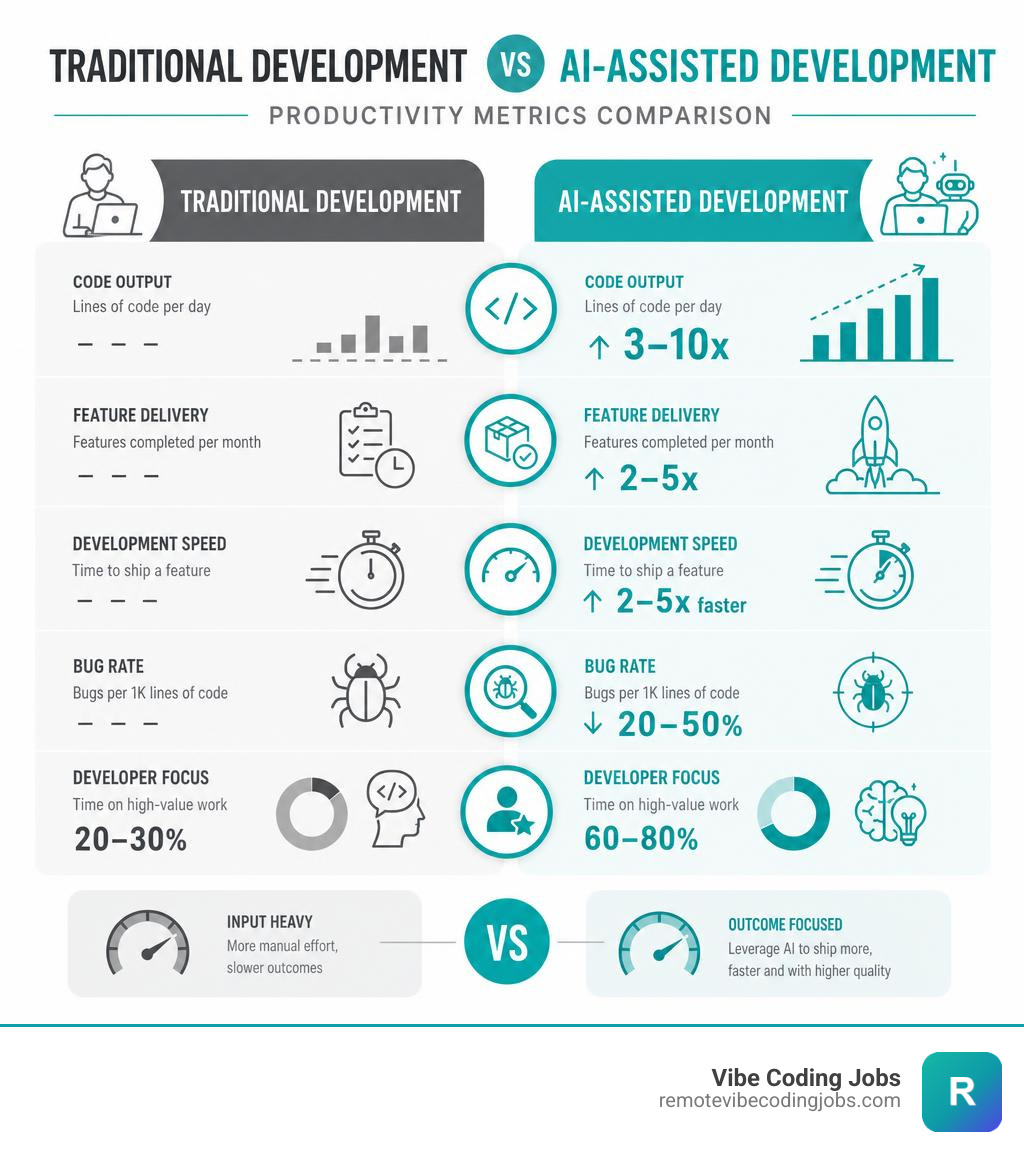
This means that to stand out to remote employers, you must shift your focus from raw coding speed to high-level system design and verification. High-leverage skills now include:
- Prompt Discipline: Writing explicit, unambiguous instructions that prevent AI models from hallucinating or generating redundant code.
- AI-Assisted Architecture: Designing modular, loosely coupled systems that are easy for AI agents to navigate and modify.
- Agent Orchestration: Running multiple AI agents in parallel to handle different parts of a codebase simultaneously.
For a deeper look at how to position these skills, check out our guide on How to Land Remote Vibe Coding Job: Skills & Tips.
Mastering the AI Operator Tech Stack
To remain competitive in 2026, you must master a new suite of tools designed for agentic workflows. It is no longer enough to use basic autocomplete extensions; you must understand how to leverage fully autonomous coding agents.
The modern AI operator’s toolkit includes:
- Claude Code: A command-line tool and agent that can autonomously read entire codebases, run terminal commands, execute tests, and edit files across a project.
- Cursor: A popular fork of VS Code that features advanced multi-file editing (Composer mode) and deep codebase indexing.
- GitHub Copilot: A reliable tool for inline autocomplete and quick unit test generation.
- OpenClaw: An open-source, highly autonomous personal AI agent. Unlike standard IDE extensions, OpenClaw can run locally (often on a dedicated machine like an isolated Mac Mini or VPS to protect sensitive data), execute scheduled tasks via cron jobs with a 30-minute heartbeat, and maintain its identity and rules through structured Markdown files (
AGENTS.md,SOUL.md,IDENTITY.md).
| Tool Category | Key Examples | Primary Function | Autonomy Level | Typical Use Case |
|---|---|---|---|---|
| Autocomplete Tools | GitHub Copilot, basic IDE extensions | Real-time inline code completion and syntax suggestions. | Low (reactive) | Writing repetitive boilerplate, quick function drafting, and inline documentation. |
| Agentic IDEs | Cursor, Windsurf | Multi-file codebase editing, indexing, and interactive chat. | Medium (collaborative) | Refactoring existing modules, generating new features, and debugging complex errors. |
| Autonomous CLI Agents | Claude Code | Reads codebases, runs terminal commands, executes tests, and edits files autonomously. | High (proactive) | End-to-end task execution, automated test suite runs, and codebase-wide refactoring. |
| Personal Workflow Agents | OpenClaw | Runs scheduled tasks, manages APIs, and automates administrative and development workflows. | High (always-on) | Scraping job boards, running daily codebase health checks, and managing notifications. |
A key technical differentiator for developers in 2026 is their understanding of the Model Context Protocol (MCP). MCP is an open standard that allows AI models to securely connect to external data sources and tools. By setting up MCP servers, you can connect your AI agents directly to databases, GitHub repositories, Slack channels, and internal APIs, allowing them to perform complex, multi-step actions with real-time context.
How Can You Build a Remote-Friendly Portfolio That Showcases Your AI-Assisted Development Capabilities?
Documenting Your AI-Augmented Workflows
Traditional PDF resumes and generic portfolio websites do very little to prove your value to modern remote employers. In 2026, hiring managers are highly skeptical of standard portfolios because they know how easily a candidate can use AI to copy-paste a functional application. To stand out, your portfolio must document how you built the project, not just the finished product.
We outline this modern approach to proof-of-work in our guide on How to Get a Vibe Coding Job: Skills, Portfolio & Networking. One of the most effective ways to show your AI-assisted development maturity is by including a structured CLAUDE.md file in the root of your GitHub repositories.
A CLAUDE.md file acts as a persistent instruction manual for AI agents working on your codebase. It should contain:
- Clear build, test, and run commands.
- Code style guidelines and architectural patterns (e.g., “We use strict TypeScript and functional components”).
- Specific rules for the AI (e.g., “Always run the test suite using
npm testbefore declaring a task complete”).

When a remote hiring manager opens your repository and sees a well-maintained CLAUDE.md alongside comprehensive system architecture diagrams, they immediately see that you know how to establish professional guardrails for AI-assisted workflows.
Building High-Signal Proof of Work
To build a truly compelling portfolio, avoid generic todo apps or basic weather APIs. Instead, focus on building high-signal starter project blueprints that demonstrate real-world utility:
- API-Connected Data Dashboards: Build a system that pulls data from multiple third-party APIs, processes it, and displays it in a clean dashboard.
- CLI Automation Tools: Create command-line utilities that automate repetitive developer workflows, such as parsing logs or formatting database exports.
- Multi-Agent Systems: Build a project where multiple AI agents communicate with each other to complete a complex task (for example, one agent scraping data, another organizing it, and a third drafting a summary).
In these projects, make sure to highlight your verification standards. Show that you don’t just accept AI-generated code blindly. Document how you audit the code for security vulnerabilities (like SQL injection or cross-site scripting) and how you optimize performance.
You should also demonstrate parallel agent workflows and autonomous loops. Show how you safely run multiple agent sessions simultaneously—using Git worktrees to prevent file conflicts—and explain the safety guardrails you put in place to prevent autonomous loops from running indefinitely and running up massive token costs.
How Can You Use AI Tools to Accelerate Your Remote Job Search?
AI-Powered Resume Tailoring and Outreach
The sheer volume of applications for remote positions has made job hunting incredibly competitive. To stand out, you must apply to roles quickly while maintaining a high level of personalization. This is where AI tools can act as a force multiplier, provided you use them correctly.
Smart candidates do not use AI as a ghostwriter to generate generic, robotic resumes and cover letters. Instead, they treat AI as a highly capable research assistant and editor. For a detailed breakdown of this approach, read our guide on How to Use AI Tools to Speed Up Your Remote Job Search.
To optimize your job search workflow, we recommend using a combination of tools:
- Perplexity or Gemini for Research: Spend 5-10 minutes researching your target company’s recent funding rounds, product launches, and engineering pain points.
- Claude or ChatGPT for Tailoring: Paste the job description and your base resume into the AI. Ask it to run a keyword gap analysis and suggest specific bullet points that highlight your relevant achievements using metrics (e.g., “Reduced page load time by 40%”).
- Human Editing for Cover Letters: Use AI to draft the structure of your cover letter, but always rewrite the opening and closing lines in your own genuine, human voice.
For more tips on navigating this process, explore our advice on Vibe Coding Career: Remote Jobs, Benefits & Application Tips.
Building Autonomous Job-Hunting Agents
If you want to take your job search to the absolute limit of efficiency, you can build a self-improving AI agent that automates the entire process of finding, scoring, and organizing job listings.
By leveraging the open-source CoinDiva/ai-job-search-agent , you can set up a repeatable, prompt-driven workflow that runs in ChatGPT, Claude, or Gemini. This agent utilizes a weighted scoring rubric to evaluate job descriptions based on your specific criteria:
- Role Alignment (25 points): Does the role match your target title and responsibilities?
- Transferable Experience (20 points): Do your skills align with the core requirements?
- AI Readiness Match (15 points): Does the company actively support or utilize AI-assisted development?
The agent automatically applies penalties for roles that require heavy, manual low-level coding or traditional ML model building if you are targeting business-side or high-level orchestration roles. It then categorizes each job into action-oriented recommendation bands:
- 85-100: APPLY NOW
- 70-84: STRONG APPLY
- 55-69: STRETCH APPLY
- <55: SKIP
To feed this agent daily listings, you can build a custom scraper using Playwright (for handling authenticated sessions on sites like LinkedIn) or Firecrawl (for fast, clean markdown extraction from public job boards). By connecting this scraper to an email service, you can receive a curated, ranked digest of highly aligned remote positions in your inbox every single morning.
How Do Remote Companies Evaluate Candidates Who Use AI Tools Extensively?
The Modern Vetting Framework in 2026
Because AI tools have made it incredibly easy to generate applications, remote hiring managers are flooded with low-effort, AI-written resumes. In fact, 74% of hiring managers say they can easily spot entirely AI-generated applications, and many will reject them outright to save time.
To separate high-leverage AI operators from candidates who are simply copy-pasting code, forward-thinking remote companies have completely overhauled their vetting processes. We track these shifting industry standards closely in our analysis of Remote Vibe Coding Jobs: Career Market Growth.
Instead of traditional LeetCode tests or static PDF resume reviews, the modern vetting framework focuses on:
- AI-Code Literacy Assessments: You will be given an AI-generated codebase that contains intentional architectural flaws, security vulnerabilities, or performance bottlenecks. Your task is to audit the code, identify the issues, and direct an AI agent to fix them correctly.
- Architectural Thinking: Interviewers will ask you to design a complex system on a virtual whiteboard, evaluating your ability to structure data flows and define clean API boundaries.
- High-Signal Communication: Remote teams operate asynchronously. Employers will evaluate how clearly you can explain technical concepts. A common practice in 2026 is asking candidates to record a short, 2-minute Loom video explaining a pull request, demonstrating that they deeply understand the system design rather than just the code the AI generated.
Measuring Business Impact Over Active Hours
The traditional model of tracking active working hours or keyboard activity is dead at progressive, async-first remote companies. When a single AI-augmented developer can operate at a 200% productivity increase, measuring “time spent at desk” makes no economic sense.
Instead, modern remote engineering teams focus entirely on output and business impact. They track metrics such as:
- Cycle Time: How quickly a feature goes from an approved design to production.
- PR Throughput: The volume of high-quality, verified pull requests shipped.
- Code Quality and Stability: The frequency of bugs or regressions introduced into production.
Remote employers recognize that a highly skilled team of 5 AI-augmented developers can deliver the output of 8 traditional developers. This massive efficiency gain allows smaller, agile teams to scale rapidly. To find remote companies that actively embrace this philosophy, you must look for organizations with an async-first culture that explicitly list tools like Cursor, Claude Code, or Windsurf in their engineering stack.
What Are the Most Common Questions About AI-Assisted Remote Jobs?
Can non-technical professionals or career switchers leverage AI to land remote development roles?
Absolutely. One of the most exciting aspects of the AI-assisted development revolution is that it fundamentally democratizes software creation. By removing the steep barrier of learning complex syntax and debugging obscure compiler errors, AI allows non-technical professionals and career switchers to build fully functional software.
However, this does not mean that technical skills are completely irrelevant. Instead, the required skillset has shifted. Success in this new landscape requires:
- Systems Thinking: Understanding how different parts of an application (frontend, backend, database, APIs) interact with each other.
- Domain Expertise: Bringing deep industry knowledge (such as finance, healthcare, or marketing) to build software that solves real, specific business problems.
- Workflow Customization: Knowing how to set up and customize AI agents to automate specific tasks within a business.
If you are a career switcher, we highly recommend reading our comprehensive guides on How to Get a Vibe Coding Job: Skills, Training & Mentorship and How to Get Vibe Coding Job: Skills, Courses, Networking & Coaching. These resources will help you map your existing non-technical expertise to the high-leverage world of AI orchestration.
What common pitfalls should developers avoid when positioning themselves as AI-augmented professionals?
While positioning yourself as an AI-augmented developer is highly lucrative, there are several critical pitfalls that can destroy your credibility with remote employers:
- Relying on Unedited AI Output: Submitting code, resumes, or cover letters that contain obvious AI patterns (such as repetitive phrasing, generic structures, or hallucinated facts) is an immediate red flag. Always review, edit, and personalize every output.
- Failing to Verify Security and Architecture: AI models are excellent at generating boilerplate, but they often struggle with long-term architectural planning and security best practices. If you ship AI-generated code without auditing it, you risk introducing critical security vulnerabilities or “architectural drift” into the codebase.
- Over-Promising on Capabilities: It is easy to assume that because an AI agent can build a simple prototype in ten minutes, you can deliver a massive enterprise system in a week. Always maintain realistic timelines and ensure you have the human oversight necessary to deliver production-grade software.
Where can I find curated remote jobs that specifically welcome AI-assisted development?
Most traditional job boards are still catching up to the AI-assisted development wave. They are flooded with traditional job descriptions that require manual coding tests and don’t mention modern AI tools.
We built RemoteVibeCodingJobs to solve this exact problem. We aggregate remote “vibe coding” and AI-assisted development jobs at progressive, async-first companies.

Our platform offers:
- Curated Daily Listings: Every job is manually vetted and filtered by remote culture, tech stack, and accepted AI tools (like Cursor, Claude Code, and Copilot).
- Free Playbooks: Access to highly practical guides and resources to help you optimize your portfolio and resume.
- Fast Applications: Direct links to apply to companies that actively value AI-driven productivity and high-leverage engineering.
How Can You Take the Next Step Toward Your AI-Assisted Remote Career?
The remote software engineering landscape has changed forever. In June 2026, the developers who thrive are not those who resist AI, but those who embrace it as a powerful collaborative partner. By mastering tools like Claude Code, Cursor, and OpenClaw, and by documenting your workflows transparently, you can position yourself at the absolute forefront of this industry.
To help you take the next step, we recommend reading our deep dive on Vibe Coding Remote Jobs: Benefits, Growth & Success to understand the long-term career outlook of this rapidly growing market.
Once you are ready to start applying:
- Optimize your portfolio by adding a
CLAUDE.mdfile to your primary GitHub repositories. - Set up your job-hunting agent using the open-source templates we discussed.
- Explore curated remote roles that actively welcome AI-assisted development at Vibe Coding Jobs.
The opportunities are out there—it’s time to build your playbook, leverage your AI tools, and land your next remote role.