
AI Machine Learning Jobs That Won’t Be Replaced by Robots
The 2026 AI Job Market: More Opportunity Than Ever (If You Know Where to Look)
AI machine learning jobs are one of the fastest-growing segments in tech right now, with over 101,000 active openings in the US alone — and nearly 14,000 new roles posted every single day.
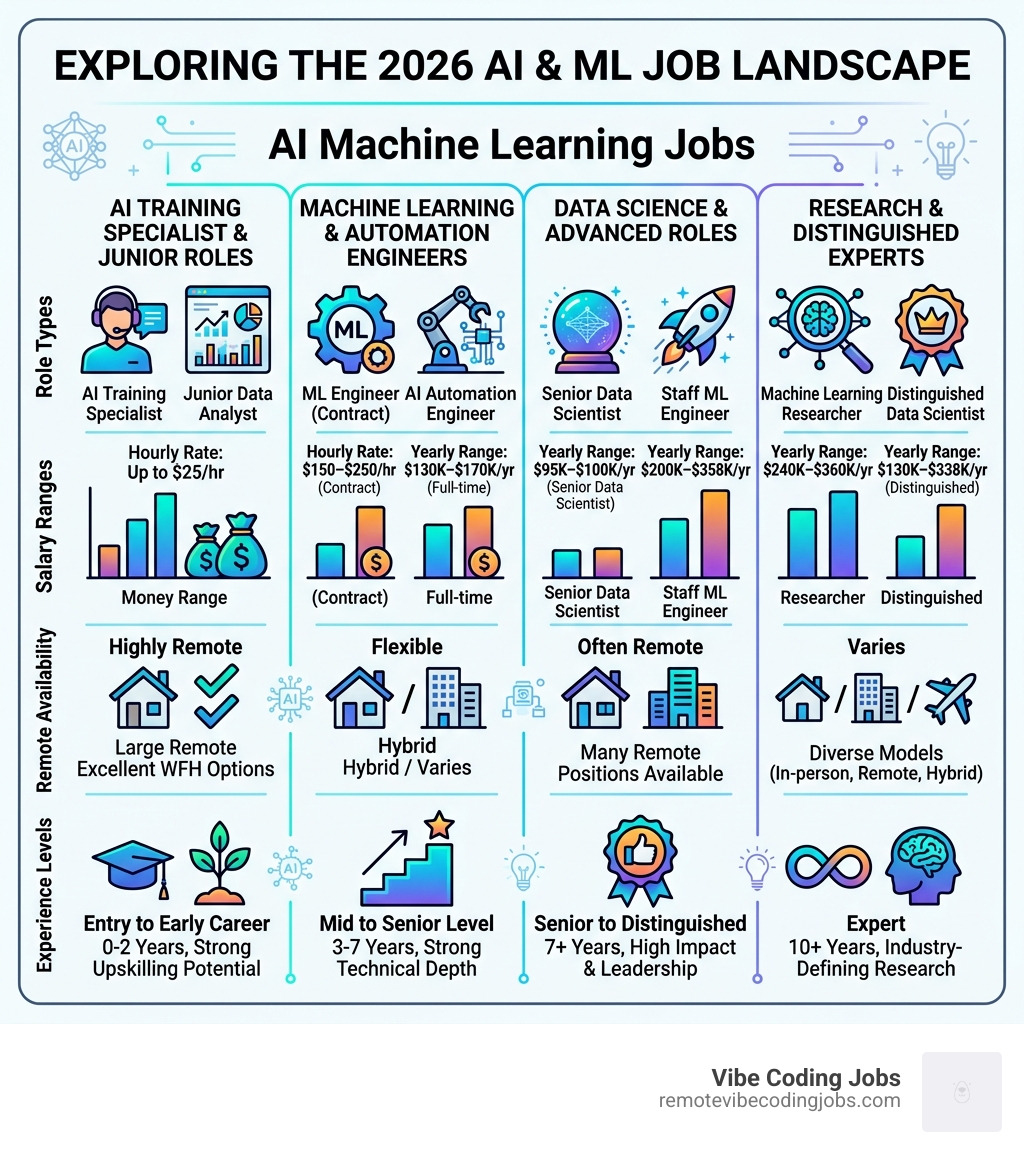
Here’s a quick snapshot of what’s available in 2026:
| Role | Typical Salary Range | Remote? |
|---|---|---|
| AI Training Specialist | Up to $25/hr | Yes |
| ML Engineer (Contract) | $150–$250/hr | Yes |
| Senior Data Scientist | $95K–$100K/yr | Often |
| AI Automation Engineer | $130K–$170K/yr | Hybrid |
| Senior ML Engineer (Salesforce) | $163K–$224K/yr | Hybrid |
| Machine Learning Researcher | $240K–$360K/yr | Varies |
| Staff ML Engineer | $200K–$358K/yr | Yes |
| Distinguished Data Scientist | $130K–$338K/yr | Hybrid |
The field spans everything from flexible, remote AI training gigs to six-figure senior engineering roles at companies like Microsoft, Apple, Walmart, and Salesforce. And despite fears about automation, the humans building and guiding these systems are more in demand than ever.
That said, breaking in — especially at the entry level — isn’t simple. Many “entry-level” listings quietly ask for 2–3 years of professional experience. Competition is fierce, and the skill bar is rising fast with new demands around agentic AI, LLMs, and tools like Cursor and Claude Code.
This guide cuts through the noise. Whether you’re looking for your first AI role or ready to level up, you’ll find exactly what the market looks like right now and how to position yourself for it.
Written by RVCJ Editorial, the team behind Remote Vibe Coding Jobs — we track and curate remote ai machine learning jobs daily, with a focus on async-first teams and AI-native engineering workflows. We’ve analyzed thousands of active job listings, salary data, and hiring trends so you can skip the research and get straight to applying.
High-Demand AI Machine Learning Jobs in 2026

As we move through 2026, the landscape of ai machine learning jobs has shifted from experimental research to production-grade implementation. Companies aren’t just looking for people who can build a model; they want engineers who can integrate that model into a complex, living product.
Current demand is concentrated in three main areas:
- Core Infrastructure: Building the pipelines that allow AI to run at scale.
- Applied Research: Taking new papers and turning them into features for users.
- Agentic Systems: The newest frontier, where AI doesn’t just answer questions but performs multi-step tasks autonomously.
Browse AI/ML job listings on RemoteVibeCodingJobs to see these roles in action, or check out our Machine Learning market trends and insights for deeper dives into which sectors are hiring fastest.
The Rise of the Agentic AI Engineer
The “hot” role of 2026 is undoubtedly the Agentic AI Engineer. Unlike traditional ML engineers who might focus on a single classification model, an Agentic AI Engineer builds systems capable of reasoning, planning, and using tools.
We’re seeing senior leadership roles emerge in this space too, such as the Quillbot Senior Director of AI R&D. These roles require a deep understanding of autonomous agents and workflow orchestration—using frameworks like LangChain, LangGraph, or CrewAI to manage how different AI “agents” talk to each other to solve a problem. It’s less about “coding a function” and more about “architecting a brain.”
Specialized Roles in AI Training and Research
Not every AI role requires a PhD in Mathematics. We’ve seen a massive surge in “AI Training” positions. For instance, a DataAnnotation AI Trainer or an AI Training Specialist can earn up to $25–$50 per hour helping models understand nuance, tone, and factual correctness.
On the more technical side, companies like Apple and Microsoft are aggressively hiring for:
- Natural Language Processing (NLP): Focusing on machine translation and named entity recognition.
- Computer Vision: Essential for everything from autonomous driving to retail visual inspection.
- Deep Learning Research: Pushing the boundaries of what transformer-based architectures can do with billions of parameters.
Salary Benchmarks for AI Machine Learning Jobs
The compensation for ai machine learning jobs remains among the highest in the global economy. In 2026, the “AI premium” is real, reflecting the scarcity of talent capable of shipping production-ready systems.
For a detailed breakdown of what you should be asking for, visit our AI/ML Salary Data page. Beyond base salary, total compensation packages in this field often include significant equity (RSUs), performance bonuses, and comprehensive benefits like 401(k) matching and unlimited PTO.
Entry-Level vs. Senior AI Machine Learning Jobs
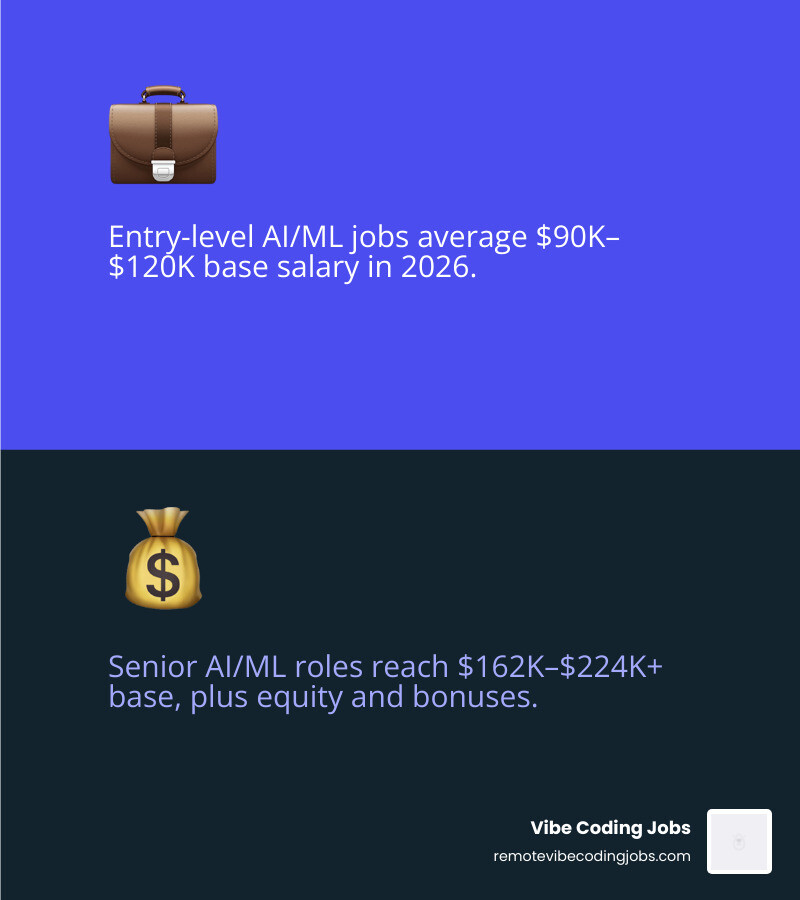
The gap between entry-level and senior pay is widening. A junior role might start in the $90,000–$120,000 range, but senior positions quickly escalate. For example:
- Salesforce Senior ML Engineer: Base salaries typically range from $162,800 to $223,900, often reaching higher in tech hubs like San Francisco or New York.
- Microsoft Senior Applied Scientist: We see Senior Applied Scientist Salary Benchmarks ranging from $120,000 up to $258,000 depending on the specific team and location.
At the “Staff” or “Principal” level, salaries often exceed $300,000, with total packages (including equity) sometimes crossing the $500,000 mark at major labs.
High-Paying Contract and Freelance Opportunities
If you prefer flexibility over a 9-to-5, the contract market is booming. Specialized Remote AI Talent Rates for ML Engineers can range from $150 to $250 per hour.
Freelance “vibe coders” (developers using AI-first tools) are also carving out a niche, charging $75–$150 per hour for rapid prototyping. This project-based work is perfect for engineers who want to work on diverse tech stacks without being tied to a single corporate roadmap.
Essential Skills and Qualifications for the AI Era

The barrier to entry for ai machine learning jobs has changed. While Python, PyTorch, and TensorFlow remain the “holy trinity” of the tech stack, the way we use them has evolved.
If you’re just starting, our Entry Level Remote AI Coding Guide is a great place to map out your learning path. You’ll need to master:
- Core Languages: Python is non-negotiable; C++ or Rust are increasingly popular for “Edge AI” and performance-critical systems.
- Cloud/MLOps: Experience with AWS SageMaker, Azure ML, or Kubernetes for deploying and monitoring models.
- Data Engineering: The ability to build clean RAG (Retrieval-Augmented Generation) pipelines and manage vector databases.
Mastering Vibe Coding and AI-Assisted Development
At RemoteVibeCodingJobs, we advocate for “vibe coding”—a methodology where you use natural language prompts and AI-native tools like Cursor and Claude Code to build software at 10x speed.
Companies like Grafana Labs and Alignerr are now explicitly looking for engineers who can leverage these tools. It’s no longer just about manual syntax; it’s about “orchestrating” the AI to write the boilerplate so you can focus on the high-level architecture and logic.
Building a Competitive AI Machine Learning Jobs Portfolio
In 2026, a traditional resume isn’t enough. Recruiters want to see “proof of work.” A strong portfolio should include:
- Live Products: A clickable app is worth more than a dozen Jupyter notebooks.
- Open-Source Contributions: Show you can collaborate on large codebases.
- Technical Depth: Projects like a Ztek Consulting AI Software Engineer role or a Navitaspartners AI/ML Software Engineer position often require experience with LLM integration and RAG pipelines.
One pro tip from the community: Implement a research paper from scratch using PyTorch. It proves you understand the “why” behind the model, not just how to call an API.
Geographic Hotspots and Remote Work Trends
While ai machine learning jobs are available everywhere, certain “hotspots” dominate the market:
- San Francisco / Silicon Valley: The heart of AI research.
- New York City: A leader in Fintech and Adtech AI applications.
- Denver / Boulder: A growing hub for ML infrastructure and healthtech.
- Seattle / Bellevue: Home to the massive AI teams at Microsoft and Amazon.
However, the trend is clearly leaning toward geographic flexibility. Remote AI Career Opportunities account for roughly 27% of all active listings, allowing talent from across the country to work for top-tier firms.
The Shift Toward Async-First Remote AI Roles
We’ve noticed a significant shift toward “async-first” cultures. Companies like Akiva Technologies and Answer Financial offer remote opportunities that prioritize deep work over constant meetings.
This is a win for engineers who value work-life balance and want to avoid the “4 days in office” mandates that some larger tech giants have recently re-implemented.
Industry Leaders in AI/ML Hiring
If you’re looking for stability and scale, these industries are currently leading the charge:
- Big Tech: Salesforce AI Research and Microsoft’s Copilot teams are constantly expanding.
- Healthcare: Companies like UnitedHealth Group are hiring “vibe coders” to build agentic workflows for patient navigation.
- Retail: Walmart is hiring Distinguished Data Scientists to build multi-agent orchestration for fulfillment centers.
- Fintech: Using AI for real-time fraud detection and personalized banking assistants.
Frequently Asked Questions about AI/ML Jobs
What is the average salary for a Machine Learning Engineer in 2026?
The average base salary for a mid-level ML Engineer in the US is approximately $150,000–$180,000. However, in high-cost areas like SF or NYC, this often jumps to $180,000–$250,000. When you factor in equity and bonuses, total compensation for senior roles frequently exceeds $350,000.
Do I need a PhD to get a high-paying AI job?
No. While research-heavy roles at places like OpenAI or Google DeepMind often prefer a PhD, the vast majority of ai machine learning jobs in 2026 value production experience over academic titles. A Master’s degree or a strong portfolio of shipped AI products is often sufficient for high-paying engineering roles.
How has “vibe coding” changed the AI job market?
Vibe coding has lowered the barrier to entry for building complex software while raising the bar for “product thinking.” Developers who use AI-assisted tools like Cursor can ship 3–10x faster. This means companies are now looking for “AI Pilots”—engineers who can direct AI agents to build entire systems, rather than just writing manual syntax.
Conclusion
The world of ai machine learning jobs is moving at light speed. While the competition is tough, the rewards—both in terms of salary and the ability to work on world-changing technology—are unparalleled.
At RemoteVibeCodingJobs, we believe the future belongs to the “AI-native” builder. By mastering agentic systems, embracing vibe coding, and focusing on production-grade implementation, you can future-proof your career against any robot.
Ready to start your next chapter? Find your next AI Engineer role on our curated board today. We’ll see you in the future of work!