AI Developer Careers Are Booming — Here’s Where to Find Them
AI developer careers are among the fastest-growing and highest-paying roles in tech right now. If you want a quick lay of the land before diving deeper, here are the top paths and where to find them:
Top AI Developer Career Paths in 2026:
- Machine Learning Engineer — Build and train models; avg. salary ~$161,522/yr
- Applied AI Engineer — Bridge research and production; up to $385,000+ at top labs
- Full-Stack AI Engineer — Build platforms and APIs on top of LLMs; $185K–$490K range
- Developer Experience Engineer — Help other devs adopt AI tools; $198K–$335K
- AI Governance / Security Engineer — Audit trails, LLM gateways, safety controls
- AI Ethics Specialist — Fairness, transparency, and responsible deployment
- Robotics / Physical AI Engineer — Integrate AI into real-world hardware systems
Where to find AI developer jobs:
- AI Engineering job boards curated for the AI engineering community
- Company career pages at OpenAI, Amazon, and AMD
- Open-source communities on GitHub, Kaggle, and LinkedIn
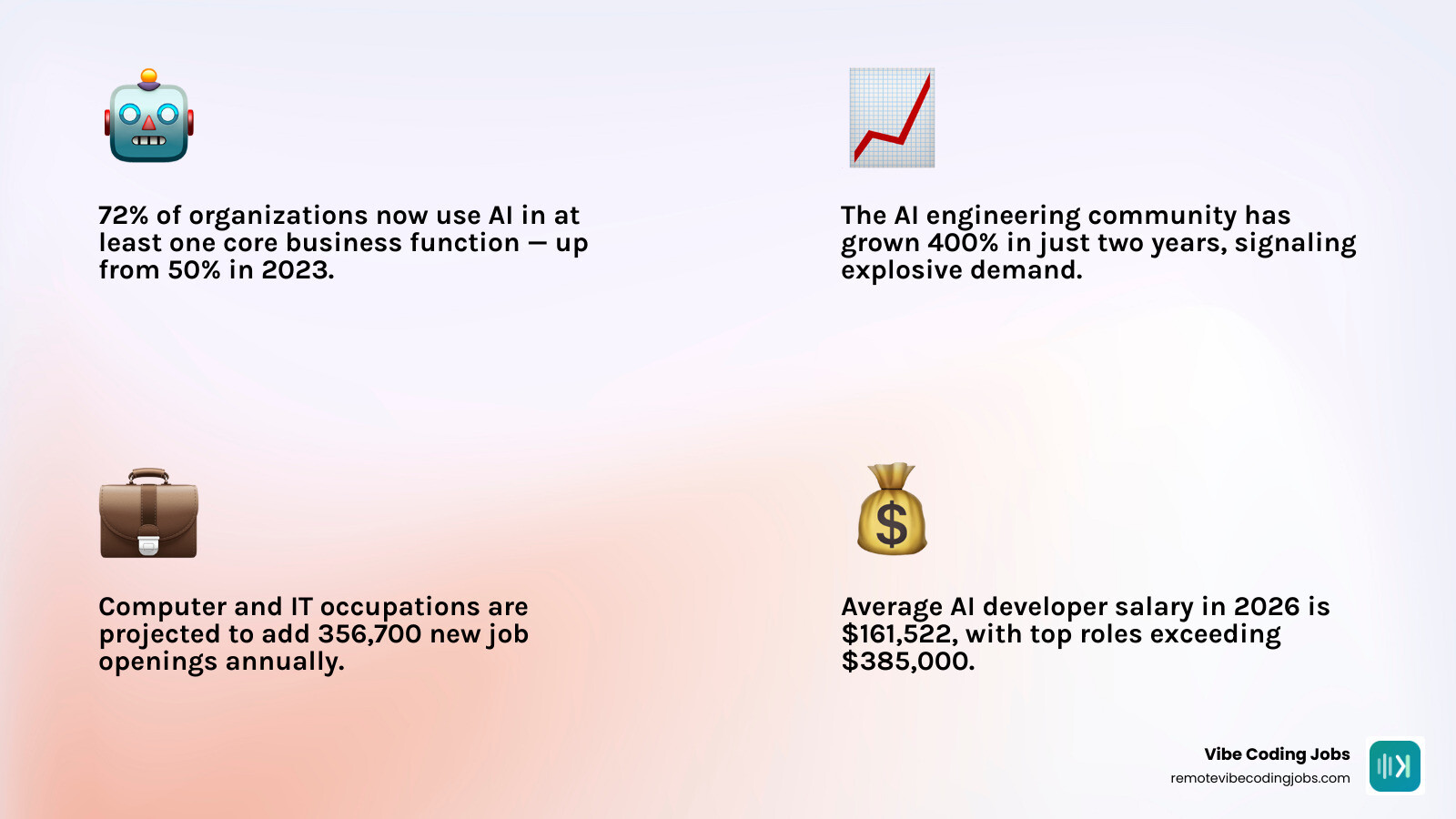
The AI engineering community has grown 400% in just two years — and 72% of organizations are now using AI in at least one core business function. This isn’t a niche anymore. It’s the mainstream of software development.
I’m Dominic Zijlstra, co-founder of Adaptify.ai and a former data scientist and DevOps engineer, and I’ve spent years at the intersection of automated systems and data infrastructure — exactly the skills that define modern AI developer careers. In this guide, I’ll cut through the noise and show you the roles, skills, and companies that matter most right now.
The Landscape of AI Developer Careers in 2026
The tech industry is undergoing a massive architectural shift. According to recent industry statistics, employment in computer and information technology occupations is expected to grow significantly faster than the average for all professions, delivering approximately 356,700 job openings annually. At the heart of this hiring boom are ai developer careers.
With 72% of organizations already using AI technology to improve at least one business function, the demand for developers who understand how to build, deploy, and optimize these intelligent systems is at an all-time high.
But what does it actually mean to build an AI career today?
In 2026, the traditional line between “writing code” and “training models” has completely blurred. We have entered the era of vibe coding—a paradigm where developers use advanced AI-assisted coding tools like Cursor and Claude to generate boilerplate, debug systems, and orchestrate complex application architectures. Instead of spending hours debugging syntax, modern software engineers act as directors, guiding autonomous agents to write and deploy code. You can explore how this workflow is changing the industry in our deep dive on AI Coding Jobs: Growth Potential.
This shift has expanded the AI developer community by 400% in just two years, with major industry events projecting over 10,000 attendees by 2030. Whether you are building custom neural networks from scratch or integrating third-party APIs to build autonomous workflows, there has never been a better time to transition into the field.

In-Demand Roles and Specialties in Artificial Intelligence
As artificial intelligence matures, the job market has diversified. Organizations are no longer just looking for generic “AI developers.” Instead, they are hiring for highly specialized roles across machine learning, deep learning, computer vision, natural language processing (NLP), and physical AI.
For instance, companies like Amazon are bridging the digital and physical worlds by operating over 750,000 robots across their fulfillment networks. This massive scale requires a unique blend of robotics and generative AI to optimize warehouse operations, predict supply chain disruptions, and manage physical AI fleets.
Let’s break down the most in-demand roles into two main categories: core engineering roles and emerging specialties.
Core Engineering Roles in AI Developer Careers
Core engineering roles focus on the design, implementation, and optimization of AI models and their supporting infrastructure.
- Machine Learning (ML) Engineer: ML engineers sit at the intersection of software engineering and data science. They take theoretical models developed by researchers and scale them into production-ready systems. In the U.S., Machine Learning Engineers earn an average salary of $161,522 annually.
- Data Scientist: These professionals specialize in data analysis, visualization, and mining. They clean and analyze massive datasets to uncover the underlying patterns that feed machine learning models.
- Applied AI Engineer: This is one of the fastest-growing titles in the industry. These engineers focus on taking state-of-the-art models and applying them to solve specific business problems. A prime example is the Applied AI Engineer, Codex Core Agent | OpenAI role, where engineers build the execution loops and interfaces that turn large language models into autonomous coding agents.
Emerging Specialties and Ecosystem Roles
As AI systems become more complex, new specialized disciplines are emerging to ensure these systems are safe, reliable, and easy to build on.
- Developer Experience (DevEx) Engineer: AI platforms are only as good as the developers building on them. DevEx engineers build the SDKs, APIs, and documentation that make integrating AI seamless. If you enjoy building tools for other builders, roles like the Developer Experience Engineer | OpenAI offer a perfect blend of full-stack engineering and developer advocacy.
- Agent Engineering: This specialty focuses on building autonomous agents that can execute long-horizon tasks, interact with external tools, and self-heal when they encounter errors. Learn more about how this is shaping remote work in our guide on Vibe Coding Jobs: Remote Career Path.
- AI Governance & Security Engineer: With great power comes great responsibility. These engineers build centralized LLM gateways to track token usage, enforce default-deny network policies around autonomous agents, and maintain secure audit trails for enterprise compliance.
- AI Ethics Specialist: These professionals focus on fairness, explainability, and safety, ensuring that AI models do not perpetuate biases or compromise user privacy.
Essential Skills and Educational Pathways
To land a high-paying job in this competitive market, you need a robust blend of traditional software engineering fundamentals and AI-native design patterns.
Modern AI engineering goes far beyond just calling an API. You need to understand the underlying infrastructure, how to manage latency and token costs, and how to design robust feedback loops.
Here is a quick look at how the required skill set compares to traditional software engineering:
| Skill Area | Traditional Software Engineering | AI-Native Development |
|---|---|---|
| Core Languages | Java, C#, JavaScript, PHP | Python, TypeScript, Go, SQL |
| Primary Focus | Deterministic logic, databases, APIs | Probabilistic systems, LLM integration, prompt design |
| Tooling | Standard IDEs, Git, CI/CD pipelines | Cursor, Claude, LangChain, vector databases |
| Infrastructure | Standard cloud servers, Docker | AWS, custom silicon (GPUs/TPUs), Kubernetes |
| Monitoring | APM tools, logging, error tracking | LLM evaluation frameworks, token tracking, guardrails |
Beyond programming languages, understanding custom silicon and hardware infrastructure is becoming increasingly important. As companies build massive supercomputers (like Amazon’s Project Ceiba) to train next-generation foundation models, developers who understand how software interacts with custom silicon (like Annapurna Labs chips or AMD hardware) are highly valued.
Educational Pathways and Transitioning into AI Developer Careers
How do you acquire these skills? While a traditional Computer Science or Data Science degree provides an excellent foundation in mathematics and statistics (specifically linear algebra, calculus, and probability), it is no longer the only path.
Many top-tier AI labs have realized there is a massive talent shortage and are creating alternative transition pathways. For example, OpenAI offers a structured, 6-month paid OpenAI Residency designed specifically to transition talented software engineers and researchers from non-AI backgrounds into full-time AI roles.
If you are transitioning with limited experience, here is the step-by-step sequence we recommend:
- Master the Fundamentals: Build a solid understanding of Python, SQL, and basic machine learning concepts.
- Build a Portfolio: Create and publish public-facing demos, LLM integrations, and autonomous agents on GitHub.
- Contribute to Open Source: Get involved in open-source AI projects to prove you can work on complex, collaborative codebases.
- Optimize Your Resume: Tailor your resume to highlight your hands-on experience with AI tools and APIs. Check out our Developer Resume for AI-Native Companies: The Ultimate Guide for practical templates.
- Apply for Internships or Residencies: Look for transition programs or early-stage startups that value rapid prototyping skills, such as roles on the Full-Stack Software Engineer, Incubation | OpenAI team.
Job Outlook, Salaries, and Top Employers
The financial rewards for ai developer careers are among the highest in the entire global economy. At top-tier AI labs, base salaries frequently range from $185,000 to $490,000 per year, often accompanied by highly lucrative equity packages.
Even outside of pure research labs, the broader market is incredibly strong. Machine learning engineers in the U.S. command an average salary of $161,522, with senior platform and infrastructure roles scaling much higher.
Let’s look at how three major industry giants approach AI careers:
- OpenAI: Known for pushing the absolute frontier of AGI. They look for mission-driven developers who align with their core values of “Humanity First” and “Act with Humility.” Engineering here is and highly collaborative, with roles like the Full Stack Software Engineer, ChatGPT Engineering | OpenAI focused on connecting user-facing web applications with massive, scalable backend AI models.
- Amazon: Amazon operates at an unparalleled global scale. Their AI careers span across AWS machine learning services, physical robotics, and their custom foundation models (Amazon Nova). Amazon operates like a collection of smaller companies, giving individual teams the autonomy to chase their own goals while leveraging world-class resources.
- AMD: As a leader in high-performance computing and semiconductor technology, AMD bridges hardware and software. They look for engineers who can optimize AI frameworks to run efficiently on their latest GPU and CPU architectures.
Regardless of the company, top employers are deeply committed to Responsible AI. For example, Amazon’s development workflow is guided by eight core priorities: fairness, explainability, privacy and security, safety, controllability, veracity and robustness, governance, and transparency. Demonstrating an understanding of these principles in your applications can give you a massive competitive edge.
To see which companies are actively hiring remote builders, check out our curated guide on the Best Companies Hiring AI Developers: Remote Career Paths.

Frequently Asked Questions about AI Careers
How can I transition into AI with no prior experience?
The best way to transition is through hands-on, practical experience. Build your own projects using APIs from OpenAI, Anthropic, or open-source models on Hugging Face. Build a portfolio on GitHub that showcases real-world utility—like a self-healing data pipeline or an autonomous customer support agent. Additionally, look for structured corporate transition programs, like the 6-month OpenAI Residency, which are designed to help experienced traditional engineers cross over into AI.
What is the average salary for an AI developer?
While the average machine learning engineer in the U.S. earns approximately $161,522 per year, top-tier AI native companies offer significantly higher compensation. At leading labs, full-stack and applied AI engineers earn base salaries ranging from $185,000 to $490,000, plus substantial equity packages and benefits like extensive parental leave.
Can I use AI tools like ChatGPT during my job application and interviews?
The short answer is: yes, but responsibly.
Major employers like AMD explicitly encourage using AI tools for industry research, refining your resume, and preparing for interviews. However, there are strict boundaries. You must not use AI tools to generate live responses during a video interview, nor should you submit AI-generated code as your own work during technical take-home assessments. Authenticity and first-principles thinking are what recruiters value most.
Conclusion
The world of ai developer careers is moving fast, but you don’t need a PhD in mathematics to get started. The rise of vibe coding and sophisticated AI-assisted development tools like Cursor and Claude has democratized the field, allowing creative software engineers to build highly complex, scalable AI applications.
At RemoteVibeCodingJobs, we believe the future of work is remote, asynchronous, and AI-assisted. We curate daily job listings from async-first companies that actively encourage the use of next-generation AI tools.
If you’re ready to take the next step in your career, explore our resources on Remote AI Developer Jobs: Boards & Market Outlook or check out our active listings directly: