Are There Specific Job Aggregators for Engineers Using AI Coding Tools?
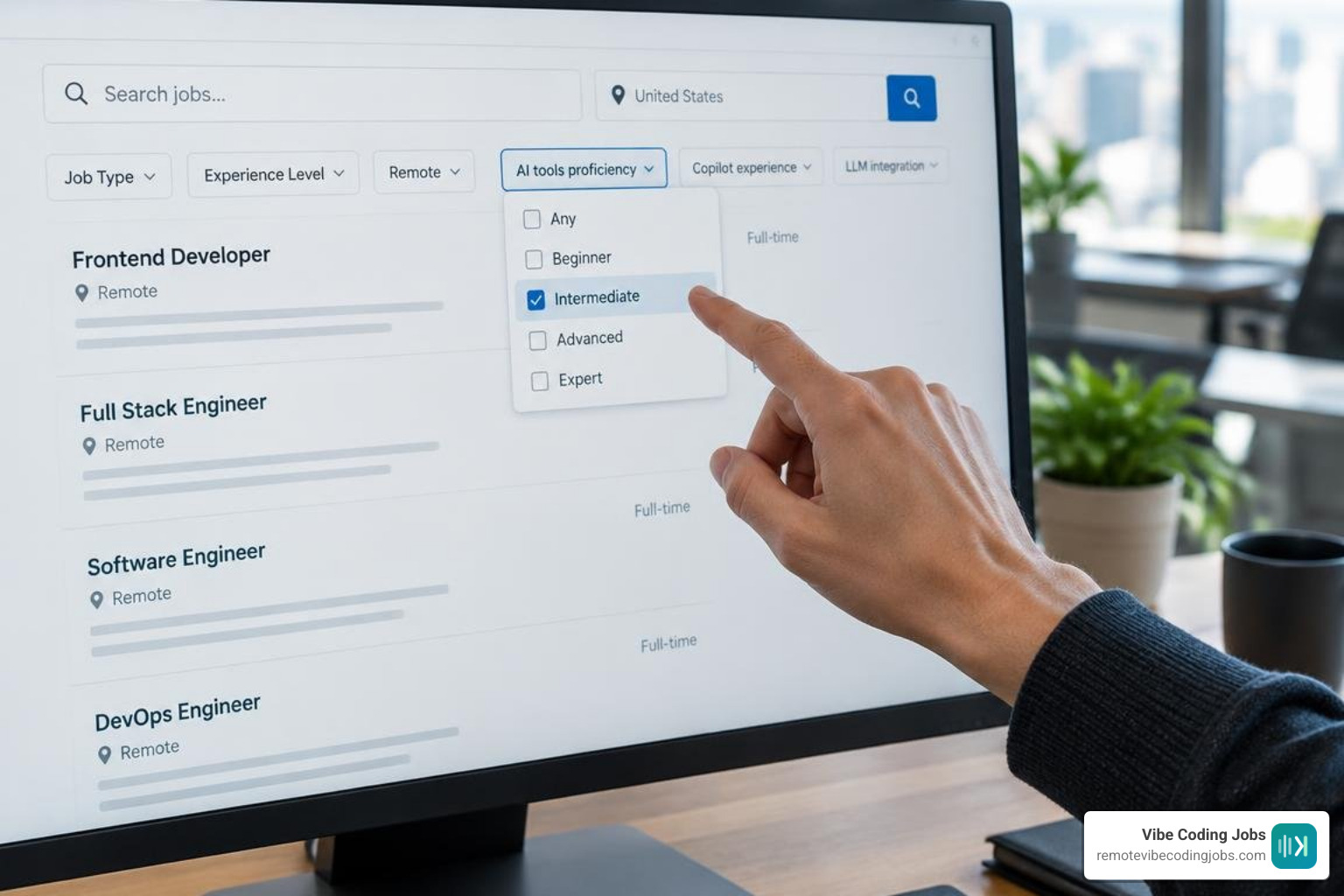
The short answer is yes. As software development transitions into an AI-augmented discipline in 2026, dedicated job discovery channels and aggregators have emerged to serve engineers who build with AI coding assistants. Rather than wading through legacy platforms where keyword search yields outdated enterprise listings, modern developers can now turn to specialized platforms tailored specifically around AI-assisted workflows and modern developer tooling.
The broader tech hiring market is undergoing a structural transformation. AI Engineer continues to rank as the fastest-growing job title in the United States, with postings climbing 143% year-over-year. Overall AI and machine learning postings surged 163% between 2024 and 2025, reaching nearly 50,000 open positions in the US alone. More importantly, the nature of these roles is shifting: while earlier hiring cycles centered heavily on research scientists, over 50% of current tech postings seek practitioners who build on top of large language models or integrate developer tools into daily shipping cycles.
Traditional job boards struggle to keep pace with this evolution. Legacy aggregators generally treat software engineering as a static set of syntax requirements—filtering strictly by Java, Python, or AWS. They lack the metadata to answer critical questions for modern builders:
- Does this team provide enterprise licenses for Cursor, GitHub Copilot, Claude Code, or Tabnine?
- Is the engineering culture async-first and evaluated on shipped velocity, or do they still enforce arbitrary LeetCode filters?
- Are developers expected to hand-craft every line of boilerplate, or are they encouraged to direct autonomous agents to scaffold systems?
Specialized platforms bridge this divide by filtering job openings based on the exact AI tooling used, the engineering team’s stance on tool enablement, and remote culture. Dedicated aggregators index roles by workflow tags, making it easier to find teams that actively invest in developer productivity.
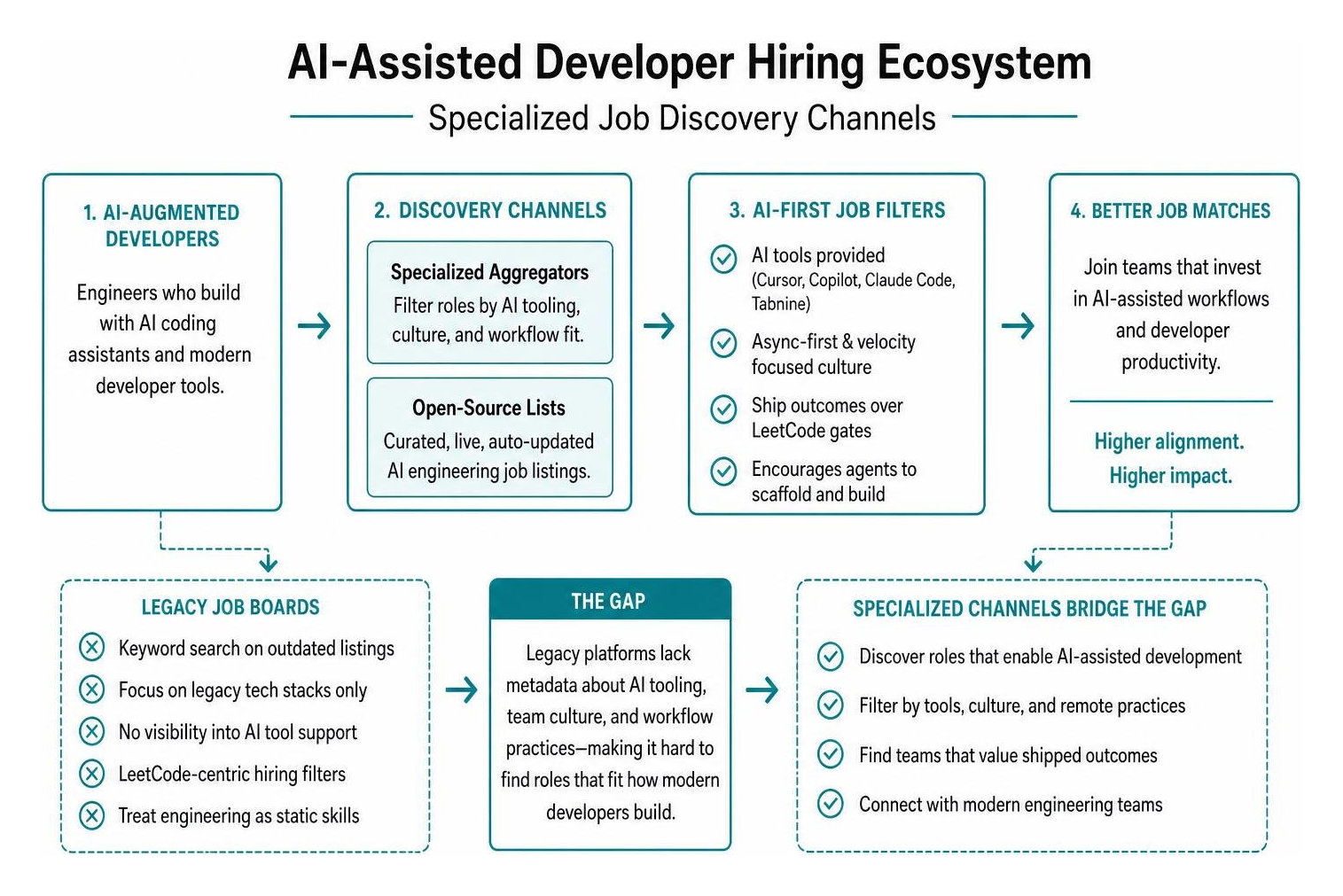
Understanding where and how to find these listings allows you to bypass legacy hiring friction and join teams that actively invest in developer productivity.
How Does RemoteVibeCodingJobs Help Engineers Find AI-Assisted Roles?
We built RemoteVibeCodingJobs specifically to solve the discovery gap for developers who rely on AI to accelerate their daily output. While generic boards dump thousands of undifferentiated listings into an unfiltered feed, our aggregator tracks remote positions at forward-thinking, async-first companies that prioritize modern engineering workflows.
With over 78% of global organizations adopting AI tooling in core business functions and more than 90% of technology leaders allocating dedicated budgets for developer enablement in 2026, engineering teams are rapidly dividing into two camps: those who restrict AI tooling due to compliance hesitation, and those who treat AI coding speed as a core competitive advantage. We focus exclusively on the latter.
| Feature / Criteria | General Job Boards | RemoteVibeCodingJobs |
|---|---|---|
| Tool-Specific Filtering | Basic keyword text search only | Native filters for Cursor, Copilot, Claude Code, Tabnine, Windsurf |
| Remote & Async Tags | Broad “remote” label (often location-restricted) | Verified async-first, remote-first company culture tags |
| Engineering Workflow Vetting | No evaluation of developer tool policies | Screened for approved AI assistant budgets and tool autonomy |
| Compensation Transparency | Often hidden or generic national estimates | Upfront salary bands reflecting AI-augmented wage premiums |
| Hiring Process Style | Traditional whiteboard and algorithmic LeetCode tests | Practical take-homes, architecture reviews, and AI pairing sessions |
RemoteVibeCodingJobs and Vibe Coding Roles
The concept of “vibe coding”—a development philosophy popularized across modern engineering circles—describes an approach where engineers direct high-level system architecture, user experience, and orchestration while using AI assistants to write, refactor, and test code at high speed.
On our platform, we curate daily remote listings from companies hiring developers who thrive in this environment. These organizations recognize that an engineer who knows how to effectively prompt, debug, and verify AI-generated output can ship features in hours that previously took an entire sprint. By cataloging roles based on team autonomy, tool stack, and asynchronous communication, we help engineers find positions where their speed is celebrated rather than viewed with skepticism.
Finding AI-Native Engineering Opportunities
Beyond standard software development, our platform indexes emerging AI-native roles. These include positions focused on Retrieval-Augmented Generation (RAG), agentic orchestration frameworks, evaluation harness design, and internal developer tooling.
A major advantage of modern AI-native engineering is that practical hands-on capability has outpaced formal academic credentials. Startups and scale-ups hiring through our platform rarely mandate machine learning PhDs; instead, they seek builders who understand context windows, model orchestration, and production integration. Our live listings provide one-click application paths to verified remote employers actively seeking these exact skills.
How Can You Filter and Search for Specific AI Coding Assistants on Job Platforms?
When searching across tech job platforms, finding teams that genuinely support AI coding requires more than typing “software engineer” into a search box. Because many companies do not yet know the standard terminology for AI-assisted engineering, developers need tactical search strategies to uncover high-paying roles.
If you are looking to find forward-thinking engineering teams, exploring Cursor Copilot developer remote jobs can quickly connect you with companies that maintain dedicated tooling budgets for their engineering staff. In addition, learning how to optimize your engineering process to the max with AI tools will help you speak the language hiring managers use when describing high-velocity workflows.
Essential Keywords and Boolean Search Strings
To cut through irrelevant postings on broader job engines, use precise Boolean search strings that combine your core programming language with specific AI developer tooling and culture keywords.
Useful search query structures include:
- Tool-Specific Queries:
("Cursor" OR "GitHub Copilot" OR "Claude Code" OR "Windsurf" OR "Tabnine") AND ("TypeScript" OR "Python") AND "Remote" - Workflow-Focused Queries:
("AI-assisted" OR "AI-native" OR "agentic workflow" OR "pair programming with AI") AND ("Full Stack" OR "Backend") - Output-Oriented Queries:
("vibe coding" OR "LLM-assisted development" OR "rapid prototyping") AND ("async" OR "remote-first") - Architecture Queries:
("LangChain" OR "LlamaIndex" OR "RAG" OR "evals") AND ("Software Engineer" OR "Product Engineer")
Combining tool names with modern developer utilities ensures that your search results favor engineering departments that have already integrated AI into their day-to-day continuous integration pipelines.
Analyzing Job Descriptions for Genuine AI Adoption
Not all job descriptions that mention AI are created equal. Some organizations use AI as a generic recruiting buzzword while maintaining rigid internal policies that restrict third-party LLM usage.
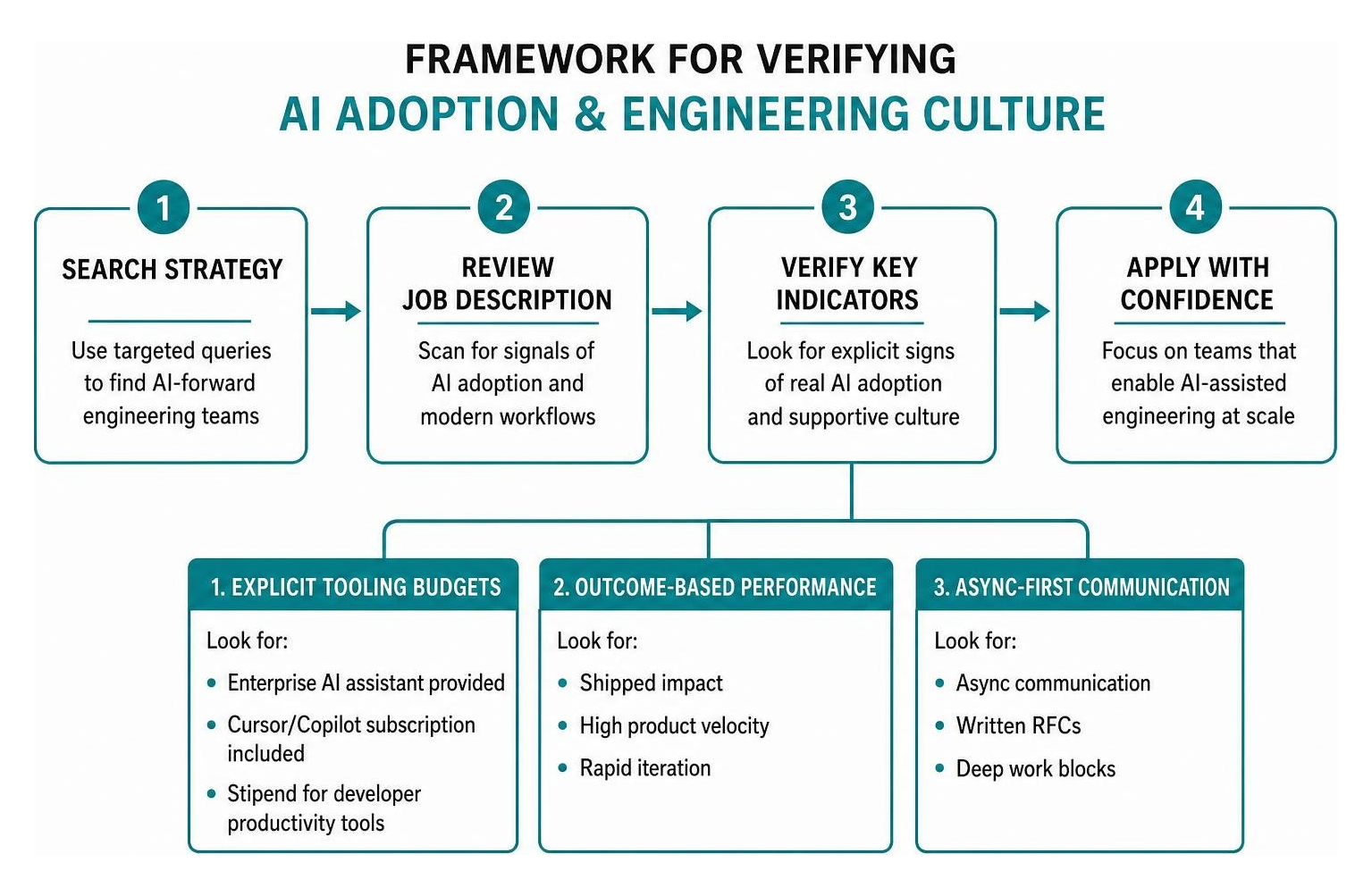
When evaluating a job description, look for these indicators of genuine AI adoption:
- Explicit Tooling Budgets: Look for phrases like “enterprise AI assistant provided,” “Cursor/Copilot subscription included,” or “stipend for developer productivity tools.”
- Outcome-Based Performance: Descriptions emphasizing “shipped impact,” “high product velocity,” and “rapid iteration” are far more likely to encourage AI-assisted development than teams measuring raw lines of code or commit counts.
- Async-First Communication: Teams that value asynchronous communication, written RFCs, and deep work blocks naturally align with AI-augmented workflows, as documented in industry guides on the best AI tools for software engineers: how to build the right stack.
- Pragmatic Testing Policies: Watch for mentions of automated test generation, AI-driven code reviews, and verification pipelines rather than restrictive manual approval bottlenecks.
What Emerging Roles and Salaries Can AI-Assisted Developers Expect in 2026?
The financial upside for engineers who master AI-assisted development is clear. Roles requiring verified AI proficiency carry a 56% wage premium over comparable non-AI software engineering positions, up from 25% just twelve months earlier.

As detailed in our analysis of AI coding jobs remote market trends, tech compensation is increasingly decoupling from legacy seniority models. Instead, compensation reflects execution velocity, architectural judgment, and the ability to leverage autonomous agents.
According to our comprehensive vibe coding salary guide, remote compensation bands for AI-augmented engineers span distinct tiers:
- Entry to Junior Developers: $75,000 – $115,000 base salary, with top startups offering equity packages for candidates who demonstrate rapid prototype shipping via modern tooling.
- Mid-Level Engineers: $130,000 – $190,000 base salary, typically requiring demonstrated experience building with LLM APIs, agentic orchestration, or multi-repo AI context management.
- Senior & Staff AI Product Engineers: $200,000 – $320,000+ base salary, awarded to engineers who guide architectural decisions, enforce security guardrails, and manage entire autonomous feature lifecycles.
Fast-Growing AI Engineering Job Titles
The titles listed on tech job boards are rapidly shifting from generalist labels to specialized hybrid roles:
- AI Systems Architect: Focuses on structuring data pipelines, vector databases, and agent networks that interact directly with enterprise codebases.
- Product Engineer (AI-Augmented): Combines full-stack engineering with rapid design-to-code execution, building complete customer-facing features in days rather than quarters.
- Vibe Coder / Agentic Engineer: Directs autonomous coding agents, defines system constraints, reviews generated logic, and maintains product momentum.
- Agentic Software Delivery Lead: Oversees CI/CD automation, AI unit test generation, and automated refactoring agents across distributed teams.
Early-career engineers can also capitalize on this shift. By focusing on rapid application delivery and tool fluency, candidates can access entry level remote AI coding jobs for beginners that value practical execution over years of traditional enterprise experience.
AI Tool Stacks and Skill Requirements
Modern engineering teams evaluate candidates on practical workflow competencies rather than abstract algorithm memorization. To remain competitive, engineers should familiarize themselves with the platforms showcased in guides like 7 AI tools every developer must know in 2026.
Key competencies currently in high demand include:
- Repository-Wide Context Management: Knowing how to structure
.cursorrules, index complex codebases, and supply relevant context to avoid model hallucination. - Autonomous Agent Direction: Using tools highlighted in our breakdown of the best AI coding tools 2026 to manage multi-file refactoring and automated test generation.
- Verification and Security Auditing: Reviewing AI-generated code for security vulnerabilities, memory leaks, and architectural anti-patterns.
- Prompt Architecture for Development: Applying foundational methods from our guide on how to vibe coding AI tools beginner techniques to reliably generate production-grade code.
How Do You Showcase Your AI Tool Expertise to Attract Relevant Employers?
To win high-paying remote roles in an AI-accelerated market, you must update how you present your skills. Standard bullet points listing programming languages no longer communicate your actual engineering output. Forward-thinking hiring managers want to see proof of velocity, verification discipline, and architectural judgment.

Engineers who highlight modern workflows outlined in our breakdown of AI coding tools for vibe coding stand out immediately against candidates who omit their tooling experience. Framing your skill set around AI-augmented leverage unlocks high-trajectory AI assisted development career growth remote opportunities.
Creating Proof-of-Work Portfolios and Case Studies
The most effective way to validate your skills is through structured proof-of-work case studies that document the full lifecycle of an application built with AI assistance.
When publishing projects on GitHub or your personal site, include a dedicated section in your README covering:
- Problem Definition & System Design: Explain how you decomposed the problem into discrete modules before writing any code.
- Toolchain & Agent Workflow: Detail the exact assistants used (e.g., Cursor Composer for multi-file generation, Claude Code for test scaffolding, and specialized LLMs for API schema validation).
- Verification and Refinement Log: Describe where the AI model failed or produced inefficient logic, and document the specific architectural decisions and manual refactoring you implemented to fix it.
- Performance & Test Coverage: Highlight unit and integration test coverage, benchmarking latency, security compliance, and deployment automation.
Demonstrating that you use AI as a force multiplier—while maintaining full ownership of code quality and security—instantly builds trust with engineering leaders.
Navigating Technical Interviews That Encourage AI Assistance
Forward-thinking organizations have overhauled their hiring processes. Rather than demanding whiteboard syntax memorization, many employers featured on our list of no LeetCode interview companies now conduct practical pairing interviews where candidates are explicitly encouraged to use their preferred AI tooling.
To excel in an AI-assisted technical interview:
- Narrate Your System Thinking: Vocalize why you are giving specific instructions to the model. Explain your architectural choices before generating code.
- Critically Review Generated Output: Never accept generated code without inspecting it. Point out potential edge cases, variable naming inconsistencies, or missing validation logic to the interviewer in real time.
- Leverage AI for Test Suites: Demonstrate mature engineering habits by prompting your AI assistant to generate edge-case test suites, run mutation tests, and check boundary conditions.
- Discuss Trade-Offs: Show that you understand the financial and computational trade-offs of different LLM APIs, vector search strategies, and caching layers.
What Are the Most Frequently Asked Questions About AI Coding Job Aggregators?
Do specialized AI job aggregators charge fees for developers to search and apply?
No. Specialized platforms like RemoteVibeCodingJobs are free for software engineers and developers. You can browse curated listings, filter by specific AI tools and remote cultures, and submit applications directly to hiring companies without subscription barriers or candidate placement fees.
How do I know if a hiring company allows or provides AI coding tools?
Check whether the job listing explicitly mentions tool subscriptions (such as Cursor, GitHub Copilot, or Claude), look for dedicated tech stack tags on AI job aggregators, and verify during initial recruiter conversations. Asking direct questions such as “What is your team’s policy on developer AI tooling and enterprise LLM subscriptions?” will quickly reveal how mature their AI enablement strategy is.
Can junior developers land remote AI-assisted coding jobs without years of experience?
Yes. Because over 90% of technology organizations are investing in AI enablement, companies prioritize candidates who can quickly build functional, tested software over those with traditional tenure alone. Junior developers who build a verified portfolio of full-stack projects using AI assistants, understand system architecture, and write comprehensive automated tests can successfully compete for well-compensated remote roles.
How Can You Get Started Finding Remote AI Coding Jobs Today?
The transition to AI-assisted software engineering is the most significant shift in developer productivity in decades. Over the next two to three years, an estimated 50% to 55% of all software engineering roles will be reshaped by AI automation and agentic workflows. By aligning your job search with platforms and companies that embrace this future, you place yourself on the winning side of this industry evolution.
To launch your search:
- Explore Curated Opportunities: Review the remote vibe coding jobs guide to understand how leading engineering teams structure their compensation, culture, and hiring pipelines.
- Refine Your Tooling Stack: Master repository context management, multi-agent workflows, and prompt-driven testing across top modern AI IDEs and assistants.
- Build Verifiable Proof of Work: Deploy full-stack projects that showcase your architectural judgment, verification discipline, and rapid delivery capabilities.
- Target Modern Hiring Teams: Set up targeted search strings and check dedicated aggregators daily to apply for roles where AI coding is supported and rewarded.
Browse our live listings on RemoteVibeCodingJobs today to connect with remote, async-first companies hiring developers who code at the speed of thought.