
Find Part-Time Remote Software Engineering Work That Fits Your Schedule
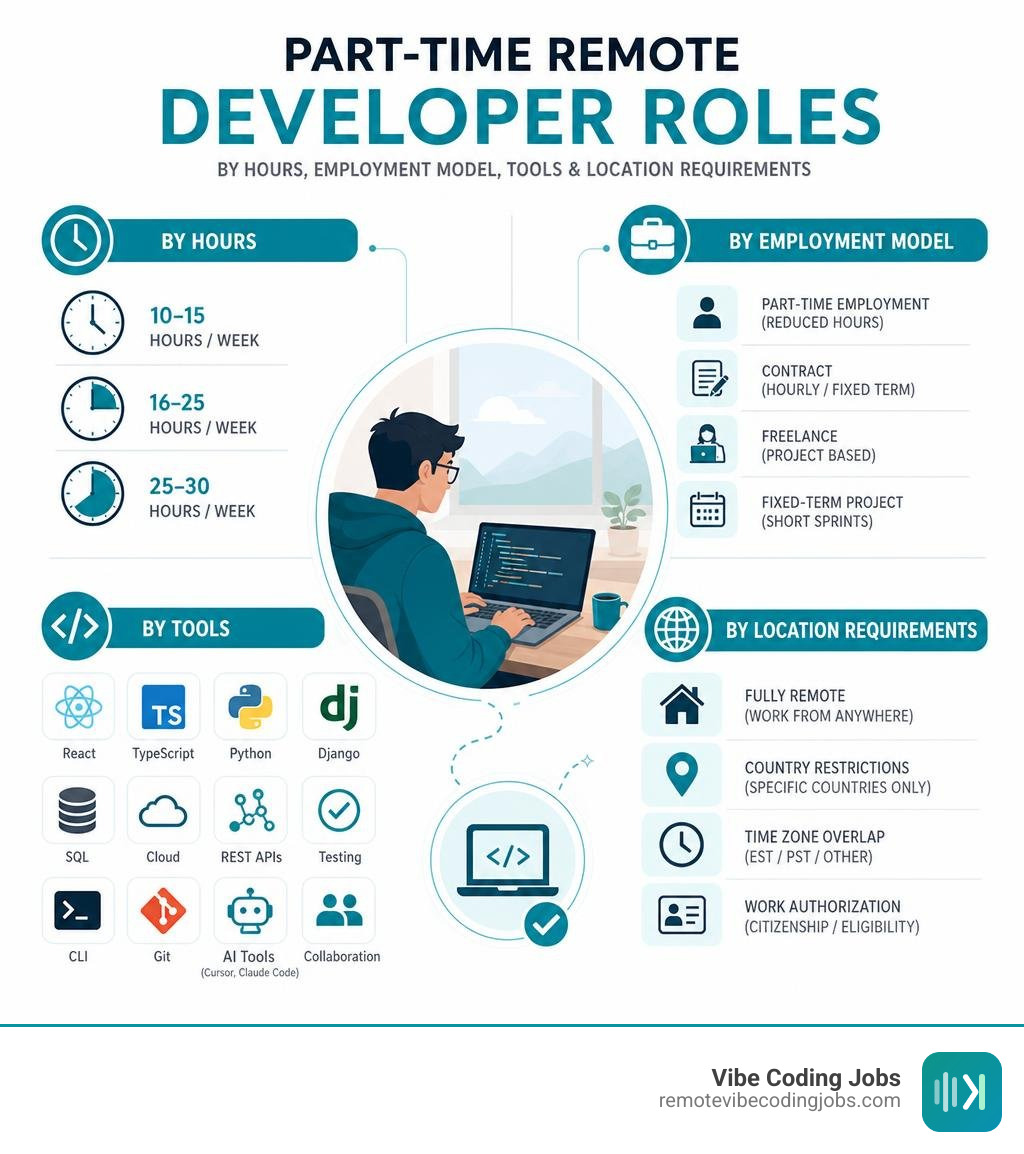
To find legitimate part-time software engineer jobs remote, search for roles with a clear weekly commitment, named tech stack, pay model, and location rules. The strongest matches are often async-first product, SaaS, healthtech, education, AI, and consulting roles requiring about 10 to 25 hours a week. Some fixed-term projects run closer to 25 to 30 hours.
Prioritize listings that answer these questions before you apply:
- What will you ship? Look for defined features, integrations, automation work, or maintenance ownership.
- Which tools matter? Common asks include React, TypeScript, Python/Django, SQL, REST APIs, cloud services, testing, and AI tools such as Cursor or Claude Code.
- How is the work structured? Confirm whether it is part-time employment, a contract, freelance work, or a reduced-hour role.
- Where and when can you work? “Remote” may still mean US-only, a specific country, citizenship eligibility, or overlap with EST or PST hours.
This market is broader than traditional web development. Current openings include full-stack product work, backend engineering, AI training and evaluation, workflow automation, client-facing technical consulting, and security-focused development. The best opportunities reward engineers who can work independently, write clearly, and ship reliable code without needing constant meetings.
I’m Di Su, a software engineer with 10+ years of experience building web products, scalable workflows, and high-converting digital experiences with tools including Svelte and Python. In this guide, I’ll share practical ways to assess and land part-time software engineer jobs remote, including AI-assisted roles where speed still has to come with sound engineering judgment.
The Modern Landscape of Part-Time Software Engineer Jobs Remote
The remote engineering job market has shifted dramatically. While full-time salaried positions historically dominated hiring boards, companies are increasingly restructuring their technical teams around flexible capacity. Today, engineering organizations regularly hire developers on reduced schedules to handle modular features, maintain internal tools, conduct code reviews, or scale early MVPs.
When evaluating remote work trade-offs, developers often find that part-time commitments offer an ideal balance between deep technical contribution and personal schedule autonomy. The scope of these arrangements ranges from short 10-15 hour advisory roles to structured 25-hour weekly sprints.
| Employment Model | Typical Weekly Hours | Compensation Structure | Primary Work Style | Ideal Candidate Profile |
|---|---|---|---|---|
| Part-Time W-2 | 15–25 hours | Hourly or Pro-Rata Base | Mixed Sync / Async | Engineers seeking steady schedules with some payroll benefits |
| 1099 Contractor | 10–25 hours | Fixed Hourly Contractor Rate | Fully Asynchronous | Independent developers with specialized domain expertise |
| Freelance / Retainer | 5–20 hours | Hourly or Milestone-Based | Outcome-Focused | Multi-client builders managing varied technical deliverables |
| Reduced-Hour (4-Day) | 30–32 hours | 80% to 100% Full-Time Salary | Async-First Distributed | Full-lifecycle developers wanting balanced corporate roles |
Understanding the mechanics behind these engagement models allows you to target roles that align with your lifestyle, tax preferences, and technical goals.
Part-Time vs. Contract, Freelance, and 4-Day Work Weeks
Navigating non-traditional tech roles requires clarity on legal and operational definitions:
- Part-Time (W-2): You are an official employee on standard payroll working fewer than 30–35 hours weekly. While some roles include prorated health benefits or 401(k) matching, taxes are automatically withheld.
- Independent Contractor (1099): You invoice the company for direct hours worked or completed project milestones. You handle your own taxes, equipment, and benefits, but gain significant freedom over your daily working schedule.
- Freelance Engagements: Often structured around short-term deliverables, freelance work gives you autonomy across multiple concurrent clients, requiring disciplined task tracking.
- 4-Day Work Weeks & Reduced Schedules: Rather than traditional hourly gigs, many modern companies offer compressed work weeks (such as 32-hour 4-day weeks or 9-day fortnights) often paid at an 80% pro-rata rate or even 100% base salary parity. When comparing remote vs office setups, these reduced schedules prioritize autonomous delivery over rigid hours logged at a desk.
Top Hiring Industries: PropTech, HealthTech, EdTech, and Regulated Sectors
Demand for part-time remote software engineering spans multiple high-growth verticals:
- Property Technology (PropTech): Fast-moving startups regularly recruit part-time developers for 20–30 hours weekly to construct automated data pipelines, manage internal tooling, and integrate customer-facing generative AI tools.
- HealthTech & Digital Therapeutics: Healthcare SaaS companies hire part-time backend engineers to build remote patient monitoring dashboards, clinician interfaces, and secure HIPAA-compliant APIs. For instance, teams frequently seek Python/Django Software Engineer (part-time, remote, with flexible schedule) | Flexmatrix candidates to maintain complex relational database systems.
- Education Technology (EdTech): EdTech platforms actively hire developers for learning suites, classroom analytics, and data migration workflows. A recent posting for a Remote Part-Time Full Stack Software Engineer – Data Entry & Platform Development for arenaflex Education Suite – USA Remote Jobs mysmartpros showcases how institutions pair routine maintenance and data workflows with traditional software engineering.
- Regulated and Defense Environments: Highly specialized defense-adjacent projects seek part-time talent for security hardening and identity management. Openings like the Part-Time Remote Full Stack Developer | Flexgen role demonstrate demand for low-level language expertise (such as Rust) combined with Public Key Infrastructure (PKI) authentication.
- Boutique Technical Consultancies: Advisory agencies regularly engage experienced engineers for 10–15 hours weekly. Openings such as the [Remote] Software Consultant (Part-time) | Flexgen position focus on running technical discovery, scoping architecture, and acting as a bridge between non-technical stakeholders and development pods.
Core Skills and Tech Stacks for Flexible Remote Roles

Securing part-time remote software engineer jobs requires a dependable technical foundation. Because part-time engineers operate with less real-time supervision, teams look for candidates who can jump directly into production codebases, write unit and end-to-end tests, and manage cloud deployments autonomously.
Essential Tech Stacks for Part-Time Software Engineer Jobs Remote
When choosing top programming languages for distributed work, several core ecosystems dominate part-time technical listings:
- Frontend Frameworks: TypeScript and modern React remain the benchmark for remote user interface engineering. Experience with state management, component libraries, and performance optimization (code splitting, asset lazy-loading) is standard.
- Backend Ecosystems: Python (Django, FastAPI) and Java (Spring Boot) lead full-stack enterprise requirements. Python powers rapid API creation, data extraction, and backend microservices, while Java underpins enterprise SaaS architectures.
- Serverless & BaaS Platforms: Contract roles increasingly focus on lightweight backend-as-a-service architectures. Postings like the Product Engineer (part-time contract) | Jquasar opening regularly ask for React Native paired with Supabase, Firebase, or Cloudflare Workers.
- Data Stores & Cloud Infrastructure: Production experience with relational databases (PostgreSQL, MySQL), clear HTTP/RESTful design, Docker containerization, and basic CI/CD pipeline management (GitHub Actions) are universally required.
The Rise of Vibe Coding and AI-Assisted Development Workflows
The software engineering landscape has transformed through the emergence of “vibe coding”—a paradigm where developers act as system orchestrators guiding AI coding assistants to build, test, and ship software at rapid speed.
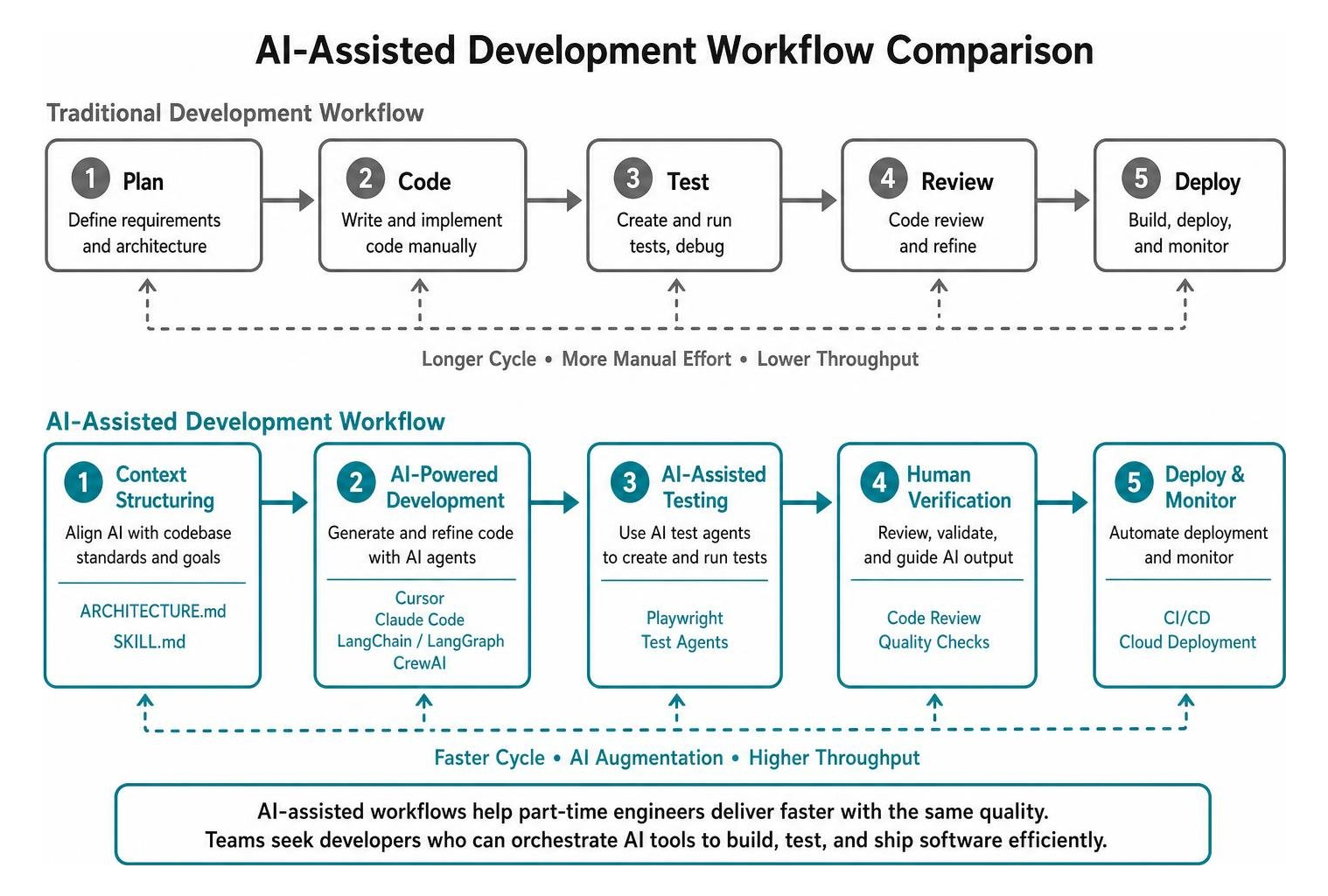
Engineering teams now explicitly seek developers skilled in agentic coding workflows. Recent postings like the Full-Stack Developer (US-Based / Remote / Part-Time) | Flexmatrix role highlight the use of agentic tools such as Cursor, Claude Code, and Playwright test agents alongside frameworks like LangChain, LangGraph, and CrewAI.
When leveraging AI developer tools for async productivity, part-time engineers can accelerate delivery cycles 3x to 10x by:
- Context Structuring: Defining system architectures via systematic configuration files (e.g.,
ARCHITECTURE.md,SKILL.md) to keep AI models aligned with codebase standards. - Automated QA Scaffolding: Using AI agents to write comprehensive unit and integration test suites, ensuring generated code is secure and regression-free.
- Rapid Prototype Iteration: Using tools like Cursor, Claude Code, and Windsurf to convert functional requirements into working full-stack features in hours rather than days.
Compensation Benchmarks, Contracts, and Location Realities
Compensation for remote part-time engineering roles varies based on experience level, project scope, and required domain specialization. When benchmarking market compensation in our remote salary guide, part-time tech roles generally distribute across distinct hourly and pro-rata tiers:
- Junior Developers & AI Trainers: Entry-level or training roles generally range from $20.00 to $30.00 per hour, focusing on script automation, unit testing, or evaluating AI coding models.
- Mid-Level Full Stack Engineers: Positions requiring 2–4 years of production experience (e.g., Java/React education suites or Python/Django services) typically pay $30.00 to $60.00 per hour.
- Senior Contractors & Technical Consultants: High-autonomy roles requiring 5+ years of experience, specialized architectural know-how, or client discovery consulting command $70.00 to $150.00+ per hour.
- Reduced-Hour Salaried Roles: Structured 4-day or 80% time arrangements frequently offer competitive pro-rata salaries ranging from $100,000 to $210,000+ USD, accompanied by comprehensive healthcare and equity options.
Hourly Rates, Pro-Rata Salaries, and Benefits Comparison
While 1099 contractor roles offer higher top-line hourly rates to offset independent tax and health insurance obligations, some part-time W-2 roles offer structured benefits. For example, certain EdTech and SaaS organizations offer pro-rated 401(k) matching, wellness stipends, and paid time off for part-time employees working above a 20-hour weekly threshold.
Navigating Timezone Overlaps and Geographic Eligibility
The term “remote” does not always mean location-independent. Before submitting applications, evaluate the geographic and schedule parameters:
- Core Working Hours: Many consultancies and agile teams require 2 to 4 hours of daily synchronous overlap with United States business hours (typically EST or PST) to attend sprint syncs or client check-ins.
- Residency and Citizenship Mandates: Roles tied to federal compliance, defense infrastructure, or specific state payroll registrations require active domestic residency or citizenship.
- Asynchronous Verification: Truly asynchronous teams evaluate your contribution entirely on delivered pull requests, issues resolved, and documentation quality, granting complete freedom over when you complete your hours.
How to Land and Succeed in Flexible Engineering Roles

Hiring managers for part-time remote software engineer roles care far less about traditional whiteboard algorithm tests and far more about your ability to deliver production-ready software without constant supervision.
How to Find and Vet Legitimate Part-Time Software Engineer Jobs Remote
When executing your job search, avoid generic job boards cluttered with mislabeled full-time positions. Instead, apply these targeted sourcing tactics:
- Filter by Hours and Delivery Model: Target niche job directories that verify weekly hour commitments (10–25 hrs/week) and workplace policies.
- Build a Live, Deployed Portfolio: When landing remote roles without Leetcode, a GitHub profile containing clean READMEs, automated CI/CD workflows, and live demo links speaks louder than abstract resume bullets.
- Propose Paid Mini-Projects: If an employer is hesitant about part-time arrangements, offer to complete a scoped, paid 1-week test milestone to prove your asynchronous output.
- Vet Listings for Transparency: Avoid postings that refuse to share hourly rates upfront or lack a clearly defined technical stack. Legitimate engineering teams provide explicit project goals and clear collaboration expectations.
Overcoming Common Part-Time Remote Challenges and Growing Your Career
Succeeding in a part-time remote engineering role requires deliberate operational habits:
- Preventing Scope Creep: Establish strict boundaries around your weekly hourly ceiling. Document completed deliverables transparently so stakeholders understand your velocity.
- Minimizing Context Switching: Dedicate uninterrupted blocks of time (e.g., three 5-hour sessions rather than ten 90-minute fragments) to maintain deep focus on complex codebases.
- Mastering Written Documentation: Because you may be offline while full-time teammates are working, maintain exceptional PR descriptions, clear architecture decision records (ADRs), and detailed Loom or screen recordings explaining your implementations.
- Asynchronous Alignment: By practicing proactive asynchronous collaboration practices and mastering the remote developer tools stack, you keep projects moving forward without requiring real-time meetings.
- Interview Preparation: When preparing for remote interviews, emphasize your self-direction, testing discipline, and experience using AI-accelerated workflows to solve problems efficiently.
Frequently Asked Questions About Remote Part-Time Engineering
How many hours per week do part-time remote software engineers typically work?
Most part-time remote engineering roles require between 10 and 25 hours per week. Technical consulting and architecture discovery roles often sit at 10–15 hours weekly, while full-stack development, backend feature work, and fixed-term startup sprints typically require 15–25 hours.
Can part-time remote software engineer roles transition into full-time positions?
Yes. Many engineering teams leverage part-time contracts as a low-risk trial period. If you demonstrate reliable async communication, ship clean code, and integrate well with the product roadmap, teams frequently extend invitations to convert to full-time or increased-hour arrangements.
What tools are required for modern AI-native or vibe coding positions?
AI-native engineering teams expect developers to be proficient with AI-first code editors like Cursor and Windsurf, command-line agents like Claude Code, code completion tools like GitHub Copilot, and automated testing frameworks (Playwright, Vitest). Developers are also expected to manage structured prompt context files (ARCHITECTURE.md) to maintain code quality.
Conclusion
Finding the right part-time remote software engineering role comes down to identifying positions with realistic weekly expectations, transparent compensation models, and modern development workflows. Whether you want to build healthtech platforms, advise as a technical consultant, or leverage AI-accelerated vibe coding tools to ship software faster, the remote ecosystem offers unparalleled flexibility.
If you are ready to skip the noise of outdated, mislabeled listings, explore curated async-first positions and find vetted part-time and async engineering opportunities tailored to modern developer workflows today.