What Is a Vibe Coder and Why Are Companies Hiring Them?
Current vibe coder job opportunities span forward-deployed engineering roles at early-stage startups, async-first full-stack positions at growth SaaS companies, and digital studio contracts building client MVPs. Enterprises are also adding AI-assisted development skills to design, security, and backend roles. A vibe coder is a software builder who orchestrates artificial intelligence models to design, assemble, and deploy functional applications at unprecedented speed. Instead of manually typing every line of boilerplate code or getting bogged down in syntax errors, a vibe coder steers large language models (LLMs) using natural language prompts, systems architecture intuition, and immediate feedback loops.
The emergence of this role marks a distinct paradigm shift in software development. In vibe coding vs traditional development, traditional engineering focuses on low-level syntax, manual memory management, and writing repetitive glue code. Vibe coding elevates the engineer to an orchestrator or technical director. The primary focus shifts from syntax to intent, rapid iteration, and user outcome.
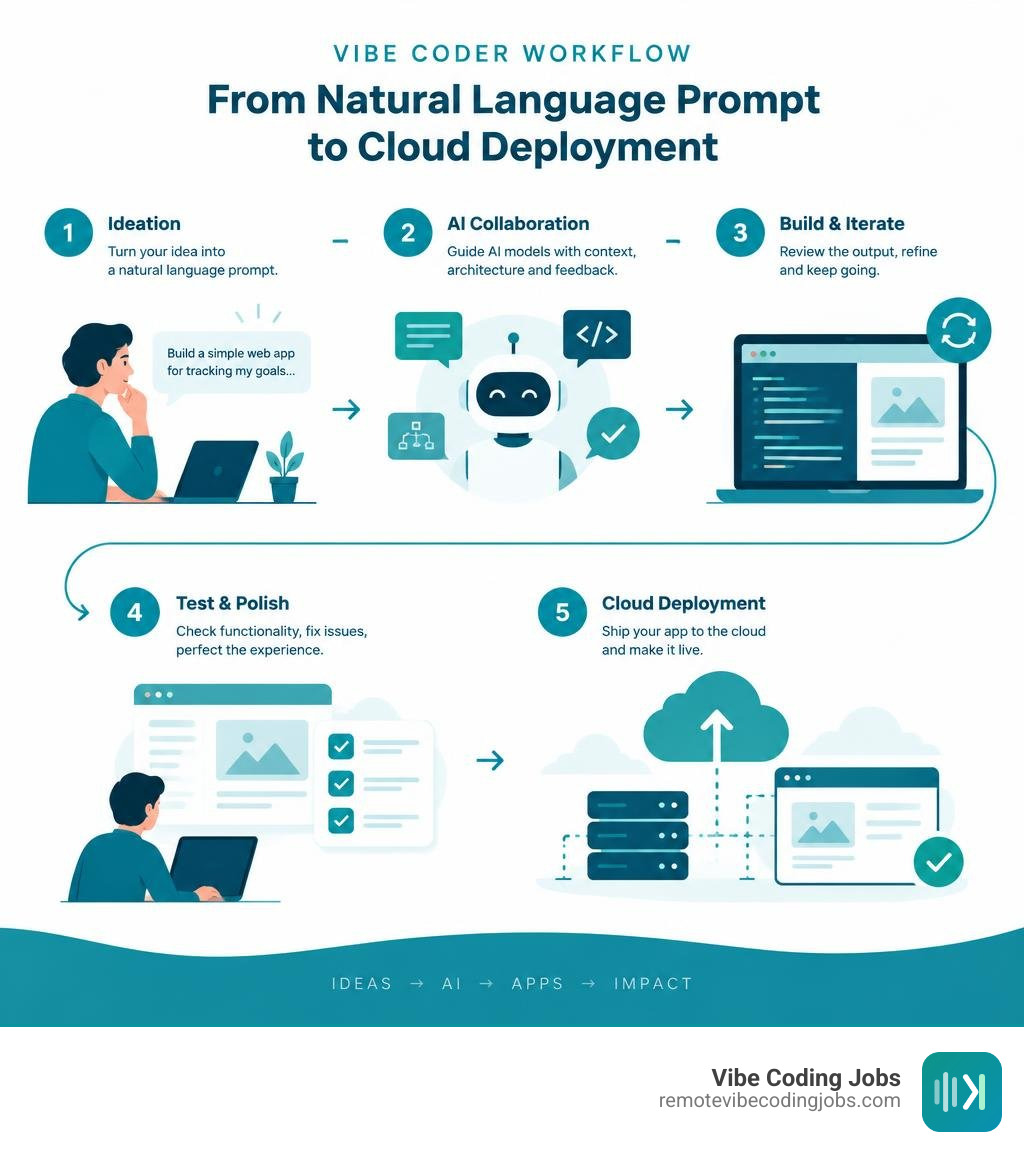
This evolution is fundamentally changing the engineering career path. As we detail in our guide on from writing code to managing agents, the modern builder acts as a product architect who guides autonomous agents. Modern startups are building smaller, hyper-leveraged teams where an individual developer can conceive, build, and deploy an entire feature in hours rather than weeks.
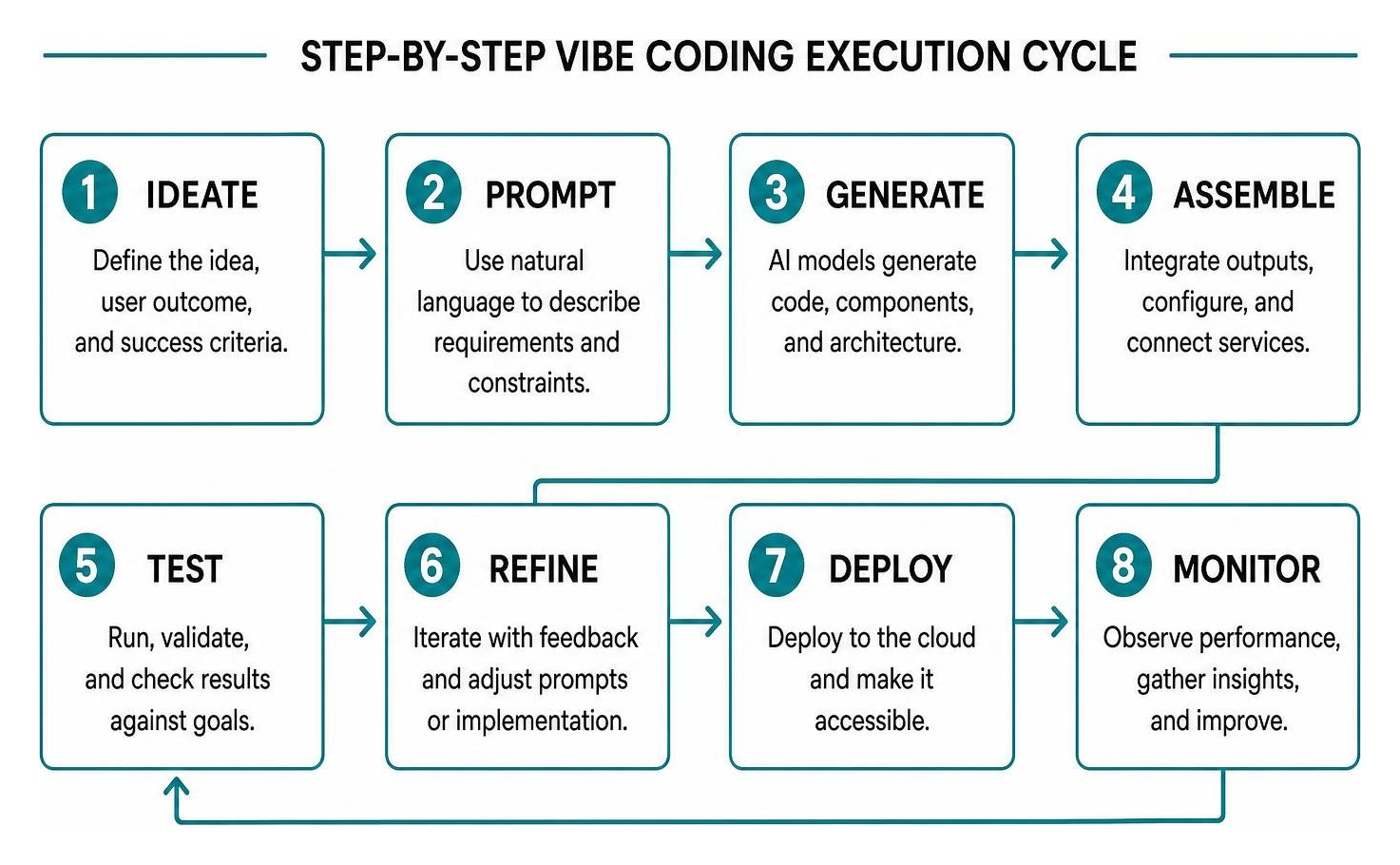
The sudden surge in hiring demand comes down to pure business velocity. Early-stage startups and lean enterprise teams are replacing months-long sprint cycles with async-first execution. When an engineer can generate an interactive prototype in a single afternoon using tools like Claude, Cursor, and v0, companies reduce their time-to-market dramatically while eliminating the friction of traditional multi-tier handoffs between product, design, and backend teams.
Which Companies and Industries Are Hiring Vibe Coders Today?

Hiring for AI-assisted engineering roles has expanded across every tier of the tech ecosystem. From venture-backed incubators to enterprise tech giants, teams are actively rewriting their job listings to attract developers who build with AI rather than fighting against it.
A growing number of innovative tech organizations have established dedicated positions. For example, growth leaders at AI-first product companies are launching formal Vibe Coder in Residence programs to accelerate experimental growth loops.
You can explore a curated breakdown of organizations actively recruiting in our directory of companies hiring vibe coding experts. The job opportunities generally fall into three primary industry segments:
Early-Stage Startups and Incubators
Seed-stage and Series A startups are the largest employers of vibe coders. In these environments, product-market fit is a race against time, making rapid prototyping the most valued skill.
Startups frequently hire for hybrid roles where an engineer manages the entire product surface:
- Forward Deployed Engineers: Fast-moving startups hire forward-deployed engineers to pair directly with users, prototype custom features on the fly, and scale functional apps. Many of these programs start with structured stipends and direct pathways to full-time roles.
- Product Builders and Founders’ Associates: Teams hire technical generalists who use AI to build internal dashboards, user onboarding flows, and customer-facing experiments without waiting for sprint planning meetings.
- Async-First Full-Stack Engineers: Companies hire full-time remote vibe coders who work across modern stacks (Python FastAPI, React, Next.js, and Firebase) in asynchronous workflows free of daily standups or ticketing overhead.
Digital Agencies and Product Studios
Digital agencies and software consultancies operate on client delivery speed and margin efficiency. By integrating AI-assisted tooling into their core workflows, agencies build custom client platforms, SaaS products, and workflow automation tools 3x to 10x faster than legacy dev shops.
Agencies hire specialized product developers who use Cursor and Next.js to deliver enterprise-grade applications for global clients. Similarly, freelance listings recruit worldwide remote talent for flexible 5 to 15-hour sprint blocks to build MVPs and experimental features on demand.
Enterprise and Tech Giants
Enterprise organizations are systematically adding AI-assisted development criteria to their job descriptions. Rather than always using the informal “vibe coder” title, major companies integrate these skills into traditional engineering, design, and security roles.
A search across live listings reveals companies like Amazon, TikTok, Adobe, Cisco, and Wipro seeking professionals skilled in prompt-assisted development for roles including:
- DFIR Automation Engineers: Automating security incident response using prompt-engineered backend scripts.
- Product and UX Platform Designers: Utilizing AI coding tools to produce production-grade React components directly from design concepts, bypassing static mockups.
- Backend Tech Leads & Solution Architects: Designing scalable cloud architectures while leveraging LLM-based code generators to build API integrations and microservice scaffolds.
What Skills, Tools, and Tech Stacks Do Employers Look For?
Landing a vibe coding role requires a balanced mix of technical foundations and advanced AI orchestration. Employers are not looking for people who blindly copy and paste raw AI outputs; they seek builders who know how to construct precise prompts, evaluate generated logic, debug edge cases, and ensure production readiness.
To stay competitive, you must master the modern ecosystem detailed in our breakdown of ai coding tools for vibe coders.
| Capability | Traditional Software Engineer | Vibe Coder / AI-Native Developer |
|---|---|---|
| Primary Input | Manual syntax, line-by-line code | Natural language prompts, system context, architectural constraints |
| Core Leverage | Memory management, algorithm design | Prompt engineering, context caching, model orchestration |
| Development Speed | Days or weeks per feature | Hours or single-day turnarounds |
| Testing Approach | Manual unit test writing | AI-generated test suites verified with automated CI/CD checks |
| Design Handoff | Static Figma mockups translated manually | Direct prompt-to-component UI generation with Tailwind CSS |
| Debugging Method | Step-through debuggers and logs | Log analysis via LLM agents, automated error remediation |
Core AI Tooling Stack
Employers expect candidates to demonstrate day-to-day fluency with modern AI-first development environments:
- AI-Native IDEs: In-depth mastery of Cursor IDE, Claude Code, and GitHub Copilot. Employers frequently target candidates with dedicated experience in cursor and copilot developer jobs.
- Rapid UI & Full-Stack Generators: Fluency with tools like v0 by Vercel, Lovable.dev, and Replit Agent for generating responsive frontend interfaces and initial application scaffolding.
- Context Management: Understanding how to structure
.cursorrulesfiles, isolate component context, and manage token limits to prevent model hallucinations.
Foundational Web & API Technologies
While AI handles syntax generation, employers still evaluate your ability to understand modern web architecture:
- Modern JavaScript & TypeScript: Understanding component lifecycles, typing, and async operations.
- Frontend Frameworks: Deep familiarity with React, Next.js (App Router), and Tailwind CSS for rapid UI styling.
- Backend & Serverless Infrastructure: Working with Python FastAPI, Node.js, and serverless backends like Supabase and Firebase.
- Third-Party API Integration: Seamlessly connecting external services such as Stripe for payments, Twilio for communication, and OpenAI/Anthropic APIs for intelligence layers.
- Human Oversight & Verification: Writing automated unit tests, validating security protocols, sanitizing inputs, and maintaining clean git histories.
What Are the Typical Salaries and Compensation Packages for Vibe Coders?
Compensation for vibe coders varies across contract types, company maturity, and geographic location. Because vibe coding spans freelance sprints, high-equity startup roles, and enterprise positions, compensation packages take several distinct forms.
For a comprehensive breakdown of market data across experience levels and regions, review our remote vibe coding salary guide.
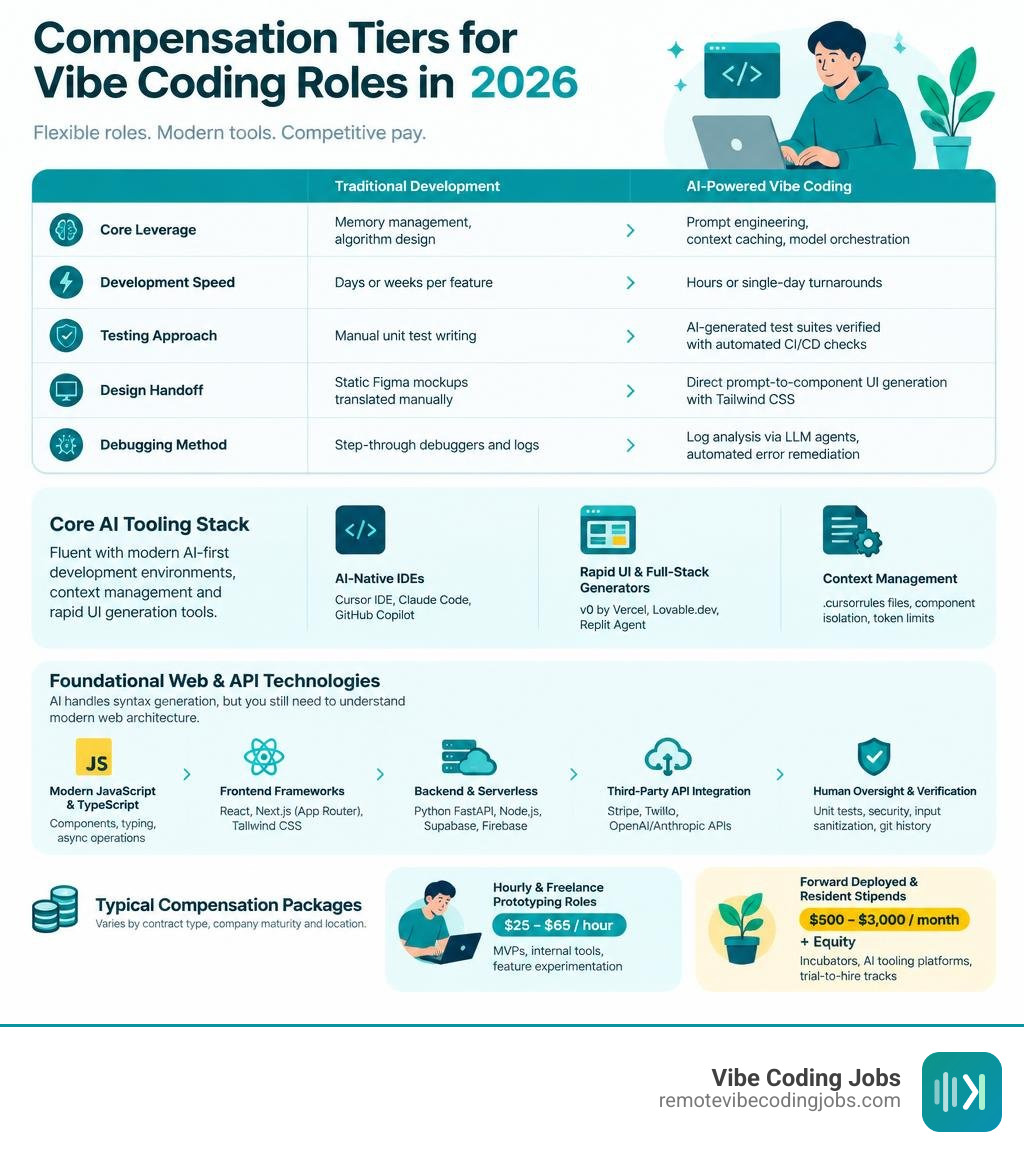
1. Hourly & Freelance Prototyping Roles ($25 – $65 / hour)
Freelance and part-time positions often focus on rapid MVP creation, internal tools, and feature experimentation. Entry-level technical assistants and freelance contractors generally earn between $25 and $45 per hour. Experienced freelance builders who deliver fully deployed web applications within short 10-hour sprint blocks frequently command $50 to $65+ per hour.
2. Forward Deployed & Resident Stipends ($500 – $3,000 / month + Equity)
Early-stage incubators and AI tooling platforms frequently offer forward-deployed engineer roles or “vibe coder in residence” tracks. These roles often start as structured part-time stipends designed as trial-to-hire funnels that quickly scale into full-time engineering packages with equity upon meeting milestone deliverables.
3. Full-Time Remote Salaries ($85,000 – $165,000 / year)
Full-time vibe coding and AI-assisted development positions at venture-backed startups and growth SaaS companies offer competitive salaries comparable to traditional mid-to-senior engineering roles. These positions typically include:
- Base Salary: $85,000 to $130,000 for mid-level product builders; $130,000 to $165,000+ for senior technical leads.
- Health & Equipment Perks: Generous home office and hardware budgets (e.g., dedicated budgets for Mac workstations and AI tool subscriptions).
- Time Off & Flexibility: Generous paid time off (frequently 28+ days PTO) with completely async-first, self-directed working hours.
How Can You Land a Remote Vibe Coding Job in 2026?
Breaking into the AI-assisted development space requires a different strategy than the traditional engineering hiring playbook. Resume buzzwords and memorized algorithms matter far less than tangible proof of your ability to ship functional products rapidly.
To navigate this transition successfully, follow the step-by-step framework in our guide on how to get a vibe coding job.
Creating a Live Product Portfolio
The most effective asset you can bring to an interview is a portfolio of live, deployed applications. Hiring managers evaluating vibe coders want to interact with working software rather than browsing abandoned GitHub repos.
When constructing your portfolio:
- Ship 3 to 5 Full-Stack Apps: Build and deploy practical applications on Vercel, Netlify, or Cloudflare that solve concrete user problems (e.g., an automated lead generation dashboard, a specialized AI text processor, or a micro-SaaS tool).
- Include Architecture and Prompt Logs: Document the prompts, system context rules, and architectural decisions you used to build each feature. This demonstrates that you steer AI deliberately rather than relying on random iterations.
- Showcase End-to-End Execution: Demonstrate clean UI design using Tailwind CSS, seamless API integrations with Stripe or Supabase, and error-free user flows.
Navigating Alternative Technical Interviews
Traditional tech interviews often force candidates through multi-hour algorithmic puzzles on whiteboards. In contrast, companies hiring vibe coders favor practical, real-world evaluations.
You can streamline your job search by specifically targeting remote coding jobs with no leetcode assessments. The evaluation process typically consists of:
- Live AI Pairing Sessions: You will be given a vague product specification and asked to build and deploy a working feature within 60 to 90 minutes using your preferred AI tools (like Cursor or Claude).
- Asynchronous Take-Home Prototypes: Building a micro-application over a weekend to evaluate your speed, design instincts, and code architecture.
- Code Review & Security Audits: Reviewing AI-generated code to identify security vulnerabilities, unnecessary dependencies, and performance bottlenecks.
At RemoteVibeCodingJobs, we curate verified, daily remote listings from companies actively seeking AI-fluent developers, making it easy to discover async-first roles tailored to your tech stack.
Frequently Asked Questions About Vibe Coder Job Opportunities?
Is vibe coding a sustainable long-term career path?
Yes, but the role will continue to mature. Vibe coding is not a temporary gimmick; it represents the natural abstraction layer of software engineering. Just as developers moved from assembly language to high-level languages like C and Python, engineers are now moving from manual line-by-line syntax to natural language orchestration and agent management.
As detailed in our analysis of vibe coding remote career paths, long-term career growth will belong to builders who combine deep domain expertise, strong product intuition, and system architecture skills with mastery over autonomous AI agents.
Do I need a computer science degree to get hired as a vibe coder?
No. The vast majority of companies hiring vibe coders value shipping velocity and functional output far above formal credentials. Product-minded individuals, self-taught builders, designers, and career switchers who master AI-assisted workflows frequently outperform traditional candidates because they focus on delivering complete user solutions rather than getting stuck on academic syntax constraints.
How do companies manage security and code quality with AI-generated code?
Security and maintainability remain the primary criticisms of unguided AI development. Production-grade companies address this by requiring human-in-the-loop oversight.
To maintain high standards, teams implement:
- Automated Static Analysis: Running automated vulnerability scanners and linters on every pull request.
- Strict Architecture Boundaries: Isolating AI-generated components within sandboxed microservices or modular directory structures.
- Mandatory Test Coverage: Requiring unit and integration tests to validate that AI-generated logic handles edge cases and sanitizes all user inputs before deployment.
Is Vibe Coding the Future of Software Engineering?
The software engineering industry is undergoing its most profound transformation in decades. Writing code line-by-line is rapidly becoming an inefficient way to build products. Companies no longer want to wait weeks for simple features when an AI-augmented developer can deliver the same outcome before the end of the day.
The developers who thrive in this new landscape are those who embrace AI orchestration early. By combining foundational technical literacy with cutting-edge tools like Cursor, Claude, and Next.js, you position yourself at the forefront of the modern remote workforce.
Explore the latest curated listings, discover async-first teams, and start applying for your next role on RemoteVibeCodingJobs today.