The Vibe is Gone: Why Prompt Engineering Might Be a Dead End
Is Vibe Coding Dead? Here’s the Honest Answer in 2026
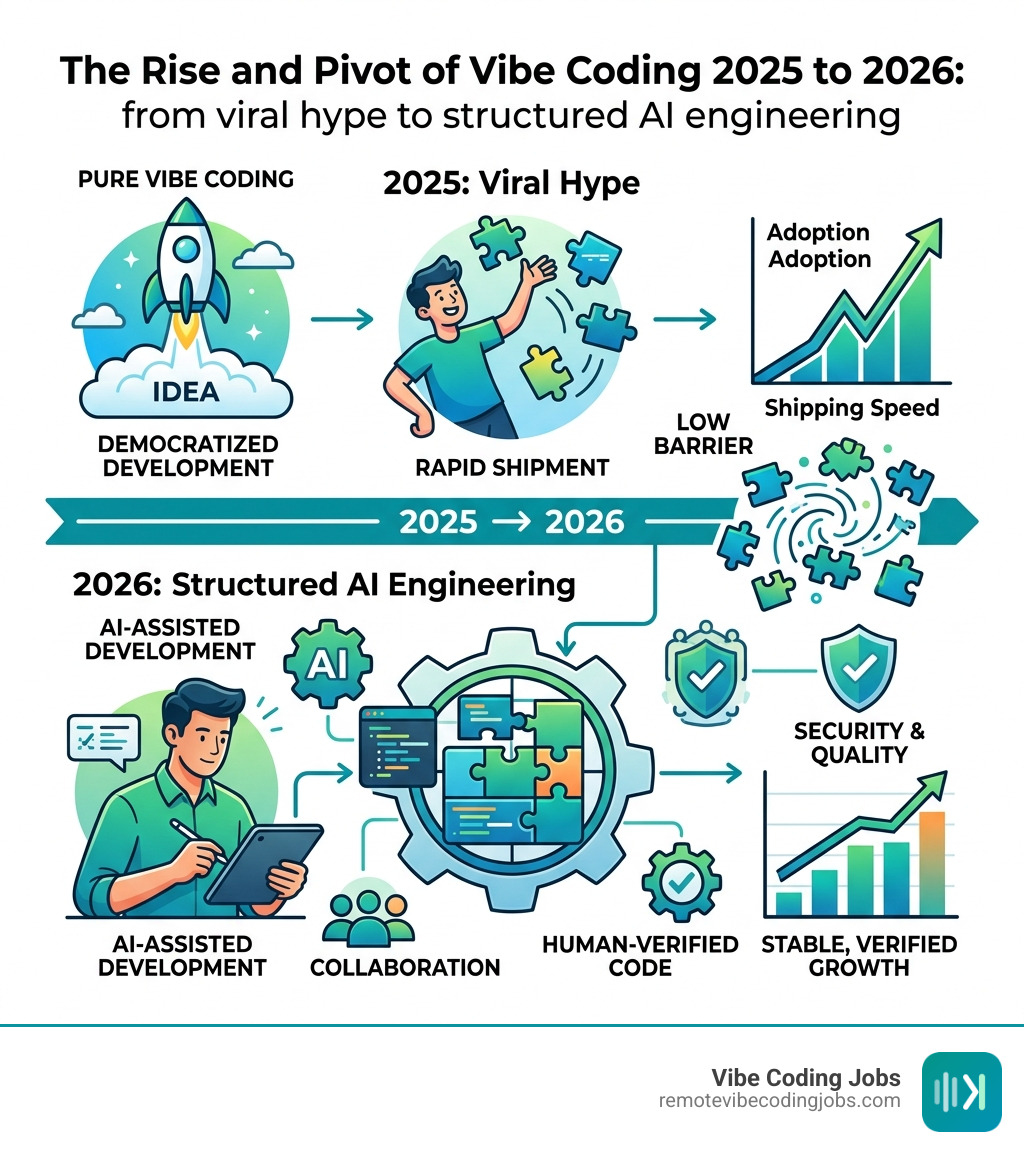
Is vibe coding dead? Not exactly — but the version that went viral in early 2025 is. Here’s the short answer:
- Pure vibe coding (prompting AI and shipping without review) is declining fast
- AI-assisted development (hybrid, structured, human-verified) is growing and maturing
- The hype has collapsed; the practice has evolved
- Most professional developers now use AI as a tool, not a replacement for engineering judgment
In February 2025, Andrej Karpathy — former Tesla AI director and OpenAI co-founder — described a new way of working: leaning fully into AI suggestions, accepting outputs without deeply scrutinizing them, letting the “vibes” guide the build. The tech world ran with it. Within weeks, a wave of founders, designers, and first-time builders were shipping apps without writing a single traditional line of code.
The promise was enormous. Anyone could build software. Teams of engineers could be replaced by a good prompt and an afternoon. The democratization of development felt real.
Then reality showed up.
By mid-2026, usage data tracked by investors like Chamath Palihapitiya showed a clear decline after that initial spike. AI-generated code was found to contain 1.7 times more critical issues than human-written code. Security vulnerabilities, unmaintainable codebases, and a flood of indistinguishable “AI slop” products began to define the downside of the vibe.
The question stopped being “should I vibe code?” and became “what comes next?”
We’re the RVCJ Editorial team at Remote Vibe Coding Jobs — we cover AI-assisted development, hiring trends, and the tools shaping how developers build and ship in 2026, which means the question of is vibe coding dead sits right at the center of what we track every day. Here’s what the data and the practitioners are actually telling us.
The Data-Driven Decline: Is Vibe Coding Dead?

If we look at the cold, hard numbers, the “vibe” era is currently in a correction phase. Investor Chamath Palihapitiya recently shared a chart on X that sent shockwaves through the tech community: after a vertical ascent in early 2025, the usage of pure vibe coding tools has been on a steady decline for months. The initial euphoria, where every “idea guy” with a Claude subscription thought they were a CTO, has met the brick wall of production reality.
Critics like Gary Marcus have long argued that vibe coding is fundamentally unreliable for complex software. The argument is simple: AI models are excellent at pattern matching but lack a world model or a deep understanding of logic. When you “vibe” a project, you are essentially gambling that the AI’s most probable next token aligns with your project’s specific, unique requirements. As we move deeper into 2026, the market is suffering from “AI slop”—an oversaturation of generic, indistinguishable applications that all look and feel like they were birthed from the same template.
According to our State of Vibe Coding 2026 report, the industry is shifting away from this “prompt-and-pray” methodology. The novelty has worn off, and what remains is a sobering realization: speed of creation does not equal value of the product.
The Data Behind Why People Ask: Is Vibe Coding Dead?
The skepticism isn’t just an “old guard” developer reaction; it’s backed by rigorous analysis. A study by CodeRabbit analyzed hundreds of open pull requests and found that AI-assisted code contained approximately 1.7 times more critical issues than human-written code. This isn’t just about minor bugs; we are talking about logic failures that can bring down entire systems.
As noted in a popular Medium piece by Mudit Rajput, many professional developers are actually celebrating this decline. Why? Because the “vibe” trend created a massive influx of technical debt that senior engineers are now being hired to clean up. The “illusion of productivity” led many companies to believe they could bypass the cost of experienced talent, only to find that they had spent six months building a “prison they couldn’t escape”—a codebase so messy that even the AI that wrote it couldn’t fix it anymore.
The 20,000 Line Ceiling
We’ve observed a recurring phenomenon in the industry: the 20,000-line ceiling. Vibe coding works beautifully for greenfield projects, MVPs, and simple landing pages. However, once a codebase reaches a certain level of complexity (typically between 10k and 20k lines of code), the “vibe” starts fighting back.
Without a solid architectural foundation, adding a new feature often breaks three unrelated things. This leads to what we call the “maintenance black-box.” When you don’t understand the code the AI generated for you, you can’t debug it when things go south. This Vibe Coding vs Traditional Development friction is the primary reason many startups founded in 2025 are currently undergoing massive rewrites in 2026.
Why “Vibes” Failed the Production Test
The transition from a “cool demo” to a “production-grade app” is where the is vibe coding dead narrative gains the most traction.
| Feature | Vibe Coding (Pure) | Traditional Engineering |
|---|---|---|
| Speed to MVP | Extremely High | Moderate |
| Security Posture | Low (High Vulnerability) | High (Audited) |
| Maintainability | Very Low | High |
| Scalability | Fragile | Robust |
| Cost (Initial) | Low | High |
| Cost (Long-term) | High (Technical Debt) | Predictable |
Research from the Global Tech Council highlights that while AI tools can automate up to 79% of coding tasks, the remaining 21% is where the reliability and security of the application live. Pure vibe coding often ignores that critical 21%. A University of Naples study on over 500,000 code samples found that AI-generated software showed a sharp increase in security vulnerabilities, specifically around command injection and hardcoded-secret issues.
Security Risks That Prove Why Is Vibe Coding Dead for Enterprise
For enterprise-level applications, the risks are simply too high. Georgetown CSET research found that 45% of AI-generated code contains real, exploitable security vulnerabilities. We’ve seen reports of startups shutting down in early 2026 because their AI-generated backends were hit with SQL injection attacks that a junior developer with three months of training would have caught.
The difference in Vibe Coding vs Traditional Software Engineering comes down to verification. Vibe coders often accept “unverified output,” assuming that if the UI looks good, the logic is sound. In reality, AI-generated code failed XSS defense tests 86% of the time in recent benchmarks. This lack of structural integrity is why “vibe coding” as a standalone profession is being replaced by more rigorous roles.
The Homogenization of Software
Beyond the technical failures, there is a “soul” problem. Critics like Michal Malewicz argue that vibe coding has led to a homogenization of the web. Because AI models are trained on existing data, they tend to produce the “average” version of any given request.
This has created an “IKEA-effect” in software: everything is functional, but it’s all made of the same digital particle board. We are seeing a loss of brand voice and a flood of commoditized UIs that look identical. When building becomes effortless, the intrinsic value of the output often drops. For a business to stand out in 2026, it needs more than just a “vibe”—it needs intentional, unique design and architecture.
From Vibe Coding to Vibe Engineering: The 2026 Pivot
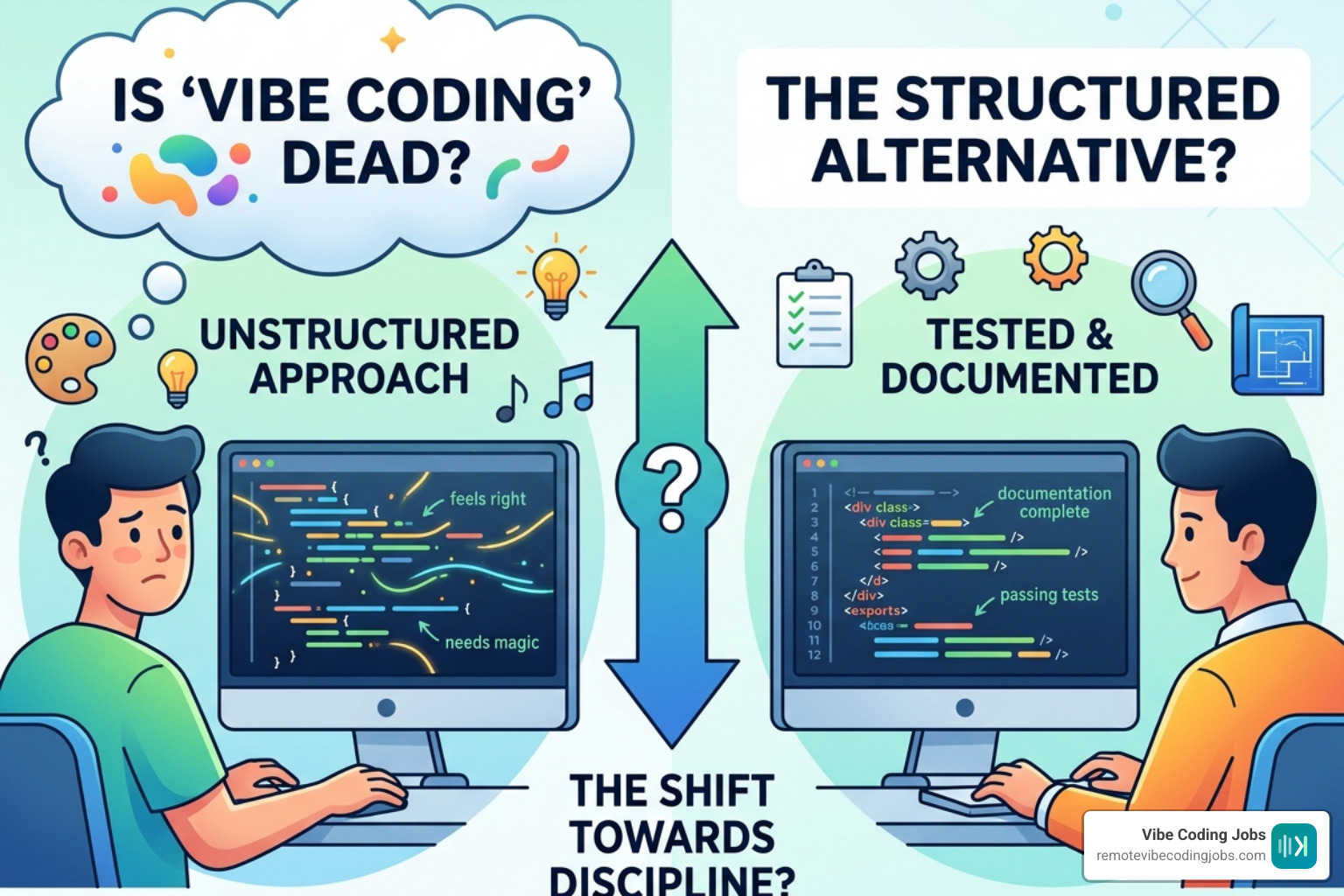
So, if the original trend is dying, what is replacing it? We are seeing the birth of “Vibe Engineering.” This is the professional evolution of the trend. It’s no longer about just prompting; it’s about intent-first development backed by engineering rigor.
Tools like Copilot and Cursor are more popular than ever, with Cursor crossing 500,000 active monthly users in Q1 2026. However, the way people use them has changed. We are moving toward specification-first AI, where you don’t just ask for a “login page,” but you provide a detailed data model, API contracts, and security requirements before the AI ever writes a line.
Why the “Is Vibe Coding Dead?” Narrative Misses the Evolution
The “death” of vibe coding is actually just a rebranding. Successful developers in 2026 use hybrid workflows. They use AI to scaffold the “plumbing” of an app but manually write the critical business logic.
A key part of this evolution is the integration of Test-Driven Development (TDD). By writing tests first, developers give the AI a “feedback loop.” If the AI’s “vibe” doesn’t pass the test, it’s rejected. This human-in-the-loop approach uses essential AI tools to increase speed by 2.5x without sacrificing the security that enterprises demand.
The Rise of the “Verifier” Role
In 2026, the job description for a “Vibe Coder” looks very different than it did a year ago. Companies are no longer looking for “prompt engineers”; they are looking for “Verifiers.” These are professionals who understand system design and architecture well enough to review AI output with a critical eye.
As highlighted in our guide on how to get a vibe coding job, the most valuable skills now are:
- Architectural Judgment: Knowing how components should fit together.
- Security Auditing: Finding the “hallucinated” vulnerabilities AI leaves behind.
- Debugging: Fixing the 21% of tasks the AI gets wrong.
Interestingly, this has kept vibe coding salaries high for those who possess both AI fluency and traditional engineering foundations.
Frequently Asked Questions about Vibe Coding
What exactly is vibe coding and who started it?
Vibe coding was popularized by Andrej Karpathy in February 2025. It refers to a style of development where the programmer (or non-programmer) uses natural language prompts to drive the creation of software, focusing on the “vibe” or high-level intent rather than the syntax of the code. You can find a deeper dive in our article: What is Vibe Coding.
Can non-technical users build production apps with AI?
While tools like Replit Agent and v0 have made it possible to build functional prototypes in minutes, maintaining a production-grade app remains a challenge for the non-technical. As Codavyn points out, the “prototype-to-production” gap is the biggest hurdle. Without understanding the underlying code, non-technical users often hit a wall when they need to scale, secure, or deeply customize their applications.
Should I still learn traditional programming in 2026?
Absolutely. In fact, learning to program is more valuable now than it was five years ago. AI has raised the floor, but it hasn’t lowered the ceiling. To effectively lead an AI “assistant,” you must understand the language it speaks. The best developers in 2026 are those who can “vibe” the UI but “engineer” the architecture.
Conclusion: The Death of a Meme, the Birth of a Discipline
So, is vibe coding dead?
The meme is dead. The “get rich quick” scheme of building SaaS apps in an afternoon with zero knowledge is dead. The era of “prompt engineering” as a standalone career is dead.
But the discipline of AI-assisted engineering is just getting started. We are seeing a shift from “vibing” as a hobby to “vibe engineering” as a professional standard. In startups founded in late 2025 and 2026, AI-assisted code now represents 60-70% of the total codebase, but it is code that is reviewed, tested, and architected by humans.
At Remote Vibe Coding Jobs, we see this shift every day in the roles our partners are hiring for. They aren’t looking for people who can just type a prompt; they are looking for engineers who can leverage AI to do the work of three people while maintaining the quality of a ten-person team.
The future isn’t about choosing between “trad coding” and “vibe coding.” It’s about integration. The “vibe” isn’t gone—it’s just finally getting the engineering foundation it needs to survive in the real world.
If you’re ready to find your place in this new era of future AI coding jobs, we’re here to help you navigate the transition.