
How to Land High Paying Remote Tech Careers in 2026
The Real State of Software Engineer Jobs in 2026 (And How to Land a Remote One)
Software engineer jobs are everywhere right now — but knowing where to look and how to stand out is harder than ever.
Here’s a quick snapshot of the current market:
| Category | Numbers |
|---|---|
| Total U.S. software engineer jobs | 59,000+ |
| Entry-level roles available | 12,119 |
| Remote positions | 15,064 |
| Hybrid positions | 11,977 |
| On-site positions | 33,255 |
| Top city (San Francisco) | 2,802 jobs |
| Entry-level Bay Area salary range | $90K–$475K |
The market is large, but it’s uneven. Remote roles make up roughly a quarter of all listings. Entry-level spots are competitive. And senior engineers with the right AI-adjacent skills are commanding serious compensation.
If you’re a developer looking to cut through the noise and find verified remote roles that match your stack and experience level, this guide is built for you.
We cover demand, salaries, skills, top employers, and exactly how to apply smarter — not just harder.
I’m RVCJ Editorial, the team behind Remote Vibe Coding Jobs, where we track AI-assisted development trends, remote hiring patterns, and career strategies for engineers working with tools like Cursor, Claude, and Copilot — including the full landscape of software engineer jobs across async-first, AI-forward teams. We’ve curated thousands of remote developer roles and we know what separates the candidates who land offers from those who don’t.
1. Software engineer jobs in 2026: where the demand is highest
The short version: demand is still strong, but the market is more selective than it was a few years ago.
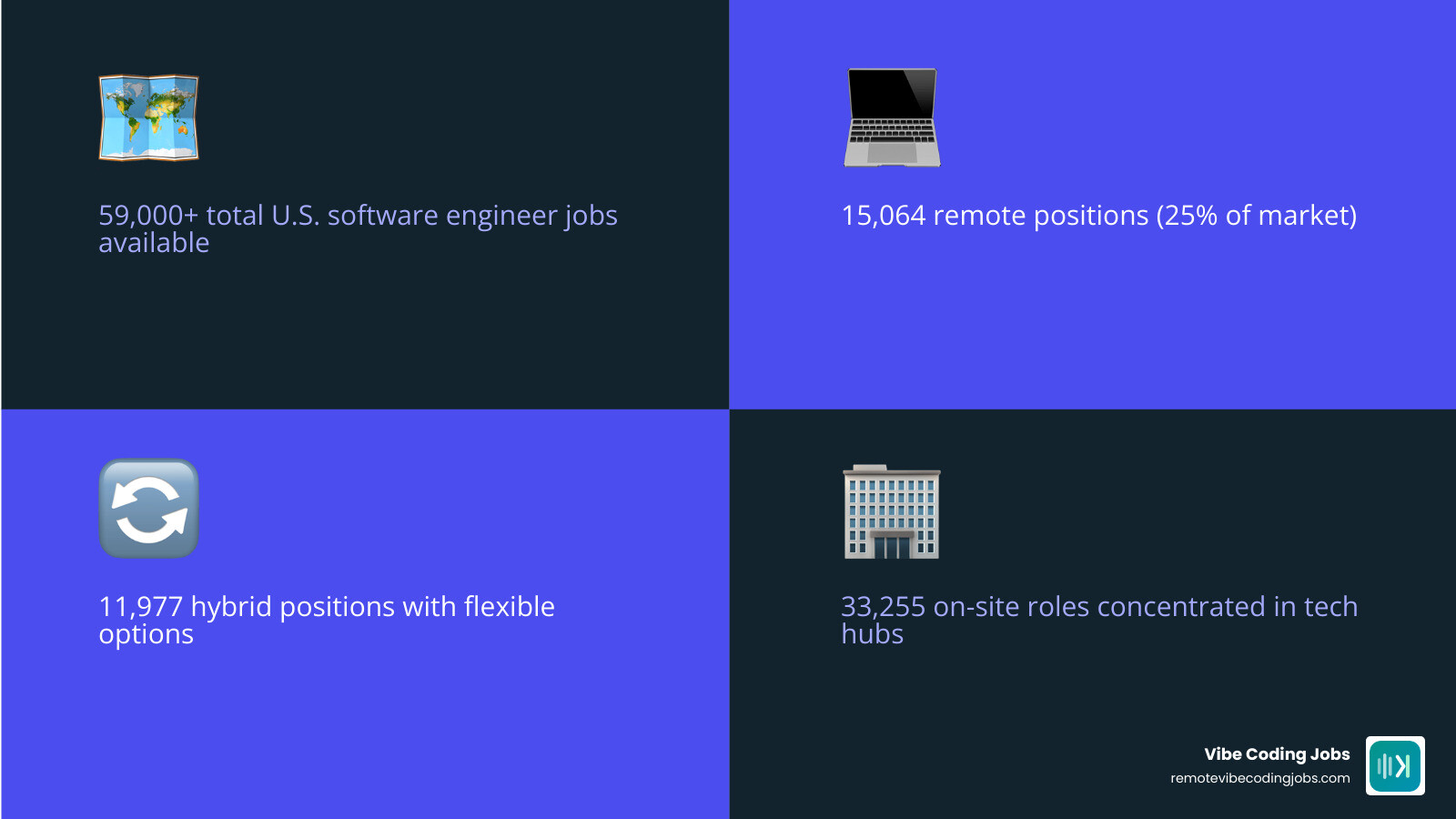
With 59,000+ software engineer openings in the U.S. and 12,119 entry-level roles, employers are still hiring at scale. What changed is not whether jobs exist, but how picky hiring teams have become. Many companies want engineers who can contribute faster, work across systems, and collaborate well in distributed environments.
Remote work is still a major slice of the market too. Out of the current listings:
- 15,064 are remote
- 11,977 are hybrid
- 33,255 are on-site
That tells us something important: remote work is real, but it is not automatic. Candidates who search lazily get buried. Candidates who search strategically have a real shot.
Why software engineer jobs are still growing despite a tougher entry-level market
A lot of developers ask us the same question: if the market is healthy, why does entry level feel brutal?
Because both things can be true at once.
Here is what we are seeing in 2026:
- Companies are still investing in software because every industry runs on it
- Hiring bounced back unevenly after layoffs and budget resets
- Teams are smaller, so each hire is expected to do more
- AI tools increased productivity, which raised expectations for output
- Employers are favoring specialized candidates over generalists for many roles
That creates an entry-level bottleneck. Junior candidates face more competition, while mid-level and senior engineers often see better response rates, especially in backend, platform, cloud, security, and AI-adjacent work.
The good news: entry-level roles are still there. They just require sharper positioning. A basic resume plus “I know Python” is no longer enough. Harsh, yes. Fixable, also yes.
The Bureau of Labor Statistics Occupational Outlook for Software Developers continues to project strong long-term growth for software development roles, reinforcing that the career path remains solid even as short-term competition fluctuates.
Which cities and regions have the most software engineer jobs
Even in a remote-first era, job concentration still matters because it influences salary bands, networking density, and the number of employers hiring at once.
The biggest city-level concentrations in the research are:
- San Francisco: 2,802 jobs
- New York: 2,801 jobs
- Seattle: 1,434 jobs
These hubs still dominate for software hiring because they have dense clusters of startups, cloud companies, enterprise tech teams, and venture-backed product organizations.
Broader state-level searches also show strong volume in large markets such as Software Engineer jobs in California – Indeed and Texas, while smaller but active markets exist elsewhere too, including places like Software Engineer jobs in Indiana – LinkedIn.
For remote job seekers, these hubs still matter even if you never move there. Why? Because many remote salary bands are anchored to major tech markets. The Bay Area premium may still influence what a national remote company is willing to pay.
How remote, hybrid, and in-office software engineer jobs compare
The current split shows that on-site work remains the largest category, followed by remote, then hybrid.
What we take from that:
- On-site roles still dominate in legacy enterprises and hardware-adjacent teams
- Hybrid is common for larger employers that want some in-person collaboration
- Remote is strongest in async-first software companies, infrastructure teams, and globally distributed startups
Remote roles are usually more competitive because they attract applicants from everywhere. But they also tend to reward written communication, ownership, documentation habits, and async collaboration skills more than office charisma. Good news for people who prefer pull requests to conference room theater.
For remote-first engineers, that means we should not only search for “remote software engineer.” We should also look for signals like:
- Async-first culture
- Written documentation
- Distributed teams
- Clear technical stack
- AI-assisted workflows
- Outcome-based performance expectations
2. The highest-paying software engineer jobs by level, location, and specialization
Pay in software engineering is still strong in 2026, but compensation varies wildly by level, specialty, and location.
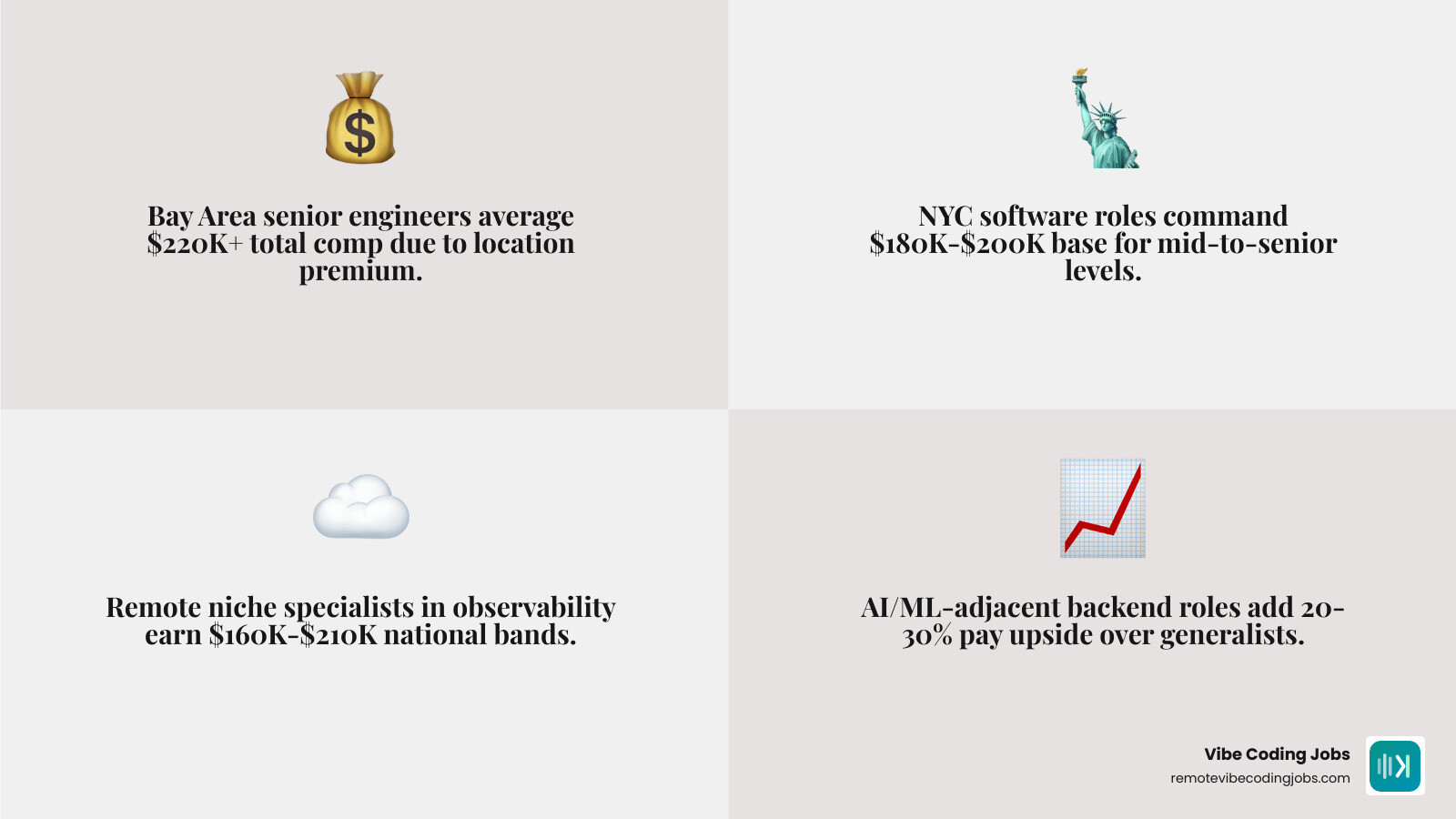
The research gives us one especially eye-catching stat: entry-level software engineer salaries in the San Francisco Bay Area can range from $90K to $475K annually. That wide spread is a reminder that “salary” can mean very different things depending on whether we are talking about base pay only or total compensation including bonus and equity.
Here is a practical pay framework for 2026:
| Level | Typical pay pattern |
|---|---|
| Entry-level | Lower base, high variance, sometimes strong equity upside |
| Mid-level | More stable pay, broader access to remote roles |
| Senior | Large jump in base pay, plus bonus/equity in many companies |
| Staff | Highest upside, especially in platform, infra, AI, and cloud systems |
Entry-level software engineer jobs salary expectations in 2026
For 0-2 years of experience, pay depends on three big factors:
- Company type
- Market salary band
- Whether equity is meaningful
Entry-level candidates at startups may see lower cash and more upside-heavy equity. Enterprise and large tech employers may offer more structured compensation. In top-paying hubs, compensation can get very high, but that is not the norm for every junior role.
What matters more than chasing the biggest number is understanding total comp:
- Base salary
- Signing bonus
- Annual bonus
- Equity or stock grants
- Benefits and stipends
For remote roles, entry-level pay is often geo-adjusted. Some companies pay one national band. Others still anchor pay to where you live. So two developers doing similar work can get different offers. Annoying? Yes. Common? Also yes.
Senior and staff software engineer jobs with the biggest pay upside
The highest upside is usually in roles where business impact and technical complexity are both high. That includes:
- Backend platform engineering
- API product engineering
- Observability
- Cloud infrastructure
- Distributed systems
- Security engineering
- AI product development
- Developer experience
A representative example from current market research is a senior API product engineering role with a base salary range of $144,840 to $210,000 for a U.S.-based senior position. It also reflects the kind of stack employers are rewarding right now: Java, Spring Boot, data systems, cloud infrastructure, observability, and AI/ML adjacency.
We are also seeing strong demand in remote infrastructure and observability roles such as:
- Grafana Labs Staff Software Engineer – Grafana Cloud Observability Kubernetes
- Grafana Labs Staff Backend Engineer – Databases Pyroscope
- Grafana Labs Senior Software Engineer – Observability Knowledge Graph Backend
These are exactly the kinds of roles where experienced engineers can command premium compensation because the work touches reliability, scale, and core product infrastructure.
How geography changes pay for software engineer jobs
Geography still shapes compensation in three ways:
- Local market rates
- Cost of living assumptions
- Company pay philosophy
The Bay Area, New York, and Seattle remain strong pay markets because they combine dense hiring with expensive labor markets. But remote work changed the equation. Many companies now use one of these models:
- Fully location-based pay
- National pay bands
- Tiered geographic bands
- Premium pay for hard-to-fill specialties regardless of location
For job seekers, the practical takeaway is simple: remote can absolutely pay well, but niche skills matter more than zip code. If you bring scarce expertise in platform engineering, observability, cloud systems, or AI-enabled products, you have more leverage than a generalist competing in a crowded lane.
3. Skills that unlock more interviews for software engineer jobs
When we review current postings, the same skill clusters keep showing up again and again.
The most in-demand technical areas include:
- Java
- Python
- JavaScript
- TypeScript
- Go
- SQL
- API design
- AWS
- Kubernetes
- Terraform
- Observability
- System design
- CI/CD
- Distributed systems
- AI integration
These skills are especially common in higher-paying remote roles because distributed teams need engineers who can work independently on complex systems.

The programming languages and frameworks employers want most
The research-backed stack patterns are pretty clear.
For backend and platform work:
- Java with Spring or Spring Boot
- Python for backend services and AI-adjacent systems
- Go in cloud and infrastructure roles
- SQL across almost everything
For full-stack roles:
- TypeScript
- React
- Node.js
For data and systems:
- PostgreSQL
- Redis
- DynamoDB
The API-focused senior posting in the research also highlights modern infra tools like Kubernetes, AWS, Terraform, Datadog, Helm, and Cloudflare. That is a strong signal that employers are not just hiring coders. They are hiring engineers who understand runtime behavior, deployment, scalability, and service health.
Emerging trends shaping software engineer jobs in 2026
The biggest trend is not “AI replaces software engineers.” It is “AI changes the job.”
In 2026, employers increasingly want engineers who can:
- Build AI-enabled features
- Integrate LLM APIs into products
- Evaluate model behavior and tradeoffs
- Use AI tools to speed up development
- Maintain good engineering judgment while using automation
We also see growing demand for:
- Developer experience engineering
- Platform engineering
- Internal tooling
- Personalization systems
- Knowledge graphs
- Alerting and observability platforms
That is why roles tied to AI-assisted development and cloud-native systems are getting attention. Teams want engineers who can move fast without turning the codebase into a haunted house.
The remote-friendly stacks showing up in higher-paying roles
Higher-paying remote jobs often cluster around specialized systems work. A few examples from our own listings include:
- CloudDevs Full Stack Backend Developers – LLM Focused
- Grafana Labs Senior Frontend Engineer – Alerting
- Grafana Labs Senior Fullstack Engineer – Observability Real User Monitoring
- Grafana Labs Staff Backend Engineer – Adaptive Telemetry
These roles point to a pattern: remote-friendly, high-paying teams often work on products where clear interfaces, deep technical ownership, and measurable system impact matter more than constant meetings.
4. Industries and employers hiring software engineers right now
Software hiring is no longer just a “tech company” story. Nearly every sector with digital products or internal systems hires engineers now.
Fast-moving sectors include:
- Fintech
- Healthtech
- Marketing technology
- Cybersecurity
- Higher education
- Enterprise consulting
- Cloud software
- AI startups
Higher education is especially worth noting because it is often overlooked. Colleges and universities do hire engineers for internal systems, research support, data platforms, and digital services.
Where entry-level software engineer jobs are most likely to appear
Entry-level roles tend to show up more often in environments where teams can support growth and ramp time. That includes:
- Higher education technology teams
- Graduate programs
- Junior full-stack roles
- Support engineering
- QA-adjacent software roles
- Internal tooling teams
- Apprenticeship-style programs
For early-career candidates, this matters a lot. If we only apply to glamorous startup roles asking for “entry-level” with three years of Kubernetes and distributed systems experience, we will lose our minds. Better to target roles where learning is part of the actual plan.
Which senior software engineer jobs are open in fast-moving sectors
Senior roles are especially common in sectors where reliability, scale, and compliance matter.
Examples from the provided research include openings in:
- Marketplace or product engineering
- Security-focused engineering
- Full-stack social impact software
- Healthcare software via Pine Park Health Senior Software Engineer
The common thread is not the industry label. It is the need for engineers who can build stable systems, ship features, and make sound technical decisions.
What benefits and perks are common in current postings
Benefits have become a meaningful differentiator, especially for remote engineers.
Common perks in current software engineering listings include:
- Health insurance
- 401(k) or retirement plans
- Equity
- Bonuses
- Flexible PTO
- Parental leave
- Learning and development budgets
- Home office or remote stipends
- Employee resource groups
- Visa support in some cases
Remote-specific perks are also getting more practical. We are seeing more emphasis on async culture, documentation, autonomy, and fewer useless meetings. Frankly, “less calendar damage” should count as a premium benefit.
5. How to apply smarter and stand out for remote software engineer jobs
This is where a lot of candidates fall apart. Not because they are unqualified, but because they apply like everyone else.
The fastest way to waste a month is to mass-apply with the same resume to 200 roles and hope the algorithm feels generous.
A better approach:
- Target fewer roles with higher fit
- Match your resume to the stack and level
- Show measurable outcomes
- Use job alerts
- Track applications
- Follow up when appropriate
- Prepare examples of ownership and technical impact
How to tailor your resume for entry-level vs senior software engineer jobs
For entry-level candidates, the resume should emphasize:
- Projects with real functionality
- Internships
- Coursework only if relevant
- Open-source contributions
- Tech stack alignment
- Measurable outcomes when possible
Good entry-level framing sounds like this:
- Built X using Y, used by Z users
- Reduced page load by N%
- Automated process that saved N hours
- Shipped feature across frontend and backend
For senior candidates, the emphasis shifts to:
- System architecture
- Team leadership
- Mentoring
- Reliability improvements
- Cross-functional collaboration
- Business outcomes
- Scope and ownership
Senior resumes should communicate not just “I coded things,” but “I improved systems, teams, and results.”
How to use job platforms effectively without getting buried
Most job seekers underuse filters and overtrust search results.
A smarter workflow is:
- Set up job alerts for exact role titles and remote preferences
- Save searches by stack, level, and company type
- Sort by date posted so you are not applying to stale roles
- Create accounts where application tracking helps
- Upload a clean, keyword-aligned resume
- Track where you applied and what version you used
This approach is especially useful on platforms with alerts, resume posting, and application tracking features, including academic job boards for higher education openings.
At Remote Vibe Coding Jobs, we think curation matters too. That is why we focus on remote roles filtered by culture, stack, and AI tool usage rather than making you scroll through everything from “remote-ish” to “must live three blocks from the office.”
What makes a candidate stand out in 2026
The best candidates in 2026 usually combine technical skill with modern work habits.
What stands out now:
- Comfort with AI-assisted development workflows
- Clear written communication
- Async collaboration
- Strong documentation habits
- Product sense
- Systems thinking
- Ownership
- Portfolio depth
- Measurable results
If you want a feel for the kinds of roles where this matters, look at examples like:
- Grafana Labs Senior Fullstack Engineer – Observability Real User Monitoring
- Replit Senior DevEx Engineer
These are not “just code” jobs. They reward engineers who can improve how software gets built, shipped, monitored, and used.
Frequently Asked Questions about Software engineer jobs
Are software engineer jobs still worth pursuing in 2026?
Yes. The market is more selective, but software engineering still offers strong compensation, broad industry demand, and long-term career flexibility.
AI is changing workflows, but it is not removing the need for engineers who can design systems, reason about tradeoffs, debug complex behavior, and ship production software responsibly. In many cases, AI is increasing the value of engineers who know how to use it well.
What qualifications do entry-level software engineer jobs usually require?
Most entry-level roles ask for some combination of:
- A CS degree or related degree
- Bootcamp training or equivalent self-taught experience
- Internships
- Personal or open-source projects
- Basic coding test readiness
- 0-2 years of experience
The exact credential matters less than proof you can build, learn, and communicate. A strong portfolio plus internships can absolutely outperform a weak resume with a fancy degree.
Can you get high-paying remote software engineer jobs without living in the Bay Area?
Yes. You may not always get Bay Area top-band compensation, but high-paying remote jobs absolutely exist outside major hubs.
Your odds improve if you have:
- A niche technical specialty
- Experience with cloud-native systems
- Strong async communication
- AI-assisted workflow fluency
- Evidence of impact
- A portfolio aligned to the jobs you want
Remote national salary bands are common now, especially for specialized senior roles. The key is not where you live. It is whether your skills are hard to replace.
Conclusion: Build a targeted path to better remote software engineer jobs
The 2026 market for software engineer jobs is big, competitive, and full of opportunity if we approach it with a clear strategy.
The winning playbook looks like this:
- Focus on roles that match your actual stack and level
- Build visible proof of your skills
- Learn the tools shaping modern engineering, including AI-assisted workflows
- Prioritize remote-first and async-friendly teams when flexibility matters
- Apply consistently, but not randomly
- Track what gets responses and refine fast
If you want to explore strong remote roles right now, start with listings like Grafana Labs Senior Backend Software Engineer – Alerting and browse our curated remote engineering opportunities at Remote Vibe Coding Jobs.
We built Remote Vibe Coding Jobs for engineers who want less noise, better filters, and faster paths to real remote opportunities. If your goal is to land a high-paying remote software role in 2026, the best time to tighten your strategy is now.