
The Slang Guide to Vibe Coding for Confused Humans
“Vibe Coding” Went From Dev Joke to Dictionary Word — Here’s What It Actually Means
If you’ve stumbled across vibe coding meaning slang and wondered what on earth people are talking about, here’s the short answer:
Vibe coding means using AI tools to build software by describing what you want in plain language — no deep programming knowledge required. You “vibe” with the AI, it writes the code, and you ship.
Quick definition breakdown:
| Term | What it means |
|---|---|
| Vibe coding | Building apps or software using AI prompts instead of writing code yourself |
| Who uses it | Gen Z and Gen Alpha developers, solo founders, beginner builders |
| Where it’s used | TikTok (DevTok), Discord, startup circles, social media |
| Tone | Part ironic flex, part real workflow |
| Example | “I vibe coded an entire app this weekend using ChatGPT.” |
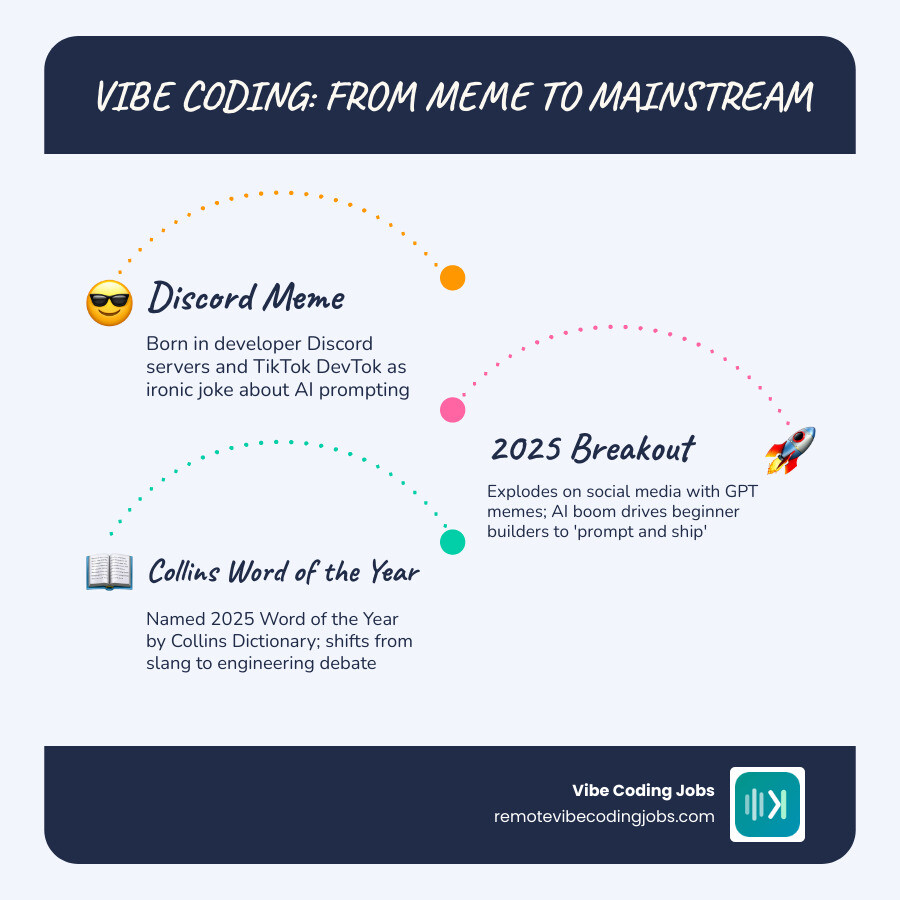
It sounds like a joke. Sometimes it is. But in 2025, Collins Dictionary named “vibe coding” its Word of the Year — so clearly something real is going on here.
The term blew up fast. What started as a meme in Discord servers and TikTok dev corners became a genuine conversation about how AI is changing who gets to build software. By May 2026, it’s no longer just slang — it’s a legitimate debate in engineering, startups, and hiring.
I’m RVCJ Editorial, the team behind Remote Vibe Coding Jobs, where we track AI-assisted development trends, remote work culture, and the tools shaping modern engineering workflows — including everything touching vibe coding meaning slang. We’ll break this down clearly so you know exactly what the term means, where it came from, and what it actually looks like in practice.
Vibe Coding Meaning Slang: The Fast Definition
At its core, vibe coding meaning slang refers to the act of developing software where the “vibe” (the intent or feeling of what you want) is more important than the syntax (the semi-colons and brackets). It is a prompt-first building method where the human acts more like a creative director or a product manager than a traditional typist of code.
What does “vibe coding” mean in slang?
In Gen Z and Gen Alpha, “vibe” is a universal term for the atmosphere or energy of a situation. When applied to coding, it represents a shift from “hard skills” to “curation skills.” It is often used as an ironic flex—a way for someone to say they built something impressive without actually knowing how to write a single line of Python or JavaScript.
The slang implies a “prompt and ship” mentality. Instead of spending weeks learning the fundamentals of computer science, a vibe coder uses natural language to describe a feature, lets a Large Language Model (LLM) generate the files, and then iterates based on whether the result “feels” right.
Is vibe coding just a joke, or a real way to build things?
We see it as a bit of both. It started as internet irony—a way to poke fun at the “AI bros” who claimed they were “engineers” just because they could use ChatGPT. However, as AI models became more capable in 2024 and 2025, the joke turned into a practical workflow. Today, people are shipping real, functional apps to the App Store and building profitable SaaS businesses entirely through vibes. It’s a half-method, half-meme that has significantly lowered the barrier to entry for creators.
How Merriam-Webster and internet dictionaries explain the phrase
The mainstream recognition of the term happened faster than almost any other tech slang in history. In March 2025, VIBE CODING Slang Meaning | Merriam-Webster officially listed it as a trending expression. They define it as a way to create software using AI-assisted tools without deep technical expertise.
Similarly, Vibe Coding – Urban Dictionary highlights the cultural side, often describing it as “hacking the matrix with vibes and ChatGPT.” It’s seen as the Gen Alpha version of “fake it till you ship it,” emphasizing tech confidence over traditional tech skills.
Where “Vibe Coding” Came From and Why It Blew Up
The term didn’t appear out of thin air; it was born in the trenches of the AI boom.
Who coined “vibe coding,” and when did it enter the mainstream?
While it’s hard to pin down a single “inventor,” the term began gaining widespread usage in late 2024 within AI developer circles and niche Discord communities. It entered the mainstream in early 2025 as tools like Cursor and Claude became more adept at handling entire codebases rather than just snippets. By mid-2025, it was being used in boardroom meetings and startup pitches.
From DevTok and Discord to Collins Word of the Year
The rise of “DevTok” (the developer side of TikTok) played a massive role. Creators would post videos showing themselves building complex games or tools in minutes, captioned with things like “no thoughts, just vibes and prompts.” This aesthetic resonated with a generation that values speed and accessibility.
The ultimate validation came when Collins Dictionary named “vibe coding” the Word of the Year for 2025. This move signaled that the phrase had moved beyond the “skibidi” slang of the internet and into the global lexicon of how we describe work in the age of AI.
Why “vibe coding meaning slang” became a search trend
Curiosity peaked as more people realized they could actually build things. The “AI boom” created a massive influx of “beginner builders” who were looking for a way to describe what they were doing. They weren’t “software engineers” in the classic sense, but they weren’t “non-coders” either. Vibe coding meaning slang provided the perfect middle ground—a way to identify as a builder without the baggage of a four-year CS degree.
What Vibe Coding Looks Like in Practice
Vibe coding isn’t just magic; it’s a specific, iterative process.
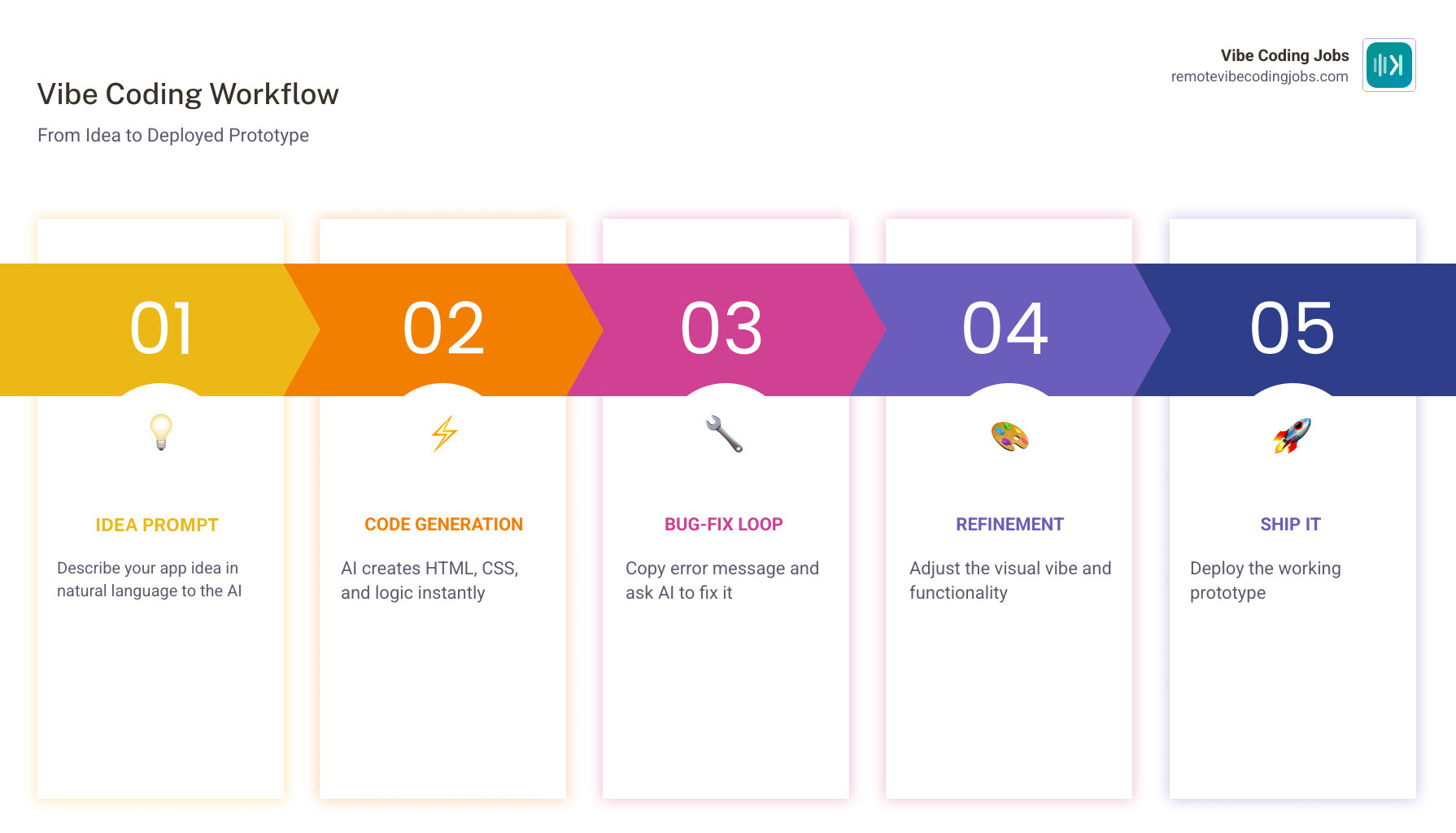
A typical vibe coding session from idea to prototype
- The Idea Prompt: You start by telling the AI, “Build me a task manager that looks like a retro 90s desktop.”
- The Generation: The AI generates the HTML, CSS, and logic.
- The Bug-Fix Loop: Something breaks. Instead of looking at the terminal, you copy the error and say, “This isn’t working, fix it.”
- Refinement: You say, “The ‘vibe’ is off, make the buttons glow more.”
- The Ship: Once it works, you deploy it.
Common tools and platforms people use for vibe coding
Vibe coders rarely use “plain” text editors. They use AI-native environments that do the heavy lifting.
- AI IDEs: Tools that integrate LLMs directly into the file structure.
- Chat Assistants: Using Claude or ChatGPT to write blocks of logic.
- App Builders: Platforms that turn prompts directly into web apps.
For a deeper dive into the specific stack, check out our guide on Vibe Coding Tools – AI-Powered Arsenal.
Vibe coding meaning slang vs traditional programming
The difference is primarily about the level of abstraction.
| Feature | Traditional Programming | Vibe Coding |
|---|---|---|
| Primary Tool | Keyboard / Logic | Natural Language Prompts |
| Focus | How it works (Syntax) | What it does (Vibe) |
| Learning Curve | Months/Years | Hours/Days |
| Debugging | Manual stack traces | “Fix this” prompts |
| Control | Granular / Precise | High-level / Emergent |
Benefits, Risks, and the Reality Check
While it sounds like a dream, vibe coding comes with its own set of “nightmare” scenarios.
Why people love vibe coding
The main draw is speed. You can go from an idea to a Minimum Viable Product (MVP) in a single weekend. It’s also incredibly empowering for solo founders who have great ideas but lack the budget to hire a full engineering team. It fosters creative momentum—you don’t get stuck on a missing semicolon for three hours.
The biggest criticisms and limitations
The “vibe” can be fragile. Critics argue that vibe coding leads to technical debt. Because the “coder” doesn’t always understand the underlying logic, they can’t fix deep structural issues when the AI gets confused. There is also the “hallucination” risk, where the AI writes code that looks correct but contains hidden security flaws.
What the data says about quality and security
The statistics are a bit sobering. Research shows that code co-authored by generative AI contains approximately 1.7 times more ‘major’ issues compared to human-written code. Even more concerningly, AI-generated code has shown:
- 2.74x higher security vulnerabilities
- 75% more misconfigurations
In one study of 1,645 AI-created web applications, 170 of them had security vulnerabilities that allowed access to personal information. Furthermore, experienced developers were actually 19% slower when using these tools because they spent so much time fixing the AI’s “vibe” mistakes.
Is vibe coding suitable for production use?
For a prototype? Absolutely. For a bank’s backend? Probably not yet. In May 2026, the consensus is that vibe coding requires a “human-in-the-loop.” You can vibe code the foundation, but you still need a professional to review the security and scalability before it goes live.
Real-World Impact on Startups, Developers, and Open Source
Despite the risks, the industry is moving fast.
Why startups embraced vibe coding so quickly
Startups live and die by their speed. In Y Combinator’s Winter 2025 batch, a staggering 25% of startups had codebases that were 95% AI-generated. For these companies, getting a product into users’ hands is more important than having a “perfect” codebase on day one.
Success stories and failure patterns
We’ve seen “weekend apps” go viral and turn into real companies. However, we’ve also seen “maintenance collapses.” A founder vibe codes an app, it gets 10,000 users, and then it breaks. Because the founder doesn’t actually know how it works, they can’t fix it, and the startup dies as quickly as it was born.
How developers and open-source communities perceive it
There is a divide. Some “power users” embrace it to automate boring tasks. However, many open-source maintainers are frustrated. They are seeing an influx of “vibe-coded” pull requests that are poorly written and hard to maintain, adding a massive burden to the community.
What vibe coding means for careers and remote work
The job market is shifting. Companies are looking for “AI-augmented” developers who can move at the speed of vibes but have the knowledge to keep things secure. This has created a new category of Vibe Coding Remote Jobs Career Path.
If you’re looking to break into this world, understanding the “vibe” is just the start. You also need to know how to navigate the professional landscape. You can learn more in our guide on What Are Vibe Coding Jobs? A Guide to the Future of Remote Work.
Frequently Asked Questions about Vibe Coding Meaning Slang
Is vibe coding the same as no-code?
Not exactly. No-code uses visual interfaces (drag-and-drop). Vibe coding actually generates real code (like Python or React), meaning it’s more flexible and can be “ejected” into a traditional development environment later.
Can non-programmers really build apps by vibe coding?
Yes, but with limits. You can build the “front” of the house, but if the plumbing (the database or security) breaks, you’ll still need to learn some basics or hire a professional to help you out.
What does the future of vibe coding look like?
By 2027, we expect to see “Vibe Auditing” tools—AI that specifically checks vibe-coded apps for security. The workflow will become more professionalized, with better guardrails and automated testing.
Conclusion
So, what is the final verdict on vibe coding meaning slang? It’s more than just a Gen Alpha meme. It represents a fundamental shift in how humans interact with machines. It’s about moving from being a “writer” of code to a “curator” of software.
While the risks of security vulnerabilities and technical debt are real, the democratization of creation is undeniable. Whether you’re a professional developer looking to speed up your workflow or a beginner with a dream, the “vibe” is here to stay.
If you’re ready to turn your prompts into a career, explore our resources on Is Vibe Coding Real? Unveiling the Truth Behind the Trend or jump straight into the action with our Vibe Coding 30-Day Challenge.
The future of work isn’t just about what you can type—it’s about the vibes you can ship. For more information on how to get started, check out What is Vibe Coding?.