
Market Overview for PostgreSQL Developer Jobs
The current job market for postgresql developer jobs is experiencing sustained momentum across multiple sectors. Driven by the enterprise movement away from proprietary database licenses toward robust, open-source solutions, PostgreSQL has firmly cemented its position as a primary data backend.
Analyzing data across major industry platforms reveals over 14,000 active job postings in the United States alone. The job distribution leans heavily toward permanent, full-time employment, accounting for over 13,400 of these listings. Contract arrangements make up roughly 950 roles, while part-time listings represent a small fraction. Market activity is extraordinarily , with over 5,300 new openings published in a single week and more than 1,000 added within 24 hours.
Enterprise adoption is a primary engine behind this demand. Major employers across diverse sectors are actively building out engineering infrastructure centered on PostgreSQL. Tech and consulting giants like Deloitte, data annotation platforms like DataAnnotation, and healthcare technology leaders like Epic consistently post hundreds of openings. Furthermore, cloud infrastructure providers—including Amazon and specialized development platforms like Supabase—actively recruit developers to build, scale, and maintain cloud-native database offerings.
Salary Benchmarks Across Experience Levels
Compensation for PostgreSQL developers reflects the mission-critical nature of database architecture and state management. Salaries across the industry range from solid base pay for mid-level developers to premium compensation structures for lower-level database engine specialists.
- Entry-Level & Junior Roles ($60,000 – $85,000): Early-career positions focus on schema design, basic PL/pgSQL function development, and assisting with application-level query optimization.
- Mid-Senior Level Roles ($85,000 – $135,000): Representing over 59% of current job listings, mid-senior professionals manage performance tuning, indexing, complex stored procedures, and migration pipelines. Over 2,800 active listings currently advertise base salaries exceeding $80,000, with more than 2,700 positions crossing the $100,000 mark.
- Senior & Lead Engineers ($135,000 – $180,000+): Senior roles demand deep expertise in high-availability architecture, autovacuum management, partitioning, and multi-tenant scaling strategies. More than 2,650 listed positions offer packages starting above $120,000.
- Database Engine & Infrastructure Specialists ($143,700 – $261,500): Engineers working directly on database engine internals, custom storage engines, or major cloud services command top-tier compensation. For example, AWS lists Software Dev Engineer, PostgreSQL Contributors roles ranging from $143,700 to $194,400, while a Senior Software Development Engineer, Aurora PostgreSQL position ranges from $151,300 to $261,500 in annual base salary.
To benchmark compensation structures across different remote tech tiers, review our comprehensive Remote Developer Salary Guide 2026.
Remote vs On-Site Work Arrangements in 2026
Work arrangements for database professionals span three distinct operational models. Out of the nationwide US openings:
- Remote Roles: 4,722 positions (approximately 32%) offer fully remote flexibility, allowing developers to work asynchronously across geographic boundaries.
- On-Site Roles: 6,936 positions (roughly 47%) require physical presence, driven by government clearances, financial compliance requirements, or legacy physical data centers.
- Hybrid Roles: 3,532 positions (around 21%) blend remote flexibility with scheduled office days.
Major metropolitan areas remain primary physical hubs for on-site and hybrid roles. New York, NY leads with over 1,000 localized listings, followed by regional enterprise hubs like Chicago, IL (248 listings) and Washington, DC (243 listings), where federal contracting and defense systems mandate strict, on-premise security clearances.
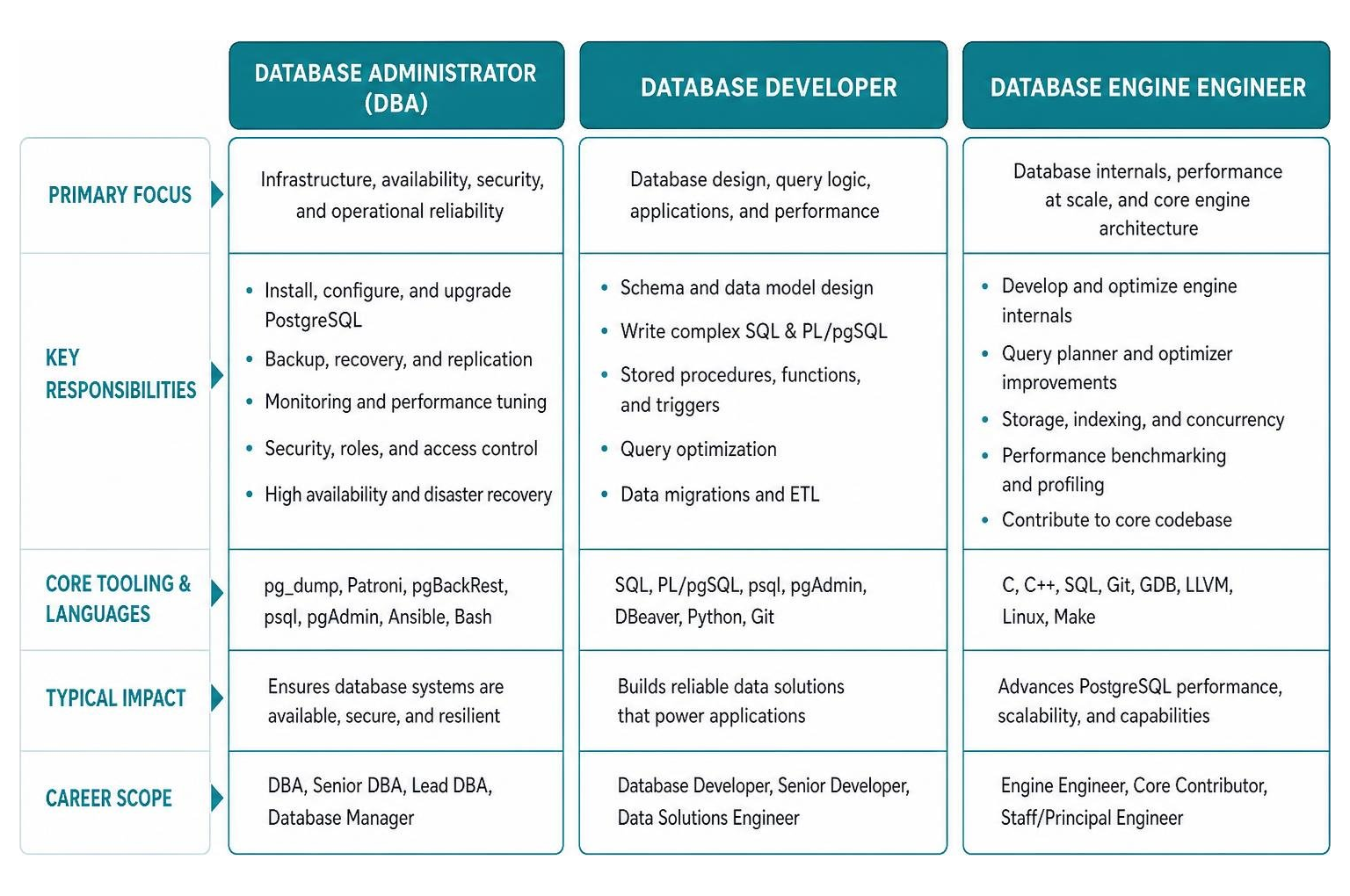
Defining Core Roles: PostgreSQL DBA vs Developer vs Engineer
While job titles in database administration and software engineering often overlap, companies distinguish strictly between specialized responsibilities. Understanding these distinctions ensures you target positions aligned with your specific skill set.
Technical Skills Needed for PostgreSQL Developer Jobs
Application-level postgresql developer jobs require a strong command of procedural language scripting, index structures, and data manipulation patterns. Essential skill sets required across database engineering positions include:
- PL/pgSQL & Procedural Code: Writing complex stored procedures, custom functions, triggers, and views to encapsulate business logic inside the database engine.
- Indexing Strategies & Query Optimization: Deep understanding of B-Tree, Hash, GIN, BRIN, and GiST indexes. Ability to read
EXPLAIN ANALYZEexecution plans, isolate sequential scans, and refactor slow join queries. - Geospatial Processing (PostGIS): Writing spatial queries, bounding-box operations, and location calculations. PostGIS experience is in high demand across civic tech, logistics, biological monitoring, and mapping industries.
- JSON & Hybrid NoSQL Support: Leveraging
JSONBdata types, GIN indexing on JSON documents, and hybrid relational-document patterns to integrate flexible schemas into relational systems. - Data Synchronization & Schema Design: Managing multi-schema environments, isolation levels, foreign key constraint networks, and ETL pipelines for enterprise integrations.
Lower-Level Engine Development with C and Rust
Below the application abstraction layer lies lower-level database infrastructure engineering. Companies building hosted platforms, specialized extensions, or fork distributions seek developers proficient in engine internals.
PostgreSQL infrastructure roles require deep comprehension of the PostgreSQL core architecture written in C, including the parser, planner, executor, Write-Ahead Logging (WAL) mechanics, and Multi-Version Concurrency Control (MVCC).
Furthermore, the extension ecosystem has expanded beyond C. Rust has emerged as a premier language for building safe, memory-efficient PostgreSQL extensions. Developers working on specialized storage engines operate directly on next-generation database architectures, customizing low-level storage layouts, background workers, and crash-recovery pipelines while pushing upstream patches directly to open-source maintainer lists.
Modern Tech Stacks: Cloud Services, PostGIS, and AI Orchestration

Modern application architecture rarely runs isolated database instances on bare metal. Instead, PostgreSQL development increasingly sits at the center of modern cloud infrastructure, serverless platforms, and AI tool integration.
AWS Aurora, RDS, and Managed Platforms
Transitioning legacy relational databases like Oracle or Microsoft SQL Server to cloud-native PostgreSQL is one of the largest corporate engineering initiatives under way. Platforms like AWS Aurora PostgreSQL decoupled storage from compute, creating hyper-scale relational database engines capable of auto-scaling across multi-datacenter environments.
Engineers specializing in managed cloud services build automated failover patterns, manage logical replication, and tune autovacuum behavior across thousands of database instances simultaneously. Modern platforms like Supabase leverage native PostgreSQL capabilities—such as Row-Level Security (RLS), real-time replication, and foreign data wrappers—to provide complete backend-as-a-service infrastructure for web and mobile developers.
AI Tools and Vibe Coding Integration
The rapid rise of AI-assisted software development (“vibe coding”) is actively transforming backend workflows. Rather than manually typing routine SQL boilerplate, schema migrations, and API wrappers, modern developers leverage AI tools like Cursor, GitHub Copilot, and Claude to orchestrate database development.
Entry-level and full-stack positions explicitly seek candidates capable of pairing solid software engineering fundamentals with rapid AI orchestration. To explore how AI tooling is redefining modern software engineering roles, read our guide on Vibe Coding vs Traditional Software Engineering Key Differences and explore active opportunities for Cursor Copilot Developer Jobs.
Strategies to Land Remote Positions

Securing a competitive remote PostgreSQL position requires showing concrete proof of practical skills, query optimization expertise, and clear asynchronous communication abilities.
Proven Application Tactics for PostgreSQL Developer Jobs
- Apply Early in the Posting Lifecycle: Data from major hiring channels shows that applying within 24 to 48 hours of a job listing dramatically increases candidate visibility. Set daily alerts on specialized job feeds and company career pages to apply as soon as positions open.
- Highlight Practical Optimization Impact: Tailor your resume around measurable performance gains rather than just listing tech stacks. Highlight instances where you optimized indexing to drop query response times from 3.5 seconds to 80 milliseconds or refactored legacy stored procedures to process high-throughput transaction loads.
- Showcase Modern Stack Integration: Demonstrate proficiency in pairing PostgreSQL with modern backend languages (Node.js, Go, Python), frameworks (Next.js, FastAPI), and cloud infrastructure tools (Docker, Terraform, AWS RDS).
Many async-first employers skip abstract whiteboard algorithms in favor of real-world coding challenges. Discover how to excel in these hiring processes through our resource on Remote Coding Jobs No Leetcode Practical Skills Projects.
Portfolio Development and Open Source Contributions
A public track record of engineering capability serves as your strongest asset when applying for remote positions.
- Deploy Production-Grade Mini-Apps: Build and deploy full-stack applications using Next.js, Supabase, and PostGIS. Document your database architecture, schema migrations, and indexing decisions in a clear project README.
- Open Source Git Contributions: Lower-level engineering roles often mandate a verified public commit history. Core engine roles at top tech companies frequently seek candidates with proven contributions in public project git logs.
- Document Execution Benchmarks: Write technical articles or GitHub repository documentation detailing how you analyzed execution plans using
EXPLAIN ANALYZE, configured connection pooling with PgBouncer, or integratedpgvectorfor AI semantic search.
For a detailed step-by-step framework on establishing your technical presence, consult our guide on How to Land Your First Remote Job as a Developer 2024 Guide.
Frequently Asked Questions
How does PostgreSQL demand compare to Oracle and SQL Server?
PostgreSQL demand is surging rapidly relative to commercial proprietary databases like Oracle and Microsoft SQL Server. While legacy enterprise environments maintain existing commercial infrastructure, new application development heavily favors PostgreSQL due to its open-source license model, zero licensing fees, vast extension ecosystem, and native support across all major cloud vendors. Additionally, legacy database migration projects—moving enterprise data off proprietary engines to AWS Aurora PostgreSQL—represent a huge portion of current cloud database engineer job listings.
What experience level is most in demand for database developers?
Mid-Senior level professionals are by far in highest demand, accounting for over 59% (8,786+) of all active US PostgreSQL job listings. Employers actively seek engineers who can operate independently, write production-grade PL/pgSQL, handle schema migrations safely, and optimize performance bottlenecks without constant oversight. However, entry-level opportunities are growing rapidly in full-stack and AI-assisted “vibe coding” roles, where developers pair foundational relational database design with AI orchestration platforms.
Is experience with cloud services like AWS Aurora mandatory?
While foundational SQL execution and database normalization skills remain universal, familiarity with cloud database services (AWS Aurora, RDS, GCP Cloud SQL, or Supabase) is strongly preferred by most remote employers. Modern engineering teams rely heavily on cloud-managed database platforms to handle automated daily backups, multi-region replication, failover orchestration, and storage scaling. Demonstrating hands-on experience with cloud DBaaS platforms makes your application significantly more competitive.
Conclusion
The market for postgresql developer jobs in 2026 offers immense opportunity across experience levels, technical disciplines, and remote work preferences. From high-level application optimization using PL/pgSQL and PostGIS to low-level C extension development and AI-assisted backend engineering, PostgreSQL expertise remains one of the most resilient and lucrative career tracks in modern software development.
| Work Arrangement | US Job Postings Share | Key Considerations & Requirements |
|---|---|---|
| Remote | ~32% (4,722 roles) | Strong async communication, self-directed query tuning, cloud DBaaS proficiency. |
| On-Site | ~47% (6,936 roles) | Security clearances, federal government contracting, physical data center operations. |
| Hybrid | ~21% (3,532 roles) | Regional tech hubs (NYC, Chicago, DC), team collaboration combined with flexibility. |
At RemoteVibeCodingJobs, we aggregate curated daily remote listings at async-first companies, filtering opportunities by team culture, tech stacks, and modern AI tool integrations like Cursor and Claude.
Ready to take the next step in your cloud backend career? Explore Remote AI Engineer Jobs to find modern, remote-first database and AI development opportunities today.