
1. High-Demand Industries Hiring Rust Remote Jobs Worldwide
The shift toward high-performance, memory-safe software has turned rust remote jobs worldwide into some of the most sought-after engineering roles across the tech ecosystem. Rust provides guaranteed memory safety without a garbage collector using its innovative ownership model, explicit lifetimes, and compile-time borrow checker. As a result, software organizations across multiple sectors are actively transitioning away from legacy C and C++ codebases to eliminate entire classes of concurrency and memory corruption bugs.
Key Tech Sectors Sourcing Remote Rust Talent
The search for top-tier Rust talent spans several highly specialized software engineering sectors:
- Cloud Infrastructure and WebAssembly: Cloud platforms depend heavily on Rust to construct distributed, low-latency backend systems. Teams routinely leverage serverless execution environments like AWS Lambda alongside WebAssembly runtimes to execute edge computations at blazingly fast speeds.
- Blockchain and Web3: Decentralized exchanges (DEXs), cross-chain smart contract infrastructure, and privacy-focused zero-knowledge protocols rely on Rust to process massive transaction volumes securely and reliably.
- High-Frequency Trading and Fintech: Quantitative financial institutions utilize Rust to build ultra-low-latency trading platforms, order matching engines, and microsecond-level metrics pipelines where sub-millisecond execution is critical.
- AI Infrastructure and Data Processing: Large Language Model (LLM) orchestration platforms, Retrieval-Augmented Generation (RAG) backend pipelines, and real-time inference engines deploy Rust to manage massive vector database workloads with minimal memory footprints.
- Defense and Embedded Systems: Engineering firms building autonomous field systems, robotics, and aerospace components depend on Rust’s no_std ecosystem to deliver deterministic software for resource-constrained edge hardware.
- System-Level Open Source: Organizations driving core operating system infrastructure deploy Rust for system bootloaders, Linux desktop services, network daemons, and kernel modules. To see a prominent example of enterprise open-source leadership, explore the Rust Engineering Lead at Canonical listing.
Regional Opportunities and Time Zone Flexibility for Rust Remote Jobs Worldwide
Finding open rust remote jobs worldwide requires understanding regional hiring approaches and geographic requirements:
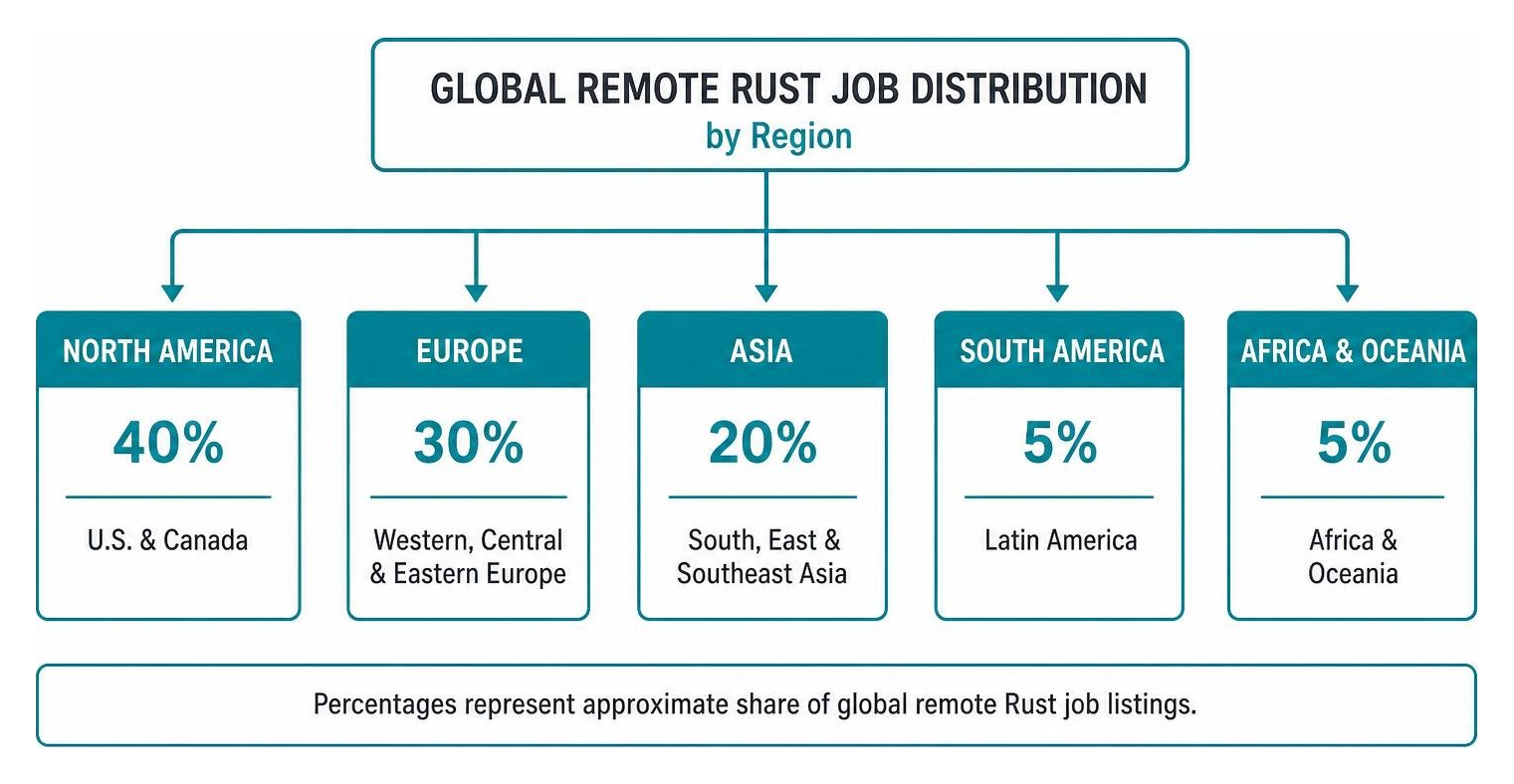
Many remote-first tech organizations adopt a true “Remote Everywhere” philosophy, operating entirely asynchronously across the United States, Europe, Latin America, and Asia. However, some companies set specific time zone constraints—such as requiring developers to reside within Central European Time (CET) ±2 hours or US Eastern Time working windows—to facilitate overlapping live collaboration hours.
European employers frequently hire across EU countries for roles involving defense technology, digital health pipelines, and industrial automation. Meanwhile, US-based platforms often recruit global talent directly through international Employer of Record (EOR) services or contract international developers with competitive compensation calculated directly in USD.
2. Salary Expectations and Technical Requirements for Global Rust Developers
Salaries for remote Rust engineers remain among the highest across the entire software industry. This premium compensation reflects the highly specialized nature of low-level systems engineering combined with explosive demand across cloud, fintech, and decentralized infrastructure sectors.
To better understand how compensation scales across technical career levels globally, check out the Remote Developer Salary Expectations by Experience Level 2026 guide, as well as our full Remote Developer Salaries Overview.
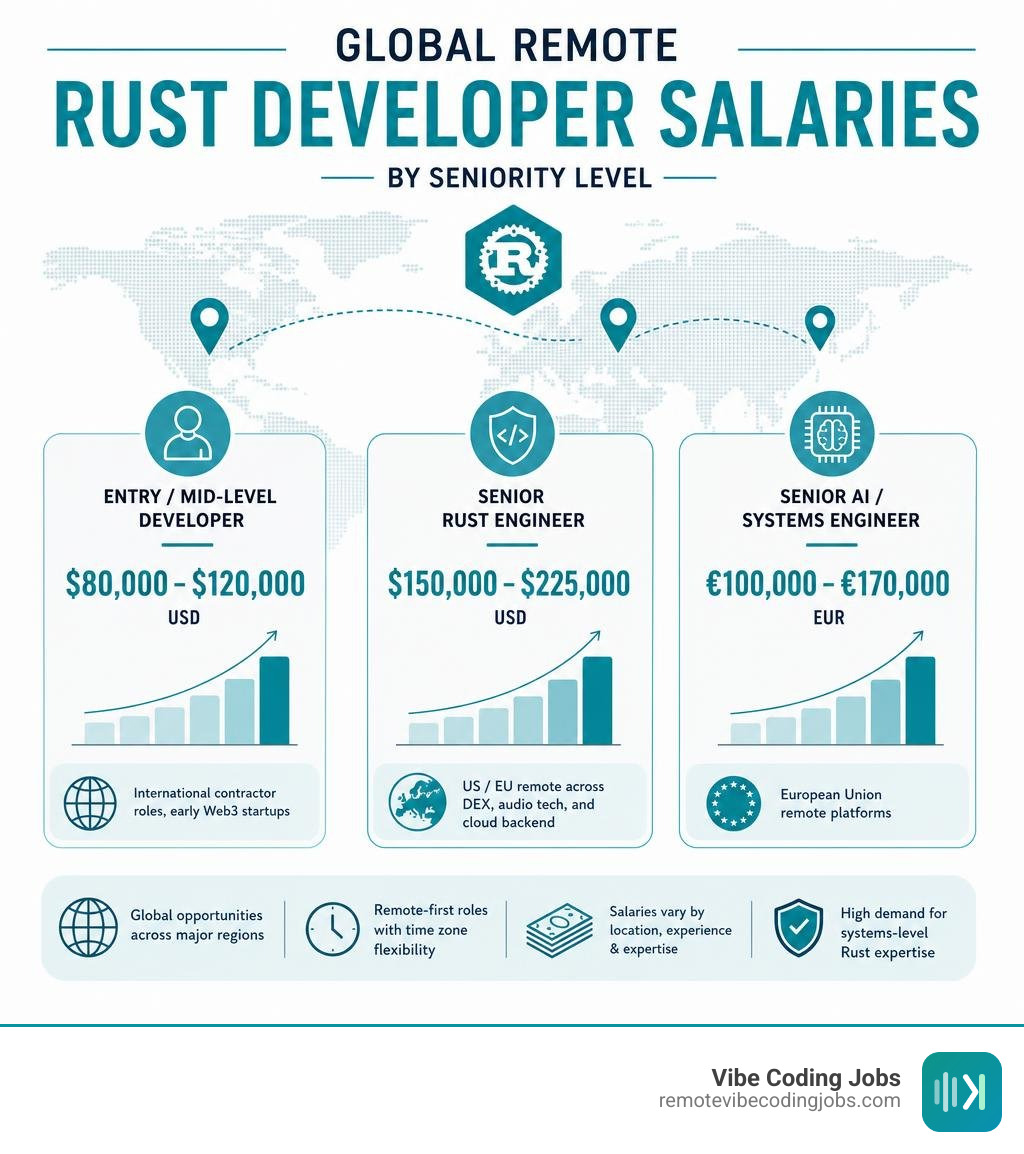
| Seniority / Role Type | Typical Salary Range (USD / EUR) | Key Geographic Context |
|---|---|---|
| Entry / Mid-Level Developer | $80,000 – $120,000 USD | International contractor roles, early Web3 startups |
| Senior Rust Engineer | $150,000 – $225,000 USD | US / EU remote across DEX, audio tech, and cloud backend |
| Senior AI / Systems Engineer | €100,000 – €170,000 EUR | European Union remote platforms |
| Staff / Lead Engineer | $195,000 – $300,000 USD | US remote infrastructure, defense, and database startups |
Core Stack: Async Rust, Tokio, and Serverless Infrastructure
Most production Rust backend services rely on a proven ecosystem of asynchronous crates and modern cloud tooling:
- Asynchronous Runtimes: The Tokio runtime serves as the industry standard for managing non-blocking I/O, multi-threaded task scheduling, and high-throughput networking microservices.
- Web Frameworks: Crates like Axum, Actix-web, and Tower enable software engineers to construct modular, type-safe, and performant REST and gRPC microservices.
- Data Serialization & Persistence: Serde manages complex JSON and binary data parsing seamlessly, while crates like SQLx and Diesel handle relational connections to PostgreSQL, MySQL, or specialized vector databases.
- Serverless Architecture: Combining optimized Rust binaries with AWS Lambda shaves off precious cold-start milliseconds, significantly lowering cloud compute overhead costs.
For a concrete look at modern backend engineering requirements, review active listings like Proxybase Rust Backend Engineers & Full Stack Developers to see how production engineering teams structure their services.
Modern Skills: AI-Assisted Development and Vibe Coding Tools
Modern engineering teams increasingly expect developers to leverage AI tools (often referred to as “vibe coding”) to accelerate software development workflows:
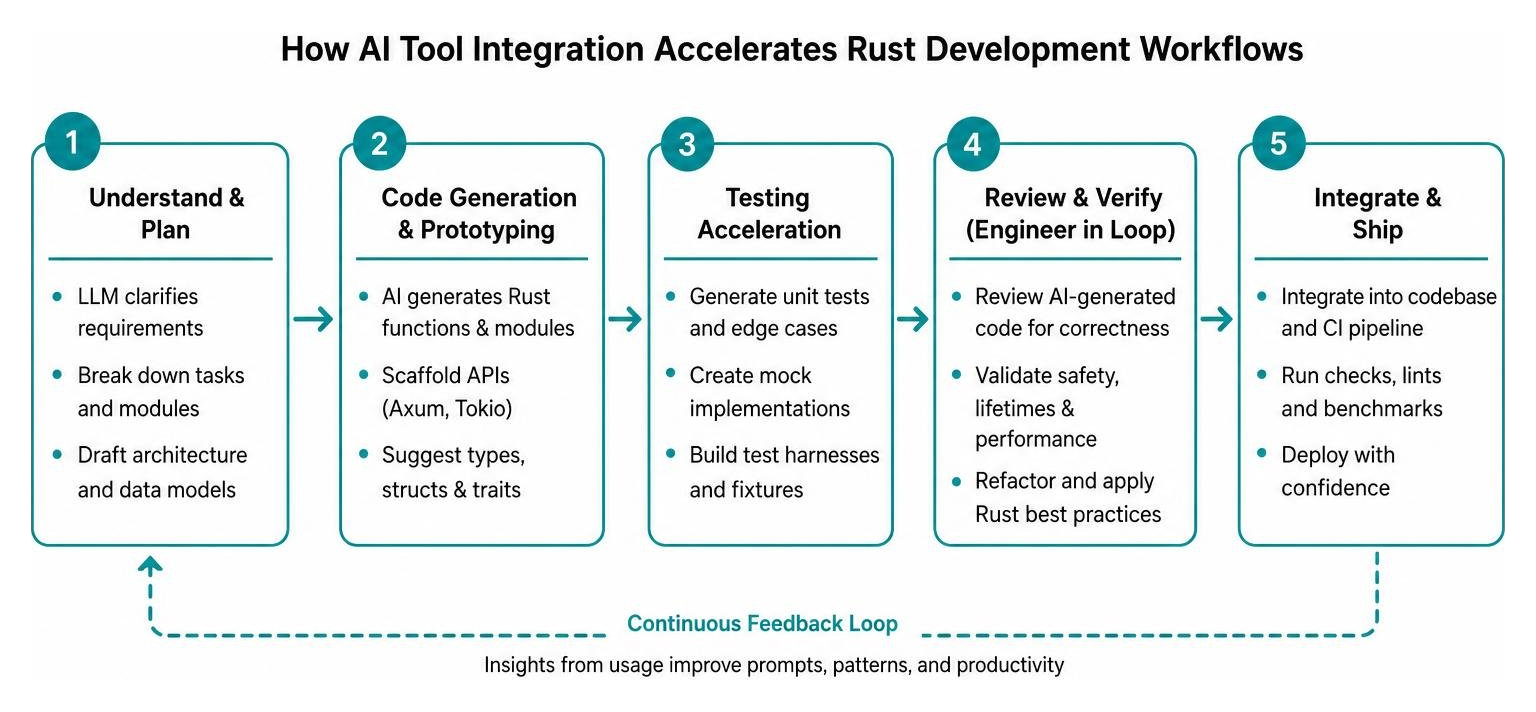
Using AI-assisted tools like Cursor, Claude, and GitHub Copilot allows Rust engineers to write exhaustive unit test suites quickly, draft API boilerplate interfaces, and auto-generate complex mock testing harnesses. However, because Rust’s compiler strictly enforces memory safety, trait bounds, and lifetime constraints, engineers must carefully review, profile, and verify all AI-assisted code suggestions before pushing changes to production deployment pipelines.
3. Best Strategies to Find and Apply for Rust Remote Jobs Worldwide

Landing a high-paying remote Rust position requires looking far beyond standard high-volume job aggregators. Specialized platforms list direct engineering roles with transparent salary bands, precise tech stacks, and explicit global remote policies.
Top Job Portals for Exclusive Rust Developer Listings
To maximize your application success rate and target high-conviction opportunities, focus your search on dedicated job directories and developer communities:
- Specialized Job Boards: Directories dedicated exclusively to Rust list un-scraped positions direct from engineering leaders, eliminating ghost postings and redundant recruiters.
- Startup Networks: Tech startup job portals highlight early-stage Web3, developer tooling, and AI infrastructure vacancies that offer flexible remote arrangements and competitive equity packages.
- Open-Source & Linux Ecosystems: Enterprise Linux distributors and open-source foundations publish global, home-based postings for system software engineering leads and core maintainers.
How to Showcase Your Rust Expertise to Stand Out
Because Rust features a steep initial learning curve, demonstrating practical, production-ready code is the single most effective way to validate your skills to prospective employers:
- Build Proof-of-Concept Projects: Create lightweight implementations of async microservices, custom database indexers, or WebAssembly edge utilities and host them publicly on GitHub.
- Document Technical Designs: Write clear design proposals (RFCs) explaining why you chose specific crates, memory management approaches, or data structures over alternatives.
- Demonstrate Polyglot Adaptability: Detail your experience refactoring legacy C/C++ libraries into memory-safe Rust modules, or showing how Rust microservices seamlessly interface with Go, Python, or Kotlin codebases via FFI or gRPC.
- Benchmark Performance: Include benchmarks using Criterion.rs to show measurable performance improvements, low latency, and efficient memory usage in your personal repositories.
4. Navigating Remote Challenges, Team Collaboration, and Hiring Processes

Working remotely as a systems engineer requires strong written communication, disciplined asynchronous work habits, and self-directed problem-solving.
Preparing for the Remote Rust Technical Interview
The interview process for remote Rust engineers typically involves multiple technical evaluation stages designed to test both low-level mechanics and high-level architecture:
- Initial Technical Screening: A conversation exploring your background, past systems projects, architecture trade-offs, and remote communication habits.
- Rust Core Concepts Assessment: Written questions or live pair programming focused on the borrow checker, explicit lifetime annotations (
'a), smart pointers (Arc,Rc,Mutex), and thread-safe concurrency primitives (Send,Sync). - System Architecture Design: Designing a distributed backend service, analyzing low-latency bottlenecks, evaluating memory footprints, and outlining event-driven cloud infrastructure.
- Take-Home or Practical Challenge: Building a lightweight async service using Tokio and Axum, accompanied by comprehensive unit tests, clear documentation, and continuous integration scripts.
Overcoming Work From Home Hurdles as a Systems Engineer
Remote systems programming introduces distinct operational challenges. Running complex integration tests, accessing target hardware peripherals, or profiling memory consumption without direct physical server access requires robust local virtual environments and containerized tooling.
Distributed teams overcome these roadblocks by maintaining thorough documentation in platforms like Notion, utilizing open-source observability setups (Prometheus and Grafana), and participating in periodic in-person sprints to align product roadmaps.
To learn more about long-term career planning in distributed environments, read Best Remote Developer Jobs 2026: Future-Proof Your Career.
Frequently Asked Questions About Remote Rust Engineering
What is the average salary range for remote Rust developer positions?
Salaries generally range from $80,000 for entry-level or international contractor roles to between $150,000 and $300,000 USD for senior, staff, and lead engineering roles in high-demand regions like North America and the European Union. Specialized roles in high-frequency trading and Web3 infrastructure often command total compensation packages at the higher end of this scale.
What technical skills are most in demand for rust remote jobs worldwide?
The most frequently requested skills include async Rust proficiency using the Tokio ecosystem, experience with web frameworks like Axum or Actix, expertise in distributed cloud architectures (AWS Lambda, Kubernetes, Docker), database tooling with SQLx, and familiarity with AI-assisted coding tools like Cursor and Claude.
How do company interview processes vet remote Rust candidates?
Hiring teams assess candidates through technical screens covering ownership and lifetime semantics, architecture design interviews focused on distributed systems performance, and practical coding exercises evaluating unit testing, error handling with Result/Option types, and overall code maintainability.
Conclusion
The global job market for rust remote jobs worldwide offers exceptional career growth, premium compensation packages, and the flexibility to work from anywhere in the world. Whether you are building ultra-low-latency crypto exchanges, optimizing AI backend data pipelines, or engineering serverless microservices, mastering Rust opens doors to top-tier technical teams globally.
At Vibe Coding Jobs, we track daily remote openings for software engineers using modern, AI-assisted development tools like Cursor, Claude, and GitHub Copilot. Explore curated active positions today by visiting Browse Global Remote Rust Developer Positions to take your next major career step.