
Why the Difference Between Synchronous and Asynchronous Communication Defines How Modern Teams Work
The difference between synchronous and asynchronous communication comes down to one thing: timing.
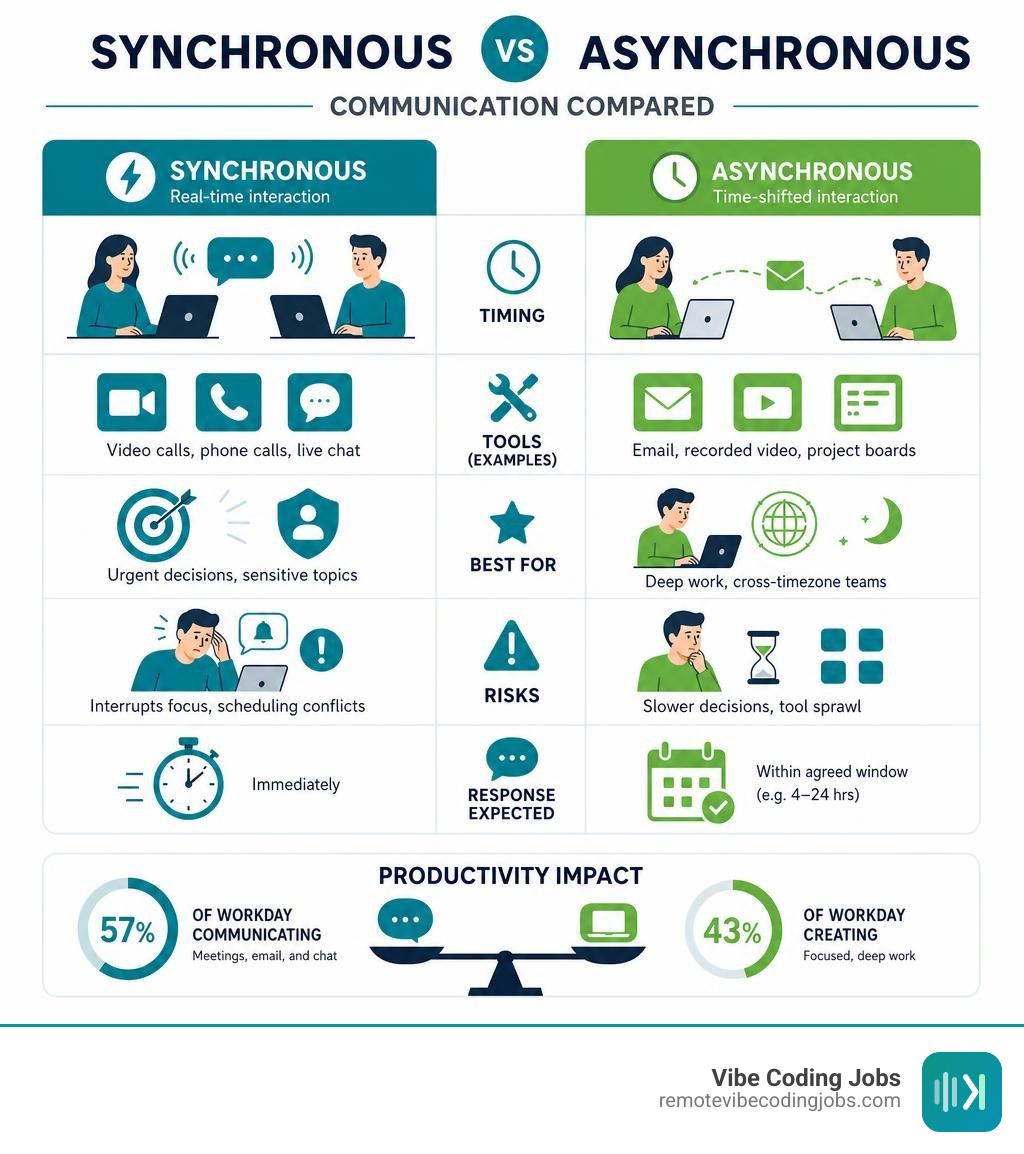
| Synchronous | Asynchronous | |
|---|---|---|
| Timing | Real-time, both parties present | Delayed, respond at your own pace |
| Examples | Video calls, phone calls, live chat | Email, recorded video, project boards |
| Best for | Urgent decisions, sensitive topics | Deep work, cross-timezone teams |
| Risk | Interrupts focus, scheduling conflicts | Slower decisions, tool sprawl |
| Response expected | Immediately | Within agreed window (e.g. 4–24 hrs) |
Here’s a number worth sitting with: the average knowledge worker spends 57% of their workday communicating — in meetings, email, and chat — and only 43% actually creating things. Employees now face an interruption roughly every two minutes, which adds up to around 275 pings per day. And after each one, it takes an average of 23 minutes and 15 seconds to fully regain focus.
For developers, that’s not just annoying — it’s the difference between shipping and spinning.
The choice between real-time and delayed communication shapes everything: your productivity, your culture, your ability to do deep work, and whether your team can function across time zones without burning out.
I’m Dominic Zijlstra, cofounder of Adaptify.ai and former communication systems engineer at Airbus, where I worked directly with the difference between synchronous and asynchronous communication at the hardware level — from satellite protocols to distributed team workflows. That dual background in technical systems and remote collaboration gives me a grounded, practical lens on why this choice matters far beyond just picking email over a meeting.
The Core Difference Between Synchronous and Asynchronous Communication
At its absolute baseline, the difference between synchronous and asynchronous communication is defined by whether the sender and receiver must be present at the exact same moment.

When we communicate synchronously, we are dancing in lock-step. We require an immediate, real-time presence. This is highly effective when we need to build rapport quickly or navigate an emergency, but it acts as a constant tax on our focus.
Conversely, asynchronous communication decouples the transmission of information from its receipt. We send a message, and the recipient processes it when they are ready. According to Synchronous vs. Asynchronous Work: How to Choose | Slack, the core difference lies in timing and response expectations. By shifting to a model where a delayed response is not a weak response, we liberate our teams from the pressure of constant presence.
Real-Time vs. Delayed Response Dynamics
To understand why this shift is so powerful, we can look at Media Synchronicity Theory, which outlines five core capabilities of any communication medium:
- Immediacy of feedback: How quickly can the receiver respond? Synchronous channels excel here, making them great for alignment but terrible for deep focus.
- Parallelism: Can multiple conversations happen at once? Asynchronous tools allow a developer to read documentation while another writes a code review, whereas a video call locks everyone into a single audio stream.
- Symbol variety: Can we use text, code, audio, and video? Asynchronous tools allow us to combine formats for maximum clarity.
- Rehearsability: Can the sender edit and refine the message before sending? Async communication allows us to think, edit, and present our best ideas rather than speaking off the cuff.
- Reprocessability: Can the message be re-examined later? A written record or recorded video is persistent, whereas spoken words in a meeting dissolve the moment the call ends.
By understanding these dynamics, we can see that choosing between sync and async is not about choosing which is “better”—it is about choosing the right medium for the specific task at hand.
Common Workplace Examples of Both Models
To bring these concepts to life, let’s look at how they manifest in our daily routines.
Synchronous channels are those that require our immediate attention:
- In-person or virtual meetings: The classic calendar invite that stops your day.
- Phone and video calls: Ad-hoc calls to resolve a sudden issue.
- Real-time chat sessions: Slack or Teams threads where participants expect a reply within minutes.
Asynchronous channels allow us to work on our own schedules:
- Email: The classic asynchronous tool, though often abused with synchronous expectations.
- Shared collaborative documents: Commenting on a spec document in Notion or Google Docs.
- Project management boards: Tracking progress in tools like Asana, Linear, or Trello.
- Recorded video updates: Loom or Zoom clips that explain a complex issue without requiring a live meeting.
As highlighted in Synchronous vs. asynchronous communication | Zoom, modern teams perform best when they intentionally combine these tools, using real-time channels for high-emotion or high-urgency situations, and async channels for execution and documentation.
Weighing the Trade-offs: Pros and Cons of Each Approach
Every communication choice we make carries an architectural tax. If we default to meeting-first, we crush our team’s ability to focus. If we default to async-only, we risk isolating our team members and slowing down critical decisions.

The Highs and Lows of Synchronous Interaction
Synchronous communication is the fast-acting glue of human connection. It is unmatched when we need to build deep rapport, deliver sensitive performance feedback, or navigate a high-stakes crisis. If a production server goes down, we don’t send an email; we jump on a live huddle to resolve it immediately.
However, the downsides of synchronous interaction are severe:
- Focus Interruption: It takes an average of 23 minutes and 15 seconds to regain focus after a distraction. When we force developers into meetings, we destroy their “flow state.”
- Scheduling Conflicts: Coordinating calendars across multiple time zones is a logistical nightmare.
- Financial Cost: Unproductive meetings cost US businesses an estimated $399 billion annually.
When we treat meetings as the default rather than the exception, we build a culture of constant interruption where 68% of workers say they don’t have enough uninterrupted focus time.
The Power and Pitfalls of Asynchronous Workflows
Asynchronous communication is the bedrock of deep, creative work. When we shift our expectations, we unlock massive benefits:
- Uninterrupted Focus: People are 43% more productive when they can carve out daily blocks of uninterrupted time.
- Better Quality of Work: Asynchronous communication allows for reflection. Instead of giving the fastest answer in a meeting, team members have the time to research, test, and write a thoughtful response.
- Time-Zone Inclusion: When we document decisions, we prevent global team members from having to join meetings at midnight.
As noted in Synchronous vs. Asynchronous Communication — The Holloway Guide to Remote Work, the constant expectation of presence is one of the most toxic behaviors that can surface in a distributed team.
However, async is not a silver bullet. Its pitfalls include:
- Delayed Decisions: If a decision requires ten back-and-forth exchanges, an async thread can drag on for days.
- Lack of Nuance: Written text can easily be misinterpreted, leading to unnecessary friction.
- Tool Sprawl: Without clear guidelines, critical information gets lost across emails, chat threads, and project boards.
According to Synchronous and Asynchronous Communication Top Differences and Synchronous vs. asynchronous communication, the secret is to use lean media (like docs and emails) when high precision is required, and rich media (like video) when we need to resolve complex, open-ended disagreements.
System Design: Decoupling Software and Human Workflows
As software engineers, we understand the difference between synchronous and asynchronous communication when we design distributed systems. Interestingly, the exact same architectural principles apply to how we design our human teams.
Defining the Difference Between Synchronous and Asynchronous Communication in System Design
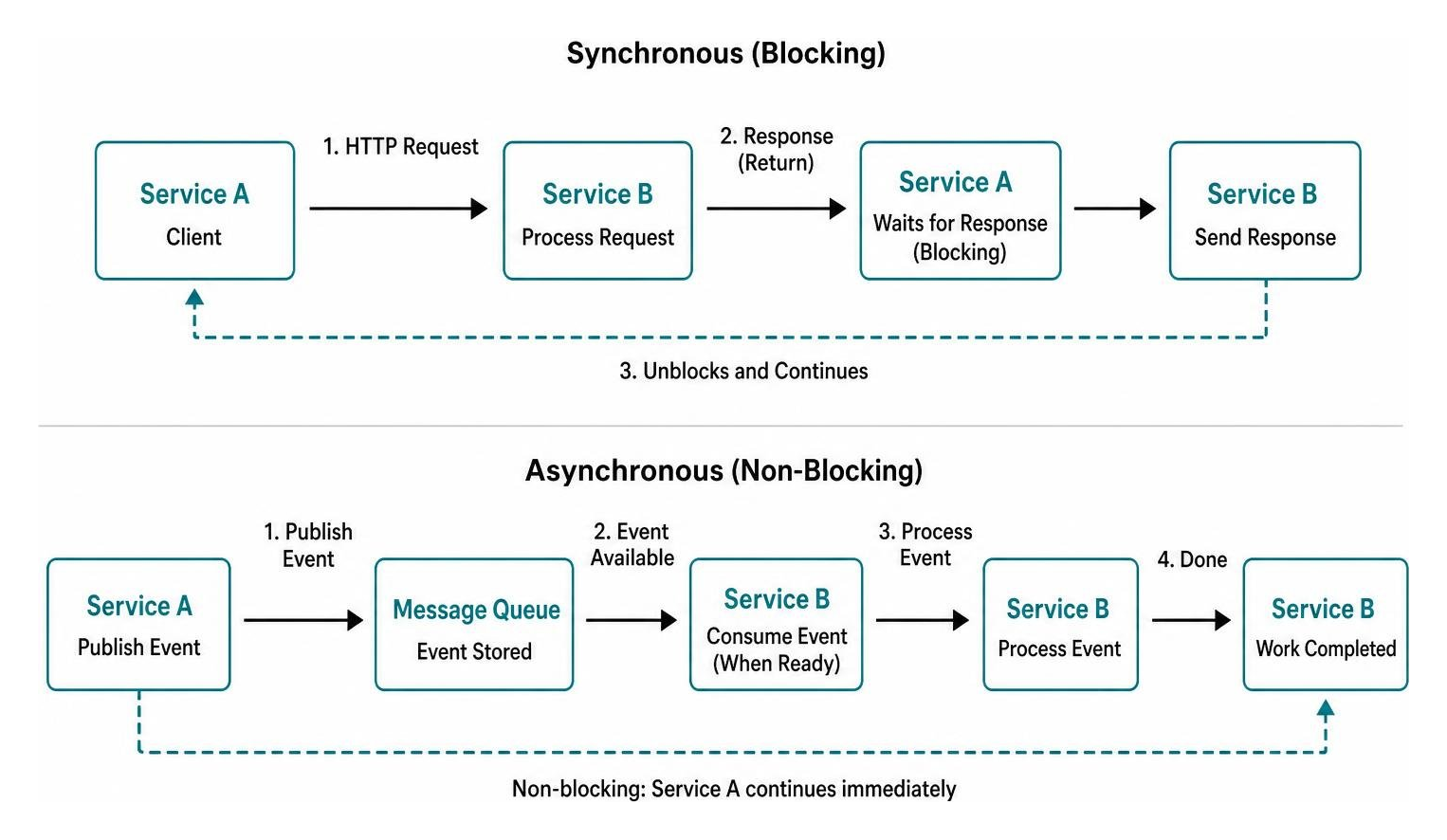
In computer science, a synchronous operation is blocking. When Service A sends an HTTP request to Service B, it halts execution and waits for a response. If Service B is slow or down, Service A stalls, potentially causing a cascading failure across the entire system.
An asynchronous operation, however, is non-blocking. Service A publishes an event to a message queue (like Kafka or RabbitMQ) and immediately continues its work. Service B consumes the message from the queue whenever it has the capacity.
According to Synchronous vs. Asynchronous Communication – System …, this asynchronous decoupling is what allows distributed systems to scale, absorb traffic spikes, and remain resilient to individual service failures.
Applying Distributed System Principles to Human Teams
When we look at our organizations through this systems-engineering lens, we realize that most traditional offices are designed as highly coupled, blocking systems.
- The Human Blocking Call: Tapping a developer on the shoulder or sending a “Hey, got a second?” Slack ping is a blocking call. It halts their execution immediately.
- The Human Message Queue: Using a project board or a structured document is a non-blocking queue. We deposit our request and allow the developer to process it when they finish their current task.
- Load Balancing: Just as we use buffers to prevent servers from being overwhelmed, we can use asynchronous response windows to protect our team’s cognitive load.
By decoupling the sender and the receiver, we build a team that is resilient, highly scalable, and capable of operating continuously across the globe.
A Practical Playbook for Balancing Sync and Async Work
Transitioning to an async-first culture is not about throwing away your video tools; it is about establishing a clear communication agreement.
How the Difference Between Synchronous and Asynchronous Communication Impacts Team Culture
When we build an async-first culture, we shift the foundation of how we measure performance. In a synchronous office, we often measure “presence”—who is first in the office, who replies fastest to chat messages, and who speaks loudest in meetings.
In an async-first culture, we measure outcomes. We trust our team to manage their own schedules. This trust directly impacts employee well-being: 61% of employees report that more asynchronous work would enable a better work-life balance.
However, we must be intentional about recognition. When we don’t see each other in person, appreciation can easily get lost. We must build persistent, public asynchronous channels to celebrate wins and show appreciation. For a deeper look at how these dynamics play out in real teams, read our guide on Async-First Remote Developer Jobs: Culture, Workflow, Communication.
Best Practices for Transitioning to an Async-First Model
If you want to transition your team away from meeting overload, use this practical playbook:
- Audit Your Calendar: Review your recurring meetings. Can your weekly status-update meeting be replaced with a written check-in? If yes, cancel it immediately.
- Define Response Windows: Establish clear expectations. For example, agree that Slack messages require a response within 4 hours, while emails or project board updates require a response within 24 hours.
- Default to Writing: Before scheduling a meeting, write down the problem, the context, and your proposed solution. Often, the act of writing will clarify the issue so thoroughly that you won’t need the meeting at all.
- Designate Focus Days: Implement “No Meeting Wednesdays” to guarantee your developers large, uninterrupted blocks of time for deep work.
When we cut our meeting load by 40%, employee productivity jumps by 71%, satisfaction increases by 52%, and stress levels drop significantly. For developers looking to work in these highly productive environments, you can explore curated opportunities on our Async Remote Developer Jobs page.
To design a complete communication policy, we also recommend checking out Synchronous vs Asynchronous Communication: A Practical Guide | Cheerillion Blog.
Frequently Asked Questions about Sync and Async Communication
Is Slack synchronous or asynchronous?
Slack is a hybrid tool, and how it functions depends entirely on your team’s culture. By default, Slack is often used synchronously, with users feeling pressured to reply within minutes—a pattern we call the “asynchronish” trap. However, if your team establishes clear channel guidelines and respects status updates (like “focusing” or “offline”), Slack can be an excellent asynchronous tool.
According to synchronous-vs-asynchronous-communication, the key is to decouple the tool from the expectation of immediacy.
How do you prevent the “asynchronish” trap?
The “asynchronish” trap occurs when a company uses asynchronous tools (like chat or email) but maintains synchronous expectations (demanding instant replies). This combines the worst of both worlds: your team’s focus is constantly fragmented by notification pings, yet they never get the benefits of real-time collaboration.
To break free, you must establish explicit, written communication norms. Encourage team members to mute notifications, block out focus time on their calendars, and measure performance by output rather than responsiveness.
When is a real-time meeting absolutely necessary?
While we champion async-first, synchronous meetings are vital when used intentionally. You should schedule a live meeting for:
- Sensitive Conversations: Delivering performance reviews, resolving interpersonal conflicts, or discussing career growth.
- Creative Brainstorming: Open-ended sessions where rapid back-and-forth builds momentum.
- Relationship Building: Initial kick-offs, team-bonding events, and 1:1 check-ins.
As outlined in Synchronous vs Asynchronous Communication, meetings earn their keep when they are used to create understanding and alignment, rather than just passing information.
Conclusion
The difference between synchronous and asynchronous communication is the defining factor in whether your team operates in a state of chaotic fragmentation or deep, productive focus.
As we navigate the remote work landscape of July 2026, the rise of “vibe coding” (AI-assisted development using tools like Cursor and Claude) has made async-first communication even more critical. When developers can generate and iterate on code at lightning speed with AI, they need uninterrupted focus time to think, architect, and review. They don’t have time for meetings that could have been an email.
At RemoteVibeCodingJobs, we aggregate remote vibe coding jobs at companies that respect your focus. We curate daily listings filtered by culture, tech stack, and modern AI tools so you can find a team that values your output over your presence.
Ready to upgrade your team’s toolkit? Explore the best async communication tools for dev teams in 2026 and start building a non-blocking, highly scalable workflow today.