
Find Remote AI Engineer Roles That Fit Your Stack
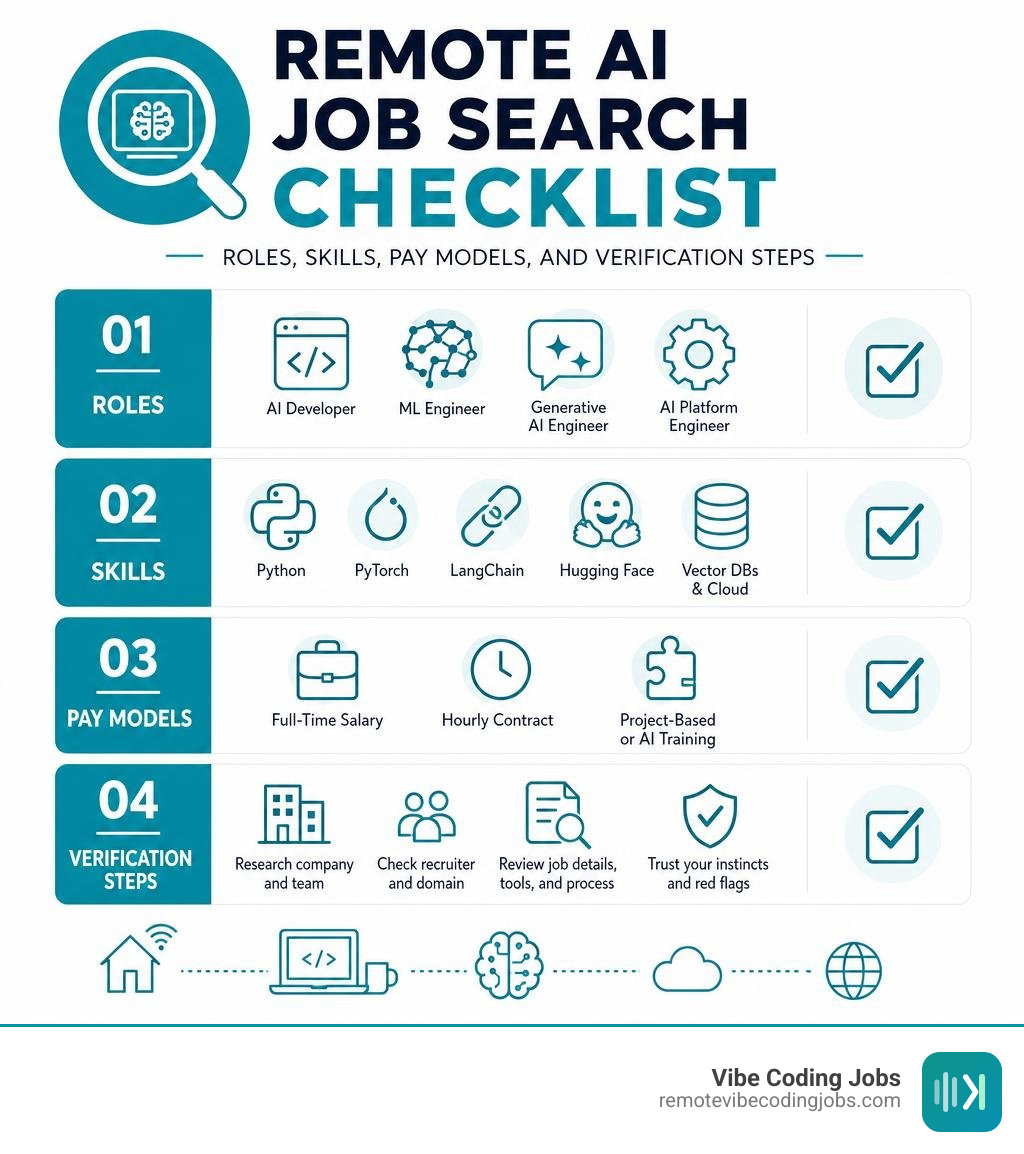
The fastest way to find remote jobs for AI engineers is to search verified, remote-first job boards with filters for your location, seniority, pay type, and tools. Prioritize roles that name the work clearly, such as:
- Generative AI engineer, ML engineer, AI platform engineer, or AI developer
- RAG, LLM evaluation, fine-tuning, agentic workflows, or ML infrastructure
- Python, PyTorch, TypeScript, LangChain, Hugging Face, vector databases, and cloud platforms
- Full-time salary roles, hourly contracts, or flexible project-based AI training work
The market is broad. Listings range from AI trainer contracts paying roughly $50 to $100 per hour to senior remote engineering roles with annual base pay above $300,000. The key is not applying to everything. Match your proven skills to a real production problem, check that the company and recruiter are legitimate, and favor teams that explain their remote process rather than simply adding “remote” to the title.
Remote AI work now includes far more than training models. You might build a retrieval system for internal documents, improve inference speed, create evaluation pipelines for AI agents, or ship a full-stack product powered by LLMs. Strong async communication matters because the best distributed teams rely on clear writing, documented decisions, and practical demos instead of endless meetings.
I’m Dominic Zijlstra, a technologist, founder, former data scientist, and DevOps engineer who has built automated systems and data infrastructure across startups and larger technical environments. In this guide, I will help you focus your search for remote jobs for AI engineers on the skills, roles, and work styles that create real career momentum.
Key terms for remote jobs for AI engineers:
Types of Remote Jobs for AI Engineers and Salary Benchmarks

The landscape for distributed artificial intelligence talent has expanded rapidly in 2026. With over 87,000 remote AI-related listings across major platforms and thousands of startup openings, compensation models reflect a mature, highly specialized market. AI engineering spans everything from foundational model training to application-layer integration. Understanding where your expertise fits helps you target the right pay bracket, as detailed in our remote developer salary guide.
Compensation structures vary heavily depending on whether an employer offers global geographic parity or local cost-of-living adjustments. Top-tier remote organizations increasingly pay flat, competitive US rates regardless of where you log in from, combining high base salaries with meaningful equity packages.
Specialized AI and Machine Learning Roles
Modern AI roles require distinct skill sets:
- Generative AI Engineers: Focus on orchestrating foundational large language models (LLMs), building agentic workflows, and implementing structured outputs using tool-calling capabilities.
- ML Infrastructure Architects: Build low-latency serving engines, containerized compute clusters, and GPU orchestration pipelines.
- Post-Training Specialists: Specialize in Reinforcement Learning from Human Feedback (RLHF), Supervised Fine-Tuning (SFT), Direct Preference Optimization (DPO), and model alignment. Companies frequently list senior roles like the post-training ML engineering roles at Airbnb that command base salaries ranging from $248,000 to $310,000 USD.
- Applied AI Developers: Bridge traditional software architecture with machine learning capabilities. You can explore standard market benchmarks through our breakdown of salaries for Python engineers.
Compensation Models: Hourly Contract vs Annual Base
Remote AI roles generally follow three compensation structures: hourly contracts, salaried full-time positions, and task-based milestone agreements. Contract rates often range from $50 to $120 per hour for specialized AI data trainers, while full-time enterprise salaries routinely span $120,000 to $310,000+ per year.
| Compensation Model | Typical Pay Range | Common Responsibilities | Ideal Profile |
|---|---|---|---|
| Hourly Contract | $50 – $120 / hr | RLHF evaluation, code reviewing, domain-specific AI training, prompt benchmarking | Freelancers, specialists wanting flexible hours, moonlighting engineers |
| Full-Time Salary | $120k – $310k+ / yr | Production RAG systems, model fine-tuning, ML infrastructure, API architecture | Engineers seeking stability, comprehensive healthcare, 401(k), and equity |
| Milestone / Per-Task | $20 – $150 / task | Synthetic data generation, prompt-response pair authoring, niche dataset validation | Part-time contributors, domain experts (legal, medical, specific CAD/coding) |
When negotiating remote offers, explore our remote developer salary negotiation strategies to benchmark equity, bonuses, and home-office stipends effectively.
In-Demand Tech Stacks and Workflows
Succeeding in remote AI roles requires a balance of core software engineering fundamentals and modern AI frameworks. Employers evaluate how cleanly you build, deploy, and monitor applications asynchronously. Reviewing the standard remote AI developer qualification requirements provides a baseline for evaluating your technical gaps.
Essential Technical Skills for Remote Jobs for AI Engineers

Production systems have shifted away from simple wrapper scripts toward robust, scalable architectures:
- Core Languages: Python remains dominant for backend services and ML pipelines, while TypeScript is standard for full-stack AI interfaces.
- Retrieval-Augmented Generation (RAG): Advanced knowledge retrieval using hybrid search, contextual compression, and graph-based indexing (GraphRAG).
- Frameworks and Orchestration: LangChain, LangGraph, and LlamaIndex for complex, multi-step agent reasoning.
- Inference & Optimization: High-throughput serving engines like vLLM, TensorRT-LLM, and quantization toolkits such as Unsloth. Production deployments like cloud platform engineering at OpenNebula emphasize these containerized, GPU-aware systems.
- Data Stores: Vector databases (Pinecone, Qdrant, Milvus, pgvector) alongside traditional PostgreSQL and Redis caches.
Tooling and AI-Assisted Development Workflows
The fastest-shipping remote engineers leverage AI-native developer toolchains. Modern teams integrate specialized IDEs and autonomous assistants directly into their day-to-day work, utilizing must-have AI developer productivity tools to accelerate delivery.
- AI-First IDEs: Cursor and Windsurf for contextual repository navigation and multi-file editing.
- Autonomous Terminal Agents: Claude Code, GitHub Copilot CLI, and Aider for executing complex code refactors directly from the shell.
- Automated Evaluation & Tracing: Arize Phoenix, Langfuse, and TruLens for real-time latency, token cost, and hallucination monitoring.
Top Companies and Hiring Requirements in 2026
Both Fortune 500 enterprises and agile startups are expanding their distributed AI talent pools. Deciding between enterprise stability and high-growth startup velocity depends on your career goals, as examined in our guide on comparing remote startups vs big tech environments.
Enterprise and HealthTech AI Opportunities
Enterprise employers place significant emphasis on safety, regulatory compliance, and high availability:
- UnitedHealth Group (Optum) hires Senior AI/ML Engineers ($120,100 to $214,500) to build clinical reasoning workflows and secure RAG pipelines over complex healthcare data.
- Capital One recruits Distinguished AI Engineers ($244,700 to $279,200 base for remote candidates, up to $335,100 in select metro tiers) to scale fraud-detection architectures and establish responsible AI governance frameworks.
- Jitterbit sources Senior AI Engineers with 10+ years of distributed systems experience to embed LLM automation directly into enterprise iPaaS platforms.
High-Growth Startups and Cloud Infrastructure Roles
Early-stage and growth-stage companies prioritize shipping speed and end-to-end ownership. These teams rely on an async-first remote culture and developer tools to build without synchronous meeting bottlenecks. Early-stage AI hires often receive significant equity grants (0.5% to 2%+) alongside competitive base salaries ($150,000 to $300,000) to design core agentic architectures.
Navigating the Job Market and Career Progression
Standing out in a competitive job market requires a clear portfolio of production deployments rather than generic sandbox tutorials. Regularly browsing curated remote AI job boards and openings ensures you stay aligned with active market demands.
How to Find and Vet Legitimate Remote Jobs for AI Engineers
With the influx of remote opportunities, vetting listings protects your time and personal information:
- Verify Domain and Communication Channels: Legitimate companies communicate via corporate email domains, never via personal Telegram or WhatsApp accounts.
- Evaluate Technical Interview Formats: Established engineering teams conduct structured technical screens, architecture discussions, or take-home system design reviews.
- Tailor Your Application: Align your experience with our guide on building a resume for AI-native companies, highlighting concrete metrics like inference latency reductions or cost-per-query optimizations.
Career Paths: From AI Trainer to Distinguished Engineer
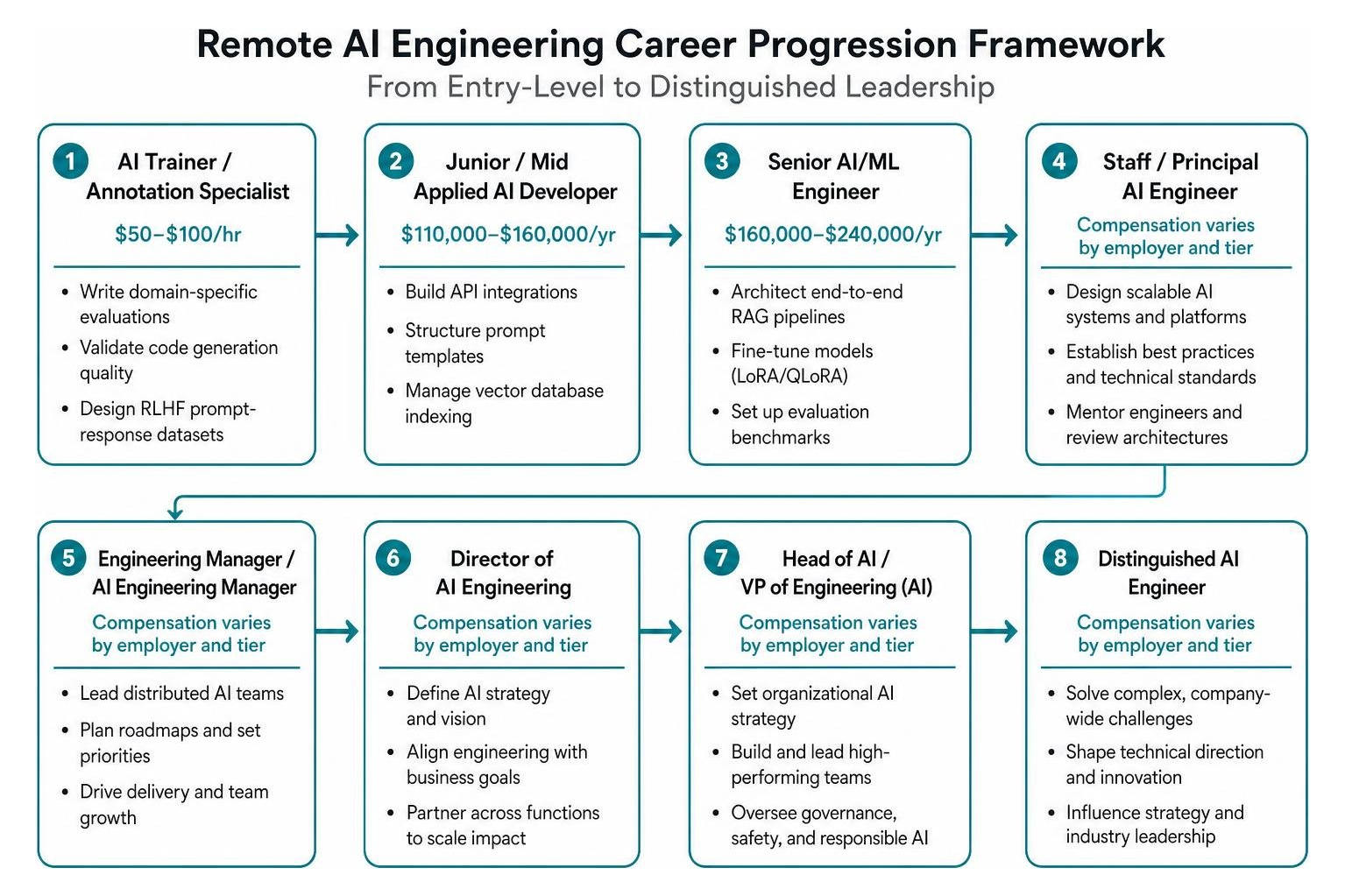
A clear career trajectory exists across remote AI engineering disciplines, offering significant long-term career growth in AI development:
- AI Trainer / Annotation Specialist ($50–$100/hr): Writing domain-specific evaluations, validating code generation quality, and designing RLHF prompt-response datasets.
- Junior / Mid Applied AI Developer ($110,000–$160,000/yr): Building API integrations, structuring prompt templates, and managing vector database indexing.
- Senior AI/ML Engineer ($160,000–$240,000/yr): Architecting end-to-end RAG pipelines, model fine-tuning (LoRA/QLoRA), and setting up evaluation benchmarks.
- Staff / Principal AI Architect ($240,000–$310,000/yr): Leading cross-team AI infrastructure, optimizing multi-agent orchestration systems, and reducing operational token spend.
- Distinguished Engineer ($300,000–$400,000+/yr): Setting enterprise-wide AI technical strategy, driving novel post-training research, and overseeing algorithmic safety standards.
Frequently Asked Questions about Remote AI Engineering Jobs
What is the average salary range for remote AI engineers in 2026?
Full-time remote AI engineers earn between $120,000 and $240,000 on average across the United States, with senior, staff, and distinguished positions scaling from $244,000 to over $350,000 base salary plus equity. Hourly contract positions for specialized data labeling and model training typically pay between $50 and $120 per hour.
What core qualifications do employers look for in remote candidates?
Most employers look for a solid foundation in Python or TypeScript, practical experience with frameworks like PyTorch, LangChain, or Hugging Face, and a track record of deploying generative AI applications to production. Distributed teams also evaluate async communication skills, documentation habits, and familiarity with AI-assisted developer workflows.
What are the main challenges of working remotely on AI infrastructure?
Key challenges include managing compute costs on distributed GPU clusters, debugging non-deterministic LLM outputs across time zones, and maintaining reliable observability for production inference latency. Successful remote teams overcome these hurdles using automated evaluation suites, comprehensive tracing tools, and robust async documentation.
Conclusion
The demand for distributed artificial intelligence talent continues to accelerate. As enterprises move past initial prototyping into large-scale autonomous agent deployments, engineers who master both systems engineering and modern AI workflows remain in high demand.
At Vibe Coding Jobs, we track and curate the latest async-first, AI-assisted development positions daily. You can explore curated remote AI engineering opportunities to find verified listings tailored to your specific technical stack.