
Find Reliable Remote Software QA Engineer Roles Faster
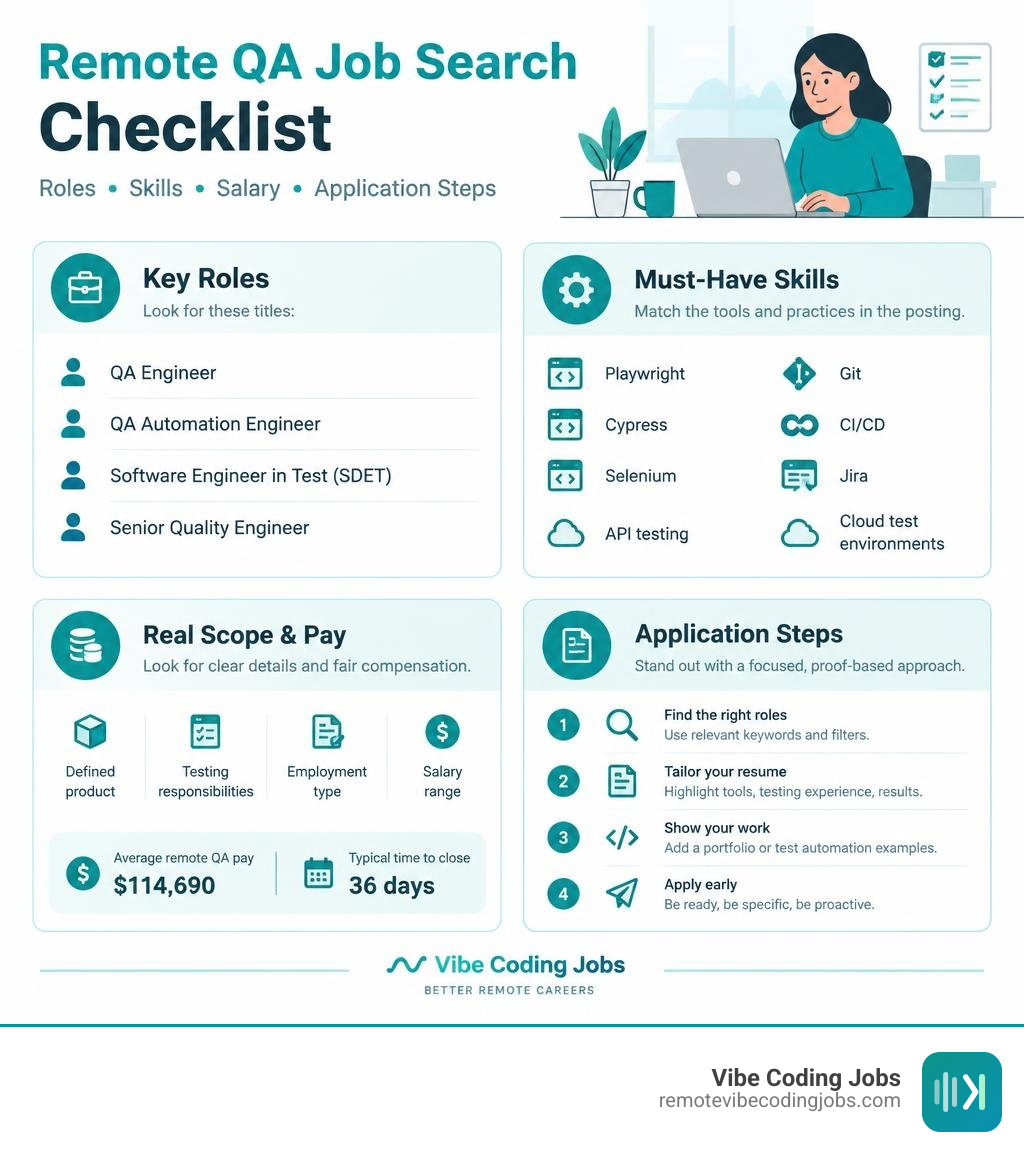
To find reliable software QA engineer jobs remote, focus on roles that clearly state the testing stack, remote-work location rules, and team workflow. Search for titles such as QA Engineer, QA Automation Engineer, Software Engineer in Test (SDET), and Senior Quality Engineer, then tailor each application to the tools named in the posting.
Prioritize jobs that mention:
- Automation and delivery tools: Playwright, Cypress, Selenium, API testing, Git, and CI/CD
- Remote-ready collaboration: Jira, clear async documentation, stable cloud test environments, and time-zone expectations
- Real scope and pay: a defined product, testing responsibilities, employment type, and salary range where required
The market is competitive, but it is active across SaaS, fintech, healthcare, enterprise cloud, and Salesforce-focused teams. Current US listing data puts average remote QA pay at $114,690, while employers typically close these openings in about 36 days. Applying early with a proof-based resume and a small portfolio of test automation work can make a meaningful difference.
I am Di Su, a software engineer with more than 10 years of experience building web products, improving workflows, and shipping user-focused software. I use that mix of engineering and growth experience to help candidates evaluate software QA engineer jobs remote with a practical eye for tools, team culture, and real career upside.
Software qa engineer jobs remote terms simplified:
Navigating the Market for Software QA Engineer Jobs Remote
The landscape of distributed quality engineering has shifted rapidly. High-growth engineering teams no longer treat quality assurance as an isolated gatekeeping phase at the end of a sprint. Instead, testing is embedded directly into the developer workflow.
Distributed teams rely on automated quality checks, telemetry, and fast feedback loops. This shift has created massive demand for engineers who understand both testing architecture and asynchronous collaboration.
Current market data indicates that employers take an average of 36 days to fill a remote QA role. This timeline reflects thorough vetting processes, including practical coding assessments, take-home test harness assignments, and system design interviews.
Thousands of distributed testing positions are listed across major job platforms. Securing these positions requires a deep understanding of role expectations and technical requirements across different career tiers.
Core Roles and Career Levels in Distributed QA Teams
Remote quality engineering roles span a wide spectrum of responsibilities, from manual product exploration to designing distributed test harnesses:
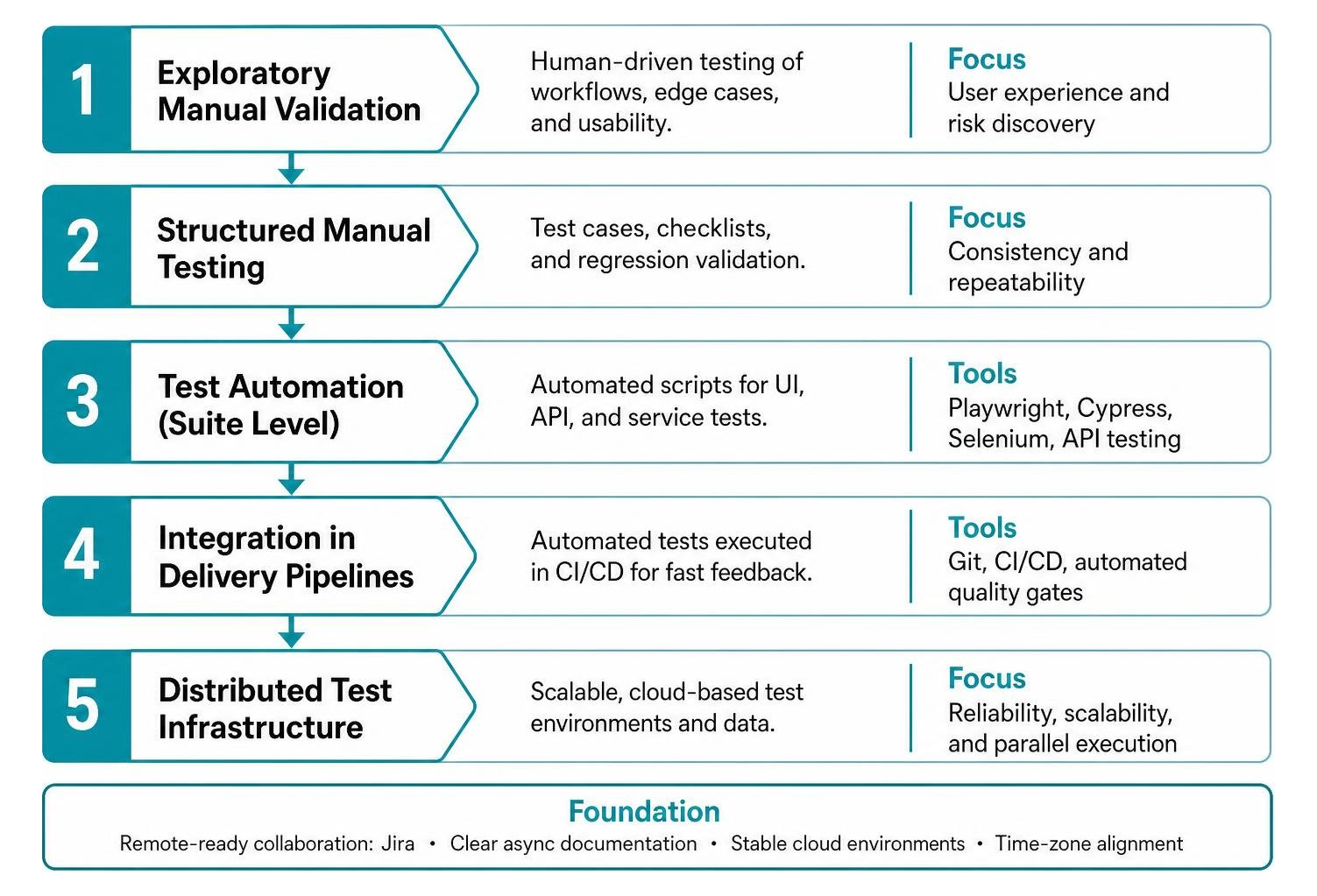
- Manual QA and Exploratory Testers: These professionals focus on validating user flows, executing edge-case scenarios, and conducting accessibility audits. Candidates starting out can find entry points such as a QA manual test engineer position to build foundational domain knowledge.
- QA Automation Engineers: Automation specialists design script suites for web, mobile, and backend microservices using tools like Playwright and Cypress.
- Software Engineers in Test (SDET): SDETs build internal testing developer platforms, design synthetic data generation pipelines, and implement self-healing test automation frameworks. Experienced engineers targeting high-impact roles often pursue senior SDET career paths to lead testing architecture.
- Quality Assurance Leadership: QA Leads, Engineering Managers, and QE Directors establish quality standards, track metrics across departments, and eliminate delivery bottlenecks.
- Entry-Level and Internship Roles: Those entering the field can evaluate structured learning tracks, such as QA intern opportunities, to gain hands-on experience with modern CI/CD pipelines.
Compensation Benchmarks and Salary Trends across US Regions
Compensation for remote QA positions is influenced by experience level, specialized domain knowledge, and framework expertise. Remote roles often provide nationwide pay bands, while certain companies calibrate offers based on geographic regions.
According to aggregate data gathered across thousands of active US positions, the national average salary for remote QA engineers stands at $114,690 annually.
| Career Level | Typical Experience | Average Annual Salary | Common Salary Range |
|---|---|---|---|
| Entry-Level QA | 0–2 Years | $62,400 | $55,000 – $78,000 |
| Mid-Level QA Engineer | 3–5 Years | $102,663 | $85,000 – $125,000 |
| Senior Quality Engineer | 5–8 Years | $133,952 | $115,000 – $165,000 |
| Lead QA / Staff SDET | 8–10+ Years | $173,119 | $145,000 – $210,000+ |
Specialized sectors offer distinct compensation ranges. For instance, Salesforce QA roles frequently range from $80,000 to $100,000. Specialized API and backend test automation positions regularly reach between $92,000 and $131,000, while Lead and Principal Quality Engineers in major metro-backed companies can exceed $180,000 to $206,700.
Essential Technical Skills and In-Demand Tooling for Remote QA Roles
Securing a remote QA position requires combining fundamental testing methodologies with modern development workflows.
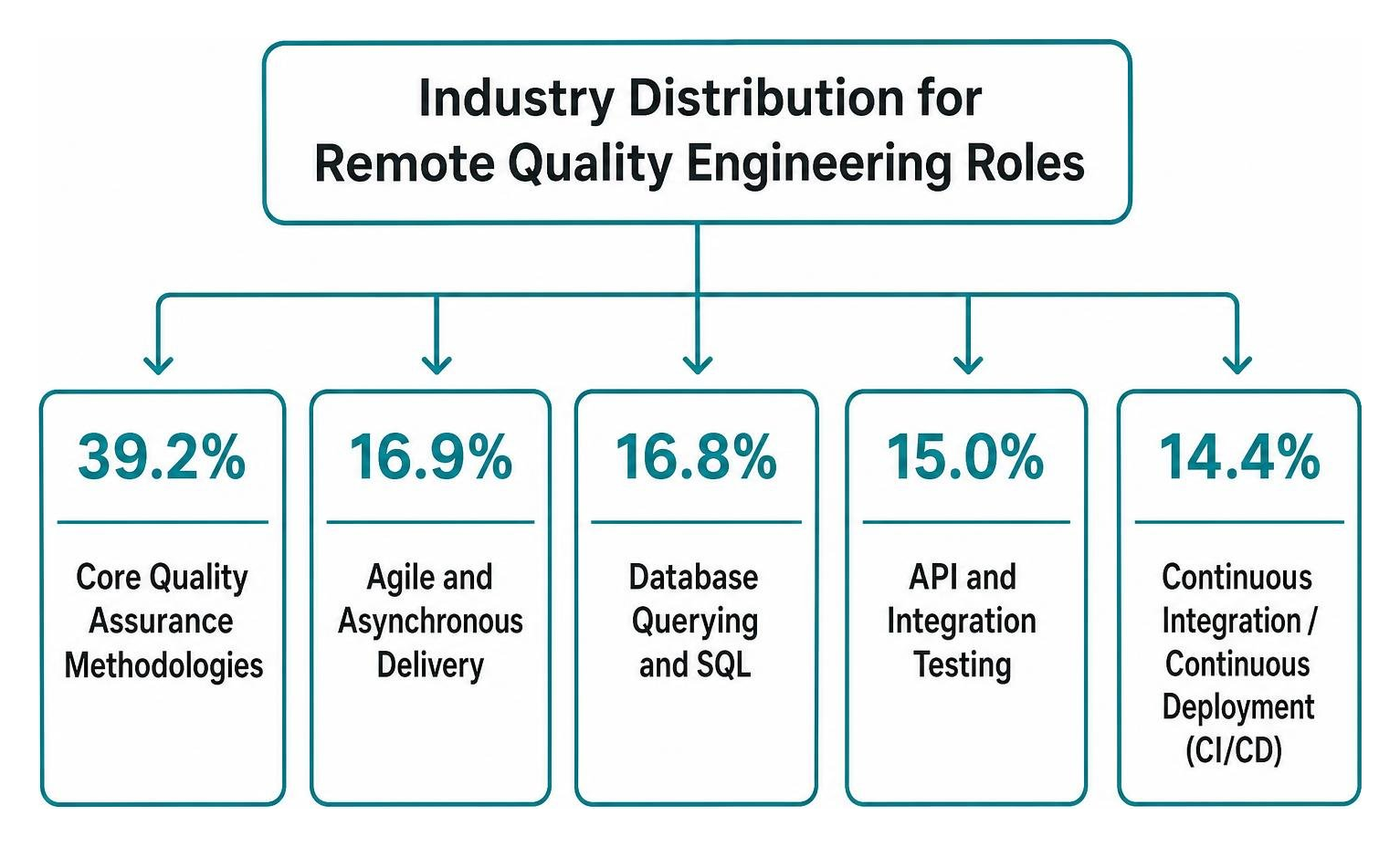
Industry hiring datasets highlight clear technical priorities across active job descriptions:
- Core Quality Assurance Methodologies: 39.2% of job listings explicitly require structured test planning, defect lifecycle tracking, and risk-based test design.
- Agile and Asynchronous Delivery: 16.9% emphasize Agile, Scrum, and ticket management workflows.
- Database Querying and SQL: 16.8% require SQL proficiency for backend data validation, database migrations, and ETL pipeline verification.
- API and Integration Testing: 15.0% prioritize REST, GraphQL, and gRPC endpoint validation.
- Continuous Integration / Continuous Deployment (CI/CD): 14.4% require direct experience running automated tests inside GitHub Actions, GitLab CI, or Jenkins.
Automation Frameworks, API Testing, and CI/CD Integration
The modern test automation landscape favors tools that provide fast execution, low flakiness, and native support for modern JavaScript, TypeScript, and Python environments. While legacy systems maintain Selenium suites, modern engineering teams have widely adopted Playwright and Cypress for end-to-end web testing.
For backend verification, automated suites rely heavily on tools like Postman, Newman, Supertest, and REST Assured. Candidates applying for Senior QA automation engineer platform roles are expected to build containerized test runners that execute parallel suites on every pull request, preventing regressions from reaching production environments.
AI-Assisted Testing and Emerging Trends in Software QA Engineer Jobs Remote
The rise of generative AI and AI-assisted development (often called “vibe coding”) is reshaping software testing workflows. Remote QA engineers increasingly use AI development environments like Cursor, Claude, and GitHub Copilot to:
- Generate complex synthetic test datasets and edge-case boundary scenarios.
- Scaffold boilerplate test automation scripts across Playwright and Cypress.
- Implement self-healing locators that dynamically adapt when frontend UI elements change.
- Validate LLM outputs, conversational interfaces, and generative AI agents for hallucinations and bias.
- Conduct chaos engineering experiments to test microservice resilience in distributed cloud networks.
Engineering teams at companies like Synera actively target comprehensive test automation by providing engineers with AI tokens and modern automated toolchains.
Top Industries and Best Platforms to Find Remote QA Positions
Remote QA roles span multiple industries, each with unique technical requirements:
High-Hiring Sectors: Fintech, Healthtech, and Enterprise Cloud
- Fintech and Banking: These platforms require zero-tolerance testing for transaction processing, ledger accuracy, and regulatory compliance.
- Healthtech and Biotech: Software systems in this space require validation against strict compliance standards such as HIPAA, along with accurate data ingestion for clinical platforms.
- Enterprise Cloud and SaaS: Teams managing large cloud footprints hire for enterprise quality engineer 3 positions to maintain continuous uptime and scalable multi-tenant architectures.
- Ecosystem Specialists: Platforms using Salesforce, SAP, or Workday rely on tools like Copado Robotic Testing to automate continuous release cycles.
To explore openings across specialized platforms, candidates can review curated listings on RemoteVibeCodingJobs and other remote job boards that focus on async-first engineering teams.
How to Stand Out for Software QA Engineer Jobs Remote
To stand out in a competitive remote applicant pool, focus on verifiable technical skills and clear communication:
- Build a Public Test Automation Portfolio: Host a GitHub repository showcasing a clean Playwright or Cypress framework with parallel test execution, API integration, and automated reporting.
- Highlight CI/CD Integration: Document how you configure GitHub Actions or GitLab CI to trigger regression tests on pull requests.
- Quantify Your Impact: Replace vague descriptions with measurable outcomes, such as: “Reduced regression test suite execution time from 4 hours to 18 minutes by implementing parallel Playwright runners.”
- Demonstrate Async Communication: Write clear, comprehensive bug reports and documentation, showing you can collaborate effectively across distributed time zones.
Overcoming Remote QA Challenges: Collaboration, Environments, and Compliance
Working remotely as a QA engineer requires navigating unique operational challenges that on-site teams rarely encounter.
Managing Distributed Test Environments and Asynchronous Workflows
Unstable test environments and flaky staging servers can stall release pipelines. Successful distributed QA teams mitigate these risks by:
- Using containerized testing environments with Docker and Kubernetes to ensure parity between local and cloud setups.
- Leveraging mock servers and service virtualization to run integration tests without depending on third-party APIs.
- Setting up real-time observability pipelines using tools like Datadog, Sentry, or Honeycomb to identify issues in production before users report them.
- Maintaining detailed Jira tickets with reproducible steps, environment details, video captures, and network logs.
Performance Evaluation, Quality Metrics, and Legal Considerations
Engineering managers evaluate remote QA engineers using clear, outcome-focused metrics rather than tracked hours:
- Defect Escape Rate: The percentage of bugs discovered in production versus pre-release environments.
- Automated Test Coverage: The proportion of critical business paths covered by reliable end-to-end and integration tests.
- Test Suite Flakiness and Execution Speed: The reliability and run time of CI/CD quality gates.
From a legal and operational perspective, remote US positions often require candidates to reside within specific states for tax and payroll compliance. Additionally, companies frequently set core working hours to ensure sufficient overlap across team time zones.
Frequently Asked Questions About Remote QA Engineering
What is the average salary for a remote QA engineer?
In the United States, the average annual salary for a remote QA engineer is approximately $114,690. Compensation ranges from $62,400 for entry-level roles to over $173,119 for Lead QA Engineers and Staff SDETs.
How long does the hiring process take for remote QA roles?
The hiring cycle for remote QA positions averages around 36 days. The process typically includes an initial screening, a technical interview, a hands-on coding or test automation assessment, and a team collaboration discussion.
What are the most critical skills needed to land a remote QA role in 2026?
The most in-demand skills include core QA testing methodologies (39.2%), Agile workflows (16.9%), SQL querying (16.8%), API testing (15.0%), CI/CD pipeline configuration (14.4%), and hands-on experience with modern automation frameworks like Playwright and Cypress alongside AI-assisted development tools.
Conclusion
The demand for skilled quality engineers remains strong across the software industry. By mastering modern test automation frameworks, integrating quality checks into CI/CD pipelines, and adopting AI-assisted testing workflows, you can position yourself for high-impact distributed roles.
To take the next step in your career, explore curated remote QA positions on RemoteVibeCodingJobs and connect with forward-thinking engineering teams today.