Why Vibe Coding AI Roles Are the Hottest Opportunity in Tech Right Now
Vibe coding AI roles are one of the fastest-growing job categories in software development — and if you’re a developer who builds with tools like Cursor, Claude, or Copilot, companies are actively competing for your skills right now.
Here’s a quick snapshot of what these roles look like in 2026:
| Role Type | Experience Level | Typical Salary |
|---|---|---|
| Junior AI-First Developer | 1-2 years | $70,000 – $100,000 |
| Mid-Level Product Engineer | 2-5 years | $100,000 – $150,000 |
| Senior AI Systems Architect | 5+ years | $150,000 – $250,000+ |
| Freelance Vibe Coder | Any | $100 – $300/hr |
| Contract MCP/Agent Expert | Senior | Up to $400/hr |
There are currently over 1,900 open vibe coding positions listed across the industry — spanning startups, Fortune 500s, and everything in between. Roles range from Product Engineer and Creative Technologist to titles as specific as Founding Vibe Coder and AI Pilot — Vibe Coding Specialist.
But the market moves fast. New job titles are appearing weekly. Salary ranges vary wildly depending on your tool stack and experience. And not every “AI developer” role is actually what it claims to be.
This guide cuts through the noise. Whether you’re a traditional developer looking to transition, or you’re already shipping products with AI tools and want to get paid more for it, you’ll find a clear path forward here.
I’m part of the RVCJ Editorial team at Remote Vibe Coding Jobs — we cover the vibe coding AI roles market daily, curating verified remote positions and practical career guidance for developers building with Cursor, Claude, Copilot, Windsurf, and Replit. We’ve tracked this space from its earliest job postings to today’s enterprise-scale hiring wave, and everything in this guide reflects what’s actually happening in the market right now.
Demystifying Vibe Coding AI Roles: Definition and Core Concepts
To successfully land one of the many vibe coding ai roles popping up on job boards today, you first need to understand what vibe coding actually is—and what it isn’t.
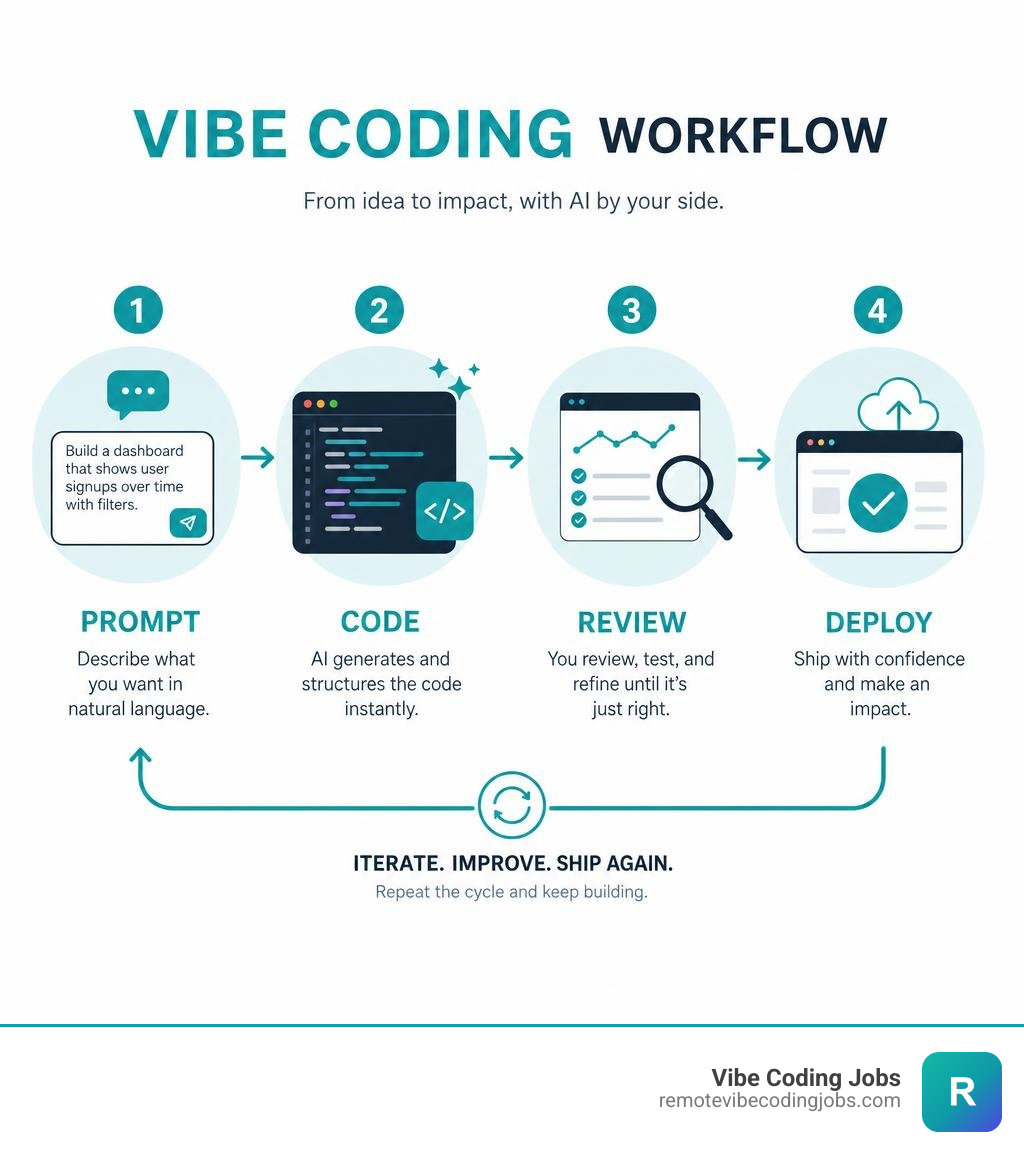
Coined by AI researcher Andrej Karpathy, the term “vibe coding” describes a modern development approach where the human developer shifts from writing code line-by-line to guiding an AI assistant conversationally. Instead of manually typing out syntax, you describe the “vibe” of what you want to build in plain English, and the AI handles the heavy lifting of generating, refactoring, and debugging the application.
However, this doesn’t mean you can just throw vague prompts at an LLM and hope for the best. As tech leaders point out, there is a massive difference between casual vibe coding and professional AI-assisted engineering. In his detailed analysis, Vibe coding is not the same as AI-Assisted engineering. – Medium argues that while pure vibe coding is fantastic for rapid prototyping and weekend hack projects, professional engineering requires a structured framework of human control, architectural oversight, and rigorous testing.
When embarking on a Vibe Coding Career Path, you must position yourself as an orchestrator who knows how to direct these AI agents safely and efficiently toward production-ready software.
The Vibe Coder Meaning and Philosophy
At its core, the philosophy of vibe coding is about elevating the human developer from a “translator of logic into syntax” to a high-level system architect. Instead of spending hours wrestling with brackets, semicolons, and package mismatches, you focus on software architecture, user experience, and product strategy.
In this paradigm, your primary interface is natural language. You write the high-level blueprints, and the AI acts as an incredibly fast junior developer executing those plans. To see this philosophy in action, developers often refer to the ultimate community playbook found in README.md at main · EnzeD/vibe-coding , which outlines how structured documentation and iterative workflows can turn simple prompts into complex, fully functional systems.
Vibe Coding vs. Traditional Software Development
The transition from traditional coding to vibe coding changes almost every aspect of the daily developer workflow. Here is how they compare:
| Feature | Traditional Software Development | Vibe Coding AI Roles |
|---|---|---|
| Primary Activity | Typing code, debugging syntax, reading documentation | Writing prompts, reviewing system architecture, verifying output |
| Development Speed | Days to weeks per feature | Hours to days (compressing 2-3 week MVP builds into 48 hours) |
| Core Skillset | Programming language syntax, framework APIs, manual debugging | System design, prompt engineering, verification, context management |
| Debugging Method | Reading stack traces, setting breakpoints manually | Feeding error logs to AI, analyzing runtime telemetry |
| Workflow Focus | Low-level implementation details | High-level business logic and user value |
The Landscape of Vibe Coding AI Roles in 2026
The job market in 2026 is undergoing a massive shift. Companies have realized that developers who leverage AI tools can achieve a 30% to 50% increase in development speed. As a result, the demand for AI-fluent professionals is exploding. Startups and enterprises alike are actively updating their tech stacks and looking for Companies Hiring Vibe Coders and AI Developers to help them ship products faster than ever before.

Common Job Titles and Emerging Vibe Coding AI Roles
If you are browsing job boards today, you might not always see the exact phrase “Vibe Coder” in the heading. Instead, companies use several emerging titles to describe these AI-native positions:
- Product Engineer: A hybrid role that blends product management with AI-assisted coding to build, test, and ship features rapidly.
- Creative Technologist: Common in design-led companies and agencies, focusing on rapid prototyping and interactive experiences using generative design and code.
- AI-First Developer: A software engineer whose default workflow starts with AI generation rather than manual typing.
- Applied AI Engineer: A more infrastructure-focused role. For instance, the Member of Technical Staff (Applied AI Engineer) @ VibeCode position highlights responsibilities like building custom AI agents, managing multi-model cost optimization, and establishing custom memory systems.
Industries Actively Hiring AI-Fluent Developers
Vibe coding is no longer restricted to tech startups. It has spread across a vast array of industries:
- Web3 and Blockchain: Teams are using AI tools to quickly prototype smart contracts, build decentralized frontends, and integrate on-chain data.
- Healthcare Tech: Companies are leveraging AI-fluent developers to build secure, compliant data pipelines and patient-facing interfaces at record speeds.
- Traditional Engineering (Mechanical, Electrical, Structural): In a fascinating twist, firms like SSOE are hiring vibe-coding professionals to automate complex design workflows, such as HVAC and hydraulic calculations, using customized LLM pipelines.
If you are looking to enter these fields, check out our curated listings of Vibe Coding Jobs with Remote AI Assistants to find companies that match your industry interests.
Essential Tools and Technical Skills for Modern Vibe Coders
To stand out in the job market, you must be highly proficient in the modern AI developer toolchain. Employers expect you to know which tool is best suited for a specific task and how to combine them to build a cohesive workflow.
The most frequently required tools in 2026 include:
- Cursor & Windsurf: Advanced, AI-first code editors that offer deep codebase indexing, enabling the AI to understand your entire project structure rather than just single files.
- Claude Code & Codex CLI: Powerful terminal-based AI agents that can run commands, edit files, and execute tests autonomously.
- Bolt.new & Lovable: Web-based prototyping platforms that allow you to go from a simple text description to a deployed full-stack application in seconds.
- v0.dev & Replit Agent: Specialized tools for rapid frontend design generation and isolated environment setup.
Must-Have Technical and Soft Skills for Vibe Coding AI Roles
Landing a top-tier role requires more than just typing “write me a website” into an LLM. Employers look for a balanced mix of technical and soft skills, which we detail in our guide on How to Get a Vibe Coding Job in Remote AI.
Key competencies include:
- Prompt and Context Engineering: Knowing how to frame problems, feed the AI relevant code snippets, and use Model Context Protocol (MCP) servers to connect your AI tools to external databases and APIs.
- System Architecture & Design: Since the AI handles the line-by-line coding, your value lies in designing scalable systems, database schemas, and clean API integrations.
- Critical Verification: The ability to spot subtle logical bugs, security vulnerabilities, or performance bottlenecks in AI-generated code.
- Low Ego & High Curiosity: A willingness to constantly adapt as AI models evolve and change overnight.
The Memory Bank Architecture and Workflow Best Practices
One of the most important technical practices for vibe coders in 2026 is maintaining a “Memory Bank” for your AI. Because LLMs have context limits and can forget details over long chat sessions, successful developers use structured markdown files to keep the AI aligned.
A typical Memory Bank folder contains:
system-rules.md(or.cursorrules): Defines coding standards, tech stack choices, and architectural rules (e.g., “always write modular, typed code; never write monolithic files”).product-requirements.md(PRD): Outlines the high-level features and user flows.progress.md: Keeps track of what features have been completed, what is currently being worked on, and what blockages exist.architecture.md: Documents system design decisions, database schemas, and API contracts.
By frequently clearing your chat context and pointing the AI back to these markdown files, you prevent the model from hallucinating or slowing down as your codebase grows.
Salary Ranges, Experience Levels, and Career Growth
Because vibe coders deliver software at unprecedented speeds, their compensation packages are highly competitive. Let’s break down what you can expect to earn in these roles based on the latest data from our Vibe Coding Salary for Remote AI Roles tracker.
For a broader look at market trends, you can also explore our analysis of Vibe Coding Careers: Remote Job Market, Skills, and Growth.
Salary Breakdown by Experience Level
- Entry-Level / Junior Vibe Coder (1-2 years experience): $70,000 – $100,000. These are often developers who have mastered AI prototyping tools and can build functional MVPs rapidly, even if they don’t have a traditional computer science degree.
- Mid-Level AI-First Developer (2-5 years experience): $100,000 – $150,000. These developers combine solid software engineering fundamentals with advanced prompt engineering and context management.
- Senior AI-First Developer / Product Engineer (5+ years experience): $150,000 – $250,000+. These professionals act as system architects, overseeing multiple AI agents and ensuring code quality, security, and scalability. At top enterprises like ServiceNow, highly specialized vibe coding roles can pay up to $465,000 per year.
Freelance and Contract Rates for AI-Native Developers
If you prefer the flexibility of freelancing, the vibe coding market is incredibly lucrative. Freelancers who can build and deploy functional MVPs in a matter of days typically charge between $100 and $300 per hour.
For contract roles requiring deep expertise in agentic workflows, custom MCP server integrations, and multi-agent orchestration, rates can reach up to $400 per hour. Clients are willing to pay these premium rates because a skilled vibe coder can deliver in 48 hours what a traditional development team might take three weeks to build.
Risks, Guardrails, and the Rise of the Vibe Code Cleanup Specialist
While vibe coding offers incredible speed, it is not without significant risks. If left completely unchecked, AI-generated code can introduce massive technical debt, security vulnerabilities, and operational headaches.
In a survey of 18 CTOs, 16 reported experiencing production disasters directly caused by deploying AI-generated code without proper human review. These disasters ranged from inverted authentication logic (allowing deactivated accounts to access admin tools) to database query timing issues that brought production systems to their knees.
This reality is echoed in the popular article, I Tried Vibe Coding for 30 Days as a Senior Engineer. Here’s My Honest Take. | by Muhammad Haseeb Sohail | May, 2026 | Medium . The author notes that while AI is brilliant at handling 70% of mechanical, boilerplate work, it frequently struggles with the remaining 30% of work that requires deep, context-specific engineering judgment.
Managing Technical Debt and AI Code Quality
To prevent these issues, companies are implementing strict guardrails:
- Comprehension Debt Control: Ensuring that at least one human developer fully understands every line of code committed to production. If no one can explain how a feature works, it shouldn’t be merged.
- Automated Testing: Requiring AI tools to generate comprehensive unit and integration tests alongside any new features.
- CI/CD Guardrails: Implementing automated linting, static analysis, and security vulnerability scanners in the deployment pipeline to catch issues before they reach users.
The Emergence of the Vibe Code Cleanup Specialist
The widespread adoption of casual vibe coding has created a brand-new, highly specialized industry role: the Vibe Code Cleanup Specialist.
This role is the software equivalent of a structural engineer called in to fix a house built without a blueprint. When non-technical founders or junior developers build complex applications entirely through conversational prompting, they often end up with a tangled, untyped, and unmaintainable codebase.
Vibe Code Cleanup Specialists are expert developers who specialize in:
- Reverse-engineering AI-generated applications.
- Adding proper TypeScript types, linting rules, and directory structures.
- Optimizing database queries and fixing memory leaks.
- Establishing proper automated test suites.
This role highlights a crucial truth about the 2026 tech landscape: AI can write code incredibly fast, but human engineering discipline is still required to make it scale.
Frequently Asked Questions about Vibe Coding
Can I get a vibe coding job without a computer science degree?
Yes, absolutely. Vibe coding has significantly lowered the barrier to entry for software development. Because the AI handles complex syntax, employers care far more about your practical ability to ship working products, your system design thinking, and your portfolio of AI-assisted builds than a formal degree. A motivated beginner with a strong portfolio of 100% vibe-coded apps can successfully transition into a junior role within 3 to 6 months.
What are the best AI coding tools to learn in 2026?
To make yourself highly employable, you should focus on mastering:
- Cursor: For daily, codebase-wide iterative development.
- Claude Code: For fast, agentic terminal workflows and refactoring.
- Windsurf: For collaborative, agent-driven coding sessions.
- Bolt.new: For rapid full-stack prototyping and instant deployments.
How do companies prevent production disasters from AI-generated code?
Smart companies treat AI-generated code like a pull request from an incredibly fast, slightly overconfident junior developer. They enforce strict peer reviews, require comprehensive unit tests, run automated security scans, and use spec-driven development—where the human and AI agree on a detailed technical specification before a single line of code is generated.
Conclusion
The rise of vibe coding AI roles is completely reshaping how software is built, deployed, and maintained. It is an incredibly exciting time to be in tech—whether you are an experienced engineer looking to multiply your productivity, or a creative builder entering the industry for the first time.
By mastering the right tools, developing a disciplined workflow, and understanding how to manage AI-generated technical debt, you can position yourself at the very forefront of this hiring wave.
If you are ready to take the next step in your career, we can help. At RemoteVibeCodingJobs, we aggregate the best remote, async-first vibe coding opportunities on the market, filtered by tech stack, culture, and AI tools.
To learn more about this shift in software development, check out our comprehensive guide on https://remotevibecodingjobs.com/blog/what-is-vibe-coding and find your next remote opportunity today!