
Why Asynchronous Communication in Distributed Systems Is the Foundation of Modern Engineering
Asynchronous communication in distributed systems is a design pattern where services send messages and continue working immediately — without waiting for a response. Instead of blocking, the sender hands off work to a queue or broker, and the receiver processes it independently.
Here is a quick summary of what this guide covers:
- What it is: Services communicate through message queues, events, or callbacks rather than direct request-response calls
- Why it matters: Prevents cascading failures, decouples services, and dramatically improves throughput and scalability
- Key tools: RabbitMQ, Apache Kafka, and Redis Streams are the most widely adopted message brokers
- When to switch: Once your system grows beyond roughly 10 microservices, synchronous HTTP calls become a serious bottleneck
- Core challenge: Managing duplicate messages, delivery guarantees, and consistency across services
As systems scale, synchronous communication becomes a liability. One slow or failing service stalls the entire call chain. Asynchronous patterns break that dependency — letting each component operate on its own schedule.
This matters a lot right now. Knowledge workers already spend nearly 3 hours and 43 minutes per day on communication overhead. Engineers building distributed systems face the same problem at the infrastructure level: every blocking call is time a service spends waiting instead of working.
I’m Dominic Zijlstra, cofounder of Adaptify.ai and former communication systems engineer at Airbus working on satellite technology — environments where asynchronous communication in distributed systems is not optional, it is the only viable architecture. That background, combined with hands-on data infrastructure work, shapes the practical approach throughout this guide.
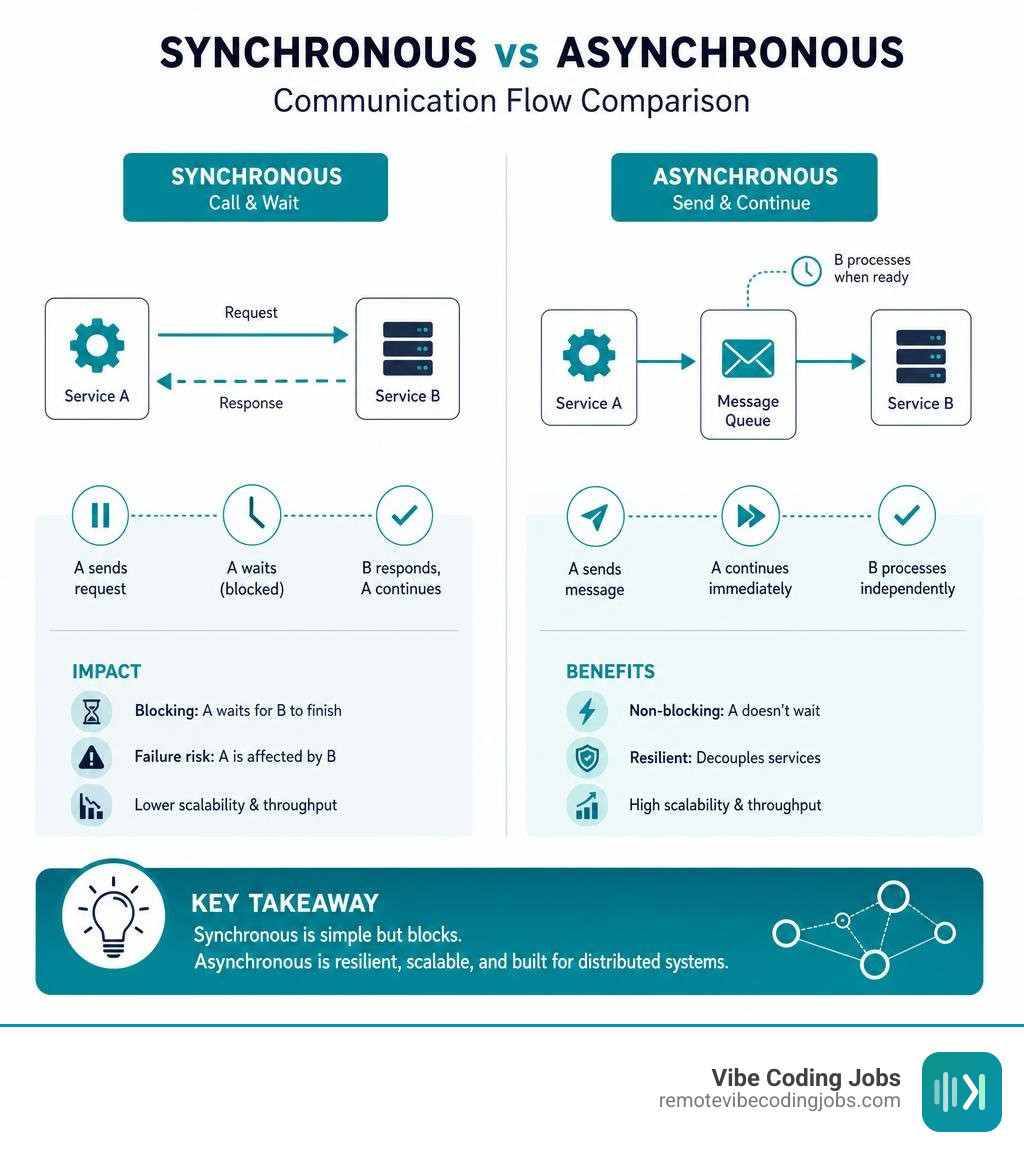
Synchronous vs Asynchronous Communication in Distributed Systems
To understand why modern architectures rely heavily on asynchronous messaging, we first need to contrast it with synchronous execution models.
In a traditional synchronous model, communication operates on a strict call-and-wait request-response cycle. When Service A invokes an HTTP REST endpoint on Service B, Service A blocks its local execution thread. It halts processing until Service B finishes execution, writes to its database, and returns an HTTP response code.
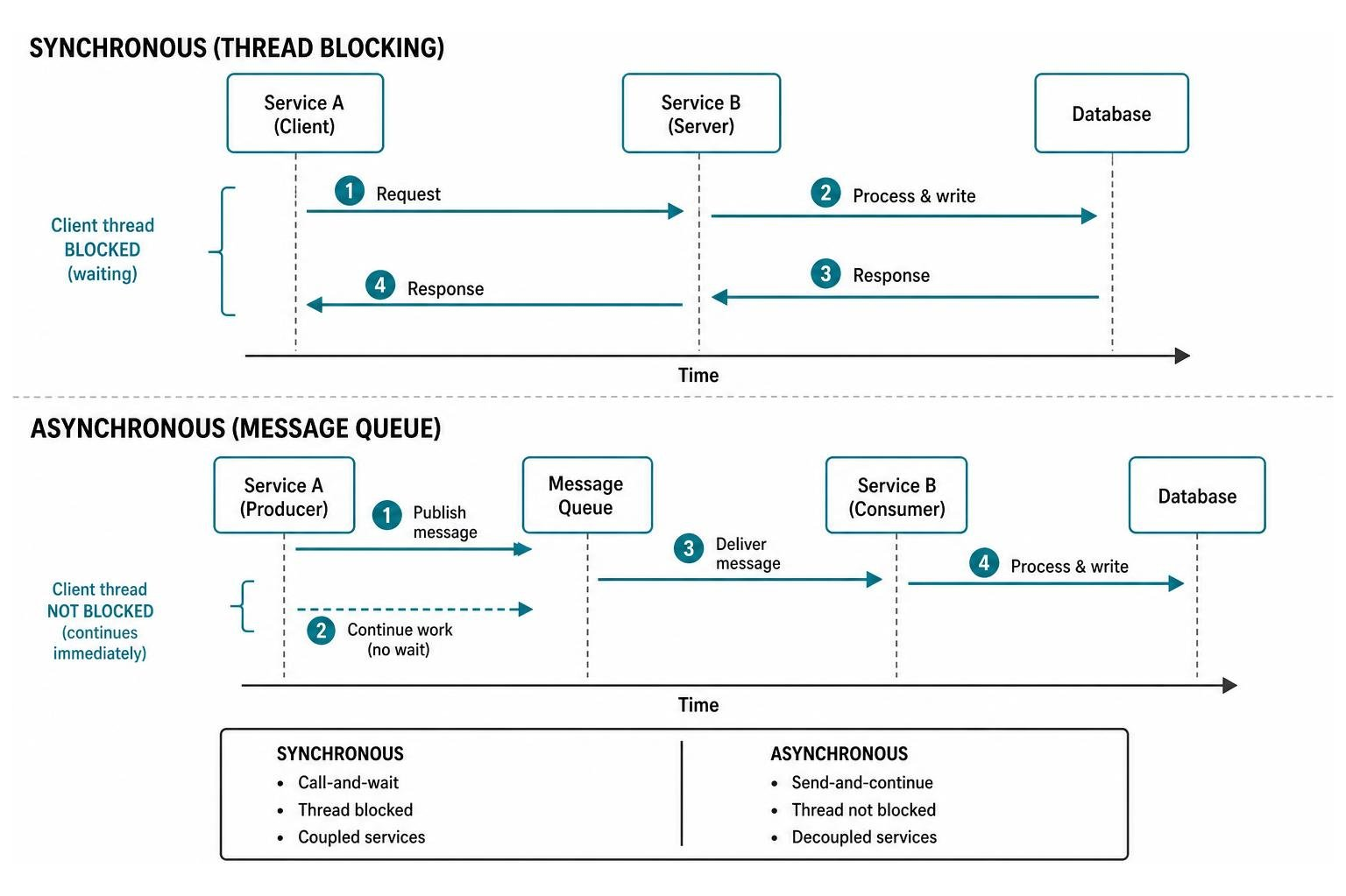
This architecture relies on call-frame stack mechanisms embedded in traditional computer languages. However, distributed systems lack a global clock. Nodes run on different hardware platforms, across varying network topologies, and process operations at fluctuating clock rates. Forcing these independent hardware boundaries to synchronize on every network call introduces extreme latency propagation.
By contrast, asynchronous communication in distributed systems relies on temporal decoupling. Instead of holding open an active network thread, the requesting component packages its payload as a discrete message and pushes it into an execution queue or message broker. The sending service immediately reclaims its execution thread to serve new incoming requests. The target receiving service fetches and processes the queued message whenever its hardware resources permit.
To explore foundational concepts of system execution patterns, read this System design synchronous vs asynchronous comparison.
The fundamental trade-offs between synchronous and asynchronous system models are summarized in the comparison table below:
| Architectural Metric | Synchronous Communication Model | Asynchronous Communication Model |
|---|---|---|
| Execution State | Thread-blocking; sender waits for response | Non-blocking; sender proceeds immediately |
| Temporal Coupling | High; both services must be online simultaneously | Low; services operate independently over time |
| Flow Mechanism | Direct HTTP REST, gRPC, RPC calls | Message queues, event logs, pub/sub streams |
| Failure Propagation | High; cascading downstreams halt callers | Isolated; failed tasks queue up without crashing callers |
| System Consistency | Strong consistency (ACID) immediately | Eventual consistency (BASE) across state boundaries |
| Throughput Resilience | Vulnerable to traffic surges and thread exhaustion | Buffers traffic spikes via durable storage queues |
Key Differences and Architectural Trade-Offs
The primary reason backend teams transition away from purely synchronous models is thread blocking and service availability. In an HTTP microservice architecture, scaling to 10 or more services creates deep call graphs. If Service A calls Service B, which calls Service C, which queries Service D, the availability of Service A becomes the multiplied availability of every downstream dependency.
If Service D experiences network jitter or a temporary database lock, every thread in Services A, B, and C stalls while waiting for a response. This rapidly leads to thread starvation across the entire cluster, causing cascading system-wide outages.
Asynchronous architecture exchanges immediate, strong consistency for operational resilience and massive system throughput. By decoupling the call path through intermediary message buffers, downstream services can fail or go offline entirely without bringing down frontend application interfaces. User requests are safely stored in durable queues, ready to be consumed when downstream components recover.
Architectural Patterns and Message Brokers in Distributed Engineering
Implementing asynchronous workflows requires robust architectural patterns designed to decouple message senders from message consumers.
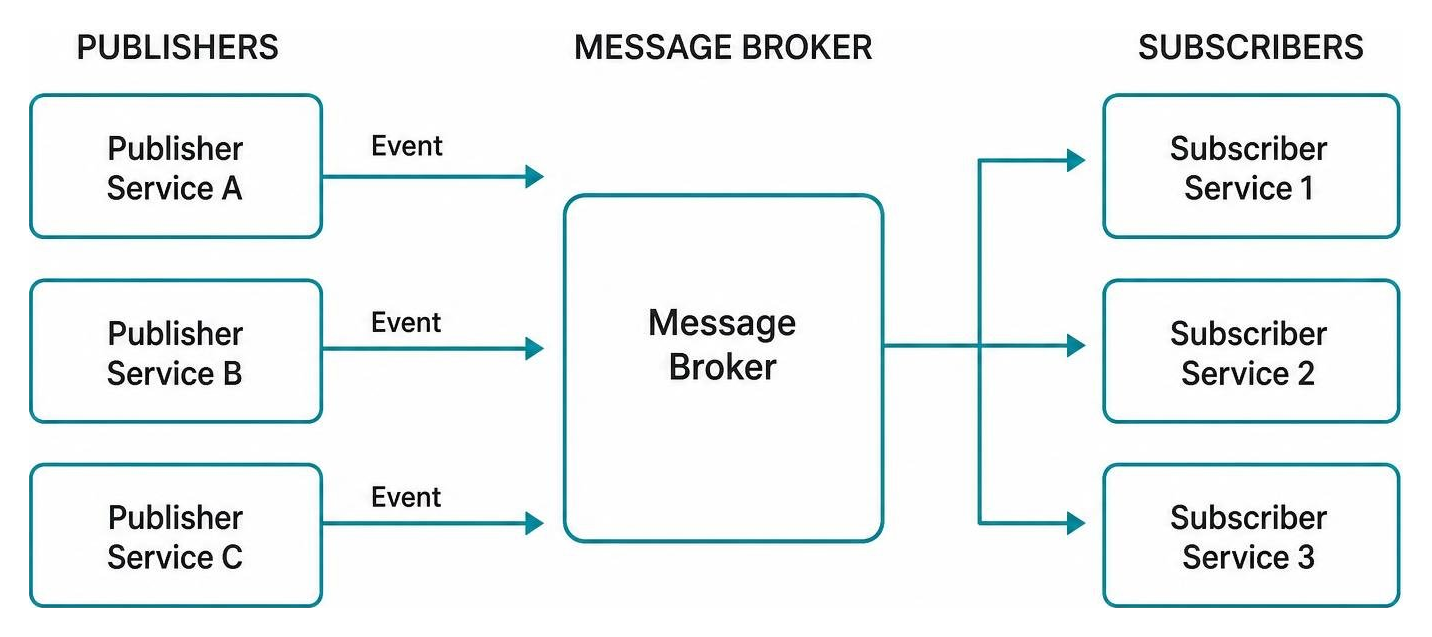
The two primary messaging abstractions used across backend infrastructure are:
- Point-to-Point Queues: A message producer places a job onto a specific queue, and exactly one consumer worker pulls that message off the queue to process it. This pattern is ideal for background job execution, such as rendering video files, processing PDF invoices, or generating analytics exports.
- Publish-Subscribe (Pub/Sub) Model: A producer emits an event to a central topic or exchange without targeting any specific receiver. Multiple downstream subscriber services listen to that topic independently. Each subscriber receives a copy of the event payload to trigger its own internal business logic.
These patterns form the foundation of Event-Driven Architecture (EDA). In EDA, systems react to changes in state (events) rather than executing direct procedural commands. For example, when a user registers on an e-commerce platform, the user service simply publishes a UserRegistered event. The notification service, analytics pipeline, and welcome gift service consume that single event independently without modifying the core user service code.
Core Components of Asynchronous Communication in Distributed Systems
To build a reliable asynchronous architecture, engineers rely on message brokers to handle transmission, buffering, and routing between services.
The core components of an asynchronous messaging infrastructure include:
- Message Producers: Senders that format events or commands into payloads and publish them to a broker.
- Exchanges and Topics: Internal broker mechanisms that receive published messages and evaluate routing rules to direct them toward appropriate destination queues.
- Durable Queues: Persistent memory or disk structures within the message broker that store messages until consumers fetch them. Queue durability ensures messages survive broker node reboots or unexpected host crashes.
- Message Consumers: Background processes or worker services that subscribe to queues, extract payload messages, execute processing steps, and send explicit acknowledgments.
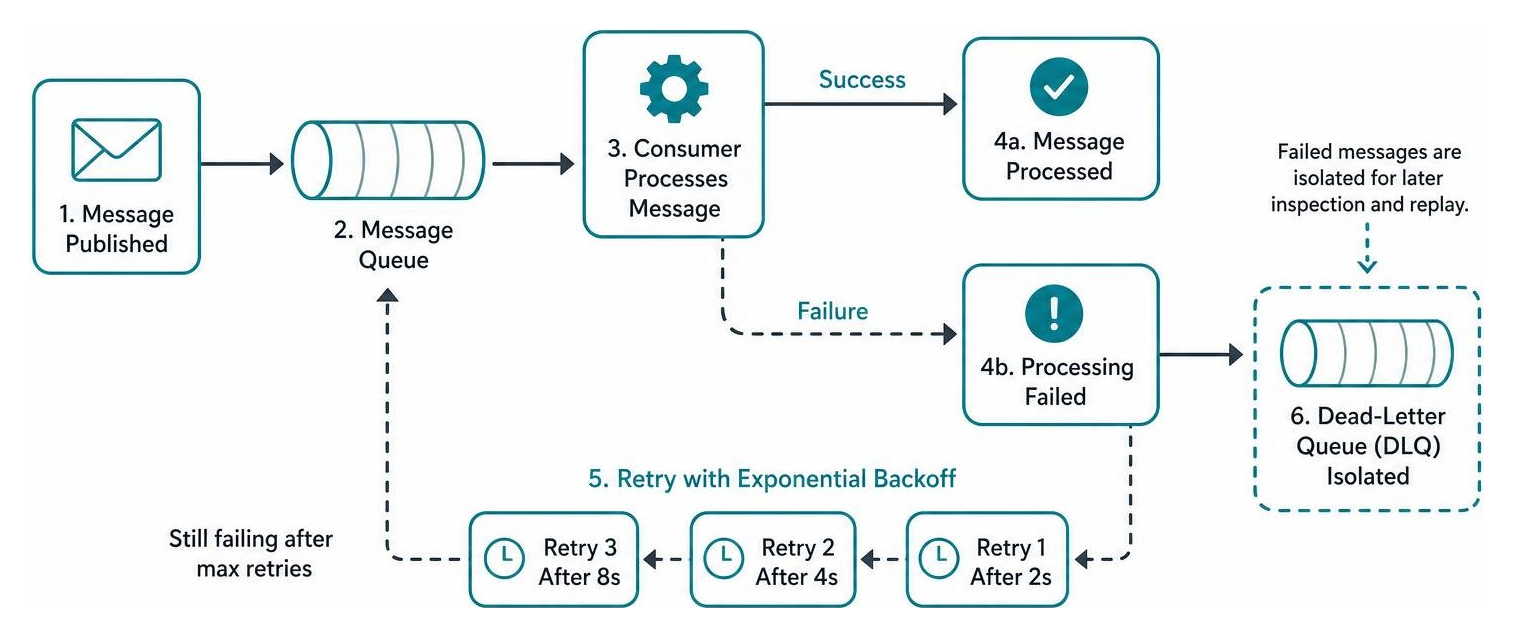
- Acknowledgment Protocols (ACK/NACK): Protocols that ensure safe processing. A consumer sends an ACK signal to the broker only after completing its task. If a worker crashes mid-task, the broker receives a timeout or NACK, re-queuing the message for another worker to claim.
To understand when your architecture requires message queues, check out this guide on When to implement asynchronous messaging.
Message Broker Options: RabbitMQ, Apache Kafka, and Redis Streams
Selecting the right message broker depends on your application’s requirements regarding routing, throughput, and state persistence:
- RabbitMQ: An advanced AMQP message broker designed for high-reliability message queuing and complex routing. It excels at complex routing topographies (headers, topics, direct, fanout exchanges) and fine-grained per-message processing guarantees.
- Apache Kafka: A distributed commit log platform built for high-throughput event streaming. Rather than deleting messages upon consumer acknowledgment, Kafka retains ordered log segments on disk for configurable retention windows. This allows thousands of independent consumers to replay historical event streams at scale.
- Redis Streams: A lightweight, in-memory data structure appended directly into Redis. It offers low latency for real-time messaging, consumer groups, and rapid prototyping without requiring dedicated cluster infrastructure.
For demanding production workloads requiring ultra-low latency ordered delivery at enterprise scale, research into storage architectures like Google’s Fast ACS demonstrates how combining distributed file-based chunks with kernel-bypassing Remote Memory Access (RMA) enables terabit-scale consumer fan-out without disk I/O bottlenecks. Read the full paper on Fast ACS low-latency ordered message delivery.
Why Asynchronous Communication Drives Scalability and Fault Tolerance
The true power of asynchronous communication in distributed systems lies in its ability to isolate failures and handle unpredictable load spikes.
When flash sales, viral marketing campaigns, or unexpected system events hit a web platform, direct HTTP calls can overwhelm backend databases. Asynchronous architecture introduces a buffer between incoming traffic and internal databases, protecting systems from sudden surges.
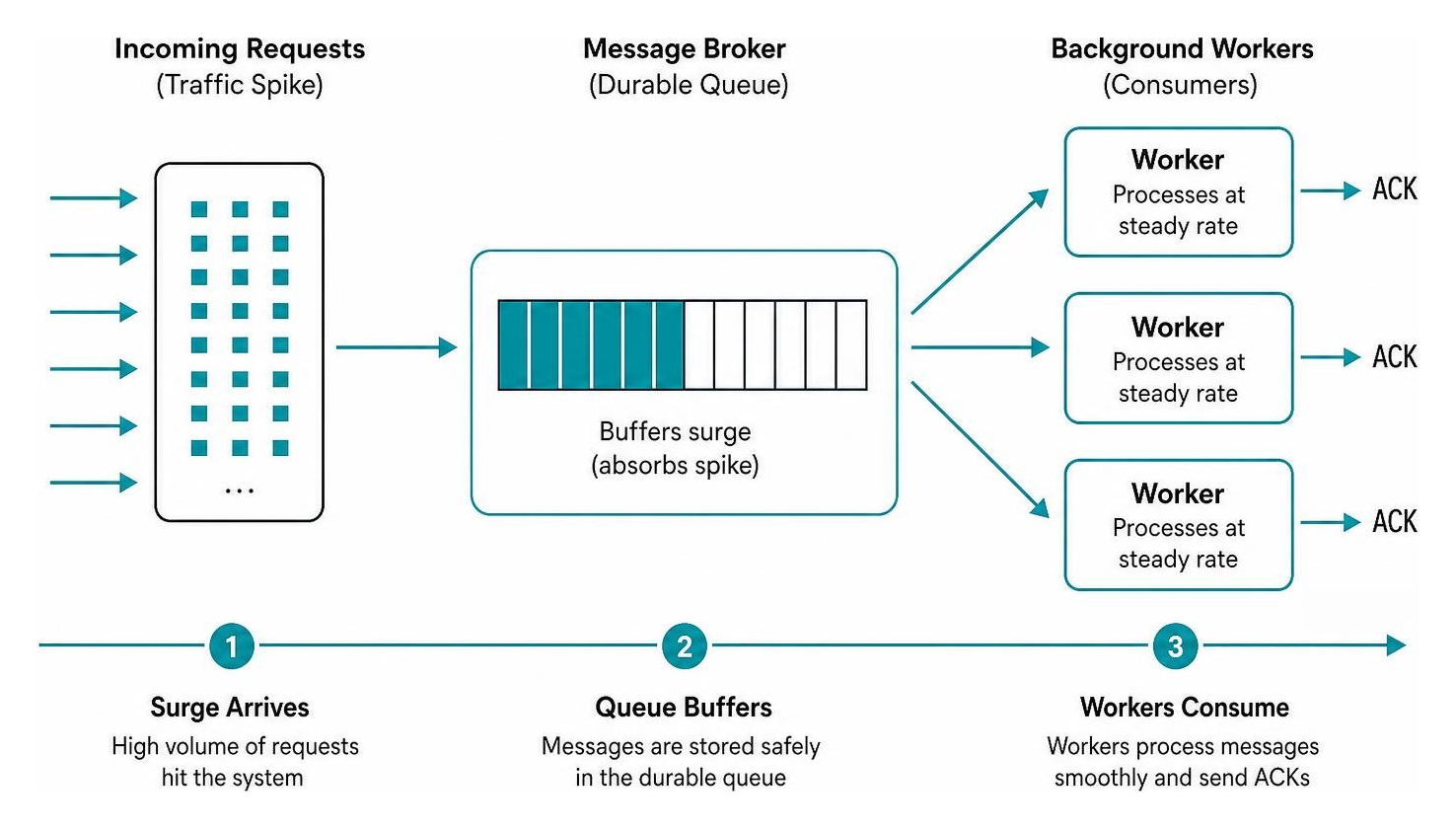
This protective mechanism relies on key resilience patterns:
- Fault Isolation: If a secondary service (such as an SMS notification gateway) experiences an outage, main order workflows remain fully operational. Messages simply accumulate safely in the broker queue until the gateway service recovers.
- Traffic Smoothing and Backpressure: Durable message queues absorb incoming spikes in traffic without failing. Consumers process messages at their maximum sustainable rate, preventing downstream system crashes.
- Horizontal Scaling: When queue depths build up, orchestration tools like Kubernetes or KEDA can automatically scale worker pods horizontally to drain queue backlogs faster.
High-Throughput Compute and Performance in Asynchronous Communication in Distributed Systems
Beyond general web backends, asynchronous messaging transforms distributed data-parallel workloads, machine learning model training, and consensus networks.
In distributed machine learning training across massive GPU clusters, traditional Bulk Synchronous Parallel (BSP) paradigms enforce global barriers. Every GPU worker must finish processing its local batch before any node can update the central parameter model. A single slow node (a straggler) stalls the entire training cluster.
Research into approximate asynchronous computation reveals dramatic efficiency improvements when replacing global barriers with asynchronous protocols:
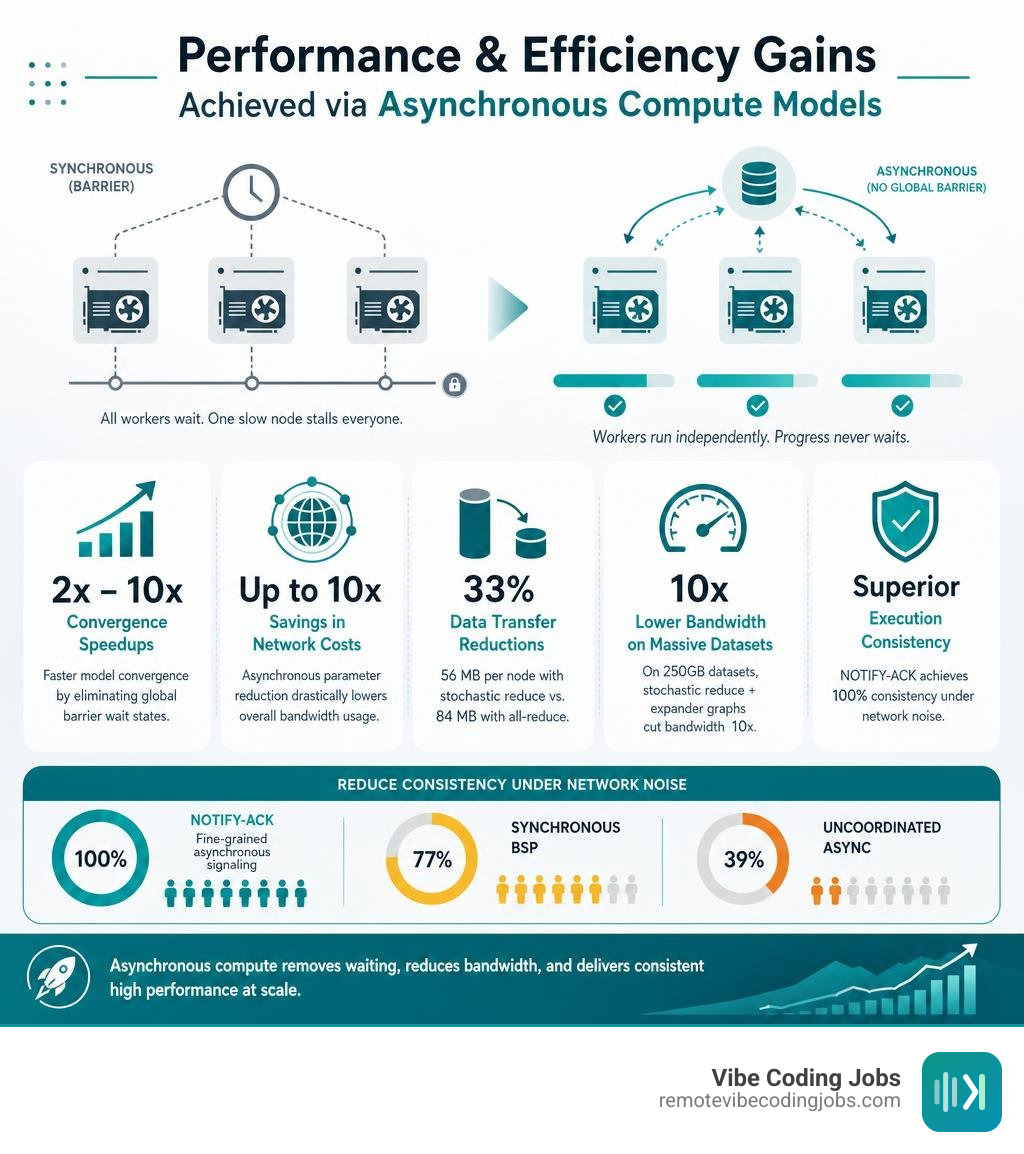
- 2x to 10x Convergence Speedups: Asynchronous communication algorithms accelerate model convergence in distributed machine learning by eliminating global barrier wait states.
- Up to 10x Savings in Network Costs: Asynchronous parameter reduction protocols drastically lower overall bandwidth consumption across cross-rack network fabrics.
- 33% Data Transfer Reductions: In empirical distributed worker evaluations, stochastic reduce topologies using expander graphs transmitted only 56 MB per node to reach target accuracy, compared to 84 MB required by standard synchronous all-reduce operations.
- 10x Lower Bandwidth on Massive Datasets: On large-scale benchmarks like the 250GB splice-site dataset, stochastic reduce combined with expander graphs cut network bandwidth requirements tenfold compared to synchronous all-reduce frameworks.
- Superior Execution Consistency: In cluster evaluations under network noise, NOTIFY-ACK fine-grained asynchronous signaling maintained 100% consistent reduce operations, compared to just 77% for synchronous BSP and 39% for uncoordinated asynchronous execution.
For a deeper look into the mathematical proofs and graph spectral gap metrics behind these optimizations, read the research on [1612.08608] ASAP: Asynchronous Approximate Data-Parallel Computation.
Similarly, in wide-area network consensus protocols, systems like DispersedLedger decouple data availability from block ordering consensus. By broadcasting erasure-coded fragments asynchronously via Verifiable Information Dispersal (AVID-M), consensus systems eliminate straggler bottlenecks, achieving 2x higher throughput and 74% lower latency compared to traditional asynchronous BFT baselines. Read more in the research on DispersedLedger consensus throughput.
Managing Architectural Challenges: Consistency, Failures, and Idempotency
While asynchronous communication in distributed systems offers clear performance advantages, it introduces unique engineering challenges that teams must address.
In a synchronous system, database transactions usually follow strict ACID guarantees. In an asynchronous system, components operate across distinct execution threads, network boundaries, and database instances. This requires adopting an eventual consistency model (BASE), where system state becomes consistent across services over time rather than instantaneously.
Even fundamental physical concepts like causality and snapshots take on new complexity in distributed networks. Recent advances in quantum computing demonstrate that classical causality principles (such as Chandy-Lamport snapshot algorithms) can be extended to asynchronous quantum networks without violating physical laws like the no-cloning theorem. Read the latest research on Asynchronous Quantum Distributed Computing: Causality, Snapshots, and Global Operations.
Handling Failures, Outages, and Out-of-Order Delivery
To build resilient asynchronous systems, engineers must design for network partitions, node crashes, and out-of-order message delivery.
Key implementation patterns include:
- At-Least-Once Delivery Guarantees: Most production message brokers guarantee that a message will be delivered to a consumer at least once. However, network acknowledgments can be lost, causing brokers to re-deliver the same message twice.
- Idempotent Consumers: Because duplicate messages are inevitable in distributed systems, consumer handlers must be idempotent. Processing the exact same message multiple times must yield the exact same system state as processing it once. This is typically achieved by recording processed message UUIDs inside a unique constraint database table or distributed Redis store.
- Exponential Backoff and Retries: When a temporary exception occurs during message processing (such as a database connection timeout), consumers should retry processing using exponential backoff schedules combined with randomized jitter to prevent retry storms.
- Dead-Letter Queues (DLQ): Messages that repeatedly fail processing due to malformed payloads or unhandled code exceptions (“poison messages”) are automatically routed to a Dead-Letter Queue. This isolates bad messages for developer debugging without blocking the main processing pipeline.
- Sequence Ordering and Causal History: When network channels deliver messages out of order, systems use Lamport timestamps, vector clocks, or causal history lists within message headers to reconstruct correct event sequences before applying state updates.
Transitioning Systems and Team Workflows to Async-First Engineering
Migrating a monolithic system or tightly coupled microservice stack to an asynchronous architecture requires a deliberate, step-by-step approach.
We recommend following this structured checklist when planning your system transition:
- Identify Non-Blocking Workloads: Map out user request paths to find operations that do not require an immediate response, such as transactional emails, image processing, data warehouse ingestion, or third-party webhooks.
- Introduce a Message Broker: Deploy a managed, highly available message broker instance (such as RabbitMQ, Kafka, or Redis) alongside your existing infrastructure stack.
- Refactor Call Paths to Producers: Update your frontend API endpoints to publish event payloads to the broker immediately, returning an HTTP
202 Acceptedstatus to client applications. - Implement Idempotent Background Consumers: Build isolated worker services dedicated to consuming queue messages, enforcing strict idempotency checks and explicit ACK acknowledgments.
- Establish DLQ and Observability Monitoring: Configure Dead-Letter Queues, queue-depth alert thresholds, and distributed tracing metadata (such as W3C Trace Context headers) across all messaging boundaries.
Transitioning software systems to asynchronous execution often runs parallel to how modern engineering teams operate. Decoupling backend microservices allows developer teams to work independently without waiting on direct synchronous coordination.
To dive deeper into team strategies, read our comprehensive Async-First Remote Work Guide and learn about the career advantages in Async-First Remote Developer Jobs: Benefits.
Aligning Engineering Culture with Asynchronous Workflows
Just as blocking calls slow down distributed software systems, constant synchronous meetings and real-time chat distractions degrade developer productivity. Knowledge workers spend nearly four hours every day communicating across fragmented channels, and 76% of employees report being more distracted on Zoom than in face-to-face meetings.

High-performing distributed engineering teams adopt async-first communication habits:
- Establish Written Team Working Agreements: Define explicit guidelines for team communication channels, setting clear expectations for message response times (e.g., 2 to 4 hours) to protect uninterrupted focus time.
- Replace Status Meetings with Automated Updates: Swap daily standup meetings for automated status updates linked directly to project management tracking systems.
- Time-Block for Processing Communication: Encourage engineers to batch notification checks into designated time slots, leaving large blocks of time reserved for deep context work.
- Leverage Modern Dev Tools and AI Workflows: Utilize modern asynchronous tooling and AI-assisted workflows (like Cursor and Claude) to document pull requests, write technical specifications, and generate automated code reviews asynchronously.
At RemoteVibeCodingJobs, we aggregate daily remote developer listings filtered by culture, stack, and AI tooling capabilities, helping developers find high-autonomy teams. Explore our curated insights on the Remote Developer Tools Stack 2026 and check out our guide on Async-First Remote Developer Jobs: Culture, Workflow, Communication.
Frequently Asked Questions
What is the primary difference between synchronous and asynchronous communication in system design?
In synchronous communication, the sending service halts its execution thread and waits for an immediate HTTP or RPC response from the receiver before moving to its next step. In asynchronous communication, the sender places a payload into an intermediary queue or message broker and immediately reclaims its execution thread, allowing the receiver to fetch and process the payload whenever resources become available.
When should a system transition from synchronous APIs to asynchronous messaging?
A system should transition when it experiences cascading service latencies, thread starvation during traffic surges, or when scaling past 10 or more interconnected microservices. It is also ideal for offloading long-running, non-blocking tasks—such as sending transactional notifications, processing image uploads, or running data pipelines—away from core user request threads.
How do asynchronous systems guarantee message delivery and prevent data loss?
Asynchronous systems enforce durability by writing queue payloads directly to persistent storage within message brokers. They rely on explicit consumer acknowledgment protocols (ACK signals), automatic retries with exponential backoff, and Dead-Letter Queues (DLQs) to isolate and retry failed messages without losing data.
Conclusion
Mastering asynchronous communication in distributed systems is an essential requirement for engineering scalable, fault-tolerant infrastructure. By replacing tight, blocking request-response dependencies with event-driven architectures and durable message queues, systems gain the resilience needed to absorb traffic spikes and isolate downstream service failures seamlessly.
Building decoupled architectures complements the culture of modern high-performing engineering teams. Shifting software stack dependencies to asynchronous execution models mirror the habits of high-autonomy engineering cultures—where deep focus, clear written context, and automated workflows replace constant synchronous interruptions.
If you are ready to join an innovative, async-first team that values deep developer focus and AI-assisted workflows, explore open roles on RemoteVibeCodingJobs today. To equip your team with the best tools for seamless collaboration, read our full guide to Explore the Best Async Communication Tools for Dev Teams in 2026.