
Start Your Junior Kotlin Developer Career With Proof, Not Years of Experience
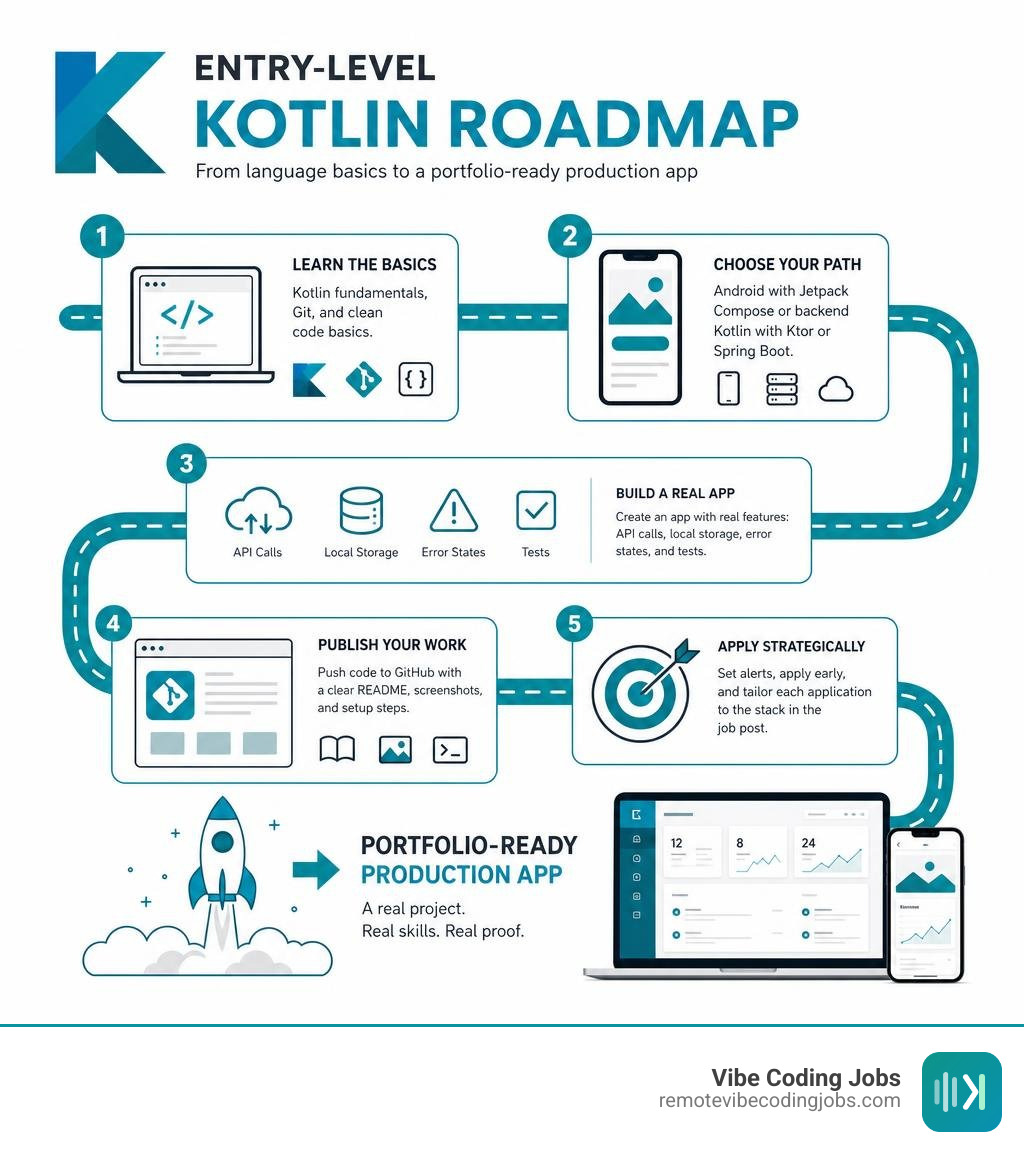
You can land a junior Kotlin developer role without years of paid experience by showing that you can build, test, and explain a small production-style project. Focus on one path, create public proof of your skills, and apply to entry-level Android, Kotlin, and broader software engineering roles.
- Learn Kotlin fundamentals, Git, and clean code basics.
- Choose Android with Jetpack Compose or backend Kotlin with Ktor or Spring Boot.
- Build an app with real features: API calls, local storage, error states, and tests.
- Put the code on GitHub with a clear README, screenshots, and setup steps.
- Set alerts, apply early, and tailor each application to the stack in the job post.
The market is competitive, but it is not closed. Current industry data shows over 1,200 entry-level Android/Kotlin jobs worldwide, alongside numerous internship roles. Android is the clearest entry route for many candidates, where Kotlin, Jetpack Compose, MVVM, Coroutines, Retrofit, Room, and Git form a practical baseline. But backend Kotlin roles also exist, especially where teams use Java alongside Spring Boot, cloud services, APIs, and databases.
Remote work is possible, though it is not the default. About one-quarter of worldwide Android/Kotlin listings are fully remote, while most are on-site. That makes a focused portfolio, strong async communication, and fast applications especially valuable when you are applying beyond your local market.
I’m Di Su, a software engineer with over 10 years of experience building user-focused web products, scalable workflows, and high-converting digital experiences. While my background spans engineering, product delivery, and growth, I know a junior Kotlin developer needs clear evidence of practical ability, not an inflated list of tools.
Core Skills Every Junior Kotlin Developer Must Master in 2026
To break into engineering today, you do not need to memorize every obscure compiler flag. Instead, hiring managers look for practical proficiency with core language idioms. Kotlin was designed to eliminate boilerplate and common runtime pitfalls, so mastering its core design principles is your first milestone.
Begin with fundamental language mechanics:
- Null Safety: Understand how nullable types (
String?), safe calls (?.), the Elvis operator (?:), and the not-null assertion (!!) function. Real-world teams value candidates who avoid!!to ensure zero runtime crashes. - Variables and Immutability: Always favor
valovervarto write predictable, thread-safe code. - Data Classes and Sealed Classes: Use data classes to model immutable domain data cleanly and sealed classes or interfaces to represent strict UI and network states (such as
Loading,Success, andError). - Extension Functions: Write reusable utilities without modifying underlying library classes.
- Coroutines and Concurrency: Concurrency is standard in modern software. Master
suspendfunctions,Dispatchers.IO,Dispatchers.Main, and structured concurrency withviewModelScopeorCoroutineScopeto handle background I/O seamlessly.
| Skill Area | Android Kotlin Stack | Backend Kotlin Stack |
|---|---|---|
| Primary Frameworks | Android SDK, Jetpack Compose | Ktor, Spring Boot, Micronaut |
| State & Concurrency | Coroutines, StateFlow, SharedFlow | Coroutines, Project Loom, WebFlux |
| Persistence | Room DB, DataStore, SQLite | Exposed, Hibernate/JPA, PostgreSQL, MongoDB |
| Networking & APIs | Retrofit, OkHttp, Moshi, Ktor Client | Ktor Server, Spring MVC, REST, gRPC |
| Architecture | MVVM, MVI, Clean Architecture | Layered Architecture, Hexagonal, Microservices |
| Testing | JUnit, MockK, Compose UI Test | JUnit 5, MockK, Testcontainers |
Essential Technical Stack for a Junior Kotlin Developer
Modern employers want to see that you can immediately fit into active agile sprints. Mastering the Remote Developer Skills in Demand 2026 Future-Proof Your Career ecosystem will ensure your profile stands out in automated applicant tracking systems.
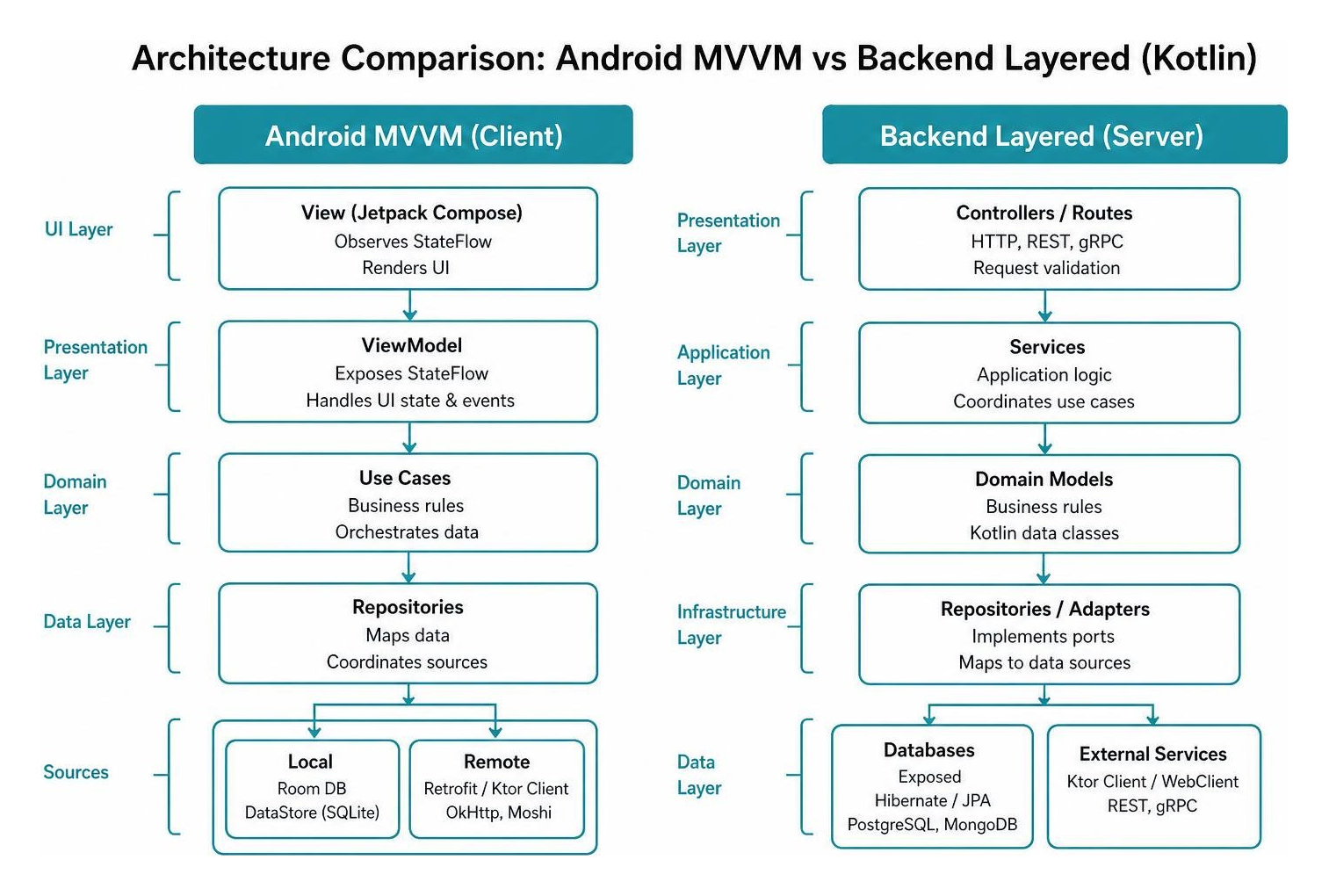
For mobile-oriented roles, declarative UI via Jetpack Compose is the industry standard, moving far beyond legacy XML layouts. Teams rely heavily on MVVM (Model-View-ViewModel) and Clean Architecture patterns to separate UI rendering from business logic. State should be exposed to your UI components predictably using StateFlow and asStateFlow().
For data persistence, implement Room Database alongside SQLite abstractions to ensure robust offline-first functionality. For networking, configure Retrofit or Ktor Client with clean JSON deserialization and centralized interceptors for error management. Finally, maintain daily discipline with Git version control—writing descriptive commit messages, creating organized feature branches, and submitting structured pull requests.
Android Development vs Backend Kotlin: Choosing Your Path
One common dilemma for early-career developers is choosing between client-side Android engineering and server-side backend development.
On the mobile front, client-side Android applications account for the vast majority of entry-level Kotlin vacancies. The feedback loop is immediate: you build an interface, test interactions on a simulator or physical device, and observe state changes visually.
On the server side, backend Kotlin is rapidly capturing market share across enterprise teams modernizing legacy Java platforms. Frameworks like Ktor (JetBrains’ lightweight asynchronous framework) and Spring Boot with Kotlin allow engineers to build high-throughput microservices, handle complex SQL transactions, and implement gRPC streams. If you enjoy database design, distributed systems, and API design, backend Kotlin provides a lucrative, future-proof career path.
Building an Industry-Ready Portfolio Without Prior Work Experience
When you lack years of commercial employment, your GitHub profile serves as your primary credential. Hiring managers review candidate repositories to evaluate architectural discipline, naming conventions, and code modularity.
You can learn how to Build a Developer Portfolio with AI Tools 2026 Guide to accelerate boilerplate development while maintaining pristine architectural standards. Rather than filling your profile with generic tutorial clones, aim for two deeply polished, end-to-end applications that solve real-world problems.
Ensure each repository includes:
- A clean
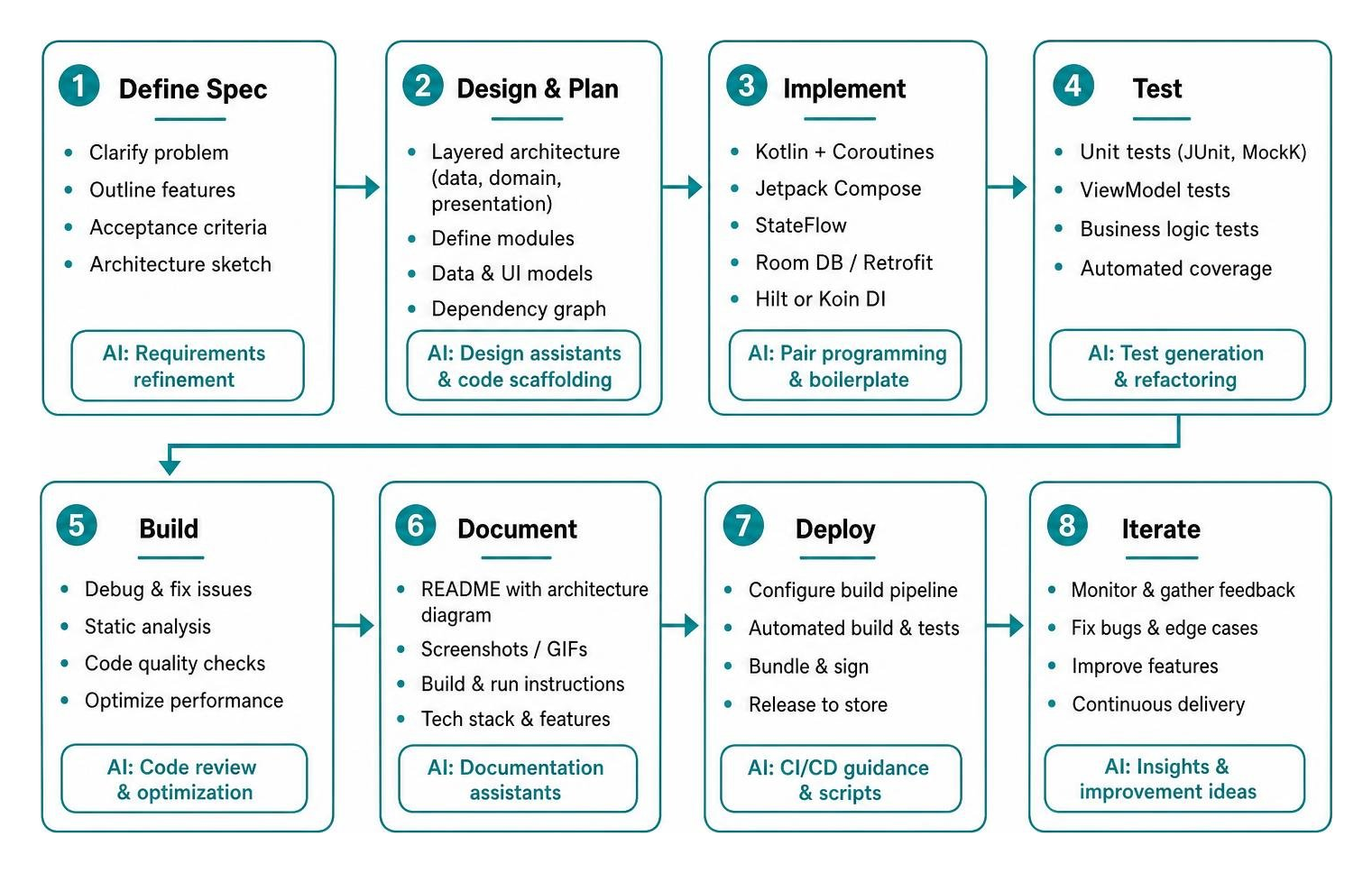
README.mdfeaturing an architecture overview diagram, app screenshots or GIFs, and step-by-step build instructions. - Clear separation of concerns across
data,domain, andpresentationlayers. - Automated unit test coverage for business logic and ViewModels using JUnit and MockK.
- Dependency injection implemented via Hilt or Koin to decouple dependencies.
High-Impact Projects Utilizing Jetpack Compose and Room DB
To demonstrate production readiness, your portfolio projects must address real-world edge cases like offline synchronization, network latency, and memory management.
Consider these high-impact project concepts:
- Offline-First Telematics or Logistics Tracker: An app that gathers GPS or sensor data, caches coordinates locally in Room DB, and synchronizes asynchronously with a mock backend via Retrofit when a network connection is restored.
- Personal Finance and Budgeting Engine: An interactive financial management tool using Jetpack Compose Canvas for interactive reporting charts, StateFlow for deterministic state transitions, and encrypted storage for sensitive data.
- Community Resource Coordinator: A real-time app connecting local food donation networks, integrating dynamic map SDKs, Firebase Authentication, and custom error-handling wrappers that prevent sudden crashes.
Quantify your results in your project descriptions. For example, highlight how structuring your UI with Jetpack Compose components and StateFlow eliminated state discrepancies and reduced unnecessary UI recompositions.
Integrating AI-Assisted Workflows and Kotlin Multiplatform
The software engineering landscape has evolved with AI-native development practices. Early-career developers who leverage AI pair-programming tools demonstrate higher shipping velocity and mature workflow management.
Understanding how to navigate Cursor Copilot Developer Jobs Remote Coding gives you a noticeable edge. Use AI tools to write boilerplate models, generate test suites, and refactor code, while maintaining full ownership of system architecture and correctness.
Furthermore, exploring Kotlin Multiplatform (KMP) will distinguish your resume. Industry practitioners, like AJITH V , demonstrate that sharing business logic across Android and iOS using KMP can reduce platform-specific code duplication by approximately 40%. Building a small KMP utility app that shares data repositories and networking logic across Android and desktop or iOS displays intermediate-level engineering maturity.
How to Land Entry-Level and Remote Kotlin Roles
Finding entry-level Kotlin roles requires a proactive, structured strategy. Rather than applying blindly across generic channels, target specialized developer directories and engage directly with technical communities.
Target dedicated technical communities and monitor platforms where async-first, high-growth startups announce hiring rounds. Tailor your resume to emphasize specific technologies like Kotlin, Jetpack Compose, Coroutines, Room DB, and Ktor rather than vague generalities.
Connect with fellow engineers across developer networks and study how practitioners like Aladin Junior , Maksym Oleksiienko , Attila Farkas , Dhruva Khatavkar , and JATIN KUMAR structure their open-source contributions, technical achievements, and project showcases.
How a Junior Kotlin Developer Can Ace Technical Interviews
Technical interviews for junior positions evaluate problem-solving clarity, foundational computer science knowledge, and communication under pressure. Many modern engineering teams have moved away from abstract algorithm puzzles toward realistic project evaluations.
If you are targeting companies that prioritize practical code reviews over complex algorithmic challenges, review our guide on Remote Coding Jobs No LeetCode Easy Interview Practical Skills.
During live coding and take-home assessments:
- Explain Your Thought Process: Talk through your design decisions before writing code. Clarify edge cases, such as handling null responses or network timeouts.
- Apply SOLID Principles: Keep functions small, classes focused on single responsibilities, and use interfaces to decouple implementations.
- Handle Errors Gracefully: Wrap network and disk operations in Kotlin
Resulttypes or sealed error models rather than letting unhandled exceptions crash the process. - Demonstrate Testing Basics: Write a concise unit test for your core business logic to show that you care about code maintainability.
Navigating Compensation and Salary Expectations Across Global Markets
Compensation for entry-level Kotlin developers varies significantly based on geographic region, industry vertical, and employment arrangement. Understanding current market benchmarks helps you negotiate effectively.
According to recent industry salary benchmarks, junior software developer starting salaries in the UK North West and across national hubs begin around £28,000 to £35,000 per year.
In the United States, entry-level remote Kotlin engineers can expect compensation packages ranging from $65,000 to $90,000, depending on technical specializations. Across European tech hubs, baseline junior developer salaries generally span €32,000 to €48,000.
For deeper benchmarks across remote contracts and distributed team models, review our analysis of Remote Developer Salaries in 2026 What to Expect.
Frequently Asked Questions about Junior Kotlin Development
Is it possible to land an entry-level Kotlin role without a computer science degree?
Yes. Many working Kotlin developers are self-taught or come from coding bootcamps and adjacent career backgrounds. Employers prioritize candidates who can demonstrate clean architecture, working apps on GitHub, and a solid grasp of Kotlin coroutines, lifecycle management, and API integrations over formal academic credentials.
What is the expected starting salary for an entry-level Kotlin engineer in 2026?
Starting salaries generally range from £28,000 to £35,000 in the UK, €32,000 to €48,000 across continental Europe, and $65,000 to $90,000 in the United States for junior or entry-level positions. Fully remote international contracts often adjust rates based on local purchasing parity or fixed distributed compensation tiers.
Should beginners focus on Android Jetpack Compose or server-side Ktor?
Beginners seeking the highest initial volume of junior-specific listings should start with Android Jetpack Compose, as mobile hiring accounts for the largest share of entry-level Kotlin postings. However, if your long-term passion lies in cloud infrastructure, distributed microservices, and database systems, learning Ktor or Spring Boot with Kotlin is a rewarding alternative path.
Conclusion
Breaking into Kotlin engineering in 2026 requires focused execution: mastering modern language syntax, building modular applications with Jetpack Compose or Ktor, and demonstrating practical engineering competence through public repositories.
Stay consistent with your learning, participate in technical communities, write clean code with automated tests, and submit targeted applications. When you are ready to find your next career opportunity, explore curated remote backend developer positions to connect with forward-thinking teams hiring distributed engineering talent today.