
Why Does Your Choice of Programming Language Determine Remote Career Success in 2026?
The best programming languages to learn for remote work in 2026 are Python, TypeScript, Go, and Rust. Python leads AI, automation, and data engineering roles, while TypeScript powers most async fullstack web teams. Go offers a high-demand path into cloud infrastructure and microservices, and Rust commands premium compensation in systems, security, and WebAssembly work. SQL remains a universal skill multiplier across all of these stacks.
In 2026, the distributed job market has evolved past the initial transition to work-from-home. Today, the most resilient remote organizations operate as async-first, AI-native engineering teams. In this environment, your tech stack selection dictates your daily workflow, your team dynamics, and your compensation potential far more than your physical location.
When distributed teams work across multiple time zones, code is communication. Languages that provide clear contracts, strong typing, and robust tooling reduce the friction of distributed collaboration. Every ambiguity in an untyped interface or loosely structured codebase requires an extra round of Slack messages or meeting cycles. Conversely, modern stacks enable distributed engineers to ship features independently without constant synchronous oversight.
The remote engineering market splits into two distinct segments:
- High-Volume Ecosystems: Languages with massive market liquidity (like Python and JavaScript/TypeScript) where thousands of companies hire continuously across frontend, backend, and AI integration layers.
- High-Scarcity Ecosystems: Languages with specialized talent pools (like Go and Rust) where engineering managers struggle to find qualified candidates, driving substantial salary premiums.
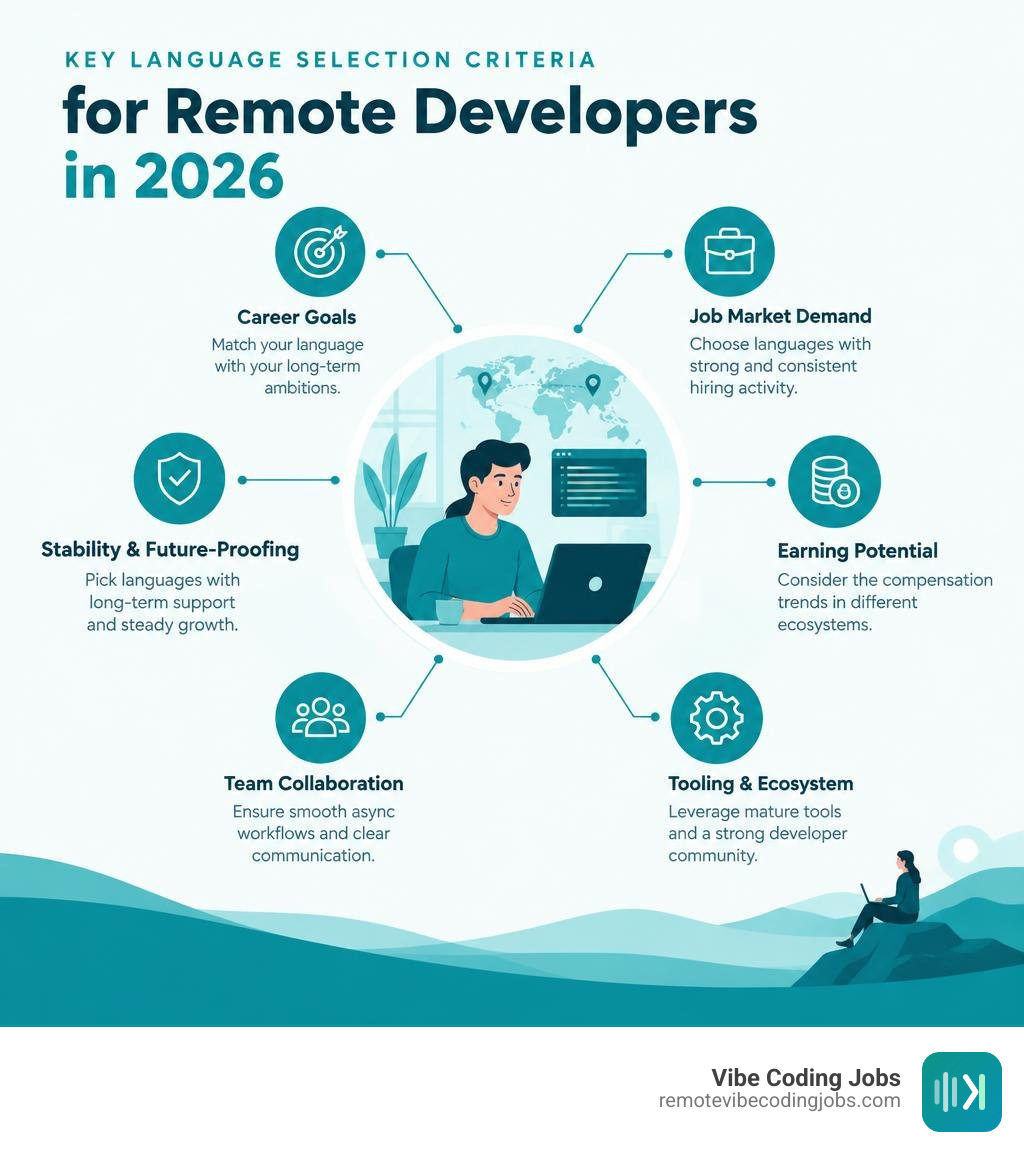
Balancing your career goals between immediate job volume and specialized compensation ceilings is the foundational decision every remote developer must make.
What Are the Top Programming Languages for Remote Work in 2026?
The global tech landscape in 2026 prioritizes developer velocity, system reliability, and seamless integration with AI development tooling. According to the comprehensive analysis of programming languages in 2026, the top tier of languages captures the overwhelming majority of remote hiring demand.
| Programming Language | Remote Salary Range | Learning Curve | Primary Domain | Remote Job Demand |
|---|---|---|---|---|
| Python | $100,000 – $200,000+ | Low to Moderate | AI/ML, Automation, Backend | Extremely High |
| TypeScript / Node.js | $90,000 – $180,000 | Moderate | Fullstack, Web Applications | Highest Overall Volume |
| Go (Golang) | $130,000 – $220,000 | Moderate | Cloud Infrastructure, Microservices | High (Talent Deficit) |
| Rust | $140,000 – $250,000+ | High | Systems, WebAssembly, Crypto/Security | Specialized / Premium |
| C# / .NET | $95,000 – $170,000 | Moderate | Enterprise Web, Cloud Services | High (Enterprise) |
| Java / Kotlin | $110,000 – $180,000 | Moderate to High | Enterprise Backend, Distributed Systems | High (Enterprise) |
| SQL (PostgreSQL) | Skill Multiplier | Low to Moderate | Data Persistence, Analytics, Optimization | Universal Requirement |
Python: The Dominant Force for AI, Automation, and Data
Python remains the world’s most versatile language, used by over 48% of professional developers. It leads the LangPop composite index with a score of 48.64, powered by unprecedented demand for generative AI, agent orchestration, and automated data pipelines.
In modern remote engineering teams, Python is the primary language for machine learning frameworks like PyTorch, Hugging Face, and LangChain. Beyond machine learning, Python powers production backend services through modern, asynchronous frameworks such as FastAPI and established web engines. Distributed teams frequently hire engineers to build scalable SaaS products, as seen across remote Python developer positions and established remote Django developer opportunities.
Its readable syntax makes async code reviews straightforward, allowing engineers on opposite sides of the globe to audit logic quickly without needing real-time syncs.
TypeScript and JavaScript: The Standard for Async Fullstack Teams
Roughly 70% of high-paying, fully remote software companies build their core applications on TypeScript and Node.js. While plain JavaScript continues to run natively in every browser, TypeScript has largely surpassed it in production job requirements due to its static type safety.
In a remote team, TypeScript acts as living documentation. When a developer in North America defines an API interface, an engineer in Europe or Asia can consume that interface with complete type safety and IDE autocompletion, catching errors at compile time rather than during runtime debugging sessions. This dramatically cuts down on async clarification cycles.
The ecosystem extends from modern server-rendered interfaces to high-performance edge compute. Developers building modern web experiences can target high-growth stacks via remote Next.js developer openings or focus entirely on backend and fullstack architecture with dedicated remote TypeScript developer jobs.
Go (Golang): The Cloud Infrastructure and High-Throughput Engine
Created by Google to solve large-scale network service challenges, Go has established itself as the backbone of modern cloud infrastructure. Industry-standard tools including Docker, Kubernetes, Terraform, and Prometheus are built in Go.
Go’s structural simplicity makes it uniquely suited for remote teams. The language enforces a standardized formatting style and eschews complex metaprogramming, meaning any Go engineer can read and maintain another engineer’s code immediately. Its lightweight concurrency primitives—goroutines and channels—allow remote teams to build microservices capable of handling millions of concurrent requests with low resource overhead.
Because demand for cloud-native backend engineers regularly outpaces the supply of seasoned Go developers, Go roles consistently offer higher median starting salaries. It serves as a natural entry point into cloud architecture and dedicated remote DevOps engineer positions.
Rust: The High-Compensation Leader for Systems and WebAssembly
Rust represents the highest-paying frontier in remote software engineering. By enforcing memory safety at compile time without relying on a garbage collector, Rust eliminates entire classes of concurrency bugs and memory leaks before code is ever deployed.
This deterministic performance makes Rust the language of choice for performance-critical systems, cryptography, distributed databases, high-frequency finance, and WebAssembly modules. Senior Rust engineers in security and crypto protocols routinely secure total compensation packages ranging from $200,000 to over $400,000 in fully distributed setups.
While Rust features a steep learning curve due to its borrow checker and ownership model, that difficulty creates a strong competitive advantage for developers who master it.
SQL and Enterprise Foundations (C# and Java)
Regardless of your primary programming language, relational database proficiency is mandatory for remote software development. Object-Relational Mapping (ORM) tools simplify standard queries, but they frequently create severe performance bottlenecks at scale. Remote teams expect engineers to understand raw SQL, indexing strategies, query execution plans, and transaction isolation levels in databases like PostgreSQL.
Alongside SQL, enterprise workhorses like C# (.NET Core) and Java/Kotlin continue to power high-scale enterprise backends. Modern .NET Core is cross-platform, modular, and fast, making it a reliable choice for remote enterprise roles. Similarly, Java and Kotlin maintain deep roots in large-scale financial institutions and global enterprise architectures.
Which Programming Languages Offer the Highest Remote Salary Potential in 2026?

Compensation for remote software engineers depends heavily on specialized domain expertise and geographic hiring structures. For European and global developers targeting high compensation, stack selection serves as the primary lever to access US-standard salary bands.
According to market data outlined in salary benchmarks for $100k+ remote tech jobs, typical compensation bands by language reflect the underlying supply-demand balance:
- TypeScript / Node.js: $90,000 – $180,000 (Senior: $130k–$210k; Staff+: $240k+)
- Python (Backend & AI/ML): $100,000 – $200,000+ (Specialized AI/GPU Engineers: $180k–$350k+)
- Go (Golang): $130,000 – $220,000 (Senior Infra/DevOps: $160k–$260k)
- Rust: $140,000 – $250,000+ (Senior Crypto/Systems: $200k–$400k+ TC)
- C++ (Infra, Finance, Security): $150,000 – $260,000+ (Trading/Low-Latency: $250k–$450k+ TC)
US-headquartered companies hiring internationally through Employer of Record (EOR) entities or B2B contractor agreements routinely pay at the upper bounds of these brackets. To explore detailed breakdowns of benefits, equity, and global pay adjustments, consult our remote developer salary guide along with our detailed analysis on remote developer compensation trends.
How Do AI Coding Tools and Vibe Coding Shift Language Demand?
The widespread adoption of AI-native development has transformed daily engineering workflows. The software development process has shifted toward “vibe coding”—a modern development loop where developers articulate specifications and business logic in structured natural language, leverage AI models to generate boilerplate and implementations, and focus their human expertise on architecture, review, debugging, and verification.
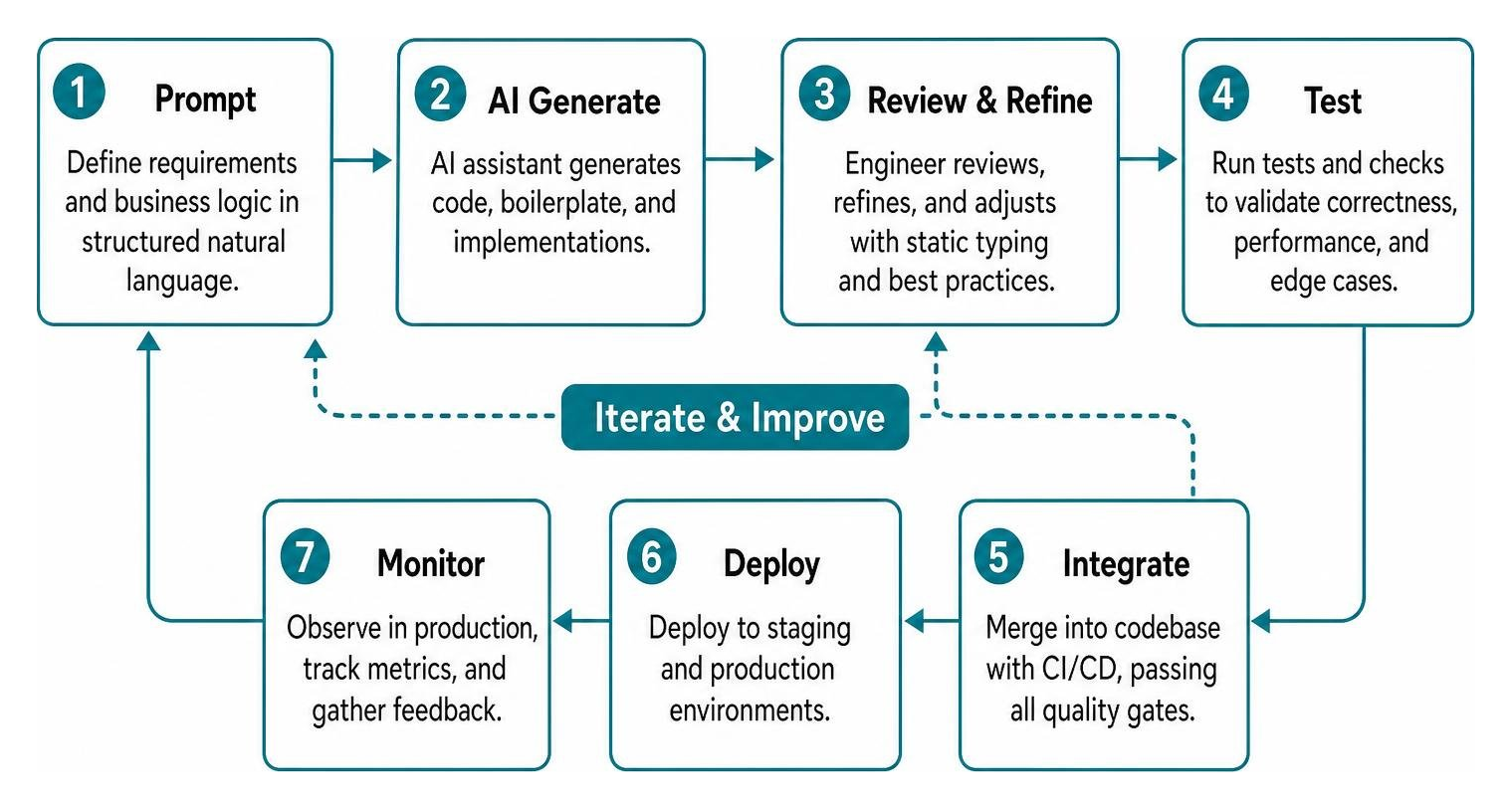
This evolution changes how programming languages are valued:
- Static Typing Prevents AI Hallucinations: Statically typed languages like TypeScript, Go, and Rust provide immediate compiler feedback when an AI assistant generates invalid code or hallucinated properties. Dynamic languages require extensive test suites to catch issues that a type checker identifies instantly.
- Standardized Idioms Benefit AI Models: Languages with uniform syntax and opinionated standard libraries (such as Go and Python) produce higher-quality AI generations because models have been trained on vast amounts of consistent, idiomatic code.
- Architecture Outweighs Syntax Memorization: As tools like Cursor and Claude handle routine syntax, remote engineers are evaluated on system design, state management, observability, and code review rigor.
To maximize daily shipping speed, engineers should integrate modern editors, terminal utilities, and AI linters as outlined in our remote developer tools stack. At Vibe Coding Jobs, we curate open positions specifically tailored for AI-augmented, async-first engineers who leverage these workflows to build production systems faster.
Which Programming Languages Should Beginners Avoid for Remote Careers?
Not every language that appears on historical popularity lists offers a viable path into remote work in 2026. Based on industry trajectory analyses from data-backed insights on programming language trajectories, early-career developers should avoid certain languages when pursuing remote roles:
- C and C++ as First Languages: While senior C++ roles in algorithmic trading and systems infrastructure pay top tier compensation, entry-level remote openings are scarce. Managing manual memory allocation, complex build toolchains, and pointer arithmetic without direct mentorship creates unnecessary obstacles for remote beginners.
- PHP and Ruby for Greenfield Roles: Although legacy codebases like WordPress (PHP) and mature SaaS platforms (Ruby on Rails) still support active maintenance roles, fewer modern distributed startups choose them for new architectures in 2026. This limits long-term remote job liquidity compared to TypeScript and Python.
- Niche Smart Contract Languages (Solidity, Vyper) Without Systems Foundations: Pursuing Web3-specific languages without mastering core computer science fundamentals, networking, and distributed systems leaves developers vulnerable to market volatility. Mastering Rust or Go first provides a much stronger foundation for high-paying distributed systems roles.
How Can You Build Proof of Skills and Land a High-Paying Remote Role?

Remote hiring managers rarely hire based on claims on a resume alone. When evaluating distributed candidates, engineering leads look for concrete proof of autonomy, asynchronous communication skills, and real-world execution.
To stand out in the 2026 remote job market:
- Maintain an Active, Professional GitHub Profile: Public repositories should demonstrate clean directory structures, clear commit histories, and active GitHub Actions workflows executing tests and deployments.
- Treat Pull Requests as Asynchronous Portfolios: Write comprehensive pull request descriptions that explain the why behind architectural decisions, document trade-offs, and attach interactive screen recordings demonstrating features in action.
- Deploy Full-Stack Projects to Production: Host live, accessible applications that include authentication, database migrations, rate limiting, and structured logging. A live URL demonstrates operational capability far better than local code.
- Contribute to Open Source: Submitting bug fixes, documentation improvements, or feature additions to established open-source tools proves you can navigate large codebases and collaborate through written code reviews.
For a broader breakdown of the hiring landscape, explore our comprehensive guide to remote programming languages.
What Are the Most Frequently Asked Questions About Remote Programming Languages?
What is the best first programming language to learn for remote work in 2026?
For most beginners, the choice comes down to Python or JavaScript/TypeScript:
- Choose Python if your primary goal is working with AI systems, data pipelines, automation scripting, or machine learning applications.
- Choose JavaScript (transitioning to TypeScript within 3–6 months) if you want to build responsive user interfaces, fullstack web applications, and interactive SaaS products.
Both languages offer high job liquidity, extensive community resources, and deep compatibility with AI-assisted developer tooling.
Can a junior engineer realistically get a fully remote job in 2026?
Securing a fully remote position as an entry-level engineer is competitive because distributed teams require a high degree of autonomy. However, candidates who bridge the gap through public proof of work consistently succeed.
Junior engineers can stand out by mastering modern AI-assisted workflows (vibe coding), building and deploying complete fullstack systems with automated CI/CD pipelines, and contributing pull requests to open-source software. Demonstrating clear written communication and proactive problem-solving proves you can operate effectively in an asynchronous team environment.
Which language offers the highest long-term job security for remote work?
Job security in distributed engineering stems from ecosystem adaptability. Python offers long-term stability due to its central role in artificial intelligence and scientific computing. TypeScript offers unmatched ubiquity across web browsers, edge networks, and fullstack frameworks.
For senior career development, pairing either Python or TypeScript with a high-performance compiled language like Go or Rust creates a resilient career profile capable of moving between product development and core infrastructure.
How Should You Take Action and Launch Your Remote Development Career in 2026?
Choosing the right programming language is about matching your learning path to a clear career goal:
- Pick One Core Stack: Commit to mastering either Python (AI, data, backend) or TypeScript (fullstack web) until you can build and ship full-featured applications independently.
- Adopt AI-Native Workflows: Integrate modern tools like Cursor, Claude, and automated test runners into your daily workflow to build software faster with proper architectural oversight.
- Publish Proof of Competence: Deploy live projects, write clear documentation, and create pull requests that demonstrate your ability to collaborate asynchronously.
- Target Modern, Async-First Companies: Apply to organizations that evaluate developers based on output, system design, and communication quality rather than hours logged in an office.
Explore curated, high-paying engineering positions across distributed teams by browsing the latest remote DevOps and infrastructure job opportunities on Vibe Coding Jobs today.