
How Do Remote Web Development Careers Compare to Other Remote Tech Jobs?
The landscape of remote tech work in September 2026 is fundamentally different from the broad “work-from-home” experiments of earlier years. While generic remote jobs—ranging from customer success and operations to digital marketing—offer geographic flexibility, technical software engineering and web development careers provide far greater compensation leverage, autonomy, and long-term defensibility.
When evaluating remote jobs versus web development specifically, the core distinction lies in deliverable-based value creation. Non-technical remote roles often remain bound to synchronous hours, client availability, or high meeting loads. In contrast, web engineering is inherently suited to asynchronous execution. A web developer’s output is tracked via merged pull requests, test coverage, and deployed features rather than active desk hours.
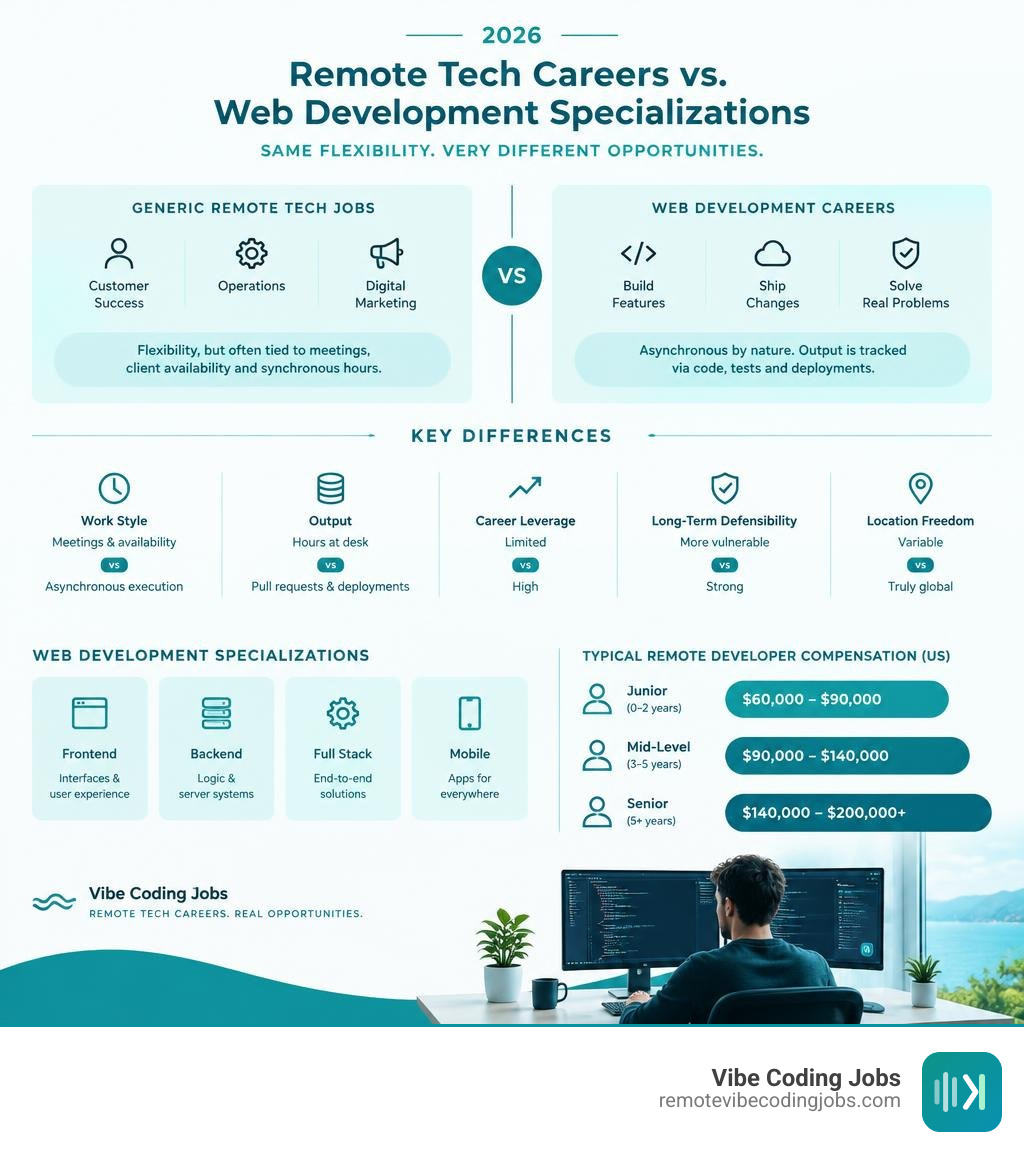
Compensation dynamics clearly reflect this divide:
- Junior Remote Developers (US): Base salaries span $60,000 to $90,000, with entry-level frontend and full-stack positions offering strong onboarding ramps.
- Mid-Level Remote Developers (US): Total compensation routinely falls in the $90,000 to $140,000 range as engineers take full ownership of feature architectures.
- Senior Remote Developers (US): Top performers command $140,000 to $200,000+, often supplemented by equity, performance bonuses, and home-office stipends.
- Global Remote Developers: The global cross-market average sits near $70,000, reflecting varied geographic baselines while still offering dramatic purchasing power advantages in emerging tech hubs.
Web development is not simply another remote role; it is the backbone of the digital product economy. As software eating the world evolves into AI transforming software, developers who master modern web stacks occupy the highest-leverage positions in the distributed workforce.
What Are the Key Differences in Salary, Demand, and Entry Barriers Across Remote Specializations?
Choosing a remote technical specialization requires balancing compensation potential against barrier to entry and day-to-day work autonomy. The most common career evaluation in 2026 pits web development against cybersecurity and cloud infrastructure engineering.
Industry compensation research indicates that cybersecurity roles frequently command a salary premium at mid-to-senior levels. In the United States, mid-level security engineers and analysts see compensation between $115,000 and $155,000, while senior security professionals reach $155,000 to $225,000. This premium stems from an acute global talent deficit numbering in the millions of unfilled roles, a shortage widely documented by industry groups such as (ISC)².
However, cybersecurity careers carry specific constraints that web development does not:
- Location and Clearance Bottlenecks: Many enterprise and defense cybersecurity roles require domestic residency, government clearances, or strict on-call rotation schedules, restricting true international nomadism.
- Abstract Feedback Loops: Security engineering often involves defensive monitoring, audit compliance, and incident response, which lack the immediate creative feedback of product shipping.
- Certification Hurdles: Entering cybersecurity requires formal credentials (such as Security+, CISSP, or OSCP), whereas web development remains driven primarily by verifiable code and live portfolio projects.
Frontend vs. Backend: The Remote Entry Point
For career changers and aspiring remote engineers, deciding where to start within web development is critical. When analyzing engineering career paths, frontend development offers the gentlest learning curve and the fastest path to a remote offer.
Frontend engineers work with immediate visual feedback—adjusting UI components, refining state management, and ensuring responsive user experiences. This makes building a standout public portfolio straightforward. Furthermore, hiring data shows a higher volume of junior and associate remote openings for remote frontend developer positions compared to pure backend roles. Junior remote frontend salaries in the US average $80,000 to $95,000, while junior backend roles typically span $75,000 to $100,000.
Understanding these variations allows you to plan your career trajectory by reviewing remote developer salary expectations by experience level in 2026 before committing to a learning track.
| Role Specialization | US Junior Salary Band | US Senior Salary Band | Remote Location Flexibility | Entry Barrier & Portfolio Ramp | Primary Tech Stack Focus |
|---|---|---|---|---|---|
| Frontend Web Dev | $80,000–$95,000 | $140,000–$185,000 | High (Fully Global) | Low–Moderate (Visual portfolio, UI apps) | React, Next.js, TypeScript, Tailwind |
| Backend Web Dev | $75,000–$100,000 | $150,000–$200,000 | High (Fully Global) | Moderate–High (System design, APIs) | Node.js, Python, Go, PostgreSQL |
| Cybersecurity | $85,000–$110,000 | $155,000–$225,000 | Moderate (Clearance / residency rules) | High (Certs, labs, network knowledge) | SIEM, Python, Linux, Cloud Sec |
| Cloud / DevOps | $90,000–$115,000 | $160,000–$215,000 | Moderate–High (On-call rotations) | High (Infra knowledge, IaC) | AWS, Kubernetes, Terraform, CI/CD |
How Do Agency Remote Web Development Roles Differ from Product Company Positions?
When pursuing remote web development, developers generally choose between two distinct operational environments: digital agencies or SaaS product companies. Each environment creates a vastly different day-to-day experience.

The Fast-Paced Agency Environment
Remote agency work is characterized by rapid project turnarounds, diverse client rosters, and continuous context-switching. An agency developer might build a custom headless e-commerce store one week and troubleshoot an enterprise WordPress migration the next.
- Skill Breadth: Agencies expose developers to multiple tech stacks, client communication styles, and rapid prototyping patterns.
- Technical Debt Handling: Because projects are handed off to clients upon completion, agency developers rarely maintain the systems they build long-term.
- Work Culture: Agencies are frequently synchronous and deadline-driven. Unplanned client requests can trigger sudden fire drills, making strict schedule boundaries harder to maintain.
The In-Depth Product Company Environment
In a software-as-a-service (SaaS) or product-focused company, engineers dedicate their attention to a single, evolving codebase.
- Deep Technical Mastery: Product engineers focus heavily on architecture, database optimization, scalability, and code maintainability.
- Technical Debt Ownership: Engineers live with their architectural decisions. Refactoring, paying down tech debt, and maintaining unit test suites are core responsibilities.
- Autonomy and Async Collaboration: Product engineering organizations typically embrace async-first developer culture and workflows, prioritizing structured sprints, written RFCs, and deep focus blocks over constant real-time chat.
- Total Compensation: While agencies may offer competitive short-term hourly rates, product companies provide higher total compensation over time through stock options, restricted stock units (RSUs), and performance bonuses.
What Are the Real Financial Trade-Offs Between Hiring Local and Remote Developers?
For engineering leaders and founders, deciding whether to hire local or remote developers involves a direct analysis of fully loaded employment costs. A comprehensive analysis of remote versus local developer cost differences highlights the massive financial leverage available through global distributed hiring.
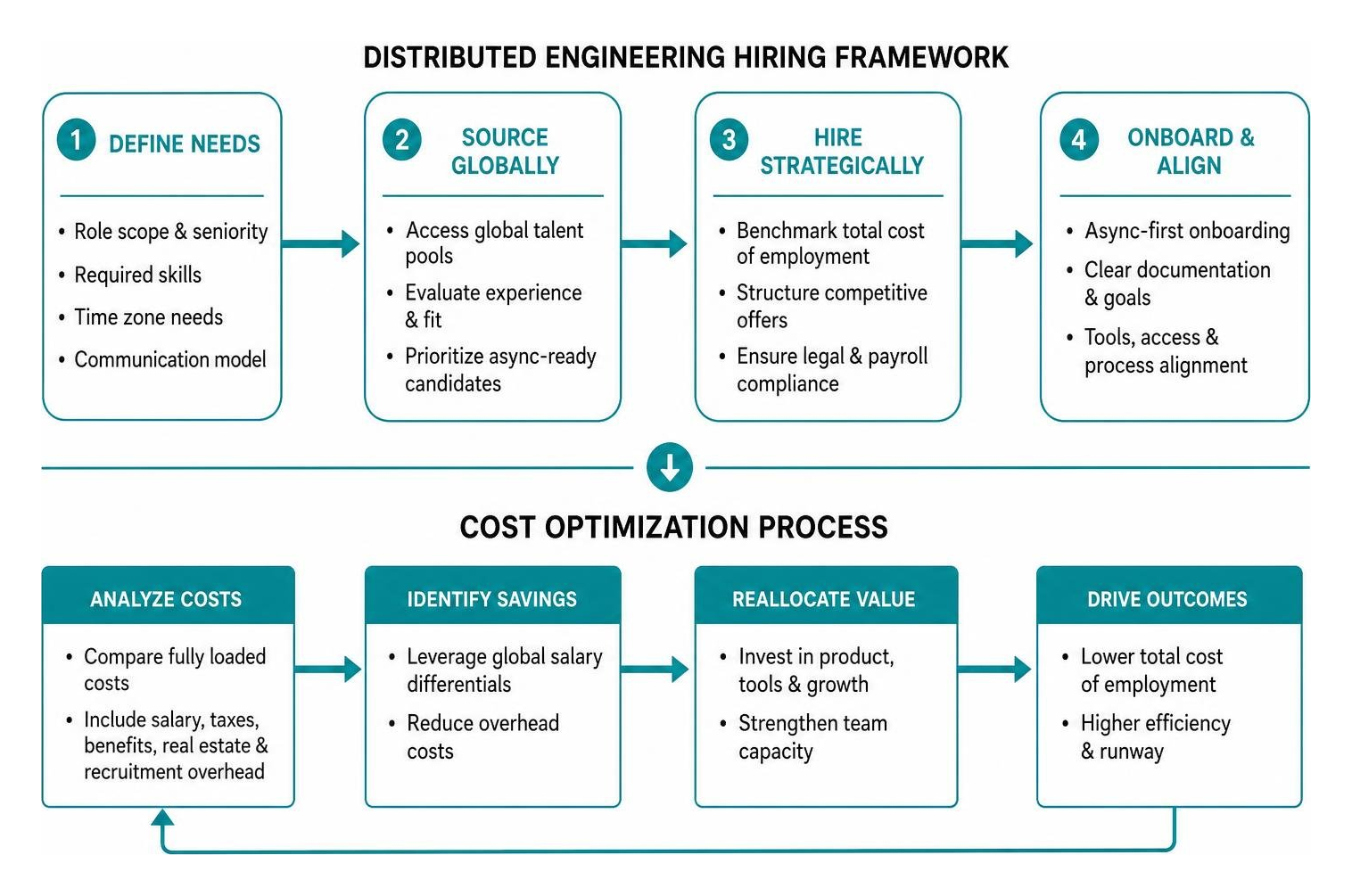
Fully Loaded Cost Disparities
A base salary comparison tells only part of the story. In tier-one US markets like San Francisco or New York, employer payroll taxes, mandatory benefits, commercial real estate, and recruitment overhead dramatically increase total expenditure:
US Senior Full-Stack Developer (San Francisco):
- Base Salary: $175,000
- Health, Dental, & Benefits: $18,000 ($8,000–$12,000 for standard health plans alone)
- Payroll Taxes & Statutory Compliance: $16,500
- Physical Office Space & Equipment Overhead: $18,000 ($15,000–$22,000 per workstation)
- Total Annual Loaded Cost: $227,500
Senior Remote Developer (Southeast Asia / Eastern Europe):
- Base Salary: $52,000
- Employer of Record (EOR) & Benefits Management: $6,250
- Equipment Stipend & SaaS Tooling: $5,000
- Physical Office Overhead: $0
- Total Annual Loaded Cost: $63,250
This represents an immediate annual cost reduction of 72% per senior engineer. Over a five-year horizon, employing a single senior remote engineer instead of an on-site San Francisco hire saves more than $820,000 to $950,000 in total capital expenditure.
5 Hidden Costs to Budget for in Distributed Teams
While remote hiring unlocks substantial savings, distributed organizations must budget for several hidden expenses to avoid operational friction:
- Employer of Record (EOR) Platform Fees: Using platforms to handle localized payroll, tax withholding, and labor law compliance costs between $400 and $800 per developer monthly.
- Synchronous Timezone Coordination: Ensuring 2 to 4 hours of daily overlapping availability requires disciplined scheduling and occasional premium compensation for shifted hours.
- Hardware and Ergonomic Stipends: Outfitting engineers with enterprise-grade laptops, monitors, and secure peripherals costs $2,500 to $4,000 upfront per hire.
- Team Offsites and In-Person Summits: Maintaining alignment and personal connection typically requires budgeting $2,000 to $4,000 per employee annually for semi-annual gatherings.
- Currency Fluctuation and Hedging: Operating international payroll exposed to local currency movements demands structured USD-denominated contracts or hedging buffers.
When Local Hiring Still Wins
Despite the cost advantages of remote teams, on-site engineering retains clear benefits in specific circumstances:
- Pre-Product-Market Fit Iteration: Early-stage startups pivoting multiple times per week benefit from instant whiteboarding and high-bandwidth synchronous debates.
- Strict Compliance & Data Sovereignty: Defense contracts, sovereign cloud systems, and select healthcare pipelines legally mandate that code be written and stored within specific domestic borders.
- Customer-Facing Technical Sales: Solutions architects who regularly join sales executives for on-site enterprise client pitches require geographic proximity.
For organizations building scalable digital products, leveraging remote fullstack developer positions remains the most capital-efficient path to scaling engineering capacity.
How Are AI Coding Tools and Modern Workflows Transforming Remote Web Development in 2026?
The day-to-day reality of remote web development has been redefined by artificial intelligence. In 2026, the industry has transitioned from manual syntax creation toward AI-assisted software engineering—a practice widely known as “vibe coding.”

Rather than spending hours writing repetitive boilerplate, configuring CRUD endpoints, or crafting complex CSS rules from scratch, developers now act as technical orchestrators. Engineers guide intelligent LLM agents, specify architectural constraints, review auto-generated pull requests, and verify test suites.
Industry benchmarks indicate that developers leveraging modern AI tooling achieve up to 55% faster task completion rates. This productivity multiplier alters the economics of remote engineering: a high-performing full-stack engineer utilizing modern AI agents can deliver the output that previously required a three-person engineering team.
Navigating the Modern AI Developer Toolchain
To remain competitive in the remote job market, developers must master specialized AI programming environments:
- Next-Generation AI Code Editors: Dedicated editors like Cursor and Windsurf integrate deep codebase indexing with agentic code modification.
- Frontier LLM Reasoning Models: Leveraging Claude 3.7 Sonnet and specialized reasoning models allows engineers to debug complex state systems and generate robust full-stack architectures.
- Automated Terminal & Workflow Agents: Tools that execute CLI commands, resolve migration errors, and run integration tests autonomously.
Developers looking to modernize their workflow can explore our comprehensive breakdown of vibe coding career paths and tool ecosystems, or review our direct comparison when evaluating tools like Cursor, Copilot, and Claude.
At RemoteVibeCodingJobs, we track this market evolution daily. We curate remote developer roles specifically tailored for professionals who leverage AI-assisted tools to ship software rapidly within async-first organizations.
Frequently Asked Questions About Remote Jobs vs Web Development?
Is web development still a viable remote career path compared to other tech disciplines in 2026?
Yes, web development remains one of the most resilient and versatile remote career paths available. Every modern business requires web applications, internal dashboards, and customer portals. While AI tools have automated routine coding tasks, the demand for developers who understand system architecture, performance optimization, data security, and end-to-end integration continues to expand. Web development offers unparalleled geographic flexibility compared to disciplines constrained by physical labs or regional compliance mandates.
Which is easier to learn for a remote beginner: frontend or backend web development?
Frontend development is generally easier for beginners to learn and showcase remotely. With frontend technologies (HTML, CSS, JavaScript/TypeScript, React, Next.js), you receive immediate visual feedback on your work. This visual nature allows you to build an interactive, demonstrable public portfolio that hiring managers can easily inspect. Backend engineering requires understanding database normalization, server orchestration, caching strategies, and concurrency—concepts that are more abstract and harder to demonstrate visually in an entry-level portfolio.
How much can international remote web developers earn working for US or European companies?
International developers working remotely for US or European firms typically earn between $40,000 and $90,000+ annually, depending on their technical stack, seniority, and communication abilities. In regions like Southeast Asia, Latin America, Eastern Europe, and South Africa, these compensation packages represent significant earning power relative to local market baselines while delivering 40% to 60% cost savings to hiring companies.
What Is the Strategic Verdict for Navigating Remote Tech Careers in 2026?
The comparison between general remote jobs and web development careers comes down to value leverage, career autonomy, and long-term earnings. While generic remote jobs provide geographic freedom, web development combines that freedom with exceptional compensation ceilings and deep career defensibility.
To capitalize on the remote software landscape in 2026:
- Master Asynchronous Communication: Clear, precise written documentation in tools like GitHub, Linear, and Notion is just as important as clean code syntax.
- Integrate AI-Assisted Workflows: Elevate your engineering speed by mastering AI code editors, automated agents, and prompt-driven architecture design.
- Build Verifiable Deliverables: Ditch resume bullet points in favor of production-deployed full-stack web applications featuring comprehensive documentation.
- Target Modern, Async-First Companies: Focus your job search on companies built around remote-first principles rather than legacy organizations enforcing hybrid surveillance.
Ready to take your next career step in modern software engineering? Browse our curated daily listings to explore high-paying remote AI engineer positions and secure a role built for the future of development.