
What Is a Claude Coding Specialist and Why Are High-Paying Teams Hiring Them?
To land a six-figure role as a Claude coding specialist, developers build public portfolios of agent-driven repositories, master CLAUDE.md architecture and subagent orchestration, and demonstrate rigorous async code verification during live technical interviews. Rather than manually typing routine boilerplate, a Claude coding specialist orchestrates a terminal-first coding agent to inspect large repositories, execute multi-file refactors, and triage complex issues at massive leverage.
In September 2026, engineering organizations are moving past simple autocomplete extensions. Frontier models have redefined autonomous problem-solving; for instance, Fable 5 leads on SWE-Bench Pro with an 80.3% score. Engineering leaders are not hiring people to write raw syntax line by line. They are hiring builders who know how to direct agentic systems, inspect generated logic, enforce strict typing, and keep technical debt near zero.
This massive leap in velocity has disrupted engineering budgets. Companies realize that one engineer operating with elite agentic workflows can deliver the output of an entire traditional sprint team. As a result, compensation trends for remote AI developers reflect a premium for practitioners who can turn ambiguous product requirements into reliable pull requests without constant oversight.
Core Capabilities of an Elite Claude Coding Specialist
Top-tier specialists master a unique blend of core software engineering fundamentals and modern agent orchestration techniques:
- CLAUDE.md Architecture: Creating concise, high-signal project rulebooks that dictate architectural boundaries, coding standards, package managers, and testing commands so agents never drift off-spec.
- Dynamic Subagent Orchestration: Spawning dozens of specialized subagents in parallel to explore distinct directories, cross-reference API schemas, and generate test suites simultaneously.
- Context Budgeting: Structuring token consumption intelligently using prompt caching, targeted file globbing, and strategic context clears to maintain high reasoning quality without hitting rate limits.
- Deep CLI & Tooling Integration: Interfacing agents directly with local shell environments, git workflows, Docker containers, and custom linters to catch compilation errors instantly.
- Multi-File Architectural Refactoring: Directing synchronized changes across monorepos, updating frontend component states, database schemas, and backend route handlers in a unified execution run.
Measuring Enterprise Productivity and Workflow ROI
High-performing specialists demonstrate their value with hard operational metrics. When integrated properly into enterprise software environments, Claude Code delivers remarkable efficiency gains:
- 60x Faster Code Review Feedback: AI platform teams leverage automated diagnostics and instant multi-file linting to identify edge cases in seconds rather than days.
- 95% Reduction in Time to Run Tests: Intelligent test selection and automated mocking scripts allow enterprise software customers to trim CI testing cycles dramatically.
- 10+ Hours Saved Weekly: Over 75% of engineers using Claude save 8 to 10+ hours every week, freeing up deep-focus time for system design and architecture.
- Accelerated Model Workflows: Staff software engineers report that Claude Code saves 1 to 2 days of routine work per project model.
| Metric | Traditional Software Engineer | Elite Claude Coding Specialist |
|---|---|---|
| Workflow Focus | Manual syntax drafting, boilerplate creation | Agent orchestration, system design, PR review |
| Context Mapping | Manual file-by-file reading (hours/days) | Agentic search and automated repo mapping (seconds) |
| Refactoring Speed | Sequential file edits across several sprints | Coordinated multi-file edits in single sessions |
| Issue Triage | Manual reproduction, step-by-step debugging | Automated subagent reproduction and redline fixes |
| Testing Overhead | Manual unit test drafting | Self-verifying test generation and automated runs |
Mastering the Claude Code Toolchain: Models, Terminal Integration, and Agentic Workflows
Navigating the Claude ecosystem requires matching the right model to the right problem. Specialists leverage the full spectrum of intelligence tiers based on task complexity, speed constraints, and token budgets.
Frontier tasks requiring deep algorithmic reasoning, large monorepo refactoring, and multi-step logic rely on Claude Opus reasoning. Claude Opus delivers exceptional intelligence for production-critical workflows while maintaining cost efficiency through prompt caching. On complex automation tasks, Opus has topped Zapier’s AutomationBench leaderboard with 100% completion rates on full churn-prevention sequences, while using roughly a seventh of the reasoning tokens and under half the latency of older releases on financial trading benchmarks.
For day-to-day feature implementation and fast code generation, specialists lean on Sonnet 4.6 for an optimal balance of speed and depth, while Haiku 4.5 handles rapid subagent search, log parsing, and lint checking. When raw turnaround time is critical, specialists engage Fast Mode on Opus to accelerate model generation speeds by 2.5x.
Beyond terminal text generation, advanced specialists employ multi-agent orchestration frameworks and computer use capabilities. This allows Claude to interact directly with local web browsers, trigger UI flows, verify rendered components, and inspect network dev tools to debug layout glitches or broken authentication tokens autonomously.
Autonomous Workflows: Turning Issues into Shipped Pull Requests
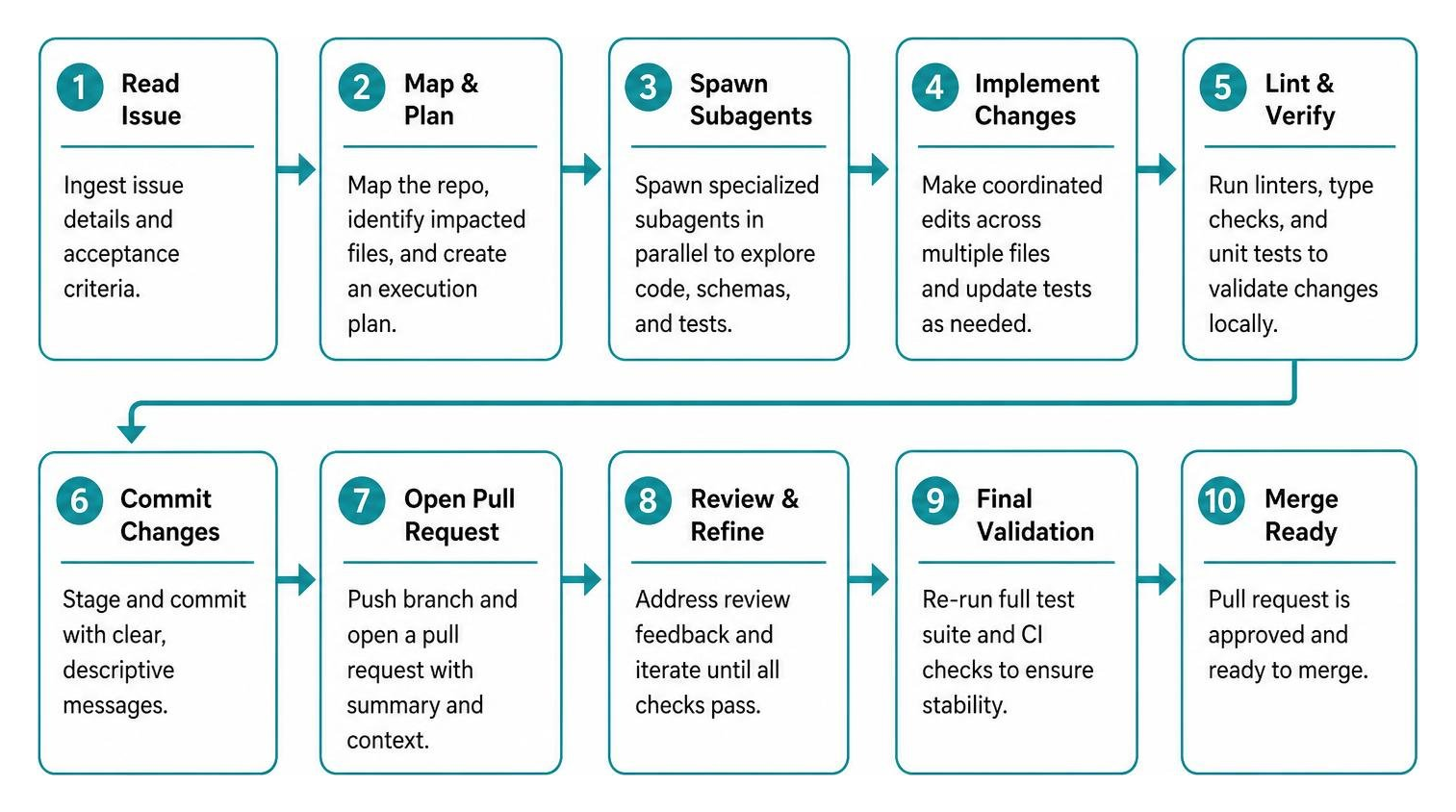
The hallmark of a high-leverage specialist is the ability to point Claude Code at a GitHub issue and receive a fully verified, passing pull request. This process follows a structured loop:
- Agentic Codebase Search: Claude scans the project structure, analyzes dependency graphs, and locates relevant function calls without requiring manual context selection.
- Contextual Alignment: The model consults the root
CLAUDE.mdto ensure modifications align with architectural conventions. Understanding how to build an agent-friendly codebase ensures that imports, test commands, and styling rules are picked up instantly. - Isolated Implementation: Claude generates targeted modifications across the necessary backend, frontend, and configuration files.
- Self-Debugging Feedback Loops: The agent executes the local test runner via the CLI. If a unit test fails or a linter throws an error, Claude reads the stack trace, adjusts its implementation, and reruns the suite until all checks pass.
- PR Generation & Summarization: Claude stages the changes, writes a concise, conventional commit message, and opens a GitHub PR complete with an architectural breakdown of changes.
Enterprise Security, Permissions, and Local CLI Execution
Speed should never come at the expense of security. Enterprise software teams require strict guardrails when deploying autonomous coding agents. Claude Code is designed around local machine execution, communicating directly with model APIs without routing proprietary source code through untrusted third-party middleware.
Specialists implement secure operations through several best practices:
- Explicit Permission Prompts: Keeping permission boundaries active for dangerous shell commands (
rm, external network requests, or database migrations) ensures human-in-the-loop validation. - Sandboxed Execution: Running Claude Code inside Docker containers or isolated virtual environments to prevent unintended system-level modifications.
- Environment Variable Protection: Excluding
.envfiles and API credentials from agent context by enforcing.claudeignorerules. - Automated Code Auditing: Running static analysis security tools over all agent-generated code prior to merging to prevent vulnerabilities such as injection flaws or insecure dependencies.
Step-by-Step Blueprint to Land High-Paying AI Developer Roles
Breaking into a top-tier role requires concrete proof of execution. Hiring managers are overwhelmed by applicants with generic resumes; they want to see verified production output and strong system stewardship.

- Build a Public, Agentic Portfolio: Create three to five open-source repositories where commit histories clearly show structured agent orchestration, comprehensive test suites, and clean documentation.
- Optimize Your AI-Native Resume: Tailor your application to highlight agent leverage, multi-file refactoring accomplishments, and CI/CD automation. Review our comprehensive guide on crafting a developer resume for AI-native companies to ensure your experience stands out.
- Demonstrate Asynchronous Ownership: High-paying AI roles are predominantly remote and async-first. Showcase your ability to write detailed architectural decision records (ADRs), clean PR descriptions, and crisp progress updates.
- Master Compensation Strategies: Once you receive offers, negotiate based on the organizational leverage you provide. Use proven remote developer salary negotiation strategies to secure compensation that matches your high-volume output.
Standing Out as a Claude Coding Specialist in Technical Interviews
Modern AI technical interviews have moved away from abstract whiteboard algorithms. Instead, teams evaluate how effectively you collaborate with agentic tools in realistic codebases.
- Live Agent Pairing: You will be asked to clone a messy, unfamiliar repository, locate a race condition or memory leak, and resolve it live using Claude Code. Focus on writing clear diagnostic prompts and letting Claude inspect log outputs.
- Prompt Refinement & Guardrails: Interviewers will test how you recover when Claude produces hallucinations or circular errors. Demonstrate how you narrow context, supply precise test failures, and redirect the agent.
- Code Verification & Scrutiny: Never blindly accept generated diffs. Explain your thought process aloud as you audit agent code for edge cases, performance bottlenecks, and architectural alignment.
Scaling from Feature Coder to High-Leverage Systems Architect
Landing the role is just the beginning. The most successful developers scale their impact across entire engineering departments:
- Designing Long-Horizon Workflows: Building scheduled Claude routines that continuously monitor bug trackers, run dependency upgrades, and generate initial PRs before the engineering team starts their day.
- Standardizing Agent Frameworks: Authoring organizational
CLAUDE.mdstandards, custom prompt libraries, and subagent configs across enterprise monorepos. - Leading Technical Architecture: Shifting focus from feature-level syntax toward domain modeling, API contract design, data consistency, and high-level platform scalability.
Frequently Asked Questions About Claude Coding Specialists
How does Claude Code differ from inline autocomplete tools like GitHub Copilot?
Inline autocomplete tools function primarily inside an editor pane, suggesting the next few tokens or lines of code based on immediate local context. Claude Code is a full-fledged agentic system that operates across your entire terminal, IDE, and version control workflow.
It can autonomously execute shell commands, run test suites, search deep across directories, edit dozens of files in a single session, and self-correct based on compiler diagnostics.
What technical background is required to transition into a specialist role?
You need a solid foundation in core software engineering principles: data structures, system architecture, API design, version control, and debugging methodologies.
You do not need a machine learning PhD, but you must possess strong CLI proficiency, an intuitive grasp of prompt structure, and the critical judgment needed to audit AI-generated code for security, maintainability, and performance.
How do companies evaluate AI coding candidates without standard LeetCode tests?
Progressive engineering teams use live repository troubleshooting assessments. Candidates are given an open issue in a large, real-world codebase and asked to reproduce the bug, instruct Claude Code to implement a fix, verify the solution with newly authored automated tests, and open a complete pull request.
Evaluators score candidates on task breakdown, context management, prompt clarity, and the rigor of their code review.
Conclusion
The shift toward AI-assisted software development is the most significant evolution in engineering productivity in decades. By mastering prompt architecture, subagent orchestration, terminal automation, and automated validation, you position yourself at the forefront of the modern tech workforce.
At RemoteVibeCodingJobs, we help high-leverage builders find remote, async-first teams that value output, autonomy, and cutting-edge toolchains. Explore our curated remote Swift and AI coding roles to find your next high-impact engineering position today.