
The Remote AI Jobs Market in 2026: What You Need to Know Before You Apply
Remote AI jobs are one of the fastest-growing career categories in 2026. Here’s a quick snapshot of what the market looks like right now:
| Category | Numbers |
|---|---|
| Total remote AI jobs (US) | 101,000+ listings |
| Fully remote roles | 71,047 |
| Entry-level positions | 35,723 |
| Full-time roles | 90,807+ |
| Pay range | $32/hr freelance → $346K/yr senior engineering |
| No-experience-required? | Yes — data annotation, online rating, AI training |
The field spans a huge range — from flexible, part-time annotation tasks you can start this week, to senior engineering roles building production LLM systems at scale. Whether you want a side income or a full remote career, there’s a real path in.
This guide breaks down every layer: job types, salaries, required skills, how to apply faster, and where to find the best opportunities.
We cover it all — no fluff, no vague advice.
I’m the RVCJ Editorial team at Remote Vibe Coding Jobs — we cover AI-assisted development, remote hiring trends, and practical career guidance for developers finding remote AI jobs at async-first companies. We curate global remote roles for AI-first teams daily, so everything here reflects what’s actually happening in the market right now.
What Remote AI Jobs Look Like in 2026
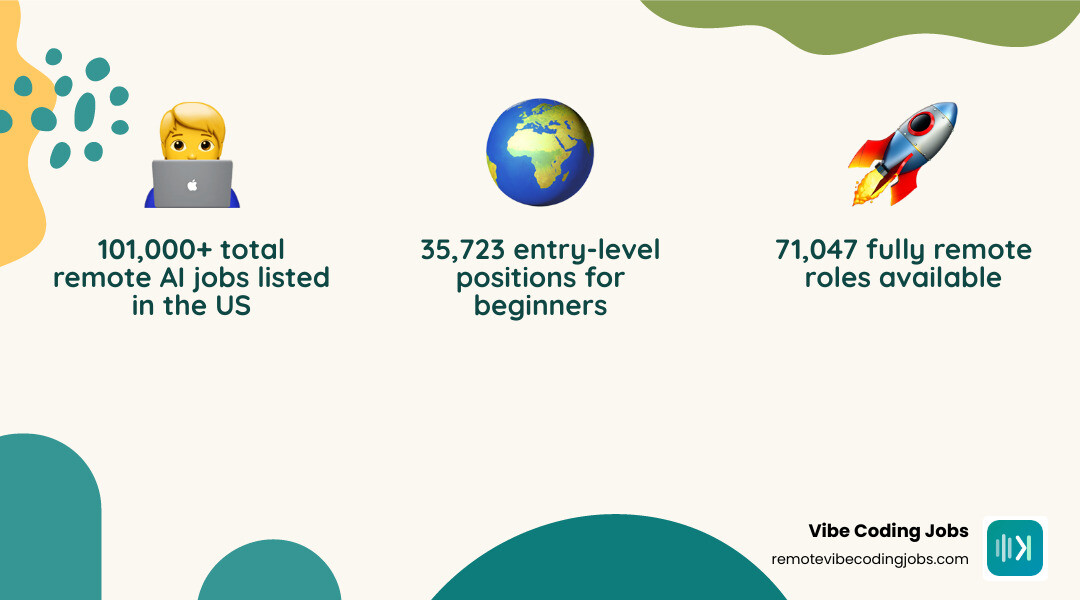
The landscape for remote AI jobs has exploded over the last few years. As of May 2026, there are over 101,000 active listings in the United States alone. What’s even more impressive is the shift toward location independence: over 71,000 of these roles are fully remote.
While the “AI” label might sound intimidating, the market is surprisingly balanced. About 35,723 of these listings are entry-level, proving that you don’t need a decade of machine learning experience to get your foot in the door. Most roles (over 90,000) are full-time, but the freelance and “gig” economy for AI training is thriving for those who prefer total schedule control.

The biggest remote ai jobs categories hiring now
If you are looking for remote AI jobs, you’ll likely find yourself in one of these high-demand categories:
- AI Trainers & Data Annotators: These are the “teachers” of the AI world. You’ll be labeling data, correcting model outputs, and ensuring AI “thinks” logically.
- ML & AI Engineering: The technical backbone. These professionals build the infrastructure, design inference pipelines, and manage the models.
- Data Science: Analyzing the massive datasets that power AI to find patterns and improve model performance.
- Solutions Engineering & Sales: AI companies need people who can explain the tech to clients and build technical demos.
- Operations & Agent Developers: A newer category focusing on “autonomous agents” that can perform tasks with minimal human intervention.
Which remote ai jobs are easiest to break into
If you’re starting from scratch, look for roles like online raters, ad evaluators, or search engine evaluators. These positions often require no prior experience or specialized degrees. Companies look for human intuition and cultural context—things AI still struggles with. You might spend your day evaluating search query results or generating dialogue for chatbots to ensure they sound natural.
For those with a bit more interest in the “how” of AI but no formal CS degree, AI Coding Jobs Entry Level Remote provide a great entry point into the technical side of the industry.
Which remote ai jobs require real technical depth
At the other end of the spectrum are the high-stakes engineering roles. These aren’t just about “using” AI; they are about building it. You’ll need deep knowledge of Large Language Model (LLM) products, Retrieval-Augmented Generation (RAG) pipelines, and vector databases like Pinecone or Qdrant.
Proficiency in Python and TypeScript is non-negotiable here, as is experience with cloud platforms (GCP, AWS) and distributed systems. If you’re ready to own the “AI core” of a product, you can find a detailed breakdown of what these companies expect in our Remote AI Developer Job Description guide.
Salary Ranges for Popular Remote AI Roles
Money in the AI sector is, frankly, excellent. Because the demand for talent far outpaces the supply, companies are willing to pay a premium for both niche expertise and reliable data work.
| Role Level | Typical Pay Range |
|---|---|
| Entry-Level / Freelance | $32/hr – $65/hr |
| Specialized AI Trainer (e.g., Medical/PhD) | $90/hr – $125/hr |
| Mid-Level AI Engineer | $100,000 – $150,000/yr |
| Senior/Distinguished Engineer | $230,000 – $346,000/yr |
Entry-level, freelance, and no-experience-required pay
Even “side hustle” AI work pays better than most traditional remote gigs. Basic data annotation and online rating roles often start around $32 per hour. For those with specific domain knowledge—like a background in pricing or research—projects can pay between $45 and $90 per hour. Some specialized communities, like Mindrift, offer up to $90/hr for domain experts who can also code in Python or SQL.
Mid-level and senior engineering salary ranges
Once you move into full-time engineering, the numbers jump significantly. In the UK, senior AI data engineers can earn between £117K and £153K, while European roles in Germany or Ireland can reach up to €184K. In the US market, it’s not uncommon for senior AI-first developers to command $150K to $250K+, especially if they have a track record of shipping production-ready LLM products. You can check out more specific data on our AI/ML Engineer Salaries page.
What makes remote ai jobs pay more
The highest paychecks go to those who bridge the gap between AI and a specialized field. For example, a Medical Imaging Specialist working as an AI Trainer can earn up to $125/hour. Having a Masters or PhD is a massive lever—70% of AI Trainers in top communities hold advanced degrees. Beyond academics, “shipping” is the ultimate currency. Companies pay more for engineers who have actually navigated the failures of AI, like prompt drift or cost overruns, and kept a product profitable at scale.

Skills, Qualifications, and Experience by Career Level
The barrier to entry for remote AI jobs is lower than you think, but the ceiling for skills is incredibly high.
No-experience remote ai jobs and what employers actually ask for
For non-technical roles, employers aren’t looking for code; they are looking for reliability and precision. Most “no-experience” platforms require:
- Being at least 18 years old.
- Fluency in English (or another target language).
- A reliable computer and high-speed internet.
- The ability to pass a “vibe check” assessment—essentially proving you can follow complex labeling instructions without getting bored or making errors.
Skills needed for entry-level technical remote ai jobs
If you want to move into technical roles, you need to understand the “AI stack.” This includes basic SQL for data retrieval, Python for scripting, and a strong “QA mindset.” You’ll need to know how to write effective prompts and evaluate the quality of model outputs. Understanding how APIs work and basic Git workflows will make you a much more attractive candidate for Entry Level AI Coding Jobs Growth Remote opportunities.
Skills needed for senior remote ai jobs
Senior roles are about orchestration. It’s not enough to call an OpenAI API; you need to know how to build the retrieval systems around it. Key skills include:
- System Design: Building scalable distributed systems on GCP or AWS.
- Cost Control: Implementing per-user caps and model routing to keep AI profitable.
- Orchestration: Using frameworks like LangChain or LlamaIndex (or knowing when to skip them for in-house solutions).
- Evaluation: Moving beyond “vibes-based” testing to rigorous adversarial evaluations.
For a deep dive into the specific toolsets currently in demand, check out our guide on Remote AI Developer Jobs AI Tools.
How Flexible Remote AI Jobs Really Are
One of the best things about remote AI jobs is the variety of work structures. You aren’t locked into a 9-to-5 unless you want to be.
Part-time, freelance, and project-based remote AI work
Many AI training roles are completely “async.” You can log in for 5 hours a week or 40, depending on project availability. This makes it a perfect side hustle for PhD students, physicians, or stay-at-home parents with specialized knowledge. Talent pools like Mindrift or RWS TrainAI allow you to dip in and out of projects, getting paid per task completed.
Full-time remote AI careers with benefits
If you choose the full-time path, you’re often joining “remote-first” or “async-first” startups. These companies typically offer:
- Flexible vacation policies (no one is counting your hours if the code ships).
- Learning reimbursements for AI certifications or conferences.
- Home office stipends and even “anniversary laptops.”
- Annual company retreats to cool locations to build the “vibe” that Slack can’t provide.
Remote vs hybrid vs location-limited roles
Be careful with the word “remote.” While 71,000+ jobs are fully remote, some are “location-limited.” For instance, some Senior Software Engineer roles at companies like AssemblyAI may be remote but restricted to the UK, US, or specific European countries due to tax and labor laws. Always check if a role requires a specific timezone overlap before spending an hour on the application.
How to Find and Apply for Remote AI Jobs Faster
The competition for remote AI jobs is stiff, but most people apply the wrong way. If you want to stand out, you need to move fast and show, don’t just tell.
Best places to find remote ai jobs today
Don’t just refresh LinkedIn all day. Use specialized boards that filter for the “vibe” of the company. At Remote Vibe Coding Jobs, we focus on companies that actually embrace AI-assisted development (using tools like Cursor and Claude) and value async culture. You can also monitor Remote AI Developer Jobs Boards Market Outlook to see which platforms are currently leading the pack.
What the application process usually includes
Expect a multi-step process:
- CV Submission: Highlight your AI tool fluency (Cursor, ChatGPT, etc.).
- Assessments: Often a “domain test” to see if you actually know your stuff.
- Profile Verification: Some platforms require ID verification to prevent fraud.
- Interview Loops: Usually 2-3 rounds focusing on your ability to ship and solve problems, rather than just solving LeetCode puzzles.
How to stand out when applying
The best way to get hired is to have a portfolio of shipped projects. If you’re an engineer, don’t just list “Python” on your resume. Link to a GitHub repo where you built a RAG-based agent or a specialized chatbot. For inspiration, look at how companies like MemberPress or AssemblyAI describe their ideal candidates—they want people who “own the core” and care about the final product.
How to Get Started With Remote AI Jobs Today
Ready to jump in? Here is your roadmap, depending on where you are starting.
If you have no experience
- Join a Community: Sign up for RWS TrainAI or DataAnnotation.
- Pass the Assessment: Take your time. These tests are the only thing standing between you and a $32/hr gig.
- Build a Track Record: Complete small tasks with 100% accuracy to unlock higher-paying projects.
If you have technical experience
- Master the Tools: Download Cursor and start “vibe coding.” If you can’t build an MVP in a weekend using AI assistants, you’re behind.
- Ship a Demo: Build a simple AI agent that solves a real-world problem (e.g., a tool that summarizes legal docs or medical papers).
- Target the Right Roles: Apply for Applied AI Engineer or Senior AI Agent Developer positions that value speed and product-thinking.
If you want curated remote AI opportunities
If you’re tired of sifting through thousands of “hybrid” roles that are actually just office jobs in disguise, we can help. We aggregate the best remote AI jobs from companies that “get it.” Whether you’re looking for Best Companies Hiring AI Developers Remote or just want to see who is hiring for “vibe coding” roles this week, our daily listings are designed to save you time.
Frequently Asked Questions About Remote AI Jobs
Are there remote AI jobs with no experience required?
Absolutely. Data annotation, online rating, and AI training roles are designed for beginners. You just need to pass an initial skills assessment to prove you can follow instructions and provide high-quality data.
Do remote AI jobs require a degree?
It depends. For data annotation and general coding roles, a portfolio and skills test often matter more than a degree. However, for “Subject Matter Expert” AI training (in fields like Physics, Law, or Medicine), a Masters or PhD is often required.
What are the best remote AI job categories for long-term growth?
AI Engineering and ML Infrastructure are the safest bets for long-term career stability. As models become more complex, the people who know how to deploy, monitor, and scale them will always be in high demand.
Conclusion
The era of remote AI jobs is just beginning. By 2026, the distinction between “tech jobs” and “AI jobs” has almost disappeared—every role now requires some level of AI fluency. Whether you start as a part-time data annotator or a senior AI Engineer, the key is to stay curious and keep building. The market is huge, the pay is competitive, and the flexibility is unmatched. It’s time to find your place in the AI economy.