
Why Agile Methodology Pair Programming Matters Before Your Next Sprint
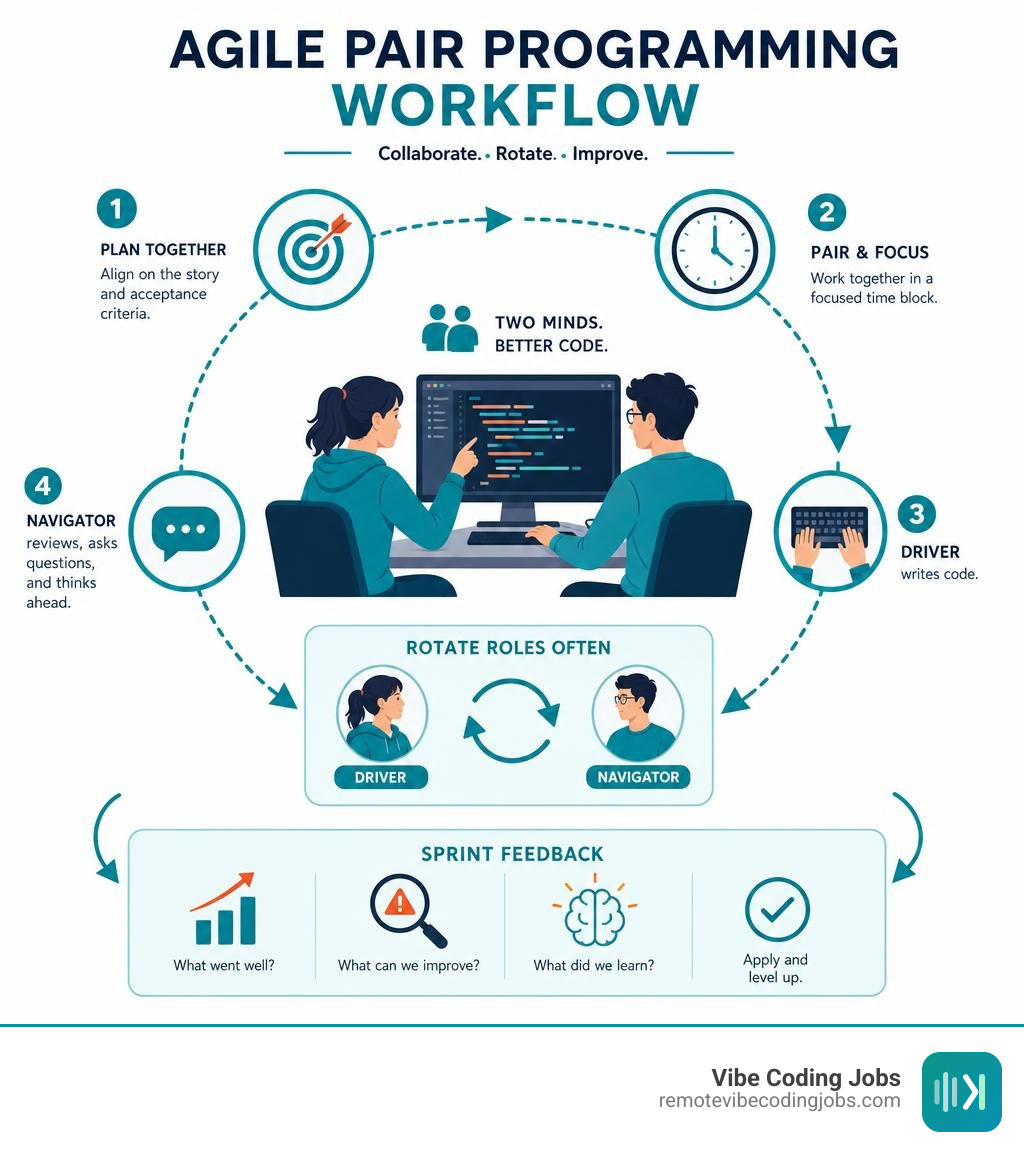
Agile methodology pair programming means two developers work on one task at the same time. One writes the code while the other reviews, questions assumptions, and thinks ahead. They switch roles often, so both stay involved.
Use it when a story is complex, risky, unfamiliar, or a good chance to share knowledge. In a sprint, agree on the goal, choose a pairing style, set a focused time block, and rotate driver and navigator roles before either person becomes passive.
Pair programming became widely known through Extreme Programming, but its value is broader than catching typos. It creates continuous code review, exposes design problems earlier, and spreads the small pieces of codebase knowledge that are otherwise easy to lose. Research often cited on the practice found a trade-off: pairs used about 15% more developer time while producing roughly 15% fewer bugs. That does not make pairing right for every task, but it can be a smart investment where rework or knowledge silos are costly.
I’m Dominic Zijlstra, a technologist, founder, and former data scientist and DevOps engineer who has worked on complex systems where clear collaboration and rapid feedback matter. In this guide, I’ll show how agile methodology pair programming can support better code, stronger learning, and more effective remote delivery.
Related content about agile methodology pair programming:
Core Principles of Agile Methodology Pair Programming
At its heart, pairing brings two distinct cognitive vantage points to bear on a single engineering problem. One engineer focuses on immediate tactical execution (syntax, API contracts, local variable scoping), while the other provides high-level strategic oversight (architecture fit, edge case validation, test boundaries). This dual-layer approach turns programming into an active dialogue rather than an isolated marathon.
Pairing reinforces collective code ownership across your agile squad. When two engineers co-create a system component, no single developer becomes an indispensable bottleneck or an isolated single point of failure. The practice creates an environment where code quality standards are maintained naturally throughout development, rather than debated days later during an asynchronous pull request review. As outlined in the Agile Alliance insights on pairing efficacy, the real-time debugging and immediate feedback loops inherent to pairing drastically compress the turnaround time between introducing a bug and resolving it.
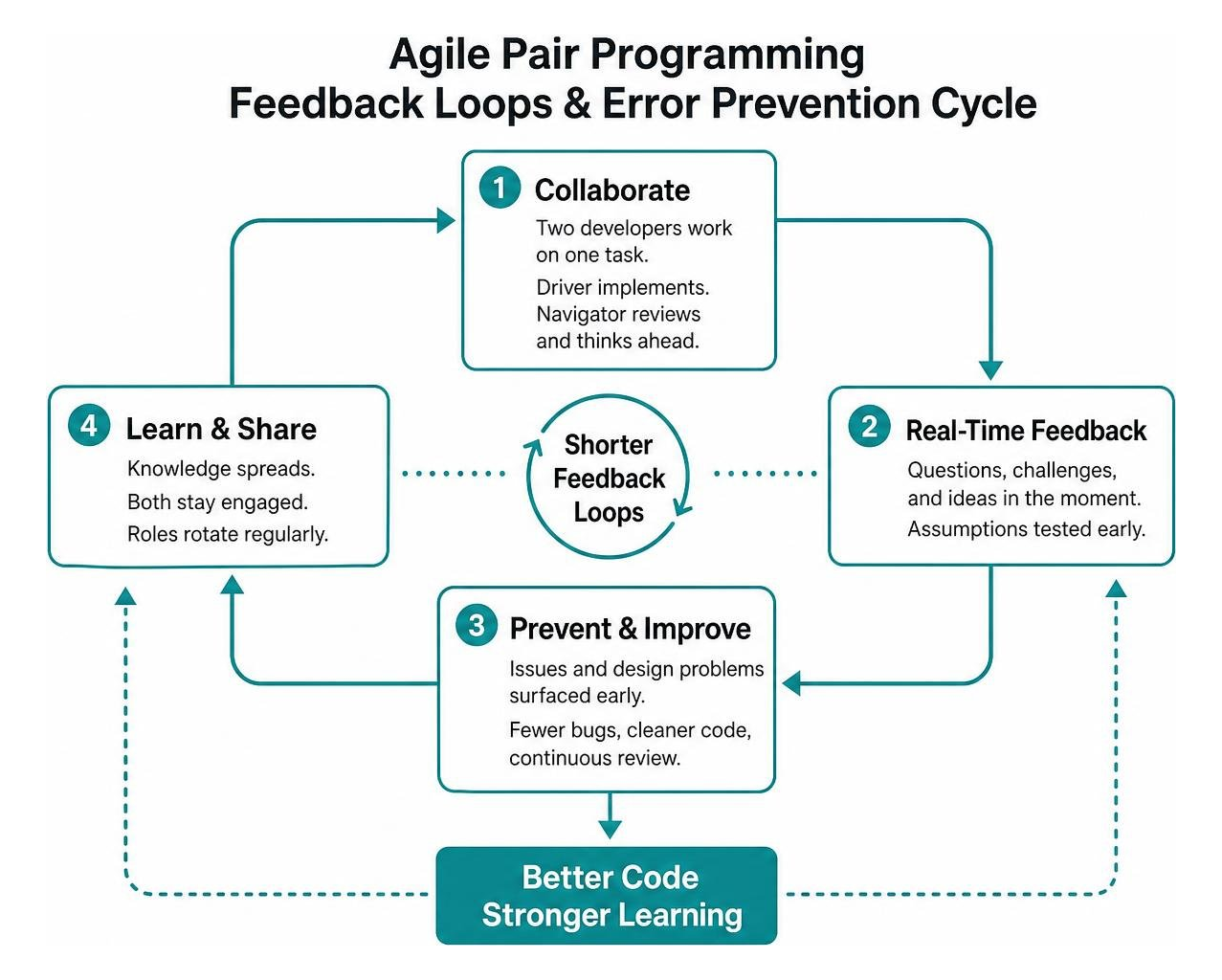
Driver and Navigator Dynamics
The collaboration relies on two clearly defined, fluid roles:
- The Driver: Operates the keyboard and mouse, focusing on tactical implementation, writing clean code, and navigating the immediate technical syntax.
- The Navigator: Observes the broader landscape, scanning for logical oversights, considering downstream architectural dependencies, and consulting documentation.
Successful pairing requires active verbal communication. The driver maintains a running commentary to articulate their thought process out loud, while the navigator engages in active listening and offers constructive alternatives rather than simply barking directives. Roles should switch every 15 to 30 minutes to ensure both engineers remain mentally sharp and engaged.
How Agile Methodology Pair Programming Fits Into Sprints
Pairing should not happen in a vacuum; it must be intentionally woven into your agile ceremonies and planning rhythms:
- Sprint Planning: Identify pairing candidates during user story estimation. Flag stories that involve critical architectural changes, high-risk refactoring, or unfamiliar tech stacks.
- Work in Progress (WIP) Limits: Because two developers collaborate on a single task, team WIP limits naturally drop by roughly 50%. This constraint accelerates throughput by reducing context switching.
- Daily Standups: Pairs provide unified updates, discussing blockers and determining whether to rotate partners for the next sprint phase.
- Sprint Retrospectives: The team inspects pairing hygiene, assessing whether rotation frequencies, session durations, and task choices delivered the intended quality improvements.
Use this checklist during sprint planning to decide which backlog items warrant a pairing session:
- Is the story touching core payment, auth, or mission-critical infrastructure?
- Does the implementation involve legacy modules that lack automated test coverage?
- Is there a clear knowledge gap between team domain experts and newer engineers?
- Will real-time architectural debate prevent expensive asynchronous PR rework?
Proven Pair Programming Styles and Collaboration Techniques
There is no single universal way to pair. High-performing engineering teams adapt their technique based on task complexity, individual familiarity with the codebase, and team dynamics, as detailed in Martin Fowler’s analysis of pair programming practices.
| Style | Best Use Case | Driver Role | Navigator Role | Recommended Rotation Interval |
|---|---|---|---|---|
| Traditional Driver-Navigator | Complex feature architecture, refactoring | Implements code tactically | Evaluates design and checks edge cases | 20–30 minutes |
| Ping-Pong Pairing | Test-Driven Development (TDD), API design | Alternates between test author and implementer | Acts as the immediate counterpart | Every passing test cycle |
| Strong-Style Pairing | Knowledge transfer, junior onboarding | Types exclusively on instruction | Formulates ideas and directs the implementation | 10–15 minutes |
| Mob / Ensemble Programming | Ambiguous domain problems, incident resolution | Rotates through the team at the keyboard | Entire team guides design and strategy | 10–15 minutes per driver |
Ping-Pong Pairing and TDD
Ping-pong pairing combines pair programming with Test-Driven Development (TDD), establishing a rapid-fire rhythm:
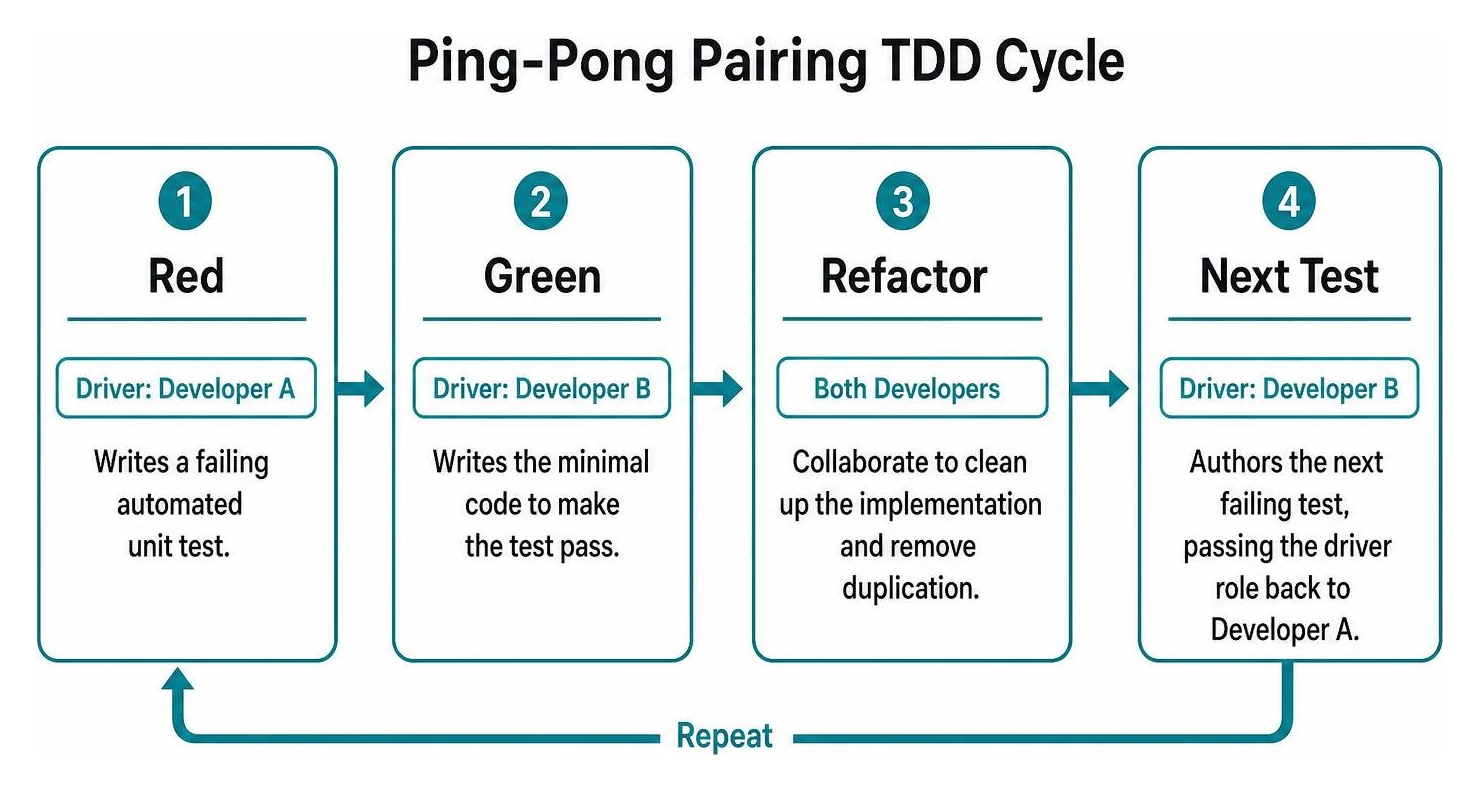
- Developer A writes a failing automated unit test (Red).
- Developer B takes over the keyboard and writes the minimal code needed to make the test pass (Green).
- Both developers collaborate to clean up the implementation and remove duplication (Refactor).
- Developer B authors the next failing test, passing the driver role back to Developer A.
This technique prevents disengagement because the keyboard changes hands continuously every few minutes, keeping both engineers invested in clean test suites and reliable code.
Strong-Style and Mob Programming Variations
Originating from Llewellyn Falco, the core rule of Strong-Style Pairing is: “For an idea to go from your head into the computer, it must go through your partner’s hands.” This approach excels during onboarding. The experienced engineer navigates by explaining the conceptual logic, while the junior engineer drives at the keyboard, building muscle memory for internal tooling, shortcuts, and code conventions.
Taking collaboration a step further, Mob Programming (or Ensemble Programming) involves the entire squad working simultaneously on a single backlog item. A rotating driver shares their screen while the rest of the team acts as a collective navigator, building consensus on complex distributed system designs without delays from scheduling review meetings.
Business Impact: Productivity, Quality, and Skill Transfer
Engineering managers often wonder whether putting two engineers on one task halves overall productivity. In practice, code generation speed is rarely the primary constraint in software delivery; system reliability, maintainability, and domain knowledge distribution are far more impactful. While evaluating remote work pros and cons, distributed organizations discover that intentional pairing establishes real-time alignment and eliminates deep context-switching overhead.
Measuring ROI in Agile Methodology Pair Programming
Empirical research across the software industry—including university studies and IBM’s analysis of pair programming—consistently reports that while pairing requires approximately 15% more developer hours than solo programming, it yields a corresponding 15% reduction in production defects.
The economics become clear when comparing development costs against lifecycle maintenance costs:
- Immediate Defect Detection: Eliminating a logic flaw while pairing costs minutes; finding that same defect in production can require days of triage, hotfixing, and root-cause analysis.
- Shorter Code Review Cycles: PRs created via pairing can be merged almost immediately because continuous review has already taken place.
- Reduced Coordination Friction: Pairing minimizes stale branches and complex merge conflicts by keeping pull requests compact and quickly integrated.
Onboarding Acceleration and Reducing the Bus Factor
Studies indicate that up to 90% of newly learned technical skills fade without active engagement and immediate practice. Pairing addresses this gap by replacing passive documentation reading with hands-on, live code navigation alongside experienced peers.
This continuous skill transfer also mitigates your project’s “bus factor.” When domain knowledge is shared across multiple engineers rather than concentrated in a single specialist, the team stays resilient against unplanned absences, departures, and reassignments.
Implementing Pair Programming in Remote and Distributed Teams
Distributed agile squads can pair just as effectively as co-located teams when they establish clear communication norms and shared digital workspaces. Rather than demanding exhaustive eight-hour video marathons, modern teams build balanced schedules that blend focused pairing windows with uninterrupted independent work. For engineers targeting high-autonomy teams, exploring async remote developer jobs highlights how structured collaboration fits into flexible remote workflows.

Tooling and Setup for Virtual Pairing
A smooth remote pairing setup requires zero-friction tooling. Leveraging a curated modern remote developer tools stack alongside actionable remote developer productivity tips helps pairs minimize audio delays and terminal desync:
- Collaborative IDEs: Real-time multi-cursor extensions (such as VS Code Live Share) allow both developers to edit files, manage terminals, and run debuggers simultaneously.
- Low-Latency Screen Sharing: High-framerate tools with real-time screen annotation help navigators highlight specific lines without taking over system controls.
- Clear Audio Channels: Noise-cancelling headsets and stable, persistent audio links are essential to prevent fatigue during extended verbal problem-solving sessions.
Overcoming Social Fatigue and Cultural Roadblocks
Pairing is mentally demanding. Sustained real-time verbal collaboration requires high cognitive energy, which can lead to social exhaustion if left unmanaged:
- Timebox with the Pomodoro Technique: Structure sessions into 25-minute focus intervals followed by mandatory 5-minute breaks to disconnect and recharge.
- Never Mandate 100% Pairing: Enforcing pairing for every single line of code across a 40-hour workweek leads to burnout. Reserve pairing for complex logic, and let engineers tackle straightforward boilerplate solo.
- Respect Individual Working Styles: Introverted developers often need time to explore ideas privately before discussing them out loud. Give team members space to research unfamiliar problems independently before starting a session.
Frequently Asked Questions About Agile Pair Programming
Does pair programming double development costs?
No. Equating pair programming with doubled costs mistakenly assumes that typing speed is the primary bottleneck in software engineering. Because pairing reduces downstream defects by roughly 15%, minimizes QA cycles, and eliminates lengthy PR review delays, the total lifecycle cost of shipping maintainable features often decreases over time.
When should teams avoid pair programming?
Pairing is generally inefficient for straightforward, repetitive tasks such as standard CRUD operations, minor styling tweaks, or writing routine configuration files. It should also be avoided during early open-ended research spikes where an engineer needs uninterrupted space to experiment and test multiple ideas quickly.
How does AI-assisted coding affect pairing dynamics?
AI code assistants change how engineers navigate pair programming sessions. Developers often use AI tools to generate boilerplate, unit tests, and routine implementation patterns, acting as a junior driver while the human engineer focuses on strategic navigation, system architecture, and security reviews.
Conclusion
Agile methodology pair programming is not about forcing two developers to share a single keyboard for every working hour. It is a strategic practice for tackling complex challenges, maintaining codebase quality, and accelerating team-wide learning.
By integrating thoughtful pairing rotations, clear driver-navigator roles, and practical remote workflows into your sprints, your engineering organization can build more resilient systems and foster a highly collaborative culture. As you refine your agile toolkit, explore our guide to the best AI tools for coding to see how pairing human insight with modern intelligence accelerates engineering delivery.