
The 2026 Market for AI Remote Developer Openings Is Bigger Than Ever
AI remote developer openings are everywhere right now — and the numbers back that up.
Here’s a quick snapshot of what’s available today:
| Role Type | Experience Level | Typical Pay |
|---|---|---|
| AI / ML Engineer | Entry-level | $70K – $100K/yr |
| Full-Stack AI Developer | Mid-level | $100K – $150K/yr |
| Senior AI Engineer | Senior / Staff | $150K – $350K/yr |
| AI Agent Developer | Contract | $150 – $250/hr |
| Junior Agentic Engineer | Entry-level | $60K – $80K/yr |
Top places to find these roles: curated boards like Vibe Coding Jobs, company career pages (GitLab, TikTok, B12), and specialized listings filtered for async, remote-first teams.
Most in-demand skills right now: Python, TypeScript, LLM APIs, RAG pipelines, prompt engineering, and AI-first tools like Cursor, Claude Code, and GitHub Copilot.
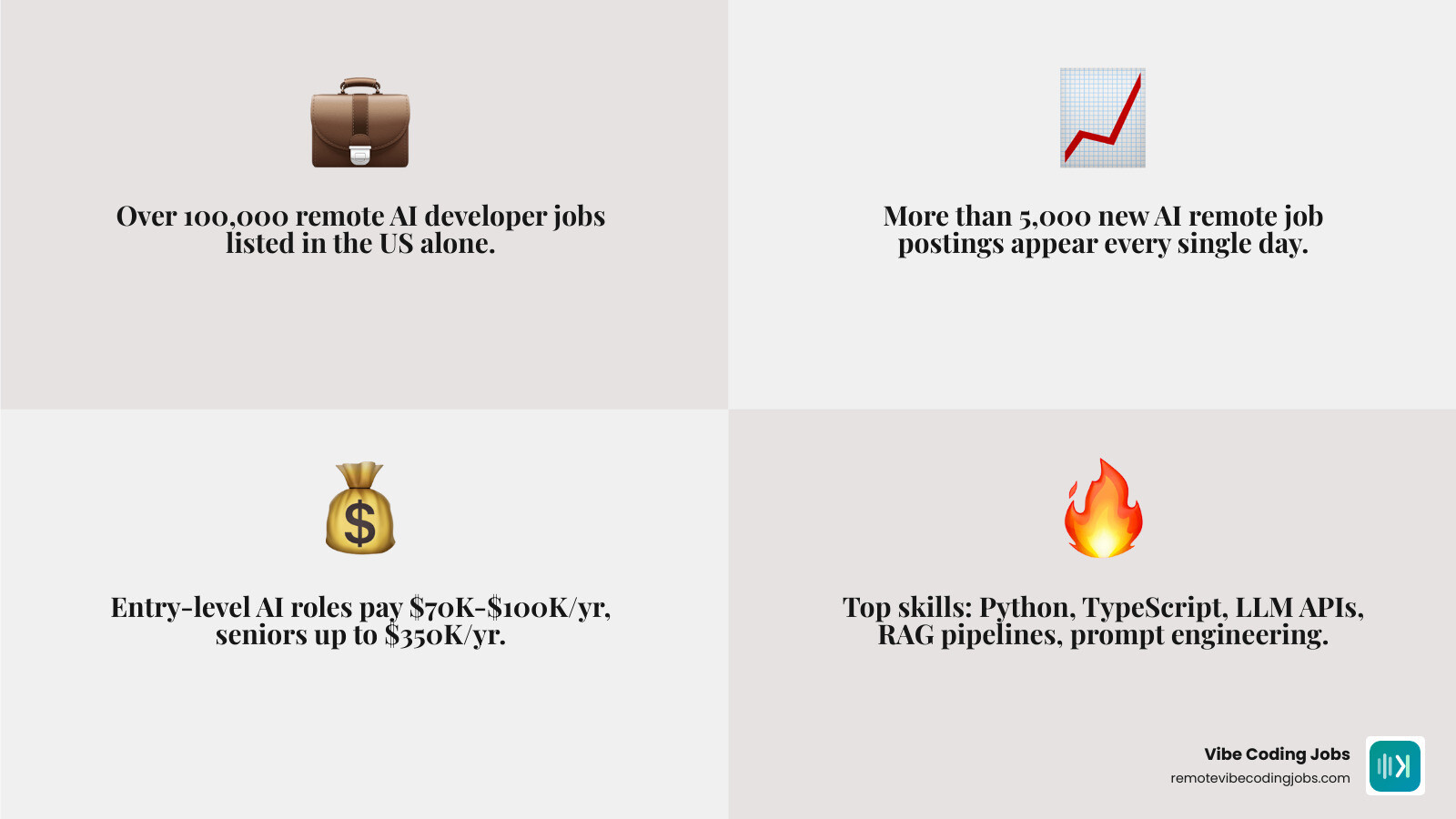
Over 100,000 remote AI jobs are currently listed in the US alone, with more than 5,000 new postings appearing every single day. Whether you want full-time stability, high-rate contracts, or flexible freelance work — the market is wide open.
But volume isn’t the problem. Finding the right role for your stack, experience, and preferred work culture — that’s where most developers get stuck.
That’s exactly what this guide is built to solve.
I’m part of the RVCJ Editorial team at Remote Vibe Coding Jobs, where we track and curate AI remote developer openings across async-first, AI-native companies globally. Our team covers AI-assisted development workflows, remote hiring trends, and practical career guidance for developers building with tools like Cursor, Claude Code, Copilot, and Windsurf — so everything in this guide is grounded in real job market data, not guesswork.
12 AI Remote Developer Openings Worth Targeting in 2026
The landscape of AI remote developer openings has shifted significantly as we move through 2026. We are no longer just looking for “Software Engineers who know a bit of Python.” Instead, the market has specialized into distinct niches that prioritize speed, orchestration, and the ability to work alongside autonomous agents.
From building RAG (Retrieval-Augmented Generation) pipelines to managing LLM application lifecycles, these roles are diverse. We are seeing a massive influx of “Product Engineer” titles—developers who own the entire lifecycle of an AI feature from prompt design to deployment.
AI remote developer openings for entry-level candidates
If you are just starting out, the “Junior Agentic Engineer” or “AI Support Developer” roles are fantastic entry points. These positions often focus on QA automation using AI tools or maintaining existing RAG pipelines. Companies are looking for candidates who have a portfolio of personal projects built with tools like Cursor or Bolt.new. Even if you don’t have five years of experience, showing that you can build and ship a functional AI-powered MVP is often enough to land a seat.
More info about entry-level AI coding jobs
Mid-level AI remote developer openings with strong growth
Mid-level roles are where we see the “Full-Stack AI Developer” shine. These developers are expected to handle API integrations, manage vector databases like Pinecone or Weaviate, and ensure that AI features have a tangible business impact. In 2026, mid-level developers are often the “glue” in remote teams, connecting front-end interfaces (built with Next.js or React) to complex back-end AI workflows.
Senior and staff-level AI remote developer openings
At the senior level, the expectations shift toward architecture and leadership. A Senior AI Engineer isn’t just writing prompts; they are designing the entire system architecture to ensure security, scalability, and cost-efficiency. These roles often involve mentoring junior staff on “vibe coding” best practices and owning the technical strategy for how a company integrates LLMs into their core product. Salaries here can reach as high as $350,000 annually.
Contract, freelance, and part-time openings
For those who value ultimate flexibility, the freelance market for AI is booming. We’ve seen contract rates for AI/ML Engineers hit $150 to $250 per hour. Many startups are looking for “Product Hackers” who can build an MVP in a few weeks. These roles are perfect if you enjoy moving from project to project and want to maximize your hourly earnings without the commitment of a full-time role.
What These Remote AI Jobs Pay Right Now
Money talks, and in AI remote developer openings, it’s talking quite loudly. Compensation in 2026 is driven by “AI fluency”—the ability to produce high-quality code at 3x to 5x the traditional speed using AI-assisted tools.
Entry-level to mid-level salary benchmarks
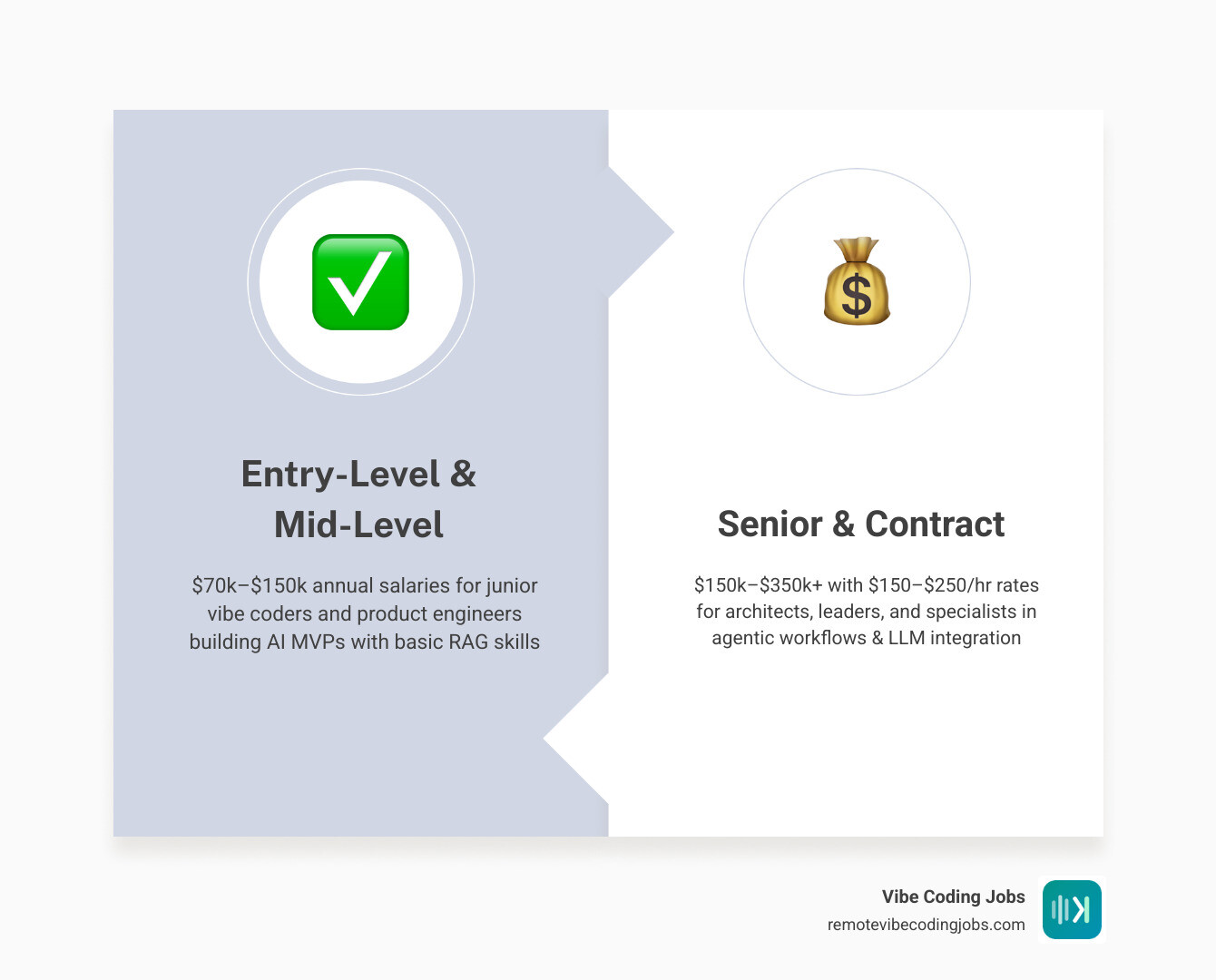
Entry-level vibe coders can expect to start between $70,000 and $100,000. As you move into mid-level “Product Engineer” territory, that range jumps to $100,000–$150,000. The premium here is paid for your ability to take a “vibe” or an idea and turn it into a working feature with minimal oversight.
More info about AI/ML Engineer Salaries
Senior salaries and premium contract rates
Senior roles are seeing unprecedented figures. We’ve tracked multiple listings for Senior AI Engineers with salary bands ranging from $124,000 to $350,000. For specialized experts in agentic workflows or niche LLM fine-tuning, contract rates are equally impressive, often exceeding $200 per hour for high-stakes enterprise projects.
Why compensation varies by role and source
Location used to be the biggest factor in pay, but in 2026, it’s all about the “tech stack premium.” A developer proficient in TypeScript, Python, and RAG pipelines will out-earn a traditional Java developer in almost every remote-first environment. Additionally, industries like Fintech and Healthcare tend to offer higher base salaries, while SaaS startups might lean more heavily into equity.
Skills That Show Up Most in AI Remote Developer Openings
To land one of these roles, you need a blend of traditional software engineering and modern AI orchestration. Employers in 2026 aren’t just looking for someone who can write code; they want someone who can direct it.
Core technical stack employers expect
- Languages: Python (for AI logic/data) and TypeScript (for robust application building).
- Frameworks: React and Next.js are the gold standards for AI-driven web apps.
- Data: SQL is still king, but you now need to know your way around Vector Databases (Qdrant, Pinecone) for RAG systems.
- DevOps: CI/CD and containerization (Docker) are essential for deploying models and autonomous agents.
AI-first tools and workflows that stand out
This is where the “Vibe Coding” movement comes in. Proficiency in AI-powered IDEs like Cursor or Windsurf is often a requirement. Companies like GitLab are hiring for engineers specifically to build editor extensions and IDE plugins. You should be comfortable with:
- Prompt Engineering: Optimizing LLM tool use and inference.
- Agentic Workflows: Using frameworks like LangChain or LlamaIndex to build autonomous task-executors.
- MCP Servers: Integrating different data sources into your AI’s context window.
If you want a simple backgrounder on how retrieval systems work, Wikipedia’s page on retrieval-augmented generation is a useful reference alongside hands-on practice.
More info about Cursor and Copilot developer jobs
Unique requirements beyond coding
Remote AI work requires high levels of “Product Thinking.” Since you can build faster, you are expected to think more about the “why” behind a feature. Async communication is also non-negotiable – you must be able to document your architecture and share progress via recorded demos or detailed PR descriptions.
Where to Find the Best AI Remote Developer Openings
The “spray and pray” method on giant job boards is dead. To find the best AI remote developer openings, you need to look where the AI-native companies hang out.
Companies and teams actively hiring remote AI talent
Large enterprises like TikTok and Mercedes-Benz are now hiring “Vibe Coders,” but the real action is in the SaaS and DevTools space. Companies like GitLab and B12 are leading the charge in remote-global, async work environments. These teams value “Product Hackers” who can take an idea from zero to MVP in record time.
More info about best companies hiring AI developers
Platforms for full-time, contract, and niche AI roles
While you can find listings on massive, general-purpose job boards, these are often cluttered and lack the specific filters needed for AI-native workflows. For curated, high-quality roles, we recommend:
- Vibe Coding Jobs: Our own platform where we filter for AI-first roles and async culture.
- Direct Careers Pages: Checking the “Jobs” link on the footers of AI startups you admire.
Browse AI Remote Developer Openings on Vibe Coding Jobs
How to apply efficiently and get shortlisted faster
Don’t just send a resume. Send a link to a live, clickable product you built using AI tools. In 2026, a “live demo” is worth a thousand bullet points. Tailor your resume to highlight your experience with specific LLMs (Claude, GPT-4, Llama) and your ability to manage AI-assisted workflows.
More info about remote AI job boards and market outlook
What 2026 Job Trends Say About the Future of Remote AI Work
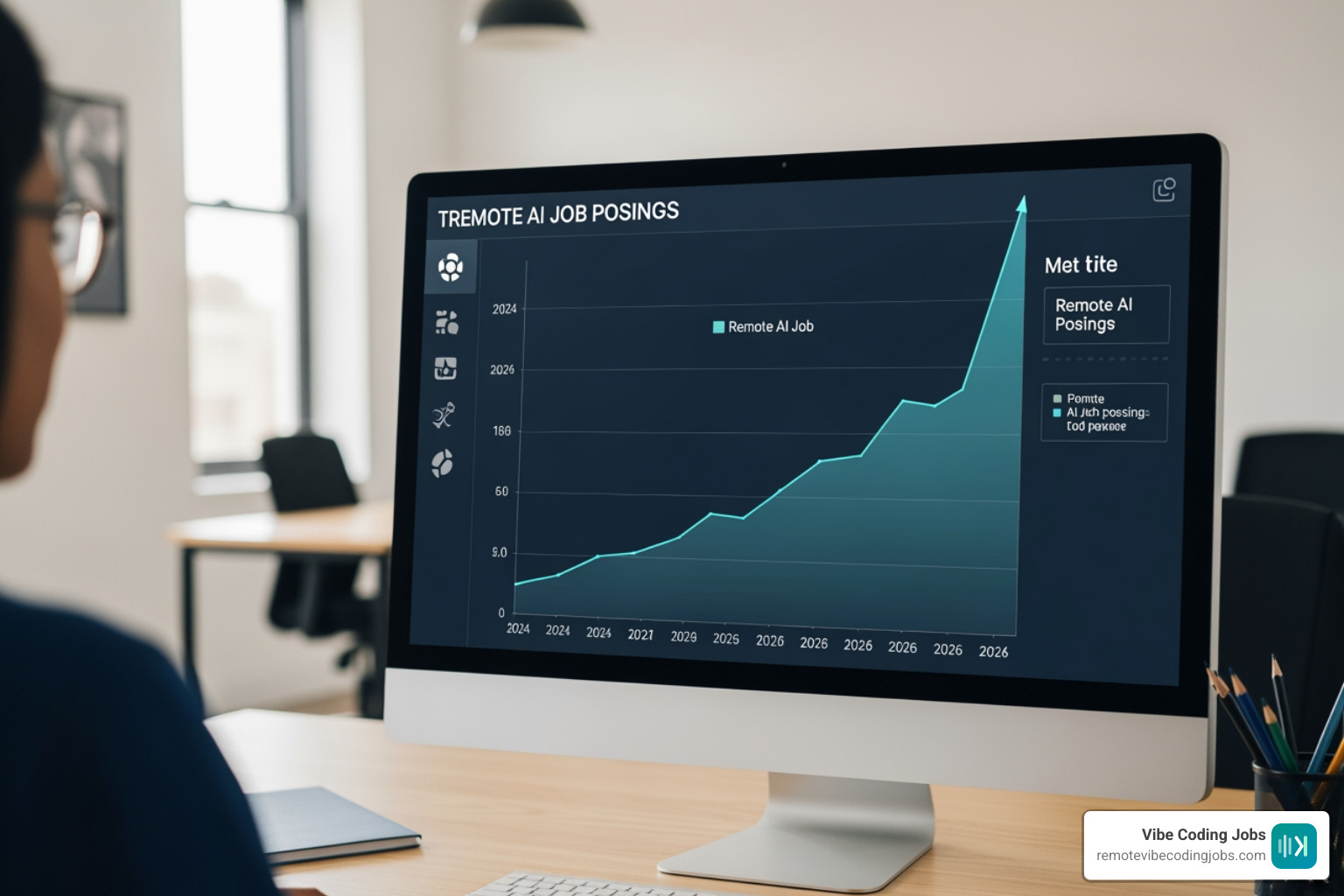
The growth of AI remote developer openings isn’t just a bubble; it’s a fundamental shift in how software is made. We are seeing a move toward smaller, high-output teams where one “AI Pilot” does the work that used to require a team of five.
Industries driving the biggest demand
Healthcare is using AI for everything from patient diagnostics to administrative automation. Fintech is leveraging agentic workflows for fraud detection and personalized banking. Even government agencies are starting to post remote AI roles to modernize legacy systems.
Why AI-assisted development is changing hiring
“Vibe Coding” has democratized development. It allows developers to move 3x–10x faster. This means companies are looking for “orchestrators” rather than “typists.” They want people who can manage the “vibes”—the high-level intent and architecture—while the AI handles the boilerplate.
More info about AI coding jobs growth and market trends
How entry-level and senior opportunities will keep diverging
The gap between junior and senior roles is widening. Junior roles are becoming more about “execution support,” while senior roles are becoming pure “architecture and strategy.” To stay relevant, you must move beyond just being able to prompt an AI; you need to understand the underlying business context and how to secure these systems.
More info about AI coding jobs remote career growth
Frequently Asked Questions about AI Remote Developer Openings
What is the best role to target if you are new to AI remote work?
Target “Full-Stack AI Developer” or “Junior Agentic Engineer” roles. Focus on building a portfolio that shows you can integrate LLM APIs into a functional web application.
More info about entry-level AI coding jobs
Are remote AI developer jobs mostly full-time or contract?
It’s a healthy mix. Large companies offer full-time stability and benefits, while the startup world is heavily reliant on high-paying contract roles for rapid product launches.
Do you need advanced machine learning experience to get hired?
Not necessarily. While “ML Engineers” need deep math and data science skills, most AI remote developer openings are for “AI Engineers” who use existing models via APIs. If you can build a RAG pipeline and manage an LLM’s context window, you are highly hirable.
Conclusion
The era of the “commute” is fading for developers who embrace the AI revolution. By focusing on “vibe coding” workflows, mastering RAG pipelines, and building a portfolio of AI-powered products, you can secure a high-paying, remote-first career in 2026.
At Vibe Coding Jobs, we are here to help you navigate this transition. Whether you are looking for your first junior role or a $300k senior position, the opportunities are waiting.