
What Are the Fundamental Differences Between Remote Startups and Traditional Remote Jobs?
When people search for “startup vs remote jobs,” they are usually conflating two distinct dimensions of work: company maturity and physical work location. A startup is an early-stage company characterized by high risk, rapid iteration, and evolving business models. Remote work, on the other hand, describes an operational model where team members contribute from outside a centralized corporate office.
The real dilemma facing technical professionals in September 2026 is choosing between a remote-first startup and a remote position at an established enterprise.
The distributed landscape has matured dramatically. Remote-first startups now account for approximately 30–40% of seed and Series A funding rounds, up from under 10% in the pre-pandemic era. Because distributed startups can source global talent without physical office constraints, they fill open technical positions 30–50% faster than location-restricted companies.
Yet the day-to-day experience across these environments could not be more different. Working remotely for an early-stage startup means wearing multiple hats, deploying code straight to production, and solving ambiguous problems with minimal oversight. Working remotely for an established enterprise means navigating defined approval chains, operating within strict security boundaries, and coordinating across cross-functional matrix teams.
The Evolution of Remote Startup Teams
The single-office tech hub has largely given way to decentralized founding teams. Modern seed and Series A startups rarely lease expensive headquarters in downtown metros. Instead, they operate with lean core teams supported by fractional leadership, distributed engineers, and specialized contractors.
Furthermore, the rise of AI-augmented development has radically reshaped startup team composition. Small engineering squads now build what previously required dozens of developers. At early-stage companies, individual contributors are expected to orchestrate AI coding agents, manage cloud infrastructure, and handle customer feedback in real time. Velocity is the primary metric of survival.
The Corporate Remote Environment
Enterprise remote work at Fortune 500 companies and late-stage tech firms operates on predictability, compliance, and risk mitigation. Large distributed organizations implement standardized communication guidelines, formal core working hours, and extensive compliance frameworks to coordinate thousands of employees across global time zones.
In an enterprise remote role, your day involves established ticket workflows, multi-tiered code reviews, architectural review boards, and scheduled alignment calls. While this structure protects systems against catastrophic failures, it inevitably introduces bureaucracy and slower release cycles.
How Do Compensation, Benefits, and Equity Compare Between Startups and Big Tech?
The financial trade-off between remote startups and established enterprises centers on guaranteed cash versus speculative equity upside. Enterprise base salaries are typically 20–40% higher than equivalent startup roles, backed by liquid Restricted Stock Units (RSUs) and comprehensive corporate benefit plans.
| Feature | Remote Early-Stage Startup (Seed–Series B) | Established Enterprise Remote Role |
|---|---|---|
| Base Salary | 20–40% below top-of-market ($140k–$220k) | Top-of-market baseline ($200k–$320k+) |
| Equity Type | Stock options (ISOs/NSOs) with high variance | RSUs in publicly traded, liquid stock |
| Benefits & Perks | Flexible stipends, home office allowance | Comprehensive health, 401(k) match, wellness |
| Autonomy Level | High autonomy, broad scope, self-directed | Defined scope, structured approval chains |
| Work-Life Balance | High flexibility, intermittent crunch cycles | Predictable hours, high meeting load |
| Job Stability | Dependent on cash runway (12–24 months) | High financial stability, periodic reorgs |
To understand market compensation benchmarks, examine our breakdown of Remote Developer Salaries in 2026 to see how compensation scales across technical specializations.
Base Salary and Cash Flow Realities
In the current market, senior developer base compensation at remote startups generally spans $160,000 to $220,000. Equivalent roles at Big Tech and tier-one enterprises pay base salaries between $220,000 and $320,000, excluding bonuses and stock packages.
When evaluating an offer, guaranteed cash must cover all personal living expenses, debt service, and savings targets before factoring in equity. Never take an below-market startup salary if you cannot absorb the cash flow gap without relying on an unproven equity exit.
Equity Packages: Options vs. RSUs
Stock compensation operates under completely different economic rules across company stages:
- Enterprise RSUs: Publicly traded companies grant Restricted Stock Units that vest on a predictable schedule (e.g., quarterly over four years). These units hold instant, measurable cash value that you can sell immediately upon vesting.
- Startup Stock Options: Early-stage companies grant Incentive Stock Options (ISOs) or Non-Qualified Stock Options (NSOs) with a strike price based on a 409A valuation. These options carry zero guaranteed liquidity until an IPO or major acquisition.
The math behind startup equity requires a reality check. Consider a senior engineer earning a $200,000 base salary plus a 0.1% equity grant at a Series B startup. For that total compensation package to match what Big Tech pays over a four-year vesting cycle, the startup must reach a $1.4B+ exit valuation. Statistically, that outcome occurs in roughly 1 out of 10 venture-backed startups. Most startups fail, leaving common shareholders with little or nothing after preferred investor liquidation rights are satisfied.
Fringe Benefits and Work Equipment
Established enterprises provide comprehensive fringe benefits packages often valued between $20,000 and $50,000 annually. These typically include 401(k) matching up to 6%, premium health and dental insurance, structured parental leave, and corporate education allowances.
Remote startups cannot match these enterprise group rates. Instead, they compensate with flexibility: open-ended home office equipment budgets, co-working stipends, flexible time-off policies, and wellness allowances. Additionally, global remote startups frequently hire international talent as independent contractors (1099 or local equivalent) via platforms like Deel, requiring workers to manage their own local taxes and retirement contributions.
What Are the Trade-Offs in Job Security, Work-Life Balance, and Career Velocity?

Company stability and daily workflow habits create stark contrasts between startup and enterprise life. A 10-person remote startup typically saves $200,000 to $600,000+ per year compared to an in-office equivalent by eliminating office overhead and optimizing remote workflows. This capital efficiency extends startup runway, yet job security remains tied to product-market fit and venture fundraising cycles.
Meanwhile, industry surveys reveal an interesting trend regarding work-life balance: small companies (<300 employees) average a work-life balance score of 3.8/5, whereas large enterprises (1,000+ employees) average 3.5/5. Although startups demand intense focus during release cycles, their absence of bureaucratic overhead and excessive status meetings allows engineers to spend more time doing deep work.
Furthermore, remote and hybrid companies experience 25–35% lower voluntary turnover than fully in-office companies. For a deeper technical perspective on career paths across these environments, read our analysis on Startup vs Big Tech for Remote Developers.
Career Growth: Generalist Scope vs. Deep Specialization
Career velocity in an early-stage startup is measured by scope and speed. Because teams are lean, you might design the database schema on Monday, build front-end components on Wednesday, and configure CI/CD deployment pipelines on Friday. Engineers at high-growth startups often see promotions in 18–24 months as the company scales under them.
In contrast, enterprise engineering teams promote depth over breadth. You might spend two years optimizing a single distributed caching layer or refactoring an authentication microservice. Promotions follow structured levels (e.g., L4 to L5) that typically take 2–4 years per level and require cross-functional consensus from promotion committees.
Autonomy and Asynchronous Culture
Remote startups survive by embracing asynchronous communication. With team members distributed across disparate time zones, successful startups document decisions openly, communicate through tickets and async updates, and minimize real-time meetings. You can explore our operational principles in our Async First Remote Work Guide and discover optimal tooling in our breakdown of the Best Async Communication Tools for Dev Teams.
Enterprise remote environments tend to replicate in-office synchronous habits online. This results in packed calendar schedules, back-to-back video calls, and complex sign-off processes for minor architectural changes.
Job Stability and Company Longevity
Job security is structurally different in both environments:
- Startup Risk: Clear and measurable. The primary risk is cash runway exhaustion (typically targeting 18–24 months). If the company fails to reach profitability or secure follow-on funding, layoffs or shutdowns happen quickly.
- Enterprise Risk: Latent and structural. While enterprises rarely shut down abruptly, they frequently undergo reorganizations, division-level budget cuts, and strategic restructuring that result in sudden broad-scale layoffs.
If a startup fails, the experience of shipping production systems from scratch provides strong signal on a resume, provided you frame your contributions around business impact and technical architecture.
How Can You Accurately Value Startup Equity and Avoid Costly Traps?

Many developers evaluate startup compensation by adding the paper value of their stock options directly to their base salary. This is a critical financial error. Startup equity should be treated as an asymmetric growth opportunity, never as guaranteed income.
According to recent industry research on Remote vs In-Person Startups data, early-stage failure rates remain substantial across the technology sector. To assess an equity package accurately, you must conduct thorough due diligence into the company’s capitalization table, runway, and legal terms before accepting an offer.
The Essential Equity Due Diligence Checklist
When an early-stage startup extends an offer, request written clarification on the following core metrics:
- Total Outstanding Shares: A grant of 10,000 shares is meaningless without knowing the denominator. What is the exact percentage ownership on a fully diluted basis?
- Current 409A Valuation vs. Preferred Round Price: What did investors pay per share in the last round compared to the fair market value strike price of your options?
- Total Capital Raised & Current Cash Runway: How many months of operating expenses remain in the bank at current burn rates?
- Liquidation Preference Stack: Do early investors hold standard 1x non-participating preferred shares, or are there aggressive multi-participating structures that reduce common shareholder payouts?
- Post-Termination Exercise Window (PTEW): Does the company enforce the outdated 90-day exercise window if you leave, or do they provide an extended 5- to 10-year exercise window to protect your vested equity?
Red Flags to Watch for in Startup Offers
- Vague Equity Numbers: Refusing to share fully diluted share counts, offering only raw share numbers without capitalization context.
- Short Cash Runway: Less than 6 months of operating runway without an active, term-sheet-backed funding round underway.
- Founder Opacity: Reluctance to discuss monthly burn rate, customer churn, or gross revenue figures during final offer discussions.
- Punitive Exercise Terms: A strict 90-day post-termination exercise window that forces you to forfeit vested options or pay prohibitive tax bills upon departing.
How Do Hiring Processes Differ and How Can You Stand Out for Remote Startup Roles?
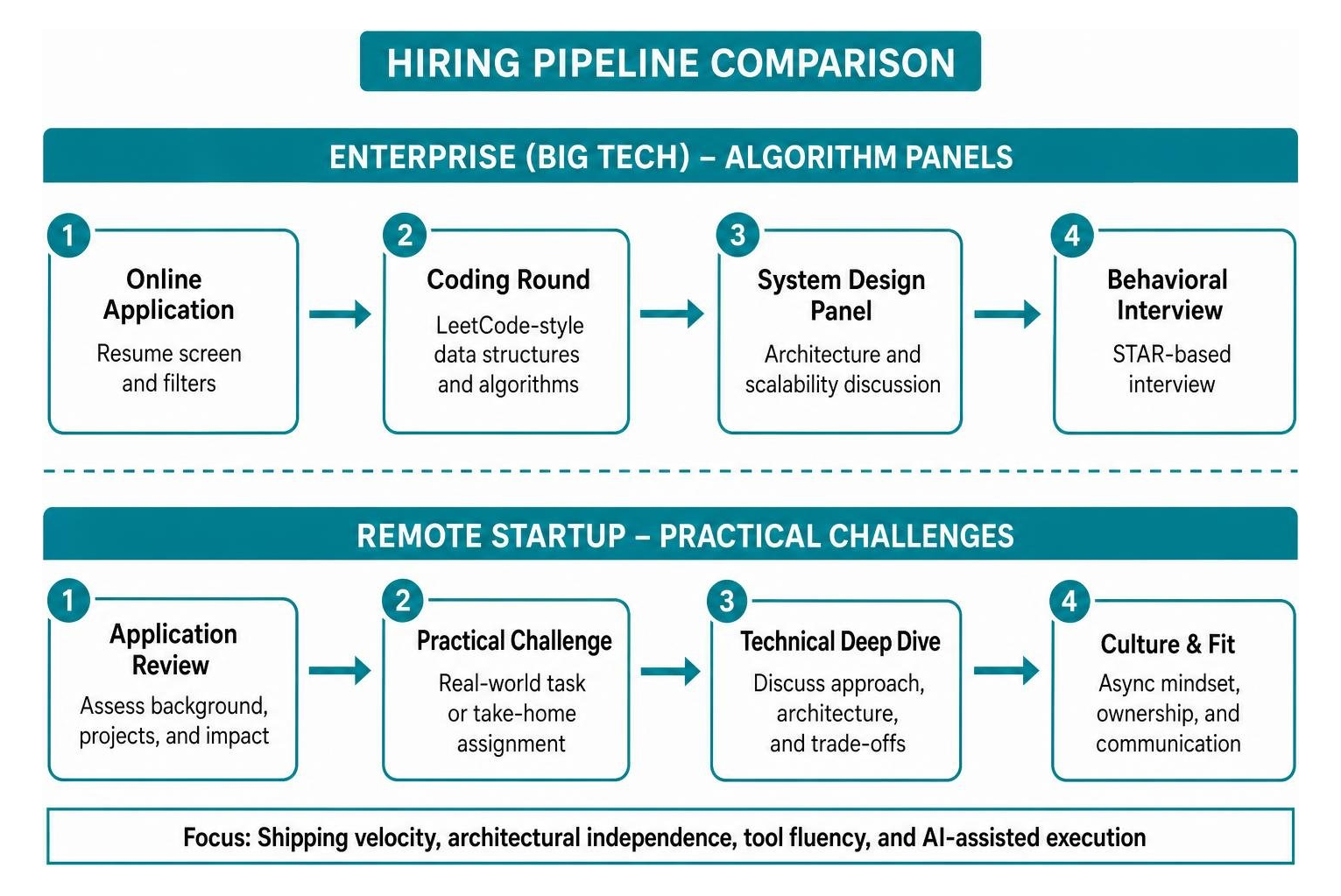
Hiring processes reflect what each organization values. Enterprise Big Tech relies on scalable, standardized interview loops consisting of LeetCode-style data structures and algorithms, system design panels, and behavioral STAR interviews. These pipelines are designed to minimize false positives across thousands of applicants.
Remote startups cannot afford slow, abstract hiring cycles. They evaluate candidates on practical shipping velocity, architectural independence, and tool fluency. The industry is moving toward modern AI-assisted engineering practices, an evolution detailed in our guide on Vibe Coding vs Traditional Software Engineering.
To demonstrate your execution speed, showcase real-world deployments and modern tool workflows as explained in our Build a Developer Portfolio with AI Tools 2026 Guide. At Remote Vibe Coding Jobs, we specifically curate daily remote opportunities at async-first startups that prioritize AI-assisted execution and practical problem-solving over abstract algorithmic puzzles.
The Startup Interview Pipeline
- Founder / Hiring Manager Intro (30 mins): High-level conversation assessing domain interest, technical background, and cultural alignment.
- Practical Take-Home or Live Build (2–4 hours): Building a small, functional feature, integrating an API, or refactoring a realistic code repository.
- Architecture & Product Deep Dive (45–60 mins): Discussing trade-offs, scalability, edge cases, and past technical failures.
- Founder Reference Check & Offer (24–48 hours): Fast decision cycles, often concluding within 5 to 10 business days.
To stand out, skip the standard job board queue when possible. Send a concise, high-signal message directly to the founder or engineering lead detailing a bug you spotted, an integration idea for their product, or a relevant open-source project you shipped.
The Enterprise Interview Pipeline
- Recruiter Screen & Online Assessment (OA): Automated algorithmic screening testing time/space complexity.
- Technical Phone Screen: Live coding session solving dynamic programming or tree/graph traversal problems.
- Virtual Onsite Loop (4–5 rounds):
- 2x Algorithmic coding rounds.
- 1x System design and distributed systems architecture session.
- 1–2x Behavioral rounds assessing cross-team collaboration and conflict resolution.
- Hiring Committee & Level Matching: Independent review of interviewer feedback to establish compensation bands and job levels (taking 3 to 6 weeks).
Who Should Choose a Remote Startup vs an Established Enterprise Role?
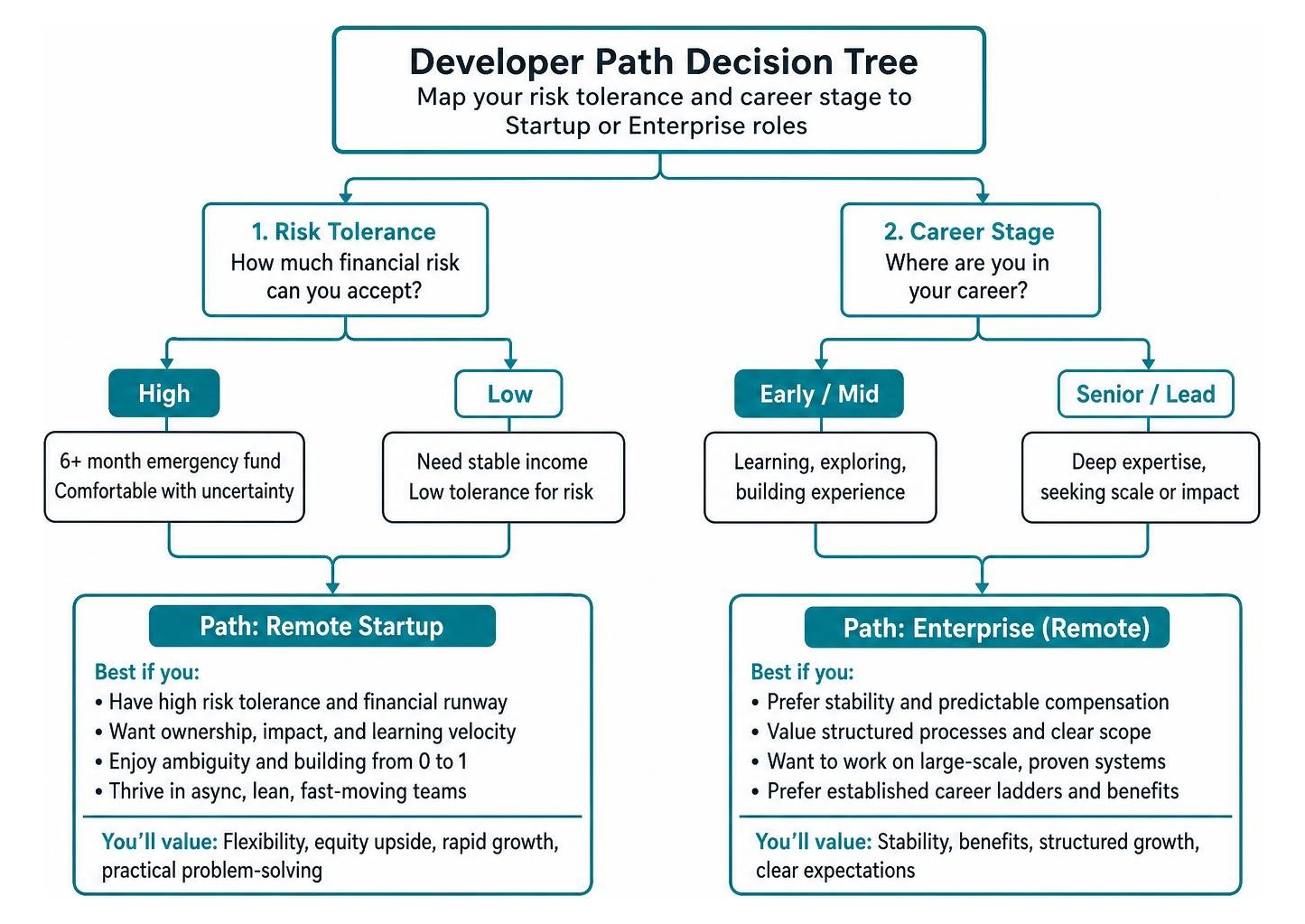
Selecting between a remote startup and an enterprise position requires aligning your career stage, financial cushion, and working style with the realities of the company environment. If you are also considering independent contract work, compare these models with our freelance vs remote fulltime comparison framework.
Choose a Remote Startup If:
- You have high risk tolerance: You have a 6+ month emergency fund and your living expenses do not depend on maximum guaranteed cash.
- You thrive in ambiguity: You enjoy taking vague business requirements and independently turning them into working production software.
- You value breadth over depth: You want to work across the stack, touch infrastructure, interact with customers, and understand how a business runs.
- You desire rapid progression: You want your contributions to directly determine team growth, technical leadership opportunities, and equity upside.
Choose an Enterprise Remote Job If:
- You prioritize guaranteed compensation: You need predictable top-of-market cash flow, 401(k) matching, and comprehensive healthcare coverage for personal or family commitments.
- You prefer deep technical specialization: You want to master specific technologies, distributed architectures, or specialized domain systems without handling unrelated operational distractions.
- You want predictable working hours: You value structured 9-to-5 schedules, defined on-call rotations, and clear boundaries between work and personal life.
- You seek resume prestige: You want an internationally recognized corporate brand that simplifies future recruiter outreach.
Frequently Asked Questions About Startup vs Remote Jobs
Is startup equity worth anything if the company doesn’t go public?
Yes, but liquidity depends on specific corporate events. While an Initial Public Offering (IPO) is the most visible exit, most successful startups deliver equity value through strategic mergers and acquisitions (M&A).
Additionally, mature private scale-ups frequently organize structured secondary share sales or tender offers, allowing employees to sell vested shares to institutional growth investors. However, because early-stage equity remains illiquid for years, you should always evaluate an offer based on whether the cash salary satisfies your living requirements.
Are remote startup jobs less stable than enterprise remote jobs?
Early-stage startups carry higher company mortality risk because their survival depends on product-market fit and venture capital cycles. If runway runs out, layoffs occur swiftly.
However, large enterprises carry structural reorg risks; sudden mass downsizings can eliminate thousands of roles regardless of individual performance. In a startup, you gain direct visibility into runway, burn rate, and revenue metrics, giving you clearer advance warning than corporate employees typically receive.
How do working hours compare between remote startups and corporate remote jobs?
Remote startups offer high day-to-day schedule flexibility combined with intermittent crunch periods during product launches or funding rounds. You have autonomy over when you work, provided deliverables ship on time.
Corporate remote roles offer more predictable start and stop times, but day-to-day schedules are often filled with mandatory synchronous meetings, recurring status updates, and formal cross-department check-ins that leave less time for uninterrupted deep work.
What Is the Final Verdict on Choosing Between Startups and Established Remote Work?
The choice between a remote startup and an enterprise remote job is not a permanent career verdict—it is a strategic decision for your current career season.
Many of the most effective technology leaders use a hybrid career path: they spend several years inside an established enterprise to master enterprise software practices, build strong network connections, and accumulate a financial savings cushion. Then, they transition to a high-growth, async-first startup where they can leverage their skills, take large architectural ownership, and capture significant equity upside.
Assess your financial needs, clarify what kind of day-to-day environment energizes you, and pursue the remote path that moves your career forward on your own terms.