
What Is the Difference Between Freelance Programming and a Full-Time Coding Job?
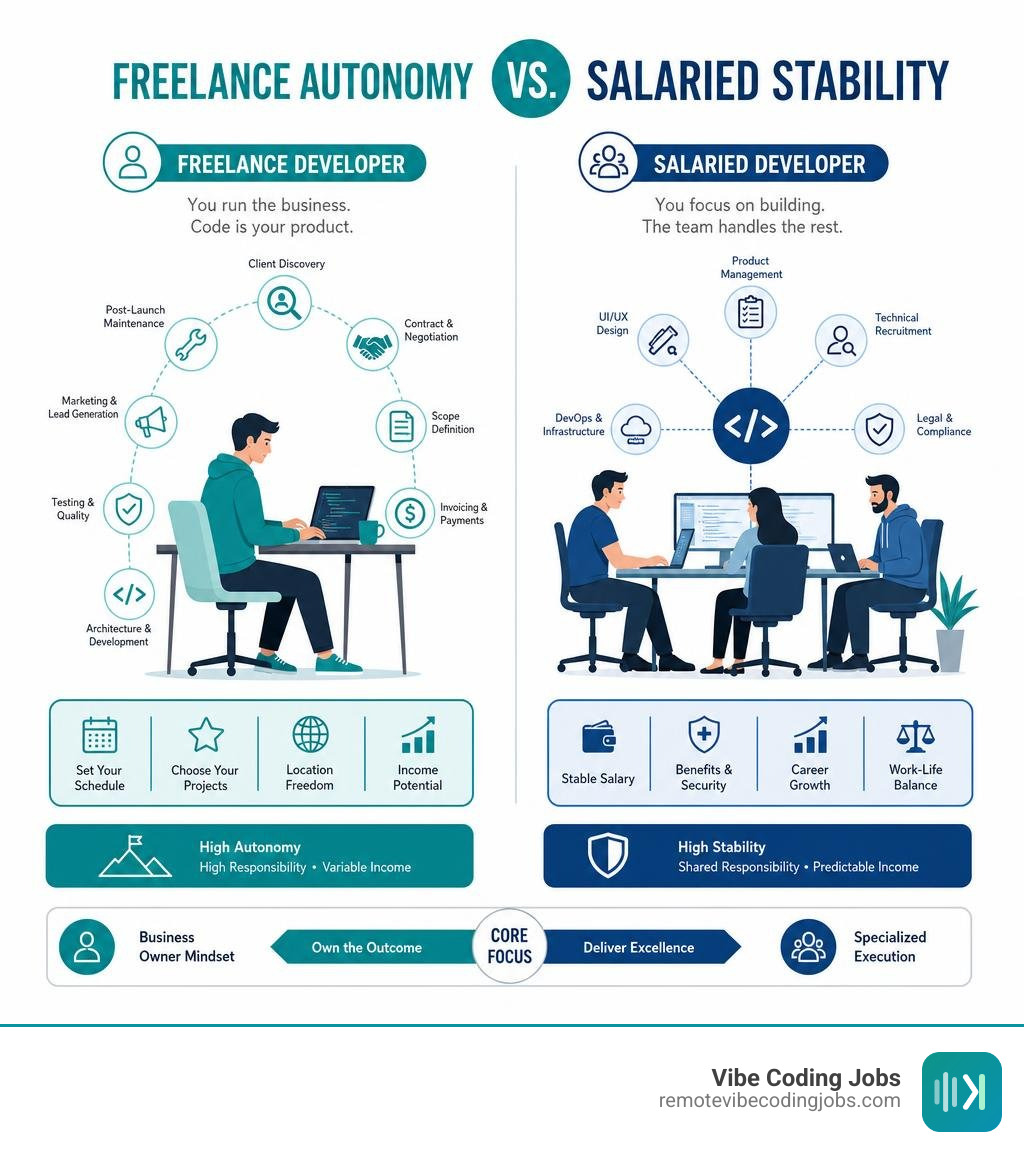
At its core, the difference between freelance programming and a full-time coding job comes down to business ownership versus specialized execution. When you work as an independent contractor, you are not simply writing software; you are operating a business where code happens to be the primary deliverable. You manage lead generation, client discovery, contract negotiations, scope definition, invoicing, software architecture, testing, and post-launch maintenance.
In contrast, salaried software engineers direct their full technical bandwidth toward building and maintaining systems for a single organization. In a standard corporate or startup environment, non-coding functions are handled by dedicated product managers, technical recruiters, UI/UX designers, legal counsel, and DevOps teams. This structural division allows employed developers to focus deeply on code quality, long-term system architecture, and agile team alignment without the overhead of client acquisition.
The modern development landscape of September 2026 has magnified these differences. With the rapid maturation of AI-driven coding workflows, solo freelancers can produce full-stack prototypes faster than ever. However, organizations manage increasingly complex, high-scale distributed systems that demand dedicated, cross-functional collaboration.
While more than 73 million tech professionals globally participate in independent contracting, roughly 60% of developers who leave full-time employment return to a salaried role within their first year. Understanding the underlying mechanics of both paths is essential before committing to a career pivot.
Defining the Freelance Developer Path
Operating as a freelance developer means running an independent technical consultancy. Most independent programmers operate as sole proprietorships or single-member LLCs.
In this structure, writing code typically represents only 50% to 65% of your working hours. The remaining time is consumed by non-billable operational tasks:
- Client Acquisition & Marketing: Pitching prospective clients, responding to RFPs, auditing project requirements, and updating technical portfolios.
- Contract & Scope Management: Drafting statements of work, establishing milestone deliverables, preventing scope creep, and managing service level agreements.
- Financial Administration: Issuing invoices, tracking unpaid balances, managing business expense write-offs, and filing quarterly estimated taxes.
- Tooling and Infrastructure Overhead: Personally funding workstation hardware, integrated development environment (IDE) licenses, cloud staging servers, AI tool subscriptions, and professional liability insurance.
Defining the Salaried Software Engineer Path
Salaried software engineers trade business autonomy for operational predictability and institutional depth. As an employee, your responsibilities center entirely on product execution, code maintainability, and team collaboration.
Key operational characteristics of the salaried path include:
- Single-Codebase Focus: Diving deep into an organization’s specific technical challenges, legacy refactors, distributed architecture, and database optimizations.
- Structured Team Cadence: Participating in standard agile ceremonies, sprint planning sessions, daily standups, backlog refinement, and engineering retrospectives.
- Operational Support Systems: Working alongside dedicated infrastructure teams, product managers, quality assurance engineers, and customer support representatives who insulate developers from end-user business operations.
- Predictable Resource Allocation: Receiving pre-configured development machines, corporate SaaS tooling budgets, employer-funded continuous education stipends, and legal protection under corporate indemnification policies.
How Do Freelance Earnings Compare to Full-Time Developer Compensation in 2026?
Directly comparing a salaried developer’s paycheck to a freelancer’s gross invoice revenue is one of the most misleading calculations in tech. While mid-level freelancers often report earning 20% to 40% higher gross income than their salaried peers, that headline number shrinks considerably once self-employment taxes, health insurance, unpaid bench time, and lost employee perks are factored in.
According to recent financial comparison data for tech roles in 2026, senior independent developers typically bill between $100 and $175 per hour, while high-demand specialists in artificial intelligence, machine learning, and application security command $150 to $250 per hour. Meanwhile, the baseline market rate for an experienced freelance programmer averages approximately $70 per hour.
To match the total compensation of a standard $150,000 salaried role with standard corporate benefits, a freelance developer needs to bill between $85 and $95 per hour across a consistent 1,800 annual billable hours—far higher than the standard $75 per hour rate calculated by simplistic online tools. Preparing for both pathways requires disciplined remote developer salary negotiation to ensure your compensation reflects your true market value.
| Financial Factor | Full-Time Senior Engineer | Freelance Developer ($100/hr @ 1,800 hrs) |
|---|---|---|
| Gross Annual Revenue / Base Salary | $150,000 | $180,000 |
| Employer Benefits Value (401k match, health, bonus) | +$39,895 | $0 |
| Total Realized Compensation | $189,895 | $180,000 |
| Payroll / Self-Employment Tax Burden | -$11,475 (7.65% FICA) | -$27,540 (15.3% SE Tax) |
| Individual Health, Dental & Vision Insurance | -$2,400 (subsidized) | -$7,200 (direct ACA plan) |
| Hardware, Software Subscriptions & Legal Admin | $0 (covered by employer) | -$4,800 (out-of-pocket) |
| Paid Vacation & Sick Leave (4 weeks) | Included in base salary | -$13,846 (unpaid bench hours) |
| Estimated Net Pre-Income-Tax Take-Home | ~$136,125 | ~$126,614 |
Understanding the Self-Employment Tax Gap
In traditional W-2 employment in the United States, the 15.3% Federal Insurance Contributions Act (FICA) tax—covering Social Security and Medicare—is split equally: the employer pays 7.65%, and the employee pays 7.65% via automatic payroll deductions.
When you become an independent 1099 contractor, you become both the employer and the employee. This means you are responsible for paying the entire 15.3% self-employment tax on your net business earnings.
For example, on a freelance gross income of $120,000, self-employment tax alone accounts for roughly $18,360 before standard federal and state income taxes are applied. Freelancers must navigate this overhead through rigorous financial practices:
- Quarterly Estimated Tax Filings: Calculating and remitting estimated payments to state and federal tax authorities four times per year to prevent underpayment penalties.
- S-Corporation Tax Election: Once net freelance earnings reach the $70,000 to $80,000 threshold, electing S-Corp status allows developers to pay themselves a “reasonable salary” (subject to FICA) and take remaining net profits as distributions (exempt from self-employment tax), potentially saving $5,000 to $15,000 annually.
- Aggressive Expense Tracking: Documenting deductible operating expenses—including home office square footage, high-performance hardware, internet utilities, and productivity software—to reduce adjusted gross income.
Accounting for Hidden Employee Benefits and Overhead
Full-time technical packages contain significant value beyond base salary. An employee with a $150,000 base salary often receives a total compensation package worth nearly $190,000 when accounting for:
- Comprehensive Health Benefits: Employer-sponsored health, dental, and vision insurance subsidies, which save employees $4,000 to $8,000 annually compared to equivalent individual Affordable Care Act (ACA) silver and gold plans.
- Retirement Matching: Standard corporate 401(k) matches of 3% to 6%, offering $4,500 to $9,000 in immediate, pre-tax compensation growth.
- Paid Time Off (PTO): Three to five weeks of paid vacation, federal holidays, and sick days. For an independent contractor billing $100 per hour, taking four weeks off represents $16,000 in unbilled potential revenue.
- Equity and Performance Bonuses: Annual performance bonuses (typically 10% to 20%) and stock grants (RSUs or options) that provide substantial long-term financial upside.
Freelancers must bridge these gaps entirely on their own by setting up solo 401(k) structures (which allow self-employed contributions up to $69,000 annually in 2026) and funding high-deductible healthcare plans out-of-pocket.
How Do Work-Life Balance, Flexibility, and Daily Workflow Differ?

Work-life balance represents the sharpest emotional divide between freelancing and corporate software engineering. Freelancing promises complete autonomy over when, where, and how you work. However, autonomy is not the same as freedom from responsibility.
A salaried developer generally adheres to predictable operational boundaries: scheduled sprint cycles, daily synchronous standups, and structured quarterly deliverables. When the workday ends, their mental overhead drops significantly.
In freelance engineering, schedule flexibility is real—you can work from anywhere and set your own hours—but it is accompanied by continuous business accountability. If a production bug surfaces on a client’s e-commerce platform at midnight on a holiday weekend, you are the entire on-call incident response team.
Furthermore, freelance billable utilization rarely matches total desk hours. According to an analysis of developer income models, independent contractors typically achieve a 60% to 75% utilization rate. This translates to 1,500 to 1,800 billable hours per year out of a standard 2,080-hour work calendar. The unbilled 25% to 40% of working time is spent on administrative logistics, proposal writing, and marketing.
To protect focus and avoid chronic exhaustion, engineers on both paths must implement clear boundary-setting protocols and discover how to avoid burnout as a remote developer. For many, working in async-first remote developer jobs provides the ideal balance: true location independence and flexible daily routines without the overhead of client acquisition.
Managing Client Communication vs. Navigating Corporate Politics
The interpersonal dynamics of the two career paths present fundamentally different emotional demands:
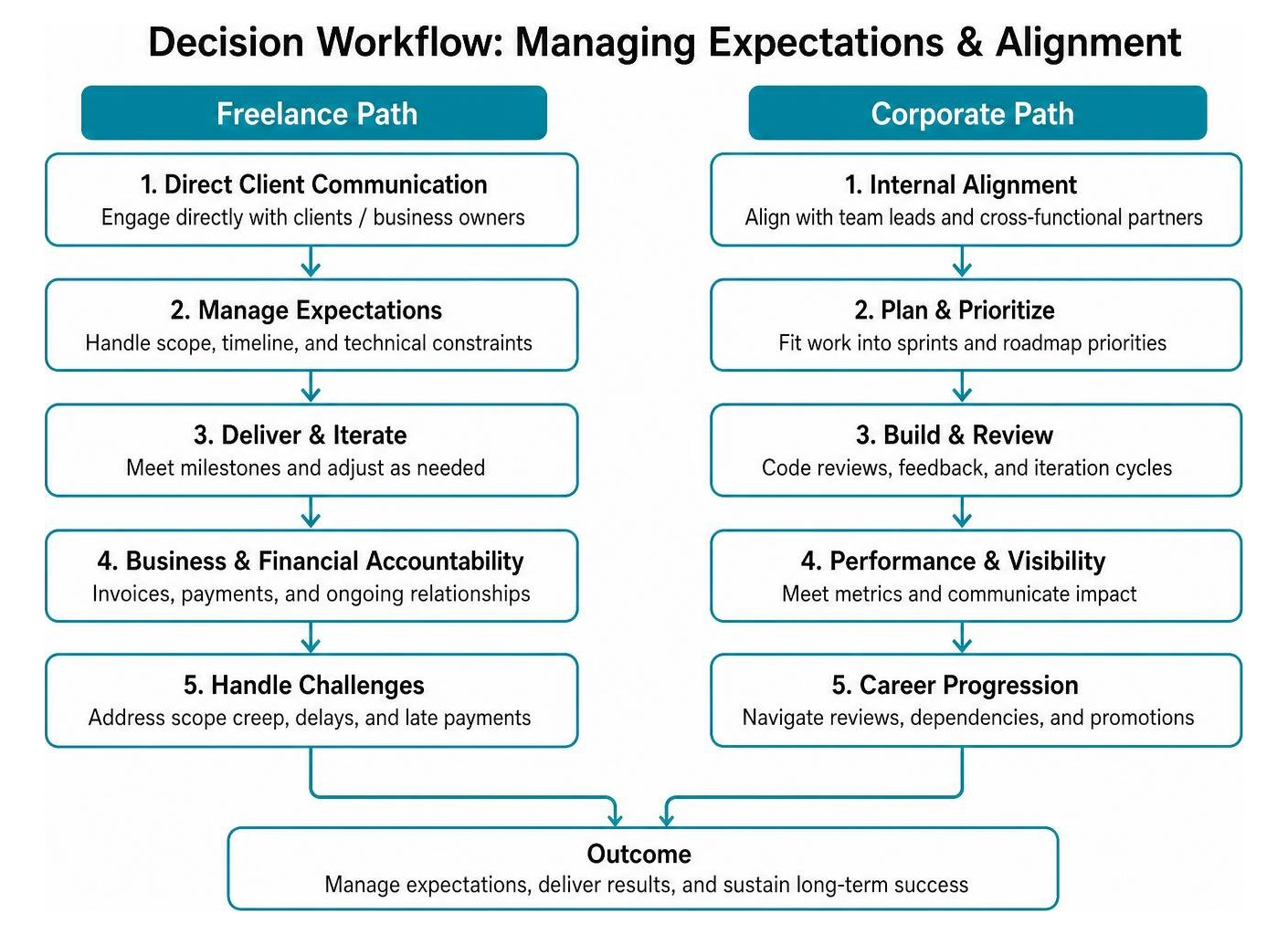
- The Freelance Stakeholder Dynamic: As a freelancer, your relationship with clients is transactional and outcome-driven. You rarely deal with internal office politics, corporate restructuring, or performative culture. However, you must handle difficult client conversations regarding scope expansion, timeline adjustments, missed payments, and technical constraints.
- The Salaried Corporate Dynamic: Salaried engineers operate within complex organizational structures. While they are insulated from commercial negotiations, they must navigate performance review cycles, cross-departmental dependencies, prioritization conflicts, and promotional politics to advance their careers.
Isolation and Autonomy in Day-to-Day Execution
Working as an independent contractor means spending long stretches in solo execution. Without engineering peers to review pull requests, brainstorm edge cases, or share debugging sessions, solo developers must be entirely self-directed and personally accountable.
Salaried remote teams, on the other hand, build institutional support through pair programming, shared architecture guilds, and team communication channels. This provides steady social and professional feedback, though it often comes at the expense of calendar fragmentation caused by recurring synchronous meetings.
How Do Career Growth and Technical Depth Compare Over Time?

Your career trajectory is shaped directly by the problems you solve every day. Freelancing and salaried engineering cultivate fundamentally different technical skill sets.
Freelance software developers thrive on breadth. Because client engagements range from small business web applications to quick MVP prototypes, independent coders regularly jump across different programming languages, hosting architectures, and third-party APIs. They become versatile full-stack generalists, skilled at rapidly shipping working software from scratch.
Salaried software engineers cultivate depth. By working on a single product for years, corporate developers encounter high-scale concurrency bottlenecks, database indexing challenges, complex microservice orchestrations, and long-term technical debt. They learn the hard operational lessons of maintaining systems that handle millions of real users.
To accelerate delivery cycles across both career paths, modern engineers use advanced AI coding tools for vibe coding, utilizing AI assistants to handle boilerplate implementations so they can focus on system architecture and product logic.
Skill Diversification vs. Deep Domain Specialization
- The Freelance Skill Matrix: Rapid prototyping, multi-cloud deployments, CMS integrations, user authentication pipelines, API integrations, client communication, cost estimation, and technical sales.
- The Salaried Skill Matrix: High-throughput data streaming, legacy refactoring, fault-tolerant system design, automated CI/CD pipeline optimization, comprehensive test suites, and cross-team architectural standards.
The primary technical risk for freelancers is plateauing with superficial knowledge—repeating the same type of basic CRUD application build dozens of times without ever solving deep distributed systems challenges. Freelancers must intentionally seek out complex, high-impact client contracts to keep their engineering capabilities sharp.
Mentorship, Feedback Loops, and Engineering Leadership
Early-career engineers typically develop technical maturity much faster in salaried roles. The presence of staff engineers, structured pull-request reviews, and technical mentorship provides immediate feedback that prevents bad architectural habits from forming.
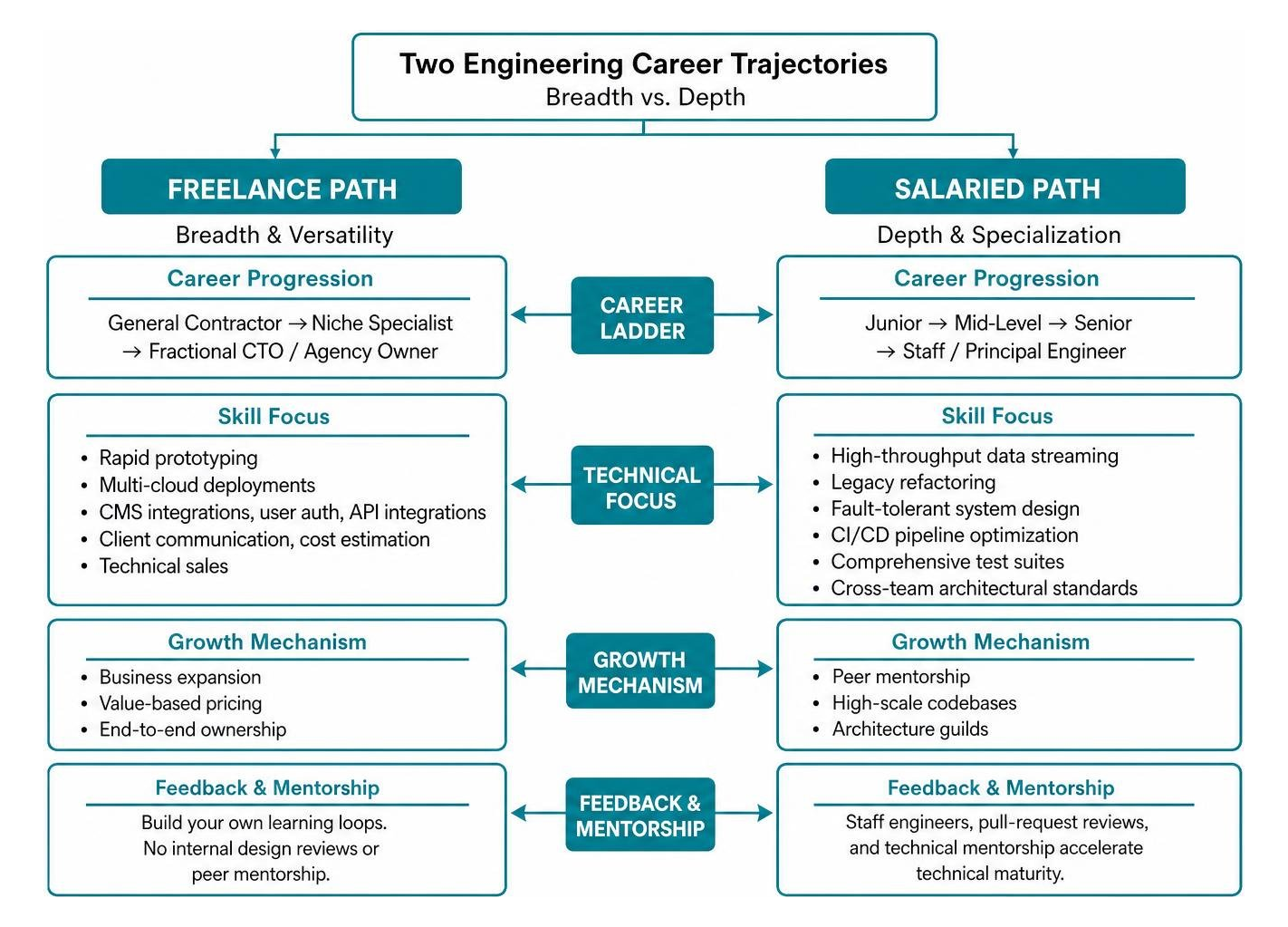
In contrast, freelance coders must build their own learning loops. They do not have access to internal design reviews or peer mentorship. However, freelancing offers an accelerated path to commercial leadership: an experienced solo developer can easily evolve into a fractional CTO, technical consultant, or agency founder, capturing far more commercial upside than a standard engineering ladder allows.
Should You Choose Freelancing, Full-Time Employment, or a Hybrid Model?
Choosing between freelancing and salaried engineering is not an irreversible decision. The right path depends on your financial runway, risk tolerance, technical seniority, and lifestyle preferences.
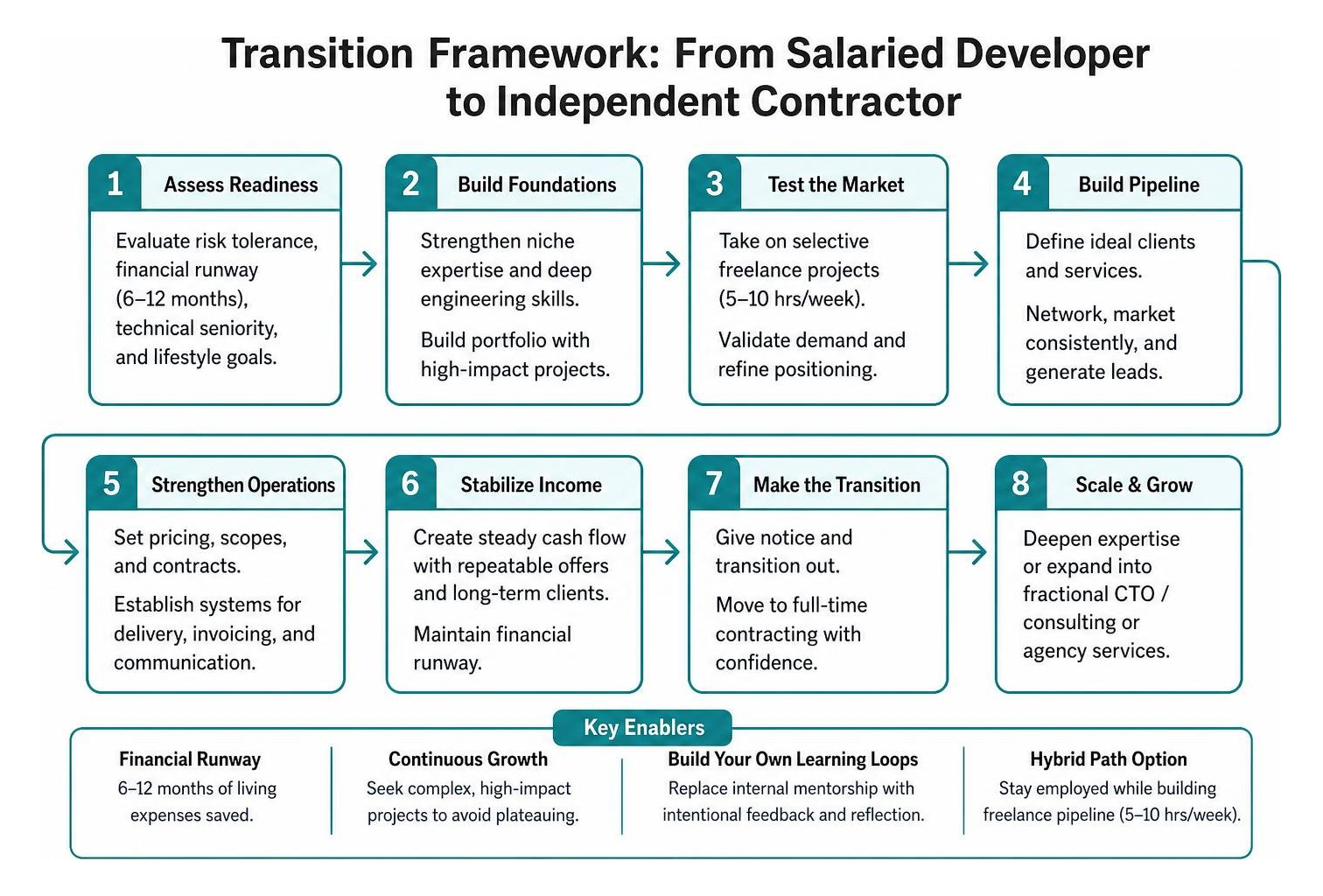
Many developers find success through a hybrid model: maintaining a stable, remote full-time software engineering position while dedicating 5 to 10 hours per week to selective freelance contracts or building indie SaaS products. This approach delivers the baseline security of regular health coverage, 401(k) matching, and steady paychecks, while allowing you to build client pipelines and test your entrepreneurial skills before taking the leap.
Before transitioning to solo contracting full-time, developers should establish a financial runway of 6 to 12 months of living expenses and follow established strategies for transitioning to remote software engineering.
Key Factors for Choosing Full-Time Employment
A salaried engineering role is likely your best choice if you:
- Prioritize Stable Income and Predictable Cash Flow: You prefer receiving consistent, automated direct deposits without managing cash-flow volatility.
- Value Comprehensive Benefits: You depend on employer-subsidized health insurance, 401(k) matching contributions, and paid parental or vacation leave.
- Seek Structured Engineering Mentorship: You are in the early-to-mid stages of your career and want guidance from senior and staff engineers.
- Enjoy Solving Deep System Architecture Problems: You want to work on large-scale distributed systems, database scaling, and high-volume traffic.
- Prefer Pure Software Construction: You want your daily work to focus on writing code, designing APIs, and reviewing pull requests without handling client acquisition and billing.
Key Factors for Choosing Freelance Software Development
An independent freelance career is likely your best choice if you:
- Demand Complete Schedule and Location Autonomy: You want full control over your calendar, daily working hours, and work location.
- Possess Specialized Expertise in High-Demand Niches: You have strong skills in specialized domains like AI agent development, cybersecurity, mobile engineering, or cloud migrations.
- Have an Established Professional Network: You can consistently generate qualified client leads through personal referrals, industry contacts, or a strong public portfolio.
- Are Comfortable Wearing Multiple Business Hats: You enjoy pitching clients, negotiating contracts, tracking expenses, and managing end-to-end deliverables.
- Have Built a 6- to 12-Month Cash Reserve: You have the financial safety net needed to navigate slow quarters, late client payments, and seasonal market dips.
Frequently Asked Questions About Freelance vs Full-Time Coding
What is the realistic timeline to achieve income parity when switching to freelance coding?
Reaching true financial parity with a previous salaried position typically takes 12 to 24 months. During the first year, most freelancers experience lower net income as they spend significant time building a client pipeline, establishing case studies, and refining their pricing structure.
Once an independent developer establishes a steady referral network and reaches a consistent utilization rate of 1,500+ billable hours at market-rate pricing ($90–$150/hr), net income often matches and eventually surpasses corporate compensation packages.
Can developers transition back to full-time employment after freelancing?
Yes. Tech hiring managers and recruiters generally view professional freelance experience positively, provided it is framed effectively on your resume.
Rather than listing yourself as “Self-Employed,” frame your experience as an Independent Technical Consultant or Lead Solutions Architect. Highlight specific, measurable business outcomes, such as:
- “Architected and deployed a multi-tenant fintech backend that reduced API latency by 65% for a Series A client.”
- “Integrated AI-powered search workflows for an enterprise e-commerce platform handling 50,000 daily active users.”
Emphasize how managing end-to-end delivery made you a more commercially minded, self-directed, and communicative engineer.
How does the rise of AI-assisted coding affect freelance rates and job demand?
The rapid adoption of AI coding assistants and modern development workflows has raised market expectations for delivery speed. Basic CRUD implementation and generic web design are increasingly commoditized, driving down billing rates for entry-level work.
However, demand and compensation for senior developers who understand how to orchestrate AI tools have increased significantly. Modern clients look for engineers who can translate ambiguous business requirements into production architectures, design secure data pipelines, audit AI-generated code for security vulnerabilities, and ship complex applications in days rather than months.
How Can You Find the Right Balance for Your Developer Career?
The choice between freelance programming and full-time software development is not a permanent commitment—it is a choice of how you want to deploy your technical skills at this stage of your career.
If you prioritize predictable compensation, deep architectural challenges, and collaborative team growth, an async-first remote engineering role provides the strongest foundation. If you value calendar independence, direct business ownership, and uncapped hourly earning potential, building an independent consulting business offers unmatched autonomy.
At RemoteVibeCodingJobs, we help developers discover top-tier remote engineering opportunities at modern companies that champion asynchronous workflows, deep work culture, and cutting-edge AI toolchains.
Explore our comprehensive freelance vs remote full-time comparison to calculate your ideal compensation path, review real-world rate benchmarks, and find the perfect role for your engineering journey today.