
Core Responsibilities of Remote Engineering Leaders
Managing an engineering team remotely requires shifting focus from hours spent in seats to measurable business outcomes, team flow, and sustainable engineering cadence. The primary responsibility of modern engineering managers is establishing high-leverage systems: unblocking developers, coordinating cross-functional roadmaps, and maintaining high engineering standards across distributed sprints.
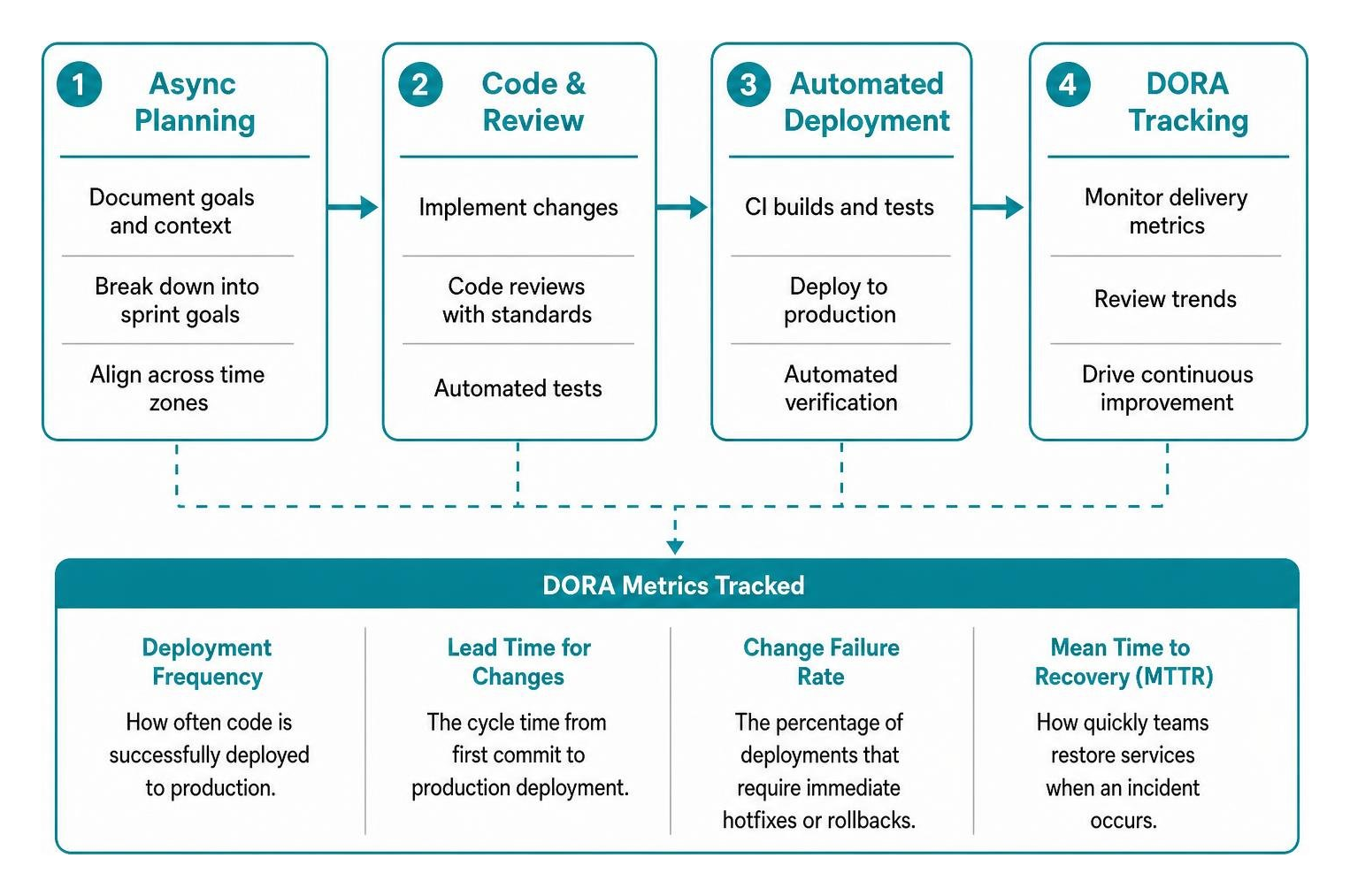
Successful leaders implement structured operational rituals. They translate broad product initiatives into actionable sprint goals, facilitate blameless retrospectives, and build environments that foster a deep work culture developer jobs finding focus flow. Instead of relying on constant tap-on-the-shoulder check-ins or intrusive micro-monitoring, they lean heavily on clear documentation and an async first remote work guide to keep squads aligned across time zones and geographic regions.
To evaluate operational health objectively, remote managers track key software delivery metrics validated by the DORA research program:
- Deployment Frequency: How often code is successfully deployed to production.
- Lead Time for Changes: The cycle time from first commit to production deployment.
- Change Failure Rate: The percentage of deployments that require immediate hotfixes or rollbacks.
- Mean Time to Recovery (MTTR): How quickly teams restore services when an incident occurs.
Player-Coach vs Administrative Leadership
The industry has moved decisively away from purely administrative managers who only forward calendar invites and track tickets. In fast-moving, remote-first environments, teams look for “player-coach” leaders. While you won’t write critical-path production code every day, you must maintain deep technical literacy to evaluate pull requests, shape Architectural Decision Records (ADRs), and balance feature velocity against technical debt.
As a player-coach, your role is to unblock complex architectural decisions, build small prototypes to de-risk ambitious features, and lead high-leverage code reviews. When teams realize their manager understands the nuances of modern state management, container orchestration, or API latency constraints, technical alignment accelerates across the squad and developer morale increases.
Async Communication and Team Health
Leading across distributed hubs requires intentional communication practices and structured feedback cadences. Without shared physical spaces, managers must establish psychological safety, transparent career ladders, and deliberate feedback loops to prevent team isolation.
High-performing remote leaders replace endless status meetings with structured written updates, spec-driven development docs, and async check-ins. They actively monitor team workloads, encourage sustainable boundaries, and study strategies on how to avoid burnout as a remote developer a comprehensive guide to protect their team’s mental well-being and long-term retention.
Top Niches and High-Growth Sectors for Software Engineer Manager Jobs Remote

While generalist full-stack leadership positions remain available across global markets, specialized sub-domains offer high hiring demand and competitive compensation. When deciding where to apply for software engineer manager jobs remote, evaluate the trade-offs between venture-backed scale-ups and established enterprises through our breakdown of startup vs big tech for remote developers which is best.
Platform, Cloud, and Infrastructure Management
Modern distributed systems require robust foundation engineering and scalable infrastructure primitives. Remote managers specializing in platform, reliability, and cloud architecture lead teams that build internal developer platforms, scale multi-region infrastructure, and implement chaos engineering frameworks.
Key areas of responsibility include:
- Container Orchestration: Scaling Kubernetes clusters and ECS/EKS workloads securely on AWS, GCP, or Azure.
- Resilience Engineering: Establishing automated rollback safeguards, multi-region failovers, and robust observability pipelines.
- Internal Developer Tooling: Reducing local environment spin-up times, standardizing container templates, and automating CI/CD pipelines.
Leadership in this domain demands fluency across cloud platforms and infrastructure-as-code tools. You can review current market benchmarks in our breakdown of Salaries Devops Engineer compensation.
AI Platform and Developer Experience Pods
The rapid emergence of AI-assisted development has created specialized management roles focused on developer experience (DevEx) and AI platform engineering. In these roles, managers are tasked with integrating Large Language Model (LLM) APIs, building agentic pipelines, and eliminating developer friction across daily workflows.
These pods explore modern methodologies like agentic engineering what it is how to thrive in 2024, standardizing automated pull request reviews and evaluating developer tools by reviewing how teams compare cursor vs windsurf. Leaders in this space ensure that AI tooling is adopted safely, ethically, and productively without degrading software stability or code quality.
Compensation Packages and Salary Expectations Across Company Tiers
Compensation for remote engineering managers remains competitive, with strong packages combining base pay, equity stakes, and dedicated remote stipends.
| Company Stage / Niche | Base Salary Range | Typical Equity / Bonus | Key Focus Areas |
|---|---|---|---|
| Early-Stage Seed / Series A | $140,000 – $180,000 | 0.5% – 1.5% Equity | Rapid prototyping, hands-on architecture, hiring initial squads |
| Growth-Stage Series B / C | $175,000 – $240,000 | $30k – $80k/yr options | Scaling agile pods, DORA metrics, microservices migrations |
| Enterprise / Late Stage | $190,000 – $275,000+ | $50k – $120k RSU/Bonus | Governance, cross-department alignment, DevSecOps compliance |
| AI Infrastructure & Resilience | $220,000 – $380,000+ | High-value equity / RSUs | Large-scale LLM pipelines, low-latency streaming, edge platforms |
Beyond base pay and stock grants, remote-first organizations frequently offer comprehensive benefits designed for distributed teams:
- Home Office Stipends: Initial setup bonuses ($500–$1,500) plus ongoing monthly internet allowances ($50–$100/mo).
- Learning & Upskilling Budgets: Annual stipends ($1,000–$3,000) for conferences, courses, and certifications.
- Wellness & Deep Work Breaks: Structured “Flow Days” with zero meetings, wellness stipends, and flexible paid leave policies.
To maximize your total compensation package, consult our guide to remote developer salary negotiation tips get paid what you re worth.
How to Prepare and Interview for Engineering Leadership Roles

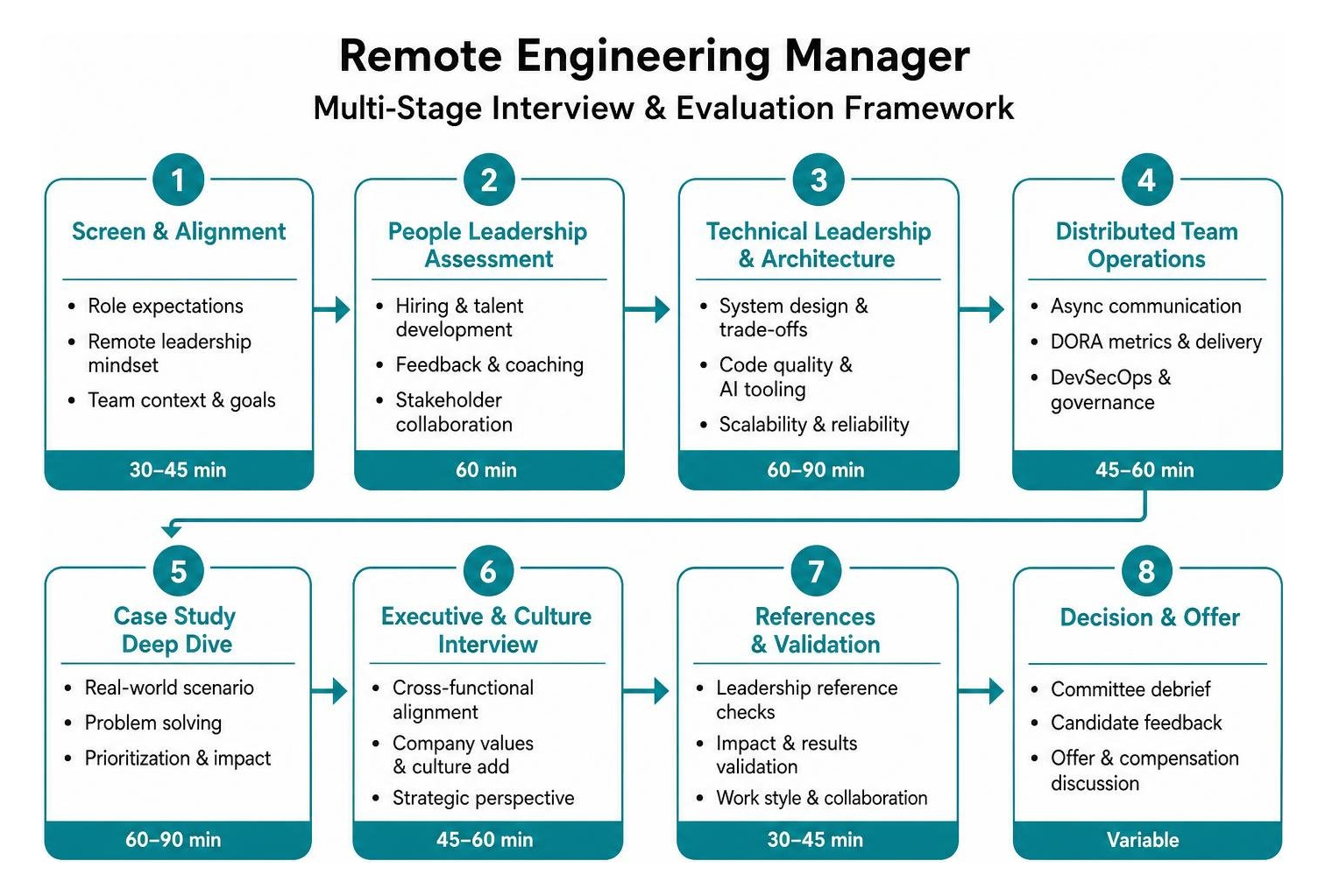
Securing a remote engineering manager role involves a specialized, multi-stage interview process. Hiring committees evaluate candidates across three core pillars: people leadership, architectural decision-making, and distributed team operations. Interviewers frequently assess how you balance developer satisfaction, communication efficiency, and delivery speed across modern frameworks like the SPACE framework for developer productivity.
Essential Technical and AI Skills for Software Engineer Manager Jobs Remote
Modern remote leaders must understand the developer workflows and modern toolchains used by their squads. Beyond traditional system design, managers are expected to guide AI adoption, evaluate code generation trade-offs, and assess tool capabilities through analyses like our Claude Code vs Copilot for developers in 2026 a deep dive.
Key proficiencies include:
- Cloud & DevSecOps Governance: Designing secure CI/CD workflows, automated vulnerability scanning, compliance guardrails, and static analysis checks.
- AI Tool Integration: Guiding teams on effective prompt orchestration, LLM API consumption, and automated unit test generation to increase developer velocity.
- Operational Observability: Implementing distributed tracing, structured logging, synthetic monitoring, and proactive alerting systems across multi-region infrastructure.
How to Interview and Negotiate for Software Engineer Manager Jobs Remote
Remote interview loops typically evaluate real-world problem-solving over abstract algorithmic trivia. If you prefer companies that skip algorithmic whiteboard puzzles, browse our directory of remote coding jobs no leetcode practical portfolio.
Expect scenario-based questions that test your leadership approach and cross-functional communication:
- How do you manage an underperforming engineer when working across different time zones?
- How do you resolve architectural disputes between senior team members asynchronously?
- What metrics and communication rituals do you use to keep cross-functional stakeholders informed?
- How do you structure feedback and career progression ladders in a distributed organization?
Structure your interview answers using the STAR method (Situation, Task, Action, Result), highlighting measurable improvements in team velocity, cycle time reductions, and engineering retention.
Frequently Asked Questions About Remote Engineering Management
What is the average salary range for a remote software engineering manager in 2026?
Base salaries for remote engineering managers in the US typically range between $150,000 and $250,000 annually. Senior leaders managing specialized AI platforms, data platforms, or enterprise commerce systems often see compensation packages extending from $260,000 to upwards of $380,000+ when factoring in bonuses and equity grants.
Can a remote engineering manager still contribute to code and architecture?
Yes. Many modern tech companies embrace the “player-coach” leadership model. While managers generally avoid taking on critical-path tickets that could block release timelines, they frequently write technical specifications, build proof-of-concept prototypes, conduct architectural reviews, and contribute to internal tooling.
What tools are essential for managing distributed engineering teams?
Modern distributed engineering teams rely on a streamlined toolkit:
- Issue & Project Tracking: Linear, Jira, or GitHub Projects for spec-driven workflows.
- Async Collaboration: Slack, Notion, and Loom for asynchronous demos and team updates.
- Delivery & Productivity Metrics: LinearB, Jellyfish, or native GitHub Insights for monitoring DORA metrics and cycle times.
- AI & Developer Tooling: Cursor, Claude Code, GitHub Copilot, and automated testing suites.
Conclusion
Transitioning into a remote engineering leadership role offers significant career autonomy, competitive compensation, and the opportunity to lead talented distributed teams worldwide. As organizations continue to adopt async-first workflows and AI-assisted tooling, demand remains high for engineering managers who combine people mentorship with strong technical architecture.
If you are ready to find your next leadership position, explore curated remote opportunities, check out our daily listings, and discover top-tier roles on Remote Vibe Coding Jobs.