
What Is the Difference Between General Remote Jobs and Remote Coding Careers?
When candidates start searching for work-from-home opportunities, search engines frequently lump together every position performed behind a laptop. This creates immediate confusion when you compare general “remote jobs” with “remote coding careers.”
General remote jobs encompass a vast range of non-technical roles, such as customer support, virtual assistance, digital marketing, recruitment, and project coordination. These roles focus on operations, human communication, or creative collateral. On the flip side, remote coding careers center on software development, infrastructure management, data science, and writing or evaluating instructions for computers.
Adding to the confusion is a major industry naming overlap: healthcare medical coding versus software coding. When job boards index the search query “remote coding,” they routinely show both:
- Healthcare Medical Coding: Assigning standardized alphanumeric codes (ICD-10-CM, CPT, HCPCS) to patient medical charts for billing, healthcare compliance, and insurance claims.
- Software Coding: Writing logic, designing architectures, and leveraging programming languages (Python, JavaScript, Go) or AI coding agents to build software applications, cloud APIs, and web platforms.
At RemoteVibeCodingJobs, we focus strictly on the tech side of this spectrum. Software development is inherently digital. Code runs on remote cloud servers, repository hostings live online, and feedback loops happen through pull requests and automated test pipelines. Because writing code requires deep concentration rather than physical presence, software development has become the ultimate asynchronous, high-wage remote career. Furthermore, the rise of AI-assisted development (“vibe coding”) is lowering traditional syntax entry barriers, allowing ambitious professionals to transition into remote technical roles faster than ever before.
Understanding Non-Coding Remote Work vs. Technical Software Development
While non-coding remote jobs provide location flexibility, they differ sharply from software development in entry barriers, workflow flexibility, and earning potential:
- Entry Requirements: Entry-level non-coding roles (like data entry or customer service) feature low technical barriers to entry, making them fiercely competitive. Software coding requires demonstrable technical literacy—whether acquired through a CS degree, self-study, or hands-on practice with AI coding tools.
- Asynchronous Workflows: Many non-coding remote jobs require strict shift adherence (e.g., answering live support queues or managing phone lines during specific hours). Software development emphasizes asynchronous work: you deliver tested code and complete tasks on flexible schedules provided project milestones are met.
- Global Remote Readiness: The global demand for software talent creates cross-border opportunities. Industry survey data reveals that over 80% of software developers work at least partially remote in 2026 (38% fully remote, 42% hybrid, and only 20% strictly in-office).
The Emergence of “Vibe Coding” and AI-Native Remote Jobs
The landscape of remote software careers changed dramatically with the rise of “vibe coding”—a phrase describing AI-native software development. Rather than typing out thousands of lines of syntax character-by-character, vibe coders guide advanced AI models and coding assistants like Cursor, Claude Code, Windsurf, and GitHub Copilot using structured prompts, agent context files, and high-level software architecture decisions.
Vibe coding allows developers to build, test, and deploy production-grade software 3 to 10 times faster than traditional manual workflows. This shift has unlocked a wave of newly defined remote job titles:
- Junior Agentic Engineer: Engineers who build and direct autonomous AI agent workflows to execute complex engineering tasks.
- AI Data Quality Specialist / AI Trainer: Technical contractors who write, evaluate, and refine code solutions to train large language models (paying between $40/hr and $100/hr).
- Vibe Coder Product Developer: Hybrid product builders who combine rapid prototyping tools like v0.dev and Lovable with back-end logic to launch complete minimum viable products (MVPs).
To explore how these roles are redefining modern tech teams, check out our comprehensive Vibe Coding Remote Job Guide.
Is Medical Coding or Software Engineering More Likely to Be Remote?
To determine whether medical coding or software engineering provides better remote opportunities, you must look closely at salary limits, credential requirements, and geographic flexibility.
| Comparison Metric | Healthcare Medical Coding | Software Coding & AI Engineering |
|---|---|---|
| Average Remote Pay | $54,784 / year ($25–$40/hr) | $75,000 global median ($184,200 senior median) |
| Required Credentials | AAPC CPC, CIC, or COC certifications | Portfolio projects, code assessments, AI tool mastery |
| Remote Adoption Rate | ~25% fully remote | 80% remote or hybrid (38% fully remote) |
| Location Flexibility | State-restricted (compliance/licensing) | Global location-agnostic opportunities |
| Career Growth Upside | Capped by administrative fee schedules | Uncapped scaling into senior, staff, and leadership roles |
Healthcare Medical Coding: Requirements and Remote Market Realities
Healthcare medical coding provides legitimate work-from-home options, but the market comes with strict administrative constraints:
- Specific Certifications Required: Data from AAPC salary surveys shows that 81% of remote healthcare coders hold the Certified Professional Coder (CPC) credential, with 64% holding a single credential.
- Experience Barriers: Despite being an entry-level healthcare role, medical coders average 11 to 12 years of industry experience before securing full-time, permanent work-from-home status with health systems or hospitals.
- Compensation Caps: The average annual salary for a remote medical coder is $54,784 per year. Outpatient surgery and emergency department coders can reach $38 to $40 per hour, but compensation remains tied to fixed billing rates.
- Strict Compliance Restrictions: Healthcare regulations require rigid geographic and internet setups. Employers typically limit hiring to specific US states (with Florida at 6.1%, Texas at 6%, and North Carolina at 4.9% having the highest remote coder concentrations). Satellite or wireless connections are prohibited; workers must maintain high-speed, wired cable internet connections for HIPAA compliance.
Software Coding: Global Remote Demand and Tech Trajectory
In contrast, software engineering (covering front-end, back-end, full-stack, data engineering, and AI development) operates under an open market.
Software engineers do not need state-issued licenses or central board credentials. Employers care about deployed code, system design capability, and output velocity. A software engineer living anywhere in North America or internationally can work for high-paying remote companies without state-boundary restrictions, earning baseline entry-level salaries that match or exceed senior medical coding caps.
How Do Remote Developer Salaries Compare to On-Site and Hybrid Roles?
A common myth is that working remotely requires taking a pay cut. The 2026 compensation data proves the exact opposite: remote software developers earn significantly more than their office-bound peers.

According to global software workforce benchmarks, fully remote software developers earn a median salary of $75,000, compared to $66,592 for hybrid developers and $44,586 for in-person developers.
When analyzing experienced talent, remote senior software engineers earn a global median base salary of $184,200 in 2026. This reflects a 15.2% pay premium over the $159,800 median base salary of on-site peers. As detailed in this analysis of senior developer remote vs. on-site pay, top senior developers hold immense leverage, allowing them to command premium location-agnostic compensation while working remotely.
For a broader overview of pay scales across levels, explore our Remote Developer Salary Guide 2026.
Take-Home Pay, Tax Advantages, and Hidden Expense Savings
Nominal base salary is only part of the equation. To evaluate real earnings, you must account for lifestyle cost offsets and state income tax variations, as documented in this Levels.fyi 2026 compensation benchmark data.
- Direct Cost Savings: Working remotely saves developers between $11,000 and $37,000 every year in reduced commuting costs, vehicle depreciation, transit passes, dry cleaning, and daily office dining expenses.
- Tax Optimization: On-site tech workers in hubs like New York City or San Francisco face combined state and local tax rates exceeding 30%. Remote engineers who relocate to zero-state-income-tax states like Texas or Florida increase their net after-tax take-home pay by up to 27%.
- Equity and Vesting: Remote-first software companies offer equity vesting schedules that average 12% longer than regional on-site firms, resulting in higher deferred compensation packages over time.
Productivity and Focus Time: Remote vs. Office Telemetry
Why do remote developers command higher pay? Because objective data proves they get more high-value engineering work done.

A Stanford study tracking thousands of workers demonstrated that working remotely provides a 13% productivity boost while reducing employee stress by 39%. As highlighted in this overview of remote vs hybrid work strategies, burnout symptoms afflict 41% of in-office workers compared to just 26% of fully remote staff.
Furthermore, direct IDE telemetry data analyzed in this study on remote vs office IDE activity reveals why remote programmers ship cleaner software:
- Uninterrupted Focus Time: Remote-first developers achieve uninterrupted “Focus Time” coding sessions averaging 68 minutes, compared to just 42 minutes for office developers interrupted by shoulder taps and ambient noise.
- Longer Deep Work Sessions: 22% of remote coding sessions exceed 90 continuous minutes, compared to only 11% of office sessions.
- Meeting Load Impact: The data shows that excessive meeting schedules destroy developer output regardless of location. When developers face 3 or more hours of daily meetings, daily coding output drops to an identical low (~28 to 31 minutes) for both remote and office workers.
Which Programming Languages and AI Tools Offer the Best Remote Job Opportunities in 2026?
If you want to secure a high-paying remote job, picking the right tech stack is critical. Certain programming languages and tools dominate distributed, async-first engineering teams.
To see which tech stacks employers are actively hiring for, check out our guide on Remote Developer Jobs AI Tools.
Top Languages for High-Paying Remote Roles
- Python: Python remains the king of versatility. It dominates data science, machine learning, back-end scripting, and contract AI training roles ($50–$100/hr). Its readable syntax makes it ideal for remote collaboration.
- TypeScript & JavaScript: Powering over 32% of remote-first web engineering stacks, TypeScript provides the strict typing required to maintain large, asynchronous web applications without breaking production.
- Go (Golang): Highly adopted by remote-first cloud-native startups, Go is heavily sought after for microservices, backend systems, and high-concurrency infrastructure.
- SQL: Essential for querying databases, SQL is a universal requirement paired with Python, TypeScript, or back-end framework roles.
Modern Tooling Stack: AI Coding Assistants and Editors
The modern remote workflow is defined by AI tooling adoption. IDE telemetry shows that remote-first companies adopt AI-native code editors like Cursor at more than double the rate of office-first companies (18% vs. 8%).
- AI-Native Editors: Tools like Cursor, JetBrains Fleet 2.0, and Windsurf integrate directly with LLMs to index local repositories, allowing remote coders to generate features from natural language prompts.
- Autonomous Coding Agents: Tools like Claude Code, v0.dev, and Lovable enable developers to generate front-end interfaces and full-stack API endpoints instantly.
- Remote Developer Pay & Tools: Salary benchmarks show that engineers utilizing advanced remote toolchains and Fleet 2.0 command a 14.7% salary premium over traditional setups, as outlined in this 2026 salary comparison for modern editor workflows.
For a deep dive into setting up your environment, read our Remote Work Tools for Developers Compared 2026 Guide.
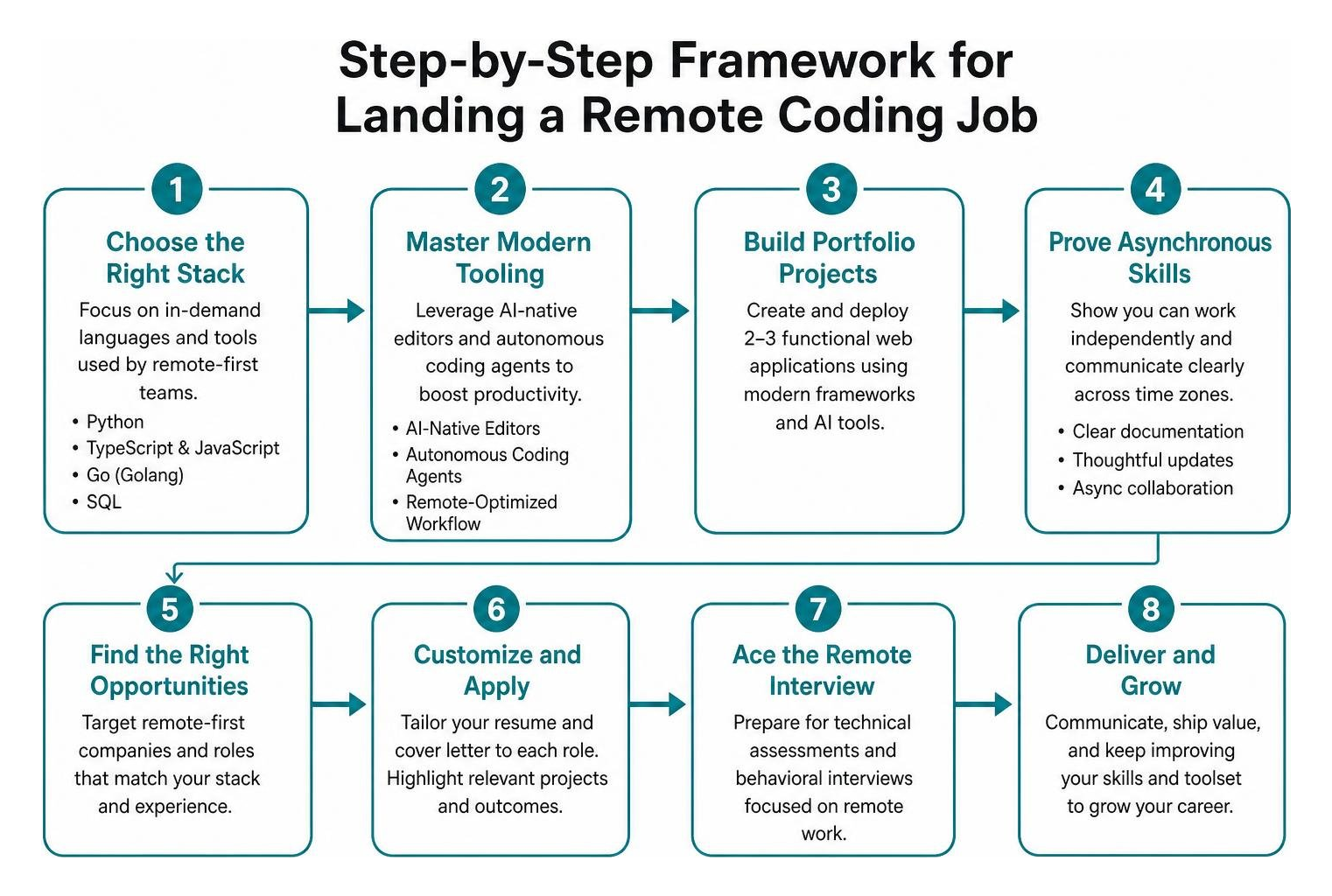
How Can You Land a Remote Coding Job in 2026?
Landing a remote coding job no longer requires a 4-year computer science degree or years of sitting in a physical office cubicle. However, it does require proving that you can write clean code, work independently, and communicate asynchronously.
For an actionable step-by-step roadmap, review our core guide on How to Get Remote Developer Job.
Portfolio Building and Asynchronous Proof of Skill
When hiring remotely, engineering managers care about verifiable output. You can prove your capabilities through:
- Deployed Portfolio Projects: Instead of static personal sites, build and host 2 or 3 functional web applications using modern web frameworks and AI tools.
- Public GitHub Commits: Show clean git hygiene, descriptive pull-request notes, clear documentation, and concise README files. This proves you can communicate effectively in async teams.
- No-LeetCode Interview Paths: A growing number of remote-first companies are abandoning traditional whiteboarding algorithms in favor of practical take-home projects or live pairing sessions using AI tools. You can explore these opportunities in our directory of Remote Coding Jobs No Leetcode.
Where to Find Legitimate Remote Coding Jobs
Finding legitimate remote roles requires filtering out outdated listings, recruiter spam, and non-remote disguised listings.
While general job platforms host broad job categories, tech professionals often waste hours sifting through administrative medical coding roles or hybrid mandates.
This is why we built RemoteVibeCodingJobs. We aggregate daily remote developer roles strictly from async-first companies that embrace modern AI-assisted workflows (Cursor, Claude Code, GitHub Copilot). We curate listings by stack, salary transparency, and culture—helping you skip corporate bureaucracy and apply directly to forward-thinking tech teams.
What Are the Biggest Challenges of Working Remotely as a Coder and How Do You Overcome Them?
While working remotely offers unmatched flexibility and high pay, it comes with real professional and psychological challenges.
Overcoming Isolation, Burnout, and Timezone Overlap
- Combating Isolation: Working from home can lead to social isolation. Successful remote coders establish structured schedules, join local co-working spaces, or participate in active online developer communities.
- Preventing “Always-On” Burnout: Because your home is your office, work hours can easily spill into personal time. Establish hard boundaries by turning off workplace notification apps outside set working hours.
- Managing Asynchronous Communication: When team members span 4+ timezones, waiting hours for a answer can stall development. Overcome timezone friction by writing detailed design docs, clear issue descriptions, and Loom video walkthroughs.
Navigating Proximity Bias and Career Growth
In traditional companies with hybrid arrangements, in-office employees often receive promotions 24% to 50% faster due to “proximity bias”—managers defaulting to people they see physically every day.
To build a thriving remote engineering career, you must make your contributions visible:
- Document Your Impact: Share concise weekly written updates detailing shipped features, bug fixes, and performance optimizations.
- Lead Internal RFCs: Author public Request for Comments (RFC) documents proposing system architecture improvements.
- Engage in Strategic Demos: Present working software builds during company-wide asynchronous video recording sessions.
For a detailed roadmap on advancing your career remotely, read our Remote Developer Career Path Junior to Senior Guide 2026.
Frequently Asked Questions About Remote Jobs vs. Coding?
Is it hard to get an entry-level remote coding job without experience?
Breaking into traditional software engineering directly as a self-taught junior can be challenging due to high applicant volumes. However, taking advantage of modern AI workflows opens new pathways. Beginners can land roles faster by mastering AI-assisted vibe coding tools, taking on contract AI data training roles ($40–$60/hr), or building a portfolio of live deployed products using tools like Cursor and v0.dev.
Do remote software developers make less money than in-office developers?
No. Data shows that fully remote software developers earn a higher global median salary ($75,000) than hybrid ($66,592) or in-person ($44,586) peers. Remote senior developers earn a median base of $184,200 (15.2% higher than on-site peers). When combined with $11,000–$37,000 in annual savings on commuting and office expenses, remote developers achieve higher real purchasing power.
What is the easiest coding role to start working remotely?
For non-technical beginners seeking immediate entry into healthcare administration, medical coding (CPC credential) offers a predictable route, though pay averages $54,784/year. For those seeking tech compensation, front-end web development with AI coding tools or AI trainer/data quality specialist roles are the fastest paths into full-time remote tech work, requiring no CS degree to get started.
How Should You Choose the Right Remote Career Path?
Choosing between general remote work, medical coding, or software engineering depends on your career goals, earning expectations, and desire for flexibility:
- Choose General Remote Jobs if you thrive on direct human interaction, prefer operational tasks, and want a low-friction entry barrier without learning technical software tools.
- Choose Healthcare Medical Coding if you want a stable, structured role in healthcare administration, don’t mind regulatory compliance, and are satisfied with an average salary ceiling around $55,000/year.
- Choose Software Engineering & AI Vibe Coding if you want maximum earning potential ($75,000 to $180,000+), location-agnostic freedom, asynchronous workflows, and the ability to build innovative digital products alongside cutting-edge AI tools.
If you are ready to build a high-paying, future-proof tech career from anywhere in the world, start exploring modern AI-assisted development workflows today.
Explore our Freelance vs. Remote Full-Time Developer Comparison to find your ideal career structure, and join us at RemoteVibeCodingJobs to land your next remote role at an async-first tech company!