
What Is Vibe Coding and Why Is It Driving Remote Tech Hiring in 2026?
The phrase “vibe coding” first gained widespread attention when tech luminary Andrej Karpathy described a new paradigm of software development: giving into the “vibes,” guiding artificial intelligence models, and building software by directing tools rather than manually writing line after line of code. By 2026, what began as a viral concept has transformed into a structured, highly sought-after engineering discipline known as agentic engineering.
In this modern landscape, developers spend less time memorizing obscure syntax or writing boilerplate code and far more time focusing on system architecture, product intuition, prompt engineering, and quality assurance. GitHub Copilot now generates an average of 46% of code across active project files, and demand for developers fluent in AI-assisted workflows has surged by 300% year-over-year.
Understanding the shift between traditional development paradigms and AI-assisted workflows highlights why remote companies are racing to hire engineers who embrace these tools:
- Syntax typing vs. Architectural steering: Traditional developers spend hours writing boilerplate functions, debugging typos, and implementing algorithms manually. Vibe coders direct AI models to scaffold entire codebases, focusing their energy on system efficiency, security, and edge-case validation. For a deeper breakdown of this paradigm shift, explore our analysis of Vibe Coding vs Traditional Development.
- Manual debugging vs. Iterative prompting: Debugging in an AI-native workflow involves reviewing generated code, refining instructions, and running automated test suites driven by LLMs.
- Synchronous alignment vs. Asynchronous execution: Because AI tools drastically accelerate execution speed, engineering teams can operate asynchronously—building full features independently before submitting them for review.
To thrive in these positions, developers leverage an evolving tech stack designed for high-velocity creation. The core toolkit includes native AI code editors like Cursor, intelligent auto-completion tools like GitHub Copilot, interactive agentic tools like Windsurf, and advanced reasoning models such as Claude Code. Mastering these tools allows developers to build end-to-end applications in days rather than months, as detailed in our guide to Vibe Coder Tools Copilot Cursor.
Remote-first and async-first organizations prioritize candidates with AI tool fluency because it directly impacts engineering velocity. When individual engineers produce functional code 3x to 5x faster, remote teams reduce meeting overhead, eliminate unnecessary status updates, and evaluate talent based purely on output and execution speed.
Which Are the Best Job Platforms for Finding Daily Remote Vibe Coding Listings?
Finding genuine remote vibe coding roles requires cut-through platforms that separate true AI-native positions from generic tech postings. Traditional job boards are often clogged with outdated listings, vague “remote-hybrid” requirements, or companies claiming to value async culture while expecting instant replies on messaging channels.
To find high-quality opportunities quickly, developers need dedicated platforms that evaluate both tech stacks and company work cultures. At Remote Vibe Coding Jobs, we built our job board specifically to address these issues. We track 1,664+ verified remote positions across more than 310+ hiring companies, updating our database daily so applicants access active roles immediately.
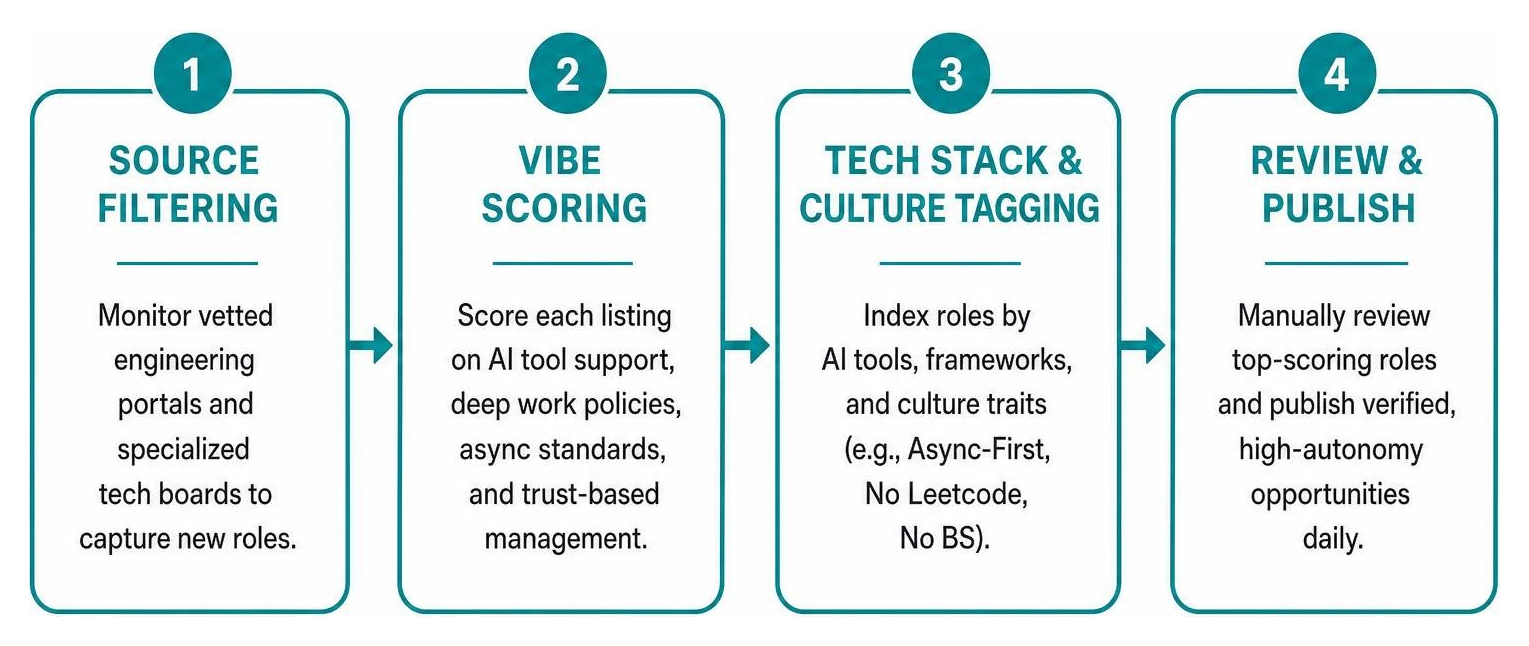
To ensure job seekers spend time only on legitimate, high-autonomy opportunities, we employ a 4-step curation framework:
- Source Filtering: We continuously monitor vetted engineering portals, specialized tech boards, and startup ecosystem pipelines to capture newly opened roles.
- Vibe Scoring: Our proprietary scoring algorithm assesses each listing against strict criteria—measuring explicit support for AI coding tools, deep work policies, async communication standards, and trust-based management.
- Tech Stack & Culture Tagging: Every role is indexed by specific AI tools (e.g., Cursor, Copilot, Claude), frameworks, and organizational traits (e.g., “Async-First”, “No Leetcode”, “No BS”).
- Remote Verification: We manually verify that listed positions are truly remote-first, filtering out hidden geographic constraints or required office days. To learn more about how top startups structure these positions, check out our report on Companies Hiring Vibe Coders Remote AI Coding.
This rigorous curation process surfaces modern developer roles tailored for AI-assisted engineering, including positions like Product Engineers, Agentic Engineers, Creative Technologists, and AI Systems Architects. For an in-depth breakdown of these titles, read our overview of Vibe Coding Jobs Remote AI Assistant.
The following table compares specialized vibe coding job platforms against general remote tech sites and freelance marketplaces:
| Platform Type | Listing Refresh Speed | AI Tool & Stack Filtering | Culture & Vibe Scoring | Primary Role Types |
|---|---|---|---|---|
| Specialized Vibe Coding Boards | Daily (Real-time updates) | High (Filters by Cursor, Copilot, Claude, LLMs) | Advanced (Async-first, No Leetcode, Deep Work) | Product Engineers, Agentic Engineers, AI Developers |
| General Remote Tech Sites | Weekly to Bi-weekly | Moderate (Basic framework & language tags) | Basic (Remote vs. Hybrid tags) | Traditional Software Engineers, Backend/Frontend Devs |
| Freelance Marketplaces | Continuous / Hourly | Low (Keyword search only) | Minimal (Client-dependent review ratings) | Short-term contract gigs, rapid MVP builders |
How Can Job Seekers Filter and Target Vibe Coding Positions Effectively?
Navigating the job market as an AI-native developer requires a strategic approach to search queries, culture parameters, and portfolio presentation. Because titles vary across companies, using the right keywords ensures you do not miss hidden opportunities.
Recommended Search Terms & Keyword Variations
When searching across job boards or professional networks, combine core development terms with AI-specific qualifiers. High-converting job title searches in 2026 include:
- “Agentic Engineer” or “AI Agent Engineer”
- “Product Engineer (AI-Native)”
- “AI-Assisted Developer” / “AI Code Engineer”
- “Prompt Engineer & Code Automation”
- “Full-Stack AI Builder” / “Creative Technologist”
Utilizing Culture and Workstyle Filters
Finding a job where you can leverage AI tools efficiently means finding an employer with a modern, low-friction work culture. When filtering roles, search specifically for cultural tags such as:
- Async-First: Indicates that the company relies on clear written documentation rather than frequent meetings.
- No Leetcode: Signals that the technical interview focuses on practical output, system architecture, or live AI-assisted building rather than abstract algorithms.
- Deep Work Environment: Ensures dedicated chunks of uninterrupted execution time designed for high-velocity output.
Building AI-Assisted Portfolio Projects
Resumes carry less weight than proven execution in the vibe coding ecosystem. Hiring teams want proof that you can take an idea from prompt to production rapidly. Showcase 2 to 3 live projects where you leveraged tools like Cursor or Claude Code to build full-stack web apps, browser extensions, or automated workflow agents. Document your development process, including the AI prompts and architectures used, in your GitHub repositories. Explore practical project ideas in our guide on Vibe Coding Portfolio Projects.
Engaging with Community Channels
Niche online communities and developer groups are valuable hubs for unlisted openings and referral opportunities. Developers frequently post job leads, contract gigs, and collaboration invites in specialized social forums, such as this community thread discussing Job opportunities for vibe coders? .
Standing Out with Async Video Applications
To immediately signal your fit for an async-first company, record a short (2-minute) Loom video walk-through when submitting your application. Highlight a live project you built, explain how you used AI tools to accelerate development, and demonstrate your product intuition. This practical proof sets you apart from applicants relying solely on traditional CVs, as detailed in our application guide on How to Get a Vibe Coding Job.
Key search filters to apply during your job search include:
- AI Tool Preferences: Cursor, GitHub Copilot, Windsurf, Claude Code, OpenAI API.
- Culture Tags: Async-First, No Leetcode, Deep Work, Outcome-Based Metrics.
- Role Scope: Remote Anywhere, Timezone Overlap (+/- 4 hours), Contract-to-Hire.
- Compensation: Pay Range Transparency, USD Compensation, Equity Inclusion.
What Salaries and Experience Levels Can You Expect in Remote Vibe Coding Roles?
Compensation for AI-assisted software engineers remains robust in 2026. Because vibe coders produce functional software faster, AI-forward companies offer premium compensation to developers who demonstrate high execution velocity.
Overall tech job postings for remote roles have risen 25% year-over-year, with 98% of remote workers expressing a desire to remain remote for the rest of their careers. While the global median developer salary across all categories sits around $63,000, remote positions at AI-native companies pay significantly higher—often 15% to 25% above traditional market medians.

Base Salary Ranges by Experience Level
- Entry-Level Vibe Coders ($70,000 – $100,000): Candidates with strong product sense and proficiency in AI tools like Cursor and Copilot, even without decades of manual coding experience. Learn more in our breakdown of Entry Level Vibe Coding Salary.
- Mid-Level AI Developers ($120,000 – $180,000): Engineers capable of architecting complex systems, integrating LLM APIs, managing data pipelines, and directing multi-agent coding workflows independently.
- Senior & Staff Agentic Engineers ($200,000 – $300,000+): Industry veterans who lead architectural strategy, optimize AI-assisted developer environments across teams, ensure code security, and drive high-impact product execution. For complete compensation data, review our guide to Vibe Coding Salary Remote AI Roles.
Full-Time Compensation vs. Freelance / Hourly Rates
Job seekers can choose between structured full-time remote employee roles and flexible freelance consulting contracts:
- Full-Time Remote Roles: Offer steady compensation paid in USD, equity packages, health coverage, home office stipends, and structured career progression within async-first teams.
- Freelance & Hourly Contract Gigs: Focus on rapid project completion, MVP building, or custom AI integration. Hourly rates for freelance vibe coding projects range from $32/hour for entry-level feature builds up to $90/hour+ for specialized agentic systems development.
Frequently Asked Questions About Vibe Coding Remote Platforms
How often are vibe coding job platforms updated with new remote listings?
At Remote Vibe Coding Jobs, our platform is updated daily with fresh listings scraped directly from vetted company career portals and engineering teams. Each listing undergoes automated vibe scoring and manual verification to filter out expired, filled, or non-remote positions.
Job seekers can set up personalized email alerts to receive instant notifications when new roles matching their tech stack and preferred work culture go live. To browse active hiring companies, check out our list of Companies Hiring Vibe Coders.
Do job seekers need years of traditional coding experience to qualify for vibe coding roles?
Not necessarily. While a strong foundational understanding of computer science, data structures, and system logic is valuable, vibe coding shifts the focus away from line-by-line syntax memorization toward prompt engineering, product design, and architectural guidance.
Entry-level developers who master tools like Cursor, Claude, and GitHub Copilot can quickly build production-grade applications, helping them land remote roles without extensive traditional engineering backgrounds. If you are starting out, read our step-by-step tutorial on How to Vibe Coding AI Tools Beginner and examine the long-term opportunities outlined in Vibe Coding Remote Career Path.
What is the difference between full-time remote vibe coding roles and freelance gigs?
Full-time remote vibe coding roles provide predictable base salaries (ranging from $70k to $300k+), equity options, comprehensive benefits, and long-term integration within async engineering teams. These positions prioritize ongoing product iteration, system maintenance, and collaboration.
In contrast, freelance vibe coding gigs are project-based, focusing on rapid execution—such as building an MVP, setting up an AI automation pipeline, or shipping a specific app feature. Freelance rates typically span from $32/hr to $90/hr, making it an attractive option for developers who want schedule autonomy and direct client relationships. To weigh your options, explore our complete Vibe Coding Remote Job Guide.
Conclusion
Finding high-paying, autonomous remote positions in 2026 requires looking beyond generic job boards. As vibe coding and agentic engineering redefine software development, dedicated platforms offer the fastest route to connects with companies that embrace AI tools, value deep work, and foster async-first cultures.
By focusing your job search on platforms that update listings daily, evaluate culture fit, and tag specific tech stacks (such as Cursor, Copilot, and Claude Code), you can bypass outdated requirements and secure roles that reward execution speed and product thinking.
Ready to take the next step in your remote AI coding career? Browse thousands of curated positions updated daily on Remote Vibe Coding Jobs, build your AI portfolio, and land your next role at an AI-native company using our step-by-step playbook on How to Get Vibe Coding Job Skills Courses Networking Coaching.