The 2026 Market Snapshot for Remote Unity Programmer Jobs
The market for remote unity programmer jobs in 2026 is defined by high flexibility, a strong preference for experienced talent, and a widening pay spectrum across distinct industries.
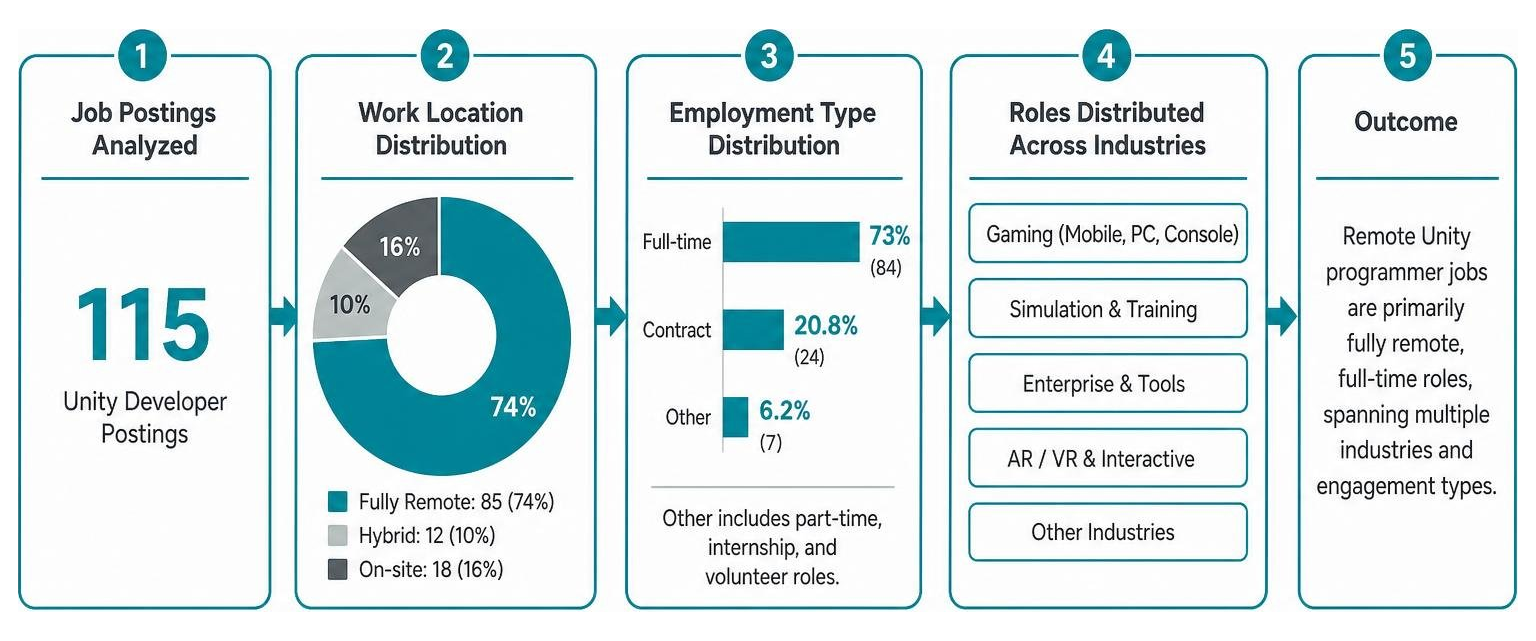
According to active job market listings in the United States, out of 115 analyzed Unity developer postings, 85 (approximately 74%) were offered as fully remote positions. Hybrid roles represented 10% (12 listings), while on-site positions made up 16% (18 listings). Full-time positions dominate the market at 73% (84 listings), while contract engagements account for 20.8% (24 listings), with part-time, internship, and volunteer roles making up the remainder.
Compensation varies depending on whether you are building casual mobile games, engineering complex military simulations, or designing core developer tools for enterprise game engines. To understand market expectations, review our comprehensive Remote Developer Salary Guide 2026.
| Seniority / Role Type | Sector Focus | Estimated Annual Salary Range | Hourly / Contract Rate |
|---|---|---|---|
| Junior / Entry Level | Porting, Mobile Casual, LiveOps | $40,000 – $65,000 | $20 – $35 / hr |
| Mid-Level Engineer | Indie Games, Simulation, AR/VR | $90,000 – $130,000 | $45 – $75 / hr |
| Senior Unity Developer | Core Architecture, VR/MR Gaming | $130,000 – $160,000 | $75 – $100 / hr |
| Specialized / Aerospace | Defense Wargaming, Virtual Sensors | $130,000 – $180,000+ | $100 – $120 / hr |
| Senior Tools Developer | High-Performance Engine Tools | $388,000 – $558,000 | Negotiable |
Demand Trends Across Mid and Senior Remote Unity Programmer Jobs
Hiring managers consistently seek engineers who can take immediate ownership of dynamic systems without requiring hand-holding. Mid-to-senior level positions account for 53.9% (62 out of 115 listings) of active remote Unity openings. In contrast, entry-level roles make up 26.1% (30 listings) and associate roles account for 13% (15 listings).
Entry-level candidates usually start in specialized niches, such as platform porting (e.g., converting PC titles to consoles or mobile), LiveOps maintenance, or UI layout programming. Junior porting roles on international job boards offer starting points between $6,000 and $10,000 per year for part-time work, serving as a stepping stone to full-time roles.
For experienced developers, contract positions provide lucrative flexibility. Highly skilled contractors in specialized areas, such as low-level frame debugging, custom render pipelines, or physics-based networking, regularly command rates between $60 and $120 per hour.
Where Companies Hire for Remote Unity Programmer Jobs
A wide variety of employers actively recruit remote Unity engineers. Key categories include:
- Independent Game Studios: Teams hiring founding engineers, multiplayer backend developers, and VR specialists for platforms like Meta Quest and Steam.
- Enterprise Tech & Gaming Giants: Companies recruiting for core engine infrastructure, developer toolchains, and ad-tech monetization platforms.
- Industrial & Aerospace Contractors: Firms building virtual training labs, synthetic data generation software, and wargaming simulations.
- AI Startups: Ventures leveraging Unity rendering pipelines to train synthetic computer vision models and autonomous agent sensors.
Candidates should note geographical and legal work constraints. Even when a job is listed as 100% remote, employers often mandate that candidates reside in specific regions (such as select U.S. states, the European Union, LATAM, or Poland) for tax and payroll compliance.
Top Platforms and Job Boards to Find Opportunities
Finding the right job requires searching both general aggregators and niche developer boards.

If you are structuring a broader search strategy, check out our guide on How to Get a Remote Developer Job.
Gaming Industry Job Boards
Specialized gaming job platforms are ideal for finding roles at indie teams, AAA game studios, and live-service operations:
- Studio Career Portals: Many developers find success by applying directly through game studio hiring pages or tracking announcements on official engine hubs like Unity.
- Indie Developer Communities: Focus on small-to-midsize indie game studios seeking specialized C# talent for multiplayer, VR, and gameplay engineering roles.
- Niche Game Industry Boards: Dedicated game industry aggregators feature international vacancies, including senior founding roles, porting positions, and technical art listings.
Non-Gaming Job Aggregators
If you want to apply your 3D skills outside traditional video games, explore general tech portals and remote job platforms:
- Enterprise Tech Portals: Feature fully remote roles focused on pipeline strategy, asset optimization, and cross-platform mobile app development.
- Regional Tech Networks: Focus on cross-border engineering opportunities across Latin America, Europe, and North America, emphasizing embedded Unity runtimes and mobile platform integrations.
- AI & Simulation Platforms: Focus on machine learning, AI simulation, and synthetic data opportunities tailored for specific time zones.
Technical Skills and Tech Stacks Employers Demand
To secure competitive remote unity programmer jobs, you need more than a basic understanding of the Unity Editor. Employers expect strong engineering fundamentals, efficient memory management, and fluency with modern C# standards.
Explore current industry requirements by checking active listings for C# Developer Jobs.
Essential Engine Competencies
Core technical competencies frequently mentioned in employer job specs include:
- C# Mastery & SOLID Principles: Writing modular, maintainable, and well-documented C# code. Understanding design patterns like Dependency Injection and Object Pooling is critical for clean architecture.
- Unity Addressables & Asset Management: Managing remote asset catalogs, dynamic memory allocation, and runtime bundle loading to keep initial download sizes small.
- Render Pipelines & Optimization: Using the Universal Render Pipeline (URP) or High Definition Render Pipeline (HDRP). Experience with HLSL shaders, compute shaders, and dynamic batching is highly valued.
- Performance Profiling: Debugging frame rates and memory bottlenecks using tools like Unity Profiler, Frame Debugger, RenderDoc, NSight, or Pix.
- Version Control Systems: Professional teams require proficiency with Git or PlasticSCM (Unity Version Control) for handling large 3D binary assets alongside code.
AI-Assisted Vibe Coding and Modern Workflows
The remote engineering landscape is evolving rapidly with the adoption of “vibe coding”—using AI-assisted development tools to write code faster, automate boilerplate, and accelerate debugging.
Small, agile remote teams actively leverage tools like Cursor IDE, Claude Code, and GitHub Copilot. In modern workflows, engineers use AI assistants to generate complex C# scripts, construct JSON communication bridges, write custom editor tools, and write unit tests in seconds.
Employers hiring for platform engineering roles look for candidates who use AI tools to achieve the output of teams three times their size. Demonstrating fluency with these tools signals that you are an efficient, modern developer ready for an async environment.
Remote Unity Roles in Gaming vs. Non-Gaming Sectors
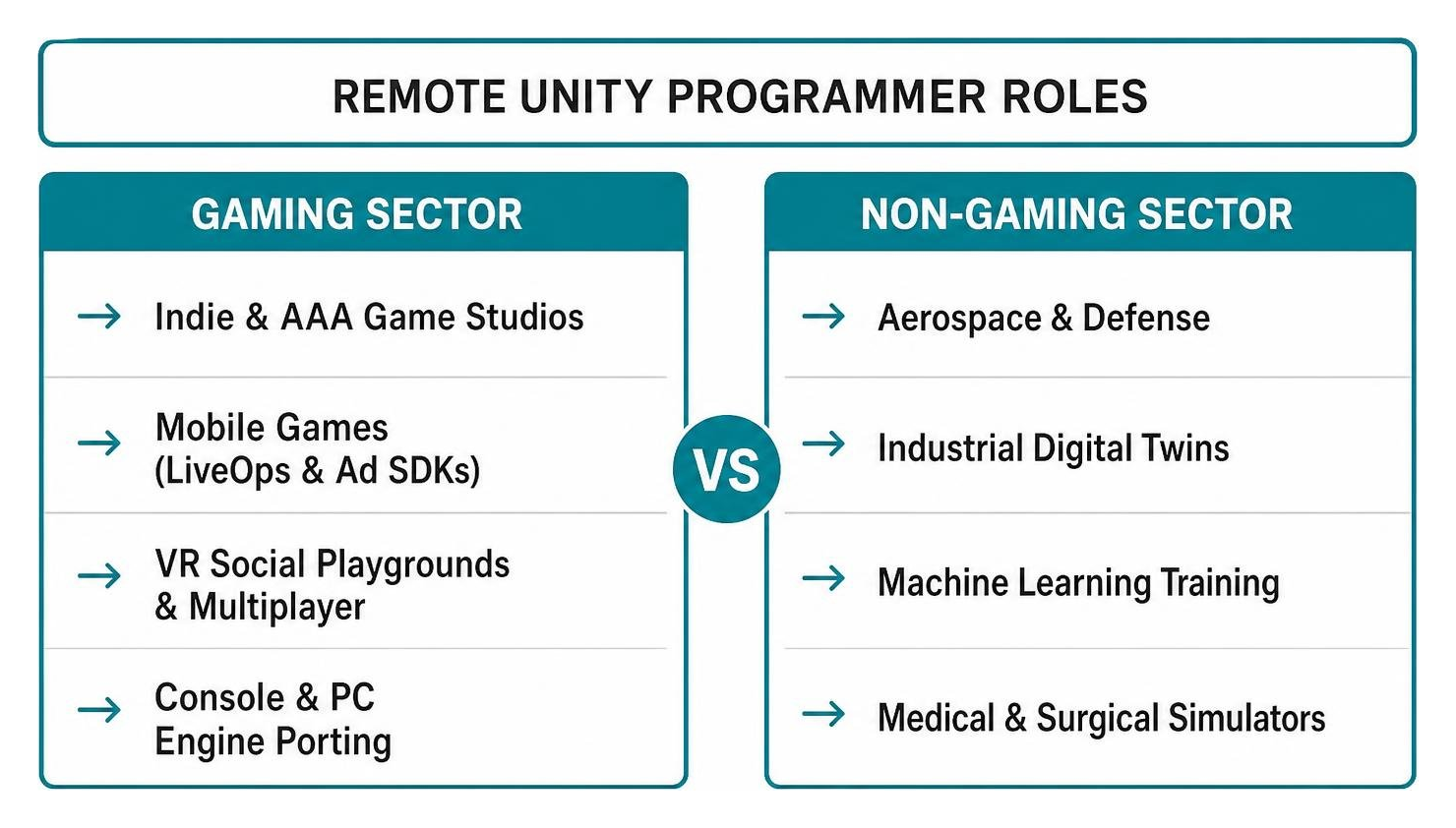
While video games remain the primary employer of Unity programmers, non-gaming industries represent a rapidly growing share of high-paying remote roles.

Understanding performance profiling and client-server architecture across mobile and desktop runtimes is vital for both industries. To learn more about cross-platform compensation trends, consult our Mobile Developer Salary Guide.
Virtual Simulations, Defense, and Machine Learning
The non-gaming sector uses Unity’s real-time 3D engine to solve complex engineering challenges:
- Aerospace & Defense: Defense contractors hire specialized Unity software engineers to build immersive wargaming architectures and flight simulators. Contract hourly rates in this sector reach up to $110 or $120 per hour.
- Machine Learning & Virtual Sensors: AI startups build virtual environments in Unity to generate synthetic datasets for computer vision models. Unity developers create virtual camera sensors, depth mappers, and physical collision environments to train algorithms for autonomous vehicles and robotics.
- Digital Twins & Industrial Design: Manufacturing firms embed Unity runtimes inside web and desktop apps to visualize operational machinery, monitor real-time IoT telemetry, and present interactive 3D product CAD designs.
- Embedded Mobile Platforms: Non-gaming mobile applications frequently embed Unity into native shells using integrations like
flutter_unity_widgetor WebGL React bridges. This allows companies to offer dynamic interactive 3D viewer experiences directly inside standard consumer mobile apps.
Work Considerations, Benefits, and Avoiding Recruitment Scams
Working as a remote Unity developer offers unique advantages, but it also comes with distinct workplace considerations.
Primary Remote Unity Job Benefits
- Flexible Hours & Autonomy: Most remote game studios operate on asynchronous schedules, allowing you to establish your own core working hours as long as milestone deliverables are met.
- Global Project Variety: You can work for an international studio, a Silicon Valley AI startup, or a European indie team without relocating.
- Competitive Perks: Top remote employers offer home office stipends, learning budgets, flexible paid time off (PTO), and performance-based profit-sharing bonuses.
Potential Challenges
- Asynchronous Communication: Distributed teams require strong written communication skills, self-management, and proactive documentation.
- Hardware & Build Times: Compiling large Unity projects and rendering heavy 3D assets requires high-end hardware, fast storage, and solid internet bandwidth.
- Time Zone Overlap Requirements: Employers often mandate 3 to 4 hours of overlap with specific time zones (such as EST, PST, or CET) for standups and pair programming.
Scam Awareness and Verification Safety
As remote job searches increase, job seekers must stay vigilant against employment scams. Scammers often impersonate reputable studios or engine creators, offering fake work-from-home positions to harvest personal data.
Stay safe by remembering these rules:
- No Text/Email Interviews: Established tech companies will never conduct a job interview exclusively via text messages, Telegram, or automated email questionnaires.
- Never Pay for Equipment: Be wary of employers offering to send you a check to purchase your own equipment from a specific vendor.
- Verify Domain Names: Check that email communications come from an official company domain rather than generic webmail addresses like
@gmail.com. - Apply Direct: Submit your application directly through verified carrier portals or reputable job platforms.
Frequently Asked Questions About Remote Unity Roles
What is the average salary range for remote Unity developers in 2026?
Full-time base salaries for mid-level remote Unity developers generally range between $90,000 and $130,000 per year. Senior VR, graphics, and backend specialists earn between $130,000 and $160,000+, while high-level engine tools engineers at major firms can earn significantly more. Contract rates typically fall between $45 and $120 per hour depending on domain specialization.
Do non-gaming industries hire remote Unity programmers?
Yes. Aerospace, defense simulation, healthcare, automotive, and AI research startups actively hire remote Unity developers. These companies utilize the engine for digital twin visualizations, synthetic training data generation, surgical training applications, and real-time physical system modeling.
What technical portfolio projects best demonstrate remote readiness?
A strong remote portfolio should showcase clean architecture alongside visual flair. Include a public GitHub repository demonstrating clean C# structure (utilizing SOLID principles, Addressables, and ScriptableObjects), a working multiplayer demo using frameworks like Photon Fusion or Netcode for GameObjects, and a documented project showing performance optimization (e.g., Frame Debugger logs or memory profiling reports).
Conclusion
The market for remote unity programmer jobs is strong, diverse, and expanding beyond traditional game development. Whether you want to build multiplayer VR playgrounds, optimize mobile casual games, or engineer real-time AI simulations, high-paying remote roles are available for developers with strong technical fundamentals.
At RemoteVibeCodingJobs, we help developers find tech jobs built around modern, flexible workflows. Explore our curated listings filtered by tech stack, remote culture, and modern AI tools like Cursor and Claude.
If you are ready to take the next step in your software career, explore curated opportunities and Find curated remote coding jobs today.