
The 2026 Remote AI Job Market Has More Doors Open Than Ever
AI jobs remote opportunities have exploded in 2026, with over 96,000 active listings in the US alone — and the market is still accelerating.
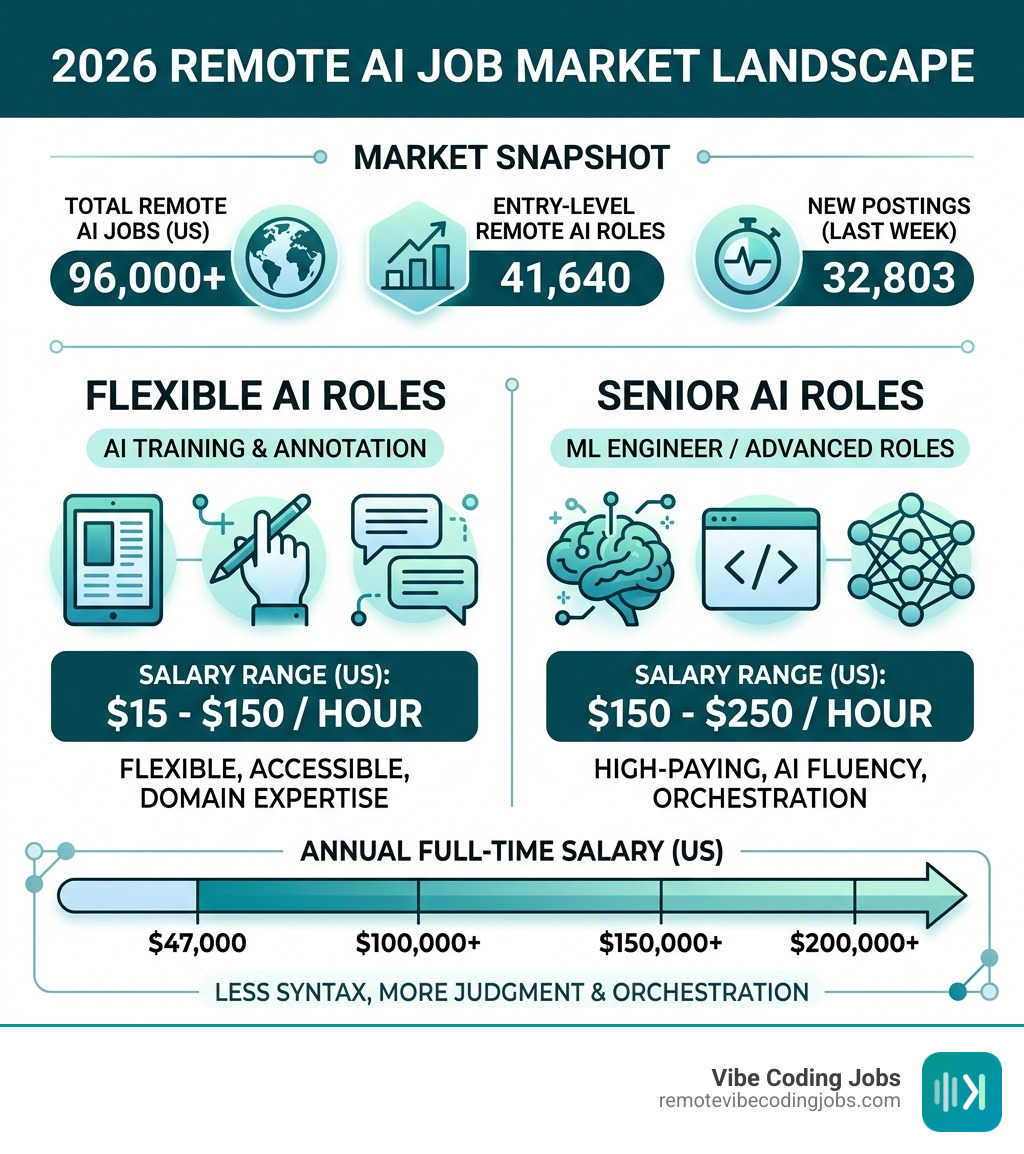
Here’s a quick snapshot of what’s available right now:
| Category | Details |
|---|---|
| Total remote AI jobs (US) | 96,000+ |
| Entry-level remote AI roles | 41,640 |
| New postings in the last week | 32,803 |
| Pay range (AI training/annotation) | $15 – $150/hour |
| Pay range (ML Engineer) | $150 – $250/hour |
| Annual salary range (full-time roles) | $47,000 – $200,000+ |
Whether you’re just starting out or you’re a senior engineer who lives inside Cursor and Claude, there is a remote AI role that fits where you are right now.
The market spans two very different worlds. On one end: flexible, no-experience-required roles in data annotation and AI training. On the other: high-paying, senior-level engineering positions at companies like GitLab and Optum, where AI fluency is the core job requirement — not just a nice-to-have.
What ties both worlds together is a simple shift: the role of the human is changing. Less syntax typing. More judgment, orchestration, and domain expertise. That’s what companies are hiring for in 2026.
The Reddit community puts it plainly — there are no shortcuts to $50K+ remote AI roles without some demonstrated skill. But the paths in are more accessible than ever before, and the tools (Cursor, Claude, PyTorch, prompt engineering) are learnable by anyone motivated enough to start.
We are RVCJ Editorial, the team behind Remote Vibe Coding Jobs, covering the intersection of AI jobs remote, async-first culture, and AI-assisted development for developers building with tools like Cursor, Claude, Copilot, and Windsurf. In the sections below, we’ll map out every major path into remote AI work — from beginner annotation gigs to elite LLM engineering roles — so you can find the right entry point for your skills and goals.
The Landscape of AI Jobs Remote in 2026
As we move through May 2026, the landscape for ai jobs remote has shifted from a niche experimental sector to the primary engine of the global tech economy. Currently, there are over 69,201 dedicated remote roles in the AI space, making up the vast majority of all AI-related openings. What is most encouraging for those looking to pivot is that 41,640 of these positions are explicitly listed as entry-level.

The shift toward an async-first culture means that companies are no longer just “allowing” remote work; they are architecting their entire business models around it. Platforms like GitLab and EverAI lead the way, processing millions of tokens daily with teams spread across the globe. This growth is detailed further in our look at AI Coding Jobs Entry-Level Remote Growth, which highlights how the barrier to entry is lowering while the volume of work increases.
Entry-Level AI Jobs Remote: No Experience Required
If you are looking to get your foot in the door without a computer science degree, the “Human-in-the-Loop” sector is your best bet. Roles such as data annotators, AI trainers, and content evaluators are the backbone of modern LLMs. These roles involve reviewing AI-generated text for accuracy, labeling images to help security systems, or even recording voice data to help assistants understand regional accents.
The pay for these roles is surprisingly competitive, ranging from $15 to $150 per hour depending on the complexity of the task and your domain expertise. For example, a general content evaluator might earn on the lower end, while a legal or medical professional training an AI in their specific niche can command top-tier rates. You can explore these paths in our guide on AI Coding Jobs Entry-Level Remote Opportunities.
High-Paying Remote AI Jobs for Specialists
For those with a technical background, the rewards are even greater. Machine Learning (ML) Engineers and AI Data Architects are seeing hourly rates between $150 and $250. These roles aren’t just about writing code; they are about fine-tuning Large Language Models (LLMs), managing RAG (Retrieval-Augmented Generation) pipelines, and ensuring model safety.
Specialists at companies like Optum or EverAI are tasked with productionizing models that handle 80 million tokens per day. These aren’t just “jobs”; they are high-stakes engineering roles where you own the model lifecycle from discovery to deployment. For a deeper dive into these figures, check out our breakdown of Remote AI Engineer Roles and Salaries.
Vibe Coding: The New Standard for Remote AI Development
The most significant trend we’ve seen in 2026 is the rise of the “Vibe Coder.” This isn’t just a buzzword; it’s a fundamental shift in how software is built. Vibe coding refers to the practice of using natural language and AI-first editors like Cursor and Claude to “orchestrate” code rather than typing it out line-by-line.

In this “vibe first” philosophy, the developer’s primary value is their ability to describe a system’s intent and then verify the AI’s output. As we outline in the Remote AI Developer Job Description, the “red flag” in 2026 isn’t using AI—it’s writing code by hand when an agent could have done it in seconds.
From Code Typist to AI Orchestrator
The transition from “typist” to “orchestrator” requires a change in mindset. Companies like Founder OS, which generates $15M/year with a tiny team, look for “AI Orchestrators” who act as quality gates. You aren’t just a coder; you are a reviewer, an architect, and a strategist.
Your day-to-day involves writing “task briefs”—short, focused instructions that tell an AI agent what to build, why it’s being built, and what to watch out for. This evolution is explored in our article on How to Become an AI Development Orchestrator.
Essential Tools for AI Jobs Remote Professionals
To land a top-tier ai jobs remote position today, you need to be proficient in a specific stack. While Python and PyTorch remain the industry standards for the “guts” of AI, the “interface” of AI development has changed.
- Cursor & Windsurf: These are the IDEs of choice for AI-native developers.
- Claude & GPT-4o: Used for complex reasoning and architectural advice.
- V0, Lovable, & Bolt: Rapid prototyping tools that turn prompts into functional frontends.
- TypeScript & React: The most common languages used by AI agents to build scalable web apps.
Mastering these tools is now a non-negotiable requirement for many Remote AI Developer Jobs.
Top Companies Hiring for Remote AI Roles
The market is currently dominated by a mix of established tech giants and “category-defining” startups. Here is how some of the top players compare:
| Company | Primary Roles | Pay Range | Key Tech/Focus |
|---|---|---|---|
| GitLab | AI Backend Engineers | $100k – $200k+ | Ruby, AI-integrated CI/CD |
| EverAI | LLM Engineers | $150/hr+ | PyTorch, AI Companionship |
| Optum (UnitedHealth) | ML Engineers | $98k – $176k | Healthcare AI, MLOps |
| DataAnnotation | AI Trainers | $20 – $40/hr | RLHF, Content Evaluation |
| Alignerr | Domain Experts | $15 – $150/hr | Multi-domain AI Training |
These companies are actively looking for talent that can navigate the nuances of generative AI, as seen in our list of Best Companies Hiring AI Developers Remote Opportunities.
Salary Expectations and Work Flexibility
Flexibility is the biggest draw for ai jobs remote. Many platforms, like Alignerr or RWS TrainAI, allow you to work anywhere from 5 to 40 hours a week on your own schedule. For full-time roles, salaries typically start around $47k for junior “Research Enablement” roles and can scale up to $200k+ for “Product Engineers” who own the entire lifecycle of an AI feature. To see where you fit, browse our High-Paying Remote AI Career Paths.
Real-World Use Cases in AI Training
What does the work actually look like?
- Safety Testing: Simulating “malicious” attacks on an AI to see if it will break its ethical guardrails.
- Reasoning Scenarios: Asking an AI to solve complex medical or financial problems and correcting its logic.
- Video Refinement: Reviewing AI-generated videos to flag “hallucinations” in motion or lighting.
These tasks are essential for the next generation of “frontier models,” and they provide a great entry point for those seeking AI Coding Jobs Remote Opportunities.
How to Break Into Remote AI Jobs with No Experience
Breaking in requires a mix of persistence and strategic upskilling. While the “no experience” tag is real, you still need to prove you can handle the tools.
The first step is often joining a “talent pool” on platforms like Mindrift or Outlier. You’ll typically undergo an assessment that tests your writing, logic, and ability to follow complex instructions. Once verified, you are matched with projects that fit your background. We discuss this further in our guide on Companies Hiring AI Developers Vibe Coders.
Steps to Get Hired as an AI Trainer
To increase your chances of being hired:
- Complete All Assessments: Don’t skip the “optional” tests; they often unlock higher-paying projects.
- Verify Your Profile: Use a clean, professional resume that emphasizes any domain expertise (e.g., “5 years in Finance” is huge for training financial AI).
- Maintain High Quality: AI platforms use “gold sets” (hidden tests) to check your work. If your accuracy drops, you lose access to the platform. These requirements are detailed in our Remote AI Developer Jobs Requirements.
Realistic Expectations for Earnings and Stability
Let’s be honest: freelance AI training is not always stable. Projects can end abruptly, and platforms can be “oversaturated” with applicants. However, for many, it serves as a perfect bridge. You can earn a solid income while building the “AI-native” portfolio needed to land a full-time role at one of the Best Companies Hiring AI Developers.
Frequently Asked Questions about Remote AI Careers
Are there truly remote AI jobs paying $50K+ for beginners?
Yes, but they are rarely “no-skill” roles. While you might not need a CS degree, you do need a specialized skill. For example, a Business Development Representative for an AI startup or a Jr. Research Enablement Engineer can easily start at $47k – $90k. The key is to look for “AI-adjacent” roles where your existing skills (sales, operations, writing) are amplified by AI tools.
What are the best job boards for finding remote AI opportunities?
Generic boards like LinkedIn and Indeed are great for volume, but they are also flooded with applicants. For the best results, use specialized, AI-native boards like Vibe Coding Jobs. We curate daily listings specifically for people who use tools like Cursor and Claude, ensuring you’re applying to companies that actually value your AI-first workflow.
How flexible are the hours for AI training and annotation roles?
Extremely. Most of these platforms operate on a “task-based” system. If there is work available, you can log in at 2 AM or 2 PM. This makes them ideal for parents, students, or anyone looking to supplement their income. However, pay is often “per task,” so your speed and accuracy directly dictate your hourly rate.
Conclusion
The era of the “syntax-first” developer is ending, and the era of the AI jobs remote professional has arrived. Whether you are training models as a domain expert or architecting systems as a vibe coder, the opportunities in 2026 are limited only by your willingness to learn the tools.
At Remote Vibe Coding Jobs, we believe the future belongs to the orchestrators. By mastering Claude, Cursor, and the art of the “vibe,” you aren’t just finding a job—you’re future-proofing your career. Ready to take the next step? Explore more info about AI Engineer roles and start your journey today.