How Much Does Swift Pay for Training?
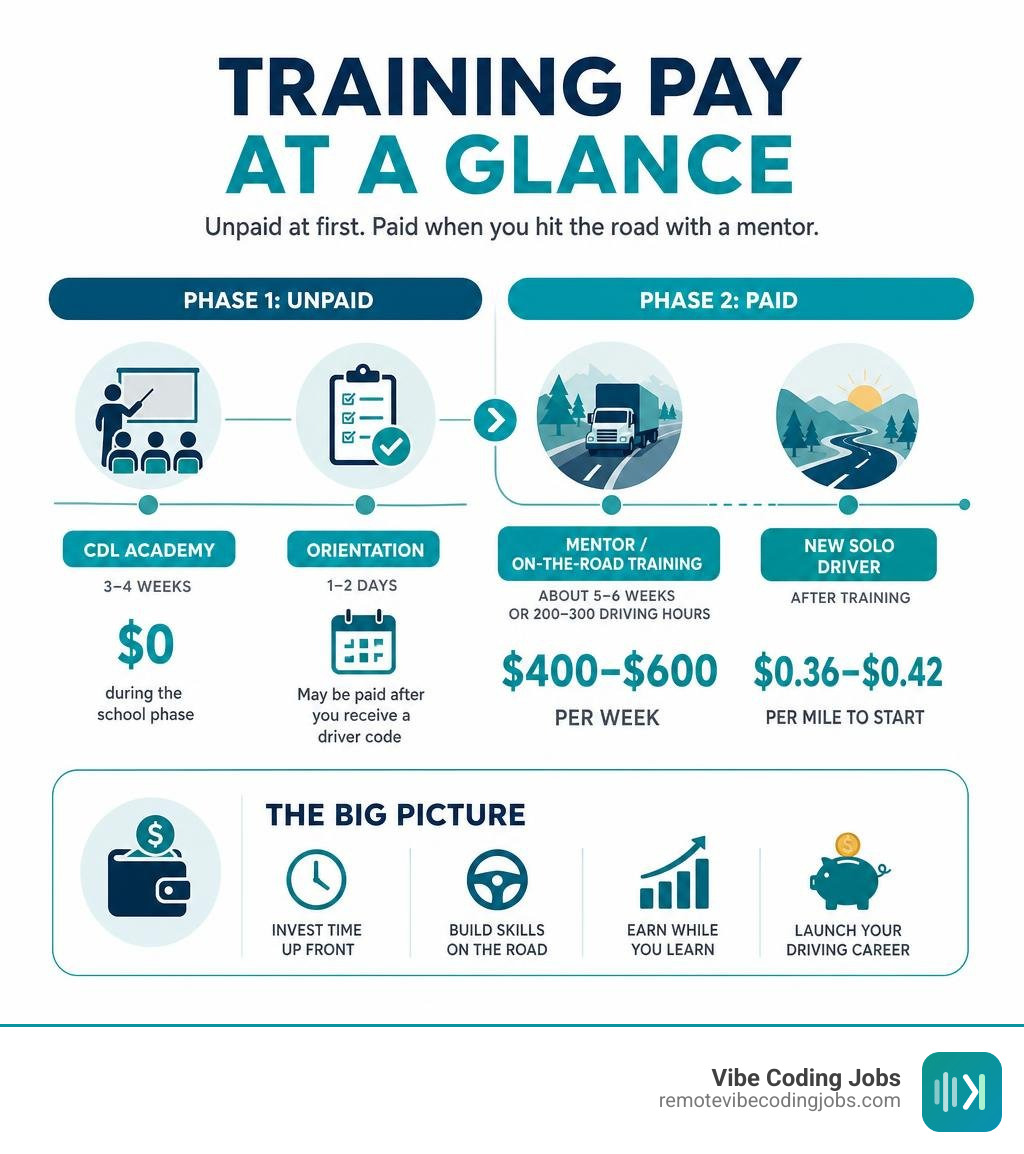
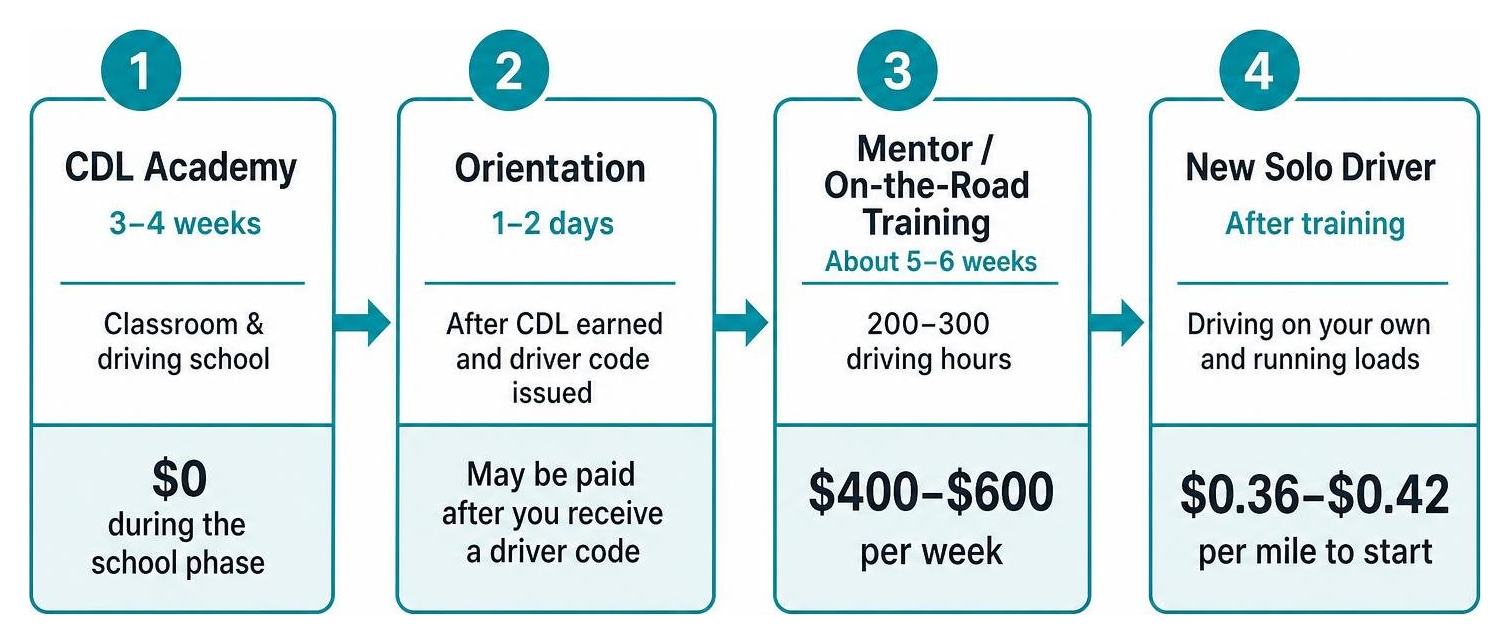
How much does Swift pay for training? The short answer is: it depends on the phase. The initial 3-4 week CDL Academy classroom and driving-school period is generally unpaid. After you earn your CDL, complete orientation, and begin on-the-road mentorship, reported trainee pay is commonly around $400-$600 per week.
At RemoteVibeCodingJobs, most of our readers are comparing career-change paths: paid apprenticeships, CDL training, bootcamps, remote entry-level tech roles, and AI-assisted development jobs. This guide looks at Swift Transportation training pay as a practical compensation case study so you can compare the cash-flow realities of trucking training with the income timeline of remote, async-first tech work.
| Training phase | Typical length | Typical pay |
|---|---|---|
| CDL Academy | 3-4 weeks | $0 during the school phase |
| Orientation | 1-2 days | May be paid after you receive a driver code |
| Mentor / on-the-road training | About 5-6 weeks, or 200-300 driving hours | About $400-$600 per week |
| New solo driver | After training | About $0.36-$0.42 per mile to start |
That simple answer leaves out the part that matters most: tuition, housing, payroll deductions, and the commitment tied to Swift Academy can change what you actually take home. A training program can look affordable upfront while still creating costs that follow you into your first year as a driver. Those same questions matter in tech career planning too: when do you get paid, what costs come first, and how long does it take before a new skill starts producing income?
I’m Di Su, a software engineer and growth-focused marketer who has spent more than a decade breaking down pay structures, career paths, and financial trade-offs into clear information. For this guide on how much does Swift pay for training, I focus on the numbers applicants need to compare before signing an agreement or choosing between trucking and remote AI-assisted development work.
How much does swift pay for training vocabulary:
How Much Does Swift Pay for Training Across Every Phase?
Entering a new career requires knowing exactly when money starts flowing into your bank account. In commercial trucking, carriers break student development down into distinct steps. If you are asking how much does swift pay for training, you need to look at each step individually rather than assuming a single flat salary from day one.
That phase-by-phase view is also useful for readers comparing trucking with remote tech work. CDL training, coding bootcamps, self-study, internships, and junior developer hiring pipelines all have different cash-flow timelines. The key question is not only total annual pay, but also how long you can afford to train before steady income begins.
The Swift progression moves from classroom study to hands-on driving with a senior mentor, followed by solo driving dispatches. Understanding this multi-step schedule helps you prepare a personal living budget so you do not run out of funds midway through your instruction.
CDL Academy Phase: How Much Does Swift Pay for Training in School?
During the initial CDL Academy phase, which typically runs 3 to 4 weeks, students receive $0 per week in wage pay. You are not yet considered an official W-2 employee of the company during this period. Instead, you are enrolled as a student working toward your Commercial Driver’s License Learner’s Permit and Class A license.
While Swift fronts the cost of your academy tuition and provides hotel lodging, you must cover incidental living costs out of your own pocket. Meals, commercial learner’s permit (CLP) testing fees, DOT physical exam fees, and state licensing expenses remain your personal responsibility. Swift regularly runs shuttles from student housing to local stores so trainees can purchase groceries, but you will need personal savings to cover 3 to 4 weeks of food and living expenses while earning zero wages. To learn more about this initial phase, read this detailed breakdown on Does Swift Pay for Training.
For career switchers, this is the first major comparison point. An unpaid CDL school period may be manageable if you have savings and want an in-person driving career. If you need to keep earning while learning, remote-friendly tech upskilling or AI-assisted coding practice may offer a more flexible path because you can often study around an existing job.
On-the-Road Mentorship: How Much Does Swift Pay for Training with a Mentor?
Once you successfully earn your Class A CDL, pass initial testing, and complete onboarding, you transition to the over-the-road (OTR) mentorship phase. During this period, you are assigned to ride alongside an experienced driver mentor to complete 200 to 300 hours behind the wheel, which usually takes between 5 and 6 weeks.
During mentorship, trainee compensation increases. Trainees typically receive a predictable flat weekly stipend ranging between $400 and $600 per week (with some regions structuring pay as $450/week for weeks 1-4, and $550/week for week 5 and beyond). This ensures steady compensation regardless of shipper delays or traffic congestion while you learn.
| Phase Element | CDL Academy Phase | OTR Mentorship Phase |
|---|---|---|
| Duration | 3 to 4 weeks | 5 to 6 weeks (200-300 hours) |
| Weekly Compensation | $0 per week | $400 to $600 per week |
| Employment Status | Student Trainee | Official Company Trainee |
| Housing & Lodging | Company-provided hotel | Sleeper berth in trainer’s truck |
| Food & Meal Expenses | Out-of-pocket personal expense | Personal expense on the road |
| Main Objective | Pass state CDL-A exam | Master road driving and maneuvers |
Orientation Pay and First Paycheck Timing
Between completing the CDL school and stepping into your mentor’s truck, you will attend a short company orientation lasting 1 to 2 days. Orientation covers company policies, medical forms, terminal tours, hair and urine drug screens, and administrative setup.
Orientation pay is contingent upon completing the session and agreeing to drive for the company. Once your official driver code is issued at the end of class, orientation pay is processed. Drivers typically receive their first official paycheck during the week immediately following orientation, marking their transition into paid employee status. You can check current entry-level driver requirements and program outlines through the official Swift CDL Training Overview.
If you are comparing this with remote tech hiring, treat the first paycheck date as a planning benchmark. In both fields, the period before your first paid role or assignment can be the most financially stressful part of the transition.
Swift Academy Costs, Tuition Reimbursement, and Contract Fine Print
While the upfront cost of CDL school can be prohibitive at private truck driving schools, company-sponsored academies remove immediate tuition hurdles through financing arrangements. However, it is essential to understand the fine print surrounding tuition charges, weekly paycheck deductions, and mandatory employment timelines.
This is where the comparison to remote tech training becomes especially important for RemoteVibeCodingJobs readers. Some career paths require a contract, tuition balance, or repayment obligation. Others rely on self-directed learning, portfolios, certifications, or job-ready projects built with AI coding tools. The best option depends on your savings, risk tolerance, learning style, and need for immediate income.

Tuition Cost and Payroll Deductions Breakdown
Attending Swift Academy incurs a base tuition fee ranging between $3,900 and $6,000, depending on location and enrollment structure. If you choose to utilize company-provided hotel housing during school, an additional optional housing fee of $750 is added to your total contract balance.
To repay this balance, Swift uses an automatic payroll deduction system once you become a full-time driver:
- Phase 1 (First 12-13 Months): Swift deducts approximately $150 to $200 per month ($37.50 to $50 per week) directly from your gross pay to cover tuition costs.
- Phase 2 (Months 13-26): If you remain employed continuously through your second year, Swift pays you back that same $150 to $200 per month as a tuition reimbursement bonus.
If you complete the full 26-month commitment, your tuition is effectively 100% reimbursed, making the program debt-free over time.
For anyone weighing CDL school against a move into remote software work, the practical question is total cost of entry. A trucking academy may reduce upfront tuition but create a service commitment. A tech path may require a laptop, time, practice projects, and job-search discipline, but it usually does not require signing a carrier-specific employment contract.
Early Departure Penalties and Contract Terms
Leaving your employer before fulfilling your contractual obligation completely alters the financial math. If you quit or are terminated for cause before completing the initial 12-to-13-month agreement, tuition reimbursement stops immediately, and the remaining tuition balance becomes due.
Specifically, drivers who resign early owe an early termination fee, often calculated at $300 for every remaining month left on the initial 13-month deduction schedule. For example, if you leave after only 3 months of solo driving, you may immediately owe thousands of dollars in accumulated tuition debt to the carrier or a designated collection agency. Reviewing the complete contract terms and tuition reimbursement details before enrolling ensures you understand these debt recovery procedures.
When comparing this model to carriers offering fully paid training from day one, the financial differences become obvious. Programs that pay students $500-$600 per week starting during classroom training with zero tuition debt eliminate early-exit penalties entirely, offering a stark contrast to programs requiring unpaid school time and multi-year repayment contracts. The same principle applies when comparing career-change options outside trucking: look beyond advertised starting pay and calculate repayment risk, lost wages, relocation, equipment, and time-to-hire.
First-Year Driver Earnings and Pay Structure After Training
After finishing your 200 to 300 mentor hours and passing your final solo upgrade evaluation, you are assigned your own truck. Your pay model then transitions from flat weekly training stipends to variable per-mile rates and performance incentives.
For readers exploring remote vibe coding jobs, this section is useful because it shows how a non-tech career path converts training into earnings. Trucking compensation often depends on miles, freight availability, route type, safety metrics, and time away from home. Remote developer compensation usually depends on skill level, portfolio quality, tech stack, company budget, and ability to work asynchronously with modern AI tools.

Per-Mile Pay Rates and Performance Bonuses
New graduates running over-the-road (OTR) dry van routes typically start at $0.36 to $0.42 per mile (CPM). Pay raises occur as you reach safe driving milestones:
- Starting Rate: $0.36 – $0.42 CPM
- 30,000 to 50,000 Safe Miles: Pay rates often increase to $0.46 – $0.48 CPM
- Performance Bonuses: Drivers can earn additional ranking bonuses and safety incentives based on low customer service failures, fuel efficiency, and clean CSA safety inspections.
This is different from most remote tech roles, where pay is normally quoted as hourly, monthly, project-based, or annual salary rather than per mile. If you are comparing both paths, convert each option into estimated monthly take-home pay after training costs, taxes, travel expenses, and unpaid ramp-up time.
First-Year Salary Expectations
When factoring in initial unpaid school weeks, mentor pay, and variable weekly mileage during your rookie year, realistic first-year earnings for new graduates average between $38,000 and $48,000 annually (though high-mileage drivers on specialized or dedicated routes can push total gross compensation closer to $50,000).
To protect new drivers from unpredictable terminal delays or slow freight cycles, carriers frequently offer a guaranteed weekly minimum pay structure, typically around $800 to $900 per week, during your first 90 days of solo driving, provided you meet availability and safety criteria. To see how entry-level trucking pay compares to entry-level roles in technology and engineering, explore overall driver compensation and salary trends.
For a complete overview of starting per-mile rates and account structures, consult this comprehensive Swift Driver Pay Breakdown.
From a career-planning perspective, the first-year number is only one part of the decision. Also compare lifestyle fit, schedule control, remote-work availability, physical demands, time away from home, and whether you prefer operating equipment on the road or building software with AI-assisted tools.
Frequently Asked Questions About Swift Training Pay
Do you get paid while attending the Swift CDL Academy?
No. Trainees receive $0 per week in wages during the 3-4 week CDL Academy classroom and driving pad phase. Swift covers upfront tuition and lodging arrangements, but trainees are not official W-2 employees until completing orientation and starting mentorship.
If you are comparing this with a remote tech career path, budget for the unpaid learning period in both cases. The difference is that CDL school is usually scheduled in person, while coding practice and AI-assisted development training can often be done around another job.
What happens if you quit Swift before completing your contract?
If you quit or are terminated before fulfilling your service commitment (typically 12 to 26 months), all remaining tuition balances become due immediately. You will be billed roughly $300 per month for each remaining month in the primary contract period, which can be sent to collection agencies if left unpaid.
Before signing, compare that obligation with other career-change options that may have lower contractual risk, such as self-paced technical learning, portfolio building, or applying for remote junior roles once you have job-ready skills.
Are meals and living expenses covered during CDL school?
No. Students must bring personal funds to cover food, beverages, and personal supplies during their 3 to 4 weeks at the academy. Shuttles are provided to take trainees to local grocery stores, but all food expenses are out-of-pocket.
That living-expense gap is one reason career changers should compare total transition costs, not just advertised pay. Whether you choose trucking or remote tech, the most important number is how much cash you need before your first reliable paycheck.
Conclusion
Determining how much does Swift pay for training reveals a clear trade-off: you get access to commercial driver training with no money down, but you must absorb 3 to 4 weeks of unpaid school time, modest weekly mentor stipends ($400-$600/week), and a long-term contract obligation. For prospective drivers who need immediate income or prefer zero debt, comparing paid-training competitors, self-funded CDL options, or alternative career paths is essential.
For RemoteVibeCodingJobs readers, the larger lesson is career math. Before committing to any path, compare unpaid training time, contract risk, first-year earnings, lifestyle demands, and long-term flexibility. Trucking may be a strong fit if you want a hands-on transportation career and can handle weeks on the road. Remote AI-assisted development may be a better fit if you want location flexibility, async collaboration, and work built around software tools like Cursor and Claude.
If heavy manual labor, long weeks away from family, and contract debt sound unappealing, modern technology careers offer an attractive alternative. Today, async-first tech companies hire remote developers for roles leveraging artificial intelligence and modern tooling. If you prefer building digital products from the comfort of your home over logging 60-hour weeks on the highway, explore remote developer career opportunities with our team at RemoteVibeCodingJobs today.