
Why Using a Remote Developer Job Board the Right Way Saves You Hours
The best remote developer job boards in 2026 — ranked by niche and use case:
| Job Board | Best For | Standout Feature |
|---|---|---|
| Vibe Coding Jobs | AI-native & vibe coding roles | 60 curated AI-first positions |
| Social impact boards | Social impact & mission-driven tech | Filter by impact area (climate, health, etc.) |
| Regional IT platforms | Broad US developer roles | 2,332 IT & software listings with salary data |
| General remote aggregators | High-volume search | 92,651 jobs, 11,317 added weekly |
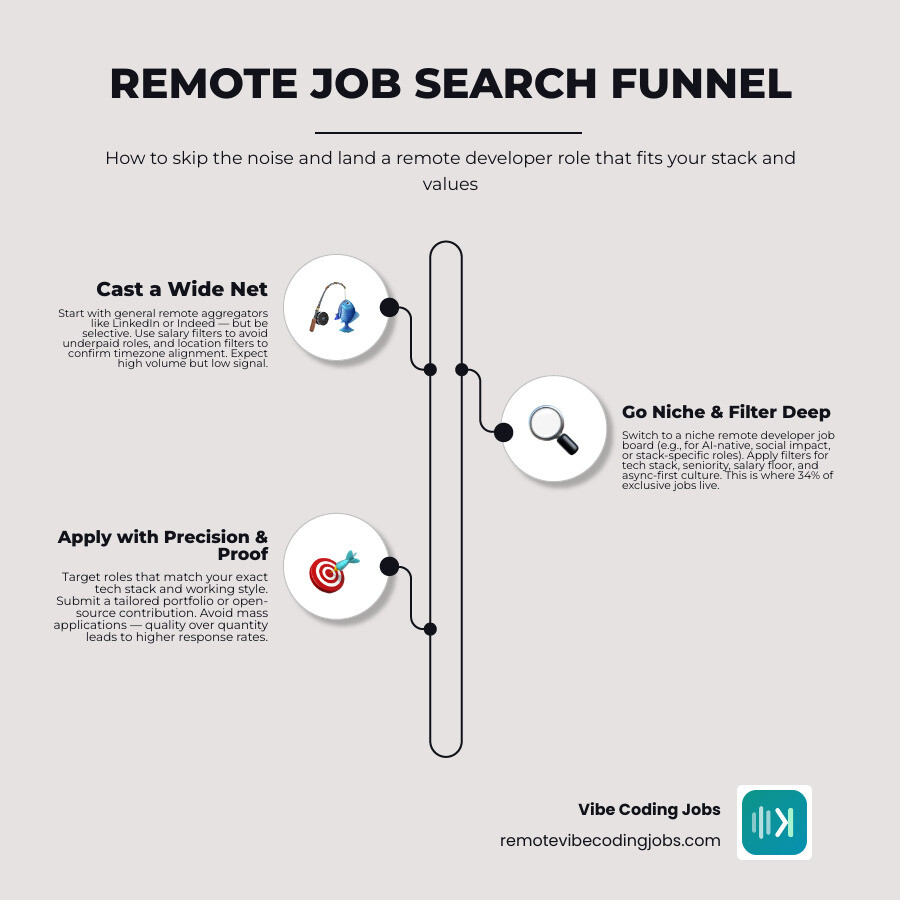
Most developers open LinkedIn, search “remote developer,” get 10,000 results, and apply to jobs that ghost them. It’s exhausting.
Here’s the real problem: the best remote developer roles often aren’t where you’re looking. Around 34% of remote developer jobs are never posted to LinkedIn — they live exclusively on niche job boards. That means a huge slice of the market is invisible if you’re only using the obvious platforms.
The right remote developer job board doesn’t just show you more jobs. It shows you the right jobs — filtered by your tech stack, seniority, salary floor, and whether the company is actually async-first or just remote-tolerant.
I’m Di Su, a software engineer with over 10 years of experience in web development and scalable product-building, and my work optimizing developer workflows has given me a close-up view of how the remote developer job board landscape has shifted — especially with the rise of AI-native roles. In this guide, I’ll cut through the noise and show you exactly how to use filters to find verified remote roles that match your stack and working style.
Remote developer job board helpful reading:
How to Choose the Right Remote Developer Job Board for Your Tech Stack
Choosing the right platform is the first step to skipping the application noise. Different job boards cater to entirely different developer ecosystems. If you are a React developer looking for an async-first startup, searching on a legacy corporate job board will only leave you drowning in hybrid enterprise listings requiring five rounds of whiteboard interviews.
By matching your personal tech stack and preferred programming languages to specialized platforms, you immediately filter out irrelevant noise. The goal is to spend your time applying to high-yield positions where your specific skills are explicitly in demand.
Why a Niche Remote Developer Job Board Beats General Job Sites
General job boards operate on volume. They scrape thousands of listings, many of which are outdated, duplicate, or mislabeled. This results in “remote” jobs that actually require you to live within 50 miles of an office for a hybrid schedule.
In contrast, a niche remote developer job board curates positions specifically for software engineers. This curation ensures higher-quality data, transparent salary ranges, and accurate tech stack tags. More importantly, as our data shows, 34% of these remote jobs are exclusive and never make it to LinkedIn. When companies post on specialized developer boards, they are looking for targeted tech stack matching and are often willing to bypass the bureaucratic resume filtering systems used by massive corporations.
How to Filter a Remote Developer Job Board to Find Exclusive Listings
If you want to find the hidden gems, you need to master the search filters on specialized platforms.
When we look at the data, the scale of the remote market is massive. On one major aggregator, there are 92,651 total remote jobs listed, with 11,317 new jobs added in a single week. If you do not use filters, you will be completely overwhelmed. To find the best opportunities, we recommend a structured approach.
First, filter by geographic restrictions. Many “remote” roles are actually localized to specific countries or time zones due to tax compliance. Next, apply strict salary filters. Platforms with transparent salary data make it easy to filter out underpaying roles immediately. Finally, look for “Exclusive” or “Is on LinkedIn?” filters. By targeting the 34% of jobs that are not cross-posted to major platforms, you instantly reduce your competition from thousands of applicants to just a handful of qualified developers. For a deeper look at these dynamics, check out our Remote Job Board Statistics.
Navigating Developer Niches: From Social Impact to AI-Native Teams
As we progress through 2026, the remote developer job market has fragmented into highly distinct developer niches. It is no longer just about choosing between frontend and backend; instead, developers are aligning their careers with specific company cultures, working methodologies, and technical paradigms.
Mission-Driven Tech and Social Impact Roles
For developers who want their code to solve real-world problems rather than just optimize corporate ad clicks, the social impact tech sector is booming. Organizations in this space are leveraging technology to tackle massive systemic issues such as climate change, poverty alleviation, healthcare access, and education.
Specialized social impact job boards focus entirely on these mission-driven organizations. If you look at their active listings, you will find opportunities to build data pipelines for environmental nonprofits, scale virtual tutoring platforms, or develop systems for poverty alleviation.
Crucially, these roles disprove the myth that working for a good cause means taking a vow of poverty. Remote software engineering and product roles in the social impact sector offer highly competitive salaries, generally ranging from $75,000 for mid-level support roles to over $210,000 for senior engineers and architects. These organizations actively recruit for advanced technical positions in Machine Learning, DevSecOps, and Data Science, proving that you can work on cutting-edge tech while making a tangible difference.
The Rise of Vibe Coding and AI-Native Engineering
On the other end of the spectrum is the most disruptive trend of 2026: the institutionalization of “vibe coding” into legitimate, high-paying corporate roles.

Vibe coding refers to an AI-assisted development workflow where developers use natural language prompts and advanced AI tools to rapidly build, prototype, and deploy software. Instead of spending hours writing boilerplate code, vibe coders collaborate with AI agents to move 3x to 10x faster than traditional developers.
This is no longer just a hobbyist trend. Forward-thinking companies are building dedicated “AI-native engineering teams” and “GTM AI pods.” On specialized job boards like Vibe Coding Jobs, there are currently 60 open positions specifically for AI-native developers, including roles like:
- Junior Agentic Engineer: Designing and maintaining autonomous AI agents.
- AI Pilot: Leading rapid prototyping and web scraping workflows.
- Vibe Coder Product Developer: Bridging the gap between product design and engineering by bypassing traditional design handoffs.
These roles require deep familiarity with AI-first development environments like Cursor, Claude Code, GitHub Copilot, Windsurf, Lovable.dev, v0.dev, and bolt.new. To provide proper context for AI agents in these environments, developers are even creating new configuration standards like SKILL.md and ARCHITECTURE.md files to guide their digital co-pilots.
Remote Developer Salary Benchmarks and In-Demand Skills (2025-2026)
To negotiate effectively in the 2026 job market, you must understand current salary benchmarks and which skills command a premium. The rise of AI-assisted development has shifted what companies are willing to pay for. While manual coding is increasingly automated, system design, code review, and product thinking are highly valued.
Here is a breakdown of remote developer salaries across different experience levels and niches:
| Experience Level / Niche | Salary Range (Annual / Hourly) | In-Demand Skills & Tools |
|---|---|---|
| Entry-Level / Associate | $85,000 – $100,000 | React, Python, basic debugging, Git |
| Mid-Level Developer | $105,000 – $150,000 | TypeScript, Node.js, Cloud APIs, Cursor |
| Senior Software Engineer | $160,000 – $240,000 | System Architecture, Claude Code, CI/CD, Go |
| Web3 / Blockchain Engineer | $180,000 – $260,000 | Solidity, Rust, Smart Contracts, Web3.js |
| AI Training / LLM Evaluation | $65 – $300 / hour | Python, Prompt Engineering, Fine-Tuning |
| Vibe Coder / AI Product Designer | $103,000 – $230,000 | Cursor, v0.dev, Tailwind, Rapid Prototyping |
According to recent data from the Stack Overflow Developer Survey, developers who integrate AI tools into their workflows report significantly higher job satisfaction and productivity. Python and React remain dominant in general web development, but expertise in AI-native orchestration (like LangChain or LlamaIndex) and prompt optimization has become the fastest route to securing premium remote rates.
Frequently Asked Questions about Remote Developer Hiring
Navigating the remote job market can raise a lot of questions, especially with how quickly technology and hiring practices are evolving. Here are answers to some of the most common questions developers have in 2026.
How can beginners or junior developers find remote work without extensive experience?
Finding a remote job as a junior developer has traditionally been difficult because remote teams require high autonomy. However, the rise of AI-assisted development tools has leveled the playing field.
To stand out, junior developers should use specialized job boards that offer dedicated filters for “beginner remote jobs” or “entry-level” roles. Roles like Associate Software Engineer (which start around $85,000 to $100,000) are designed specifically for early-career developers.
Additionally, focus on building a clickable portfolio of live, working products. Because tools like Cursor and Claude Code allow you to build functional MVPs quickly, showing that you can actually ship and maintain a live application is far more valuable to a remote hiring manager than a static resume. Contributing to open-source projects and documenting your AI prompting workflows can also demonstrate your readiness for an autonomous remote environment.
What is the difference between remote-only, hybrid, and onsite job listings?
Understanding these distinctions on a remote developer job board is crucial to avoiding application friction:
- Remote-Only (True Remote): You can work from anywhere, though some listings may have geographic restrictions (e.g., “US-Only” or “EU-Only”) for legal, tax, or payroll compliance. True remote-only companies often embrace async-first communication, meaning you don’t have to be online at the exact same hours as your teammates.
- Hybrid: This requires you to live within commuting distance of an physical office, split between working from home and working on-site (e.g., 2 days in the office, 3 days remote).
- Onsite: Traditional office-based roles with no regular work-from-home options.
Always check the timezone alignment requirements in the job description to ensure your working hours align with the team’s core collaboration windows.
How do ‘vibe coding’ roles differ from traditional software engineering jobs?
Traditional software engineering focuses heavily on manual syntax writing, managing complex memory allocations, and writing boilerplate code. It requires deep, continuous focus on the mechanics of writing code.
Vibe coding, on the other hand, shifts the developer’s role from “writer” to “editor and architect.” Vibe coders use natural language prompts to direct AI agents to write the code, then spend their time reviewing, debugging, and integrating those pieces.
While vibe coding allows you to build products up to 10 times faster, it still requires a solid understanding of programming fundamentals. You must be able to spot when an LLM hallucinating, manage context windows, optimize prompt chains, and ensure that the AI-generated code meets security, performance, and testing standards.
Conclusion
Finding your next remote role doesn’t have to be a numbers game of endless applications and radio silence. By leveraging a specialized remote developer job board, you can bypass the noise of general job sites, target exclusive listings, and align your search with your specific tech stack and values.
At Vibe Coding Jobs, we aggregate remote “vibe coding” and AI-assisted development jobs at async-first companies. We curate daily listings filtered by culture, tech stack, and modern AI tools like Cursor and Claude, helping you find forward-thinking teams that value speed and modern workflows.
Ready to find your next remote role? Explore our resources:
- Compare Remote Job Boards to find the right platform for your search.
- See Who’s Hiring Remote Developers right now.
- Learn how to work in flexible environments with our guide on Async-First Remote Developer Jobs.
- Looking to scale your team? Post a Job and Hire Remote Developers with us today.
Skip the noise and find your dream remote role at Vibe Coding Jobs.