
The Async Vibe Developer Job Market Is Real — and Growing Fast
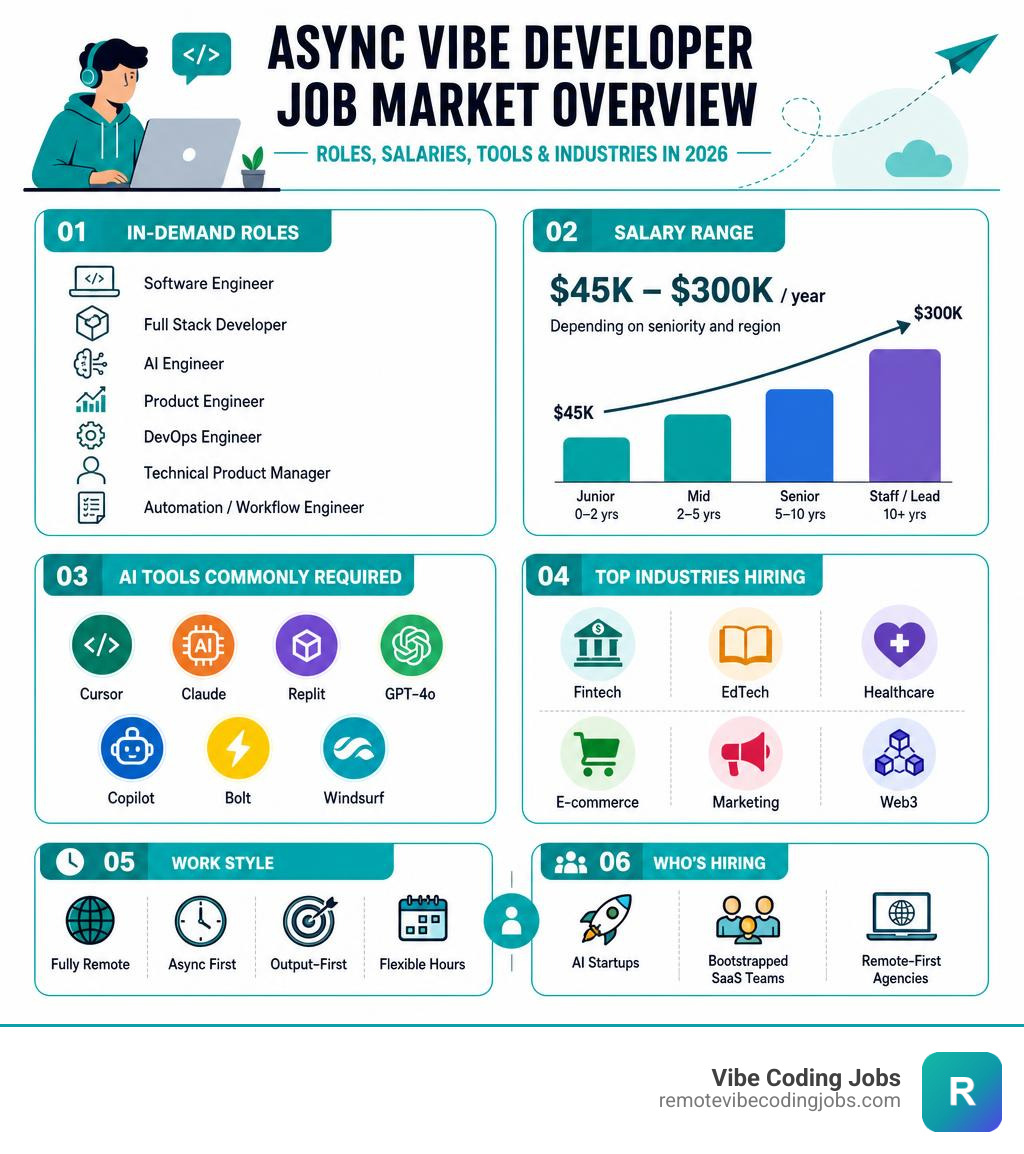
Async vibe developer jobs are one of the fastest-growing categories in remote tech hiring right now. As of May 2026, there are 194 remote positions actively listed that explicitly value or require AI-assisted development skills.
Here’s a quick snapshot of what’s available:
| What | Details |
|---|---|
| Open roles | 194 remote vibe coding positions listed |
| Salary range | $45K-$300K/year depending on seniority and region |
| AI tools required | Cursor, Claude, Replit, GPT-4o, Copilot, Bolt, Windsurf |
| Experience needed | 0-2 years (junior) to 10+ years (senior AI engineer) |
| Work style | Fully async, output-first, flexible hours |
| Top industries hiring | Fintech, EdTech, healthcare, e-commerce, marketing, Web3 |
| Who’s hiring | AI startups, bootstrapped SaaS teams, remote-first agencies |
Over 40% of these listings explicitly name AI tools like Cursor or Claude as requirements – not nice-to-haves. And it’s not just engineering roles. Product managers, operations leads, and even finance roles are now asking for vibe coding ability.
The model is simple: ship fast, own outcomes, skip the standups.
If you’ve been building side projects late at night with AI tools, automating workflows nobody asked you to automate, and obsessing over new model releases, companies are actively looking for you.
I’m RVCJ Editorial, the team behind Remote Vibe Coding Jobs, where we cover AI-assisted development, async work culture, and the hiring market for developers building with tools like Cursor, Claude, and Replit. We’ve tracked this market from early AI-assisted tooling to the hiring category it has become in 2026, and the guide below pulls from real job postings, compensation data, and workflow patterns across hundreds of roles.
What async vibe developer jobs are—and why they are different
An async vibe developer is a software builder who uses AI tools as a normal part of the development process and works in a mostly asynchronous environment.
That means two things happen at once:
- You build with AI.
- You communicate without needing constant meetings.
Vibe coding is using tools like Cursor, Claude, Replit, Copilot, Bolt, Windsurf, and v0 to move from idea to working software faster.
Async development is the work culture around it: written specs, Loom walkthroughs, GitHub issues, decision logs, documentation, and progress updates that teammates can read later.
Put together, async vibe developer jobs are for people who can turn vague business problems into shipped software without waiting for a manager to turn every step into a ticket.
If you want the broader remote-work foundation, our guide to async-first remote developer jobs breaks down how this culture works.
How async vibe developer jobs differ from traditional software engineering
Traditional engineering roles often involve long cycles: product writes requirements, engineering breaks them into tickets, developers estimate them, teams discuss them in daily standups, and developers wait for design or QA approvals before shipping.
Async vibe developer jobs compress that loop.
Instead of waiting for perfect requirements, you may build a working prototype first. Instead of manually writing repetitive boilerplate, you use AI copilots. Instead of spending hours in synchronous meetings, you post a detailed async update.
The biggest differences are:
| Traditional engineering | Async vibe development |
|---|---|
| Ticket-driven | Outcome-driven |
| Manual boilerplate-heavy | AI-assisted and prompt-first |
| Daily standups | Written async updates |
| Long planning cycles | Prototype-first discovery |
| Clear handoffs | High ownership |
| Specialized roles | Full-stack/product overlap |
| “Wait for requirements” | “Clarify by building” |
This does not mean standards disappear. In fact, strong engineering judgment matters more. AI can generate bad code very quickly. Your job is to know what to accept, what to refactor, what to test, and what to delete.
The “lazy-but-productive” developer profile companies want
The phrase “lazy-but-productive” is affectionate. It does not mean careless. It means you dislike unnecessary work so much that you automate it.
Companies hiring async vibe developers tend to love people who:
- Build personal tools without being asked.
- Use AI to remove repetitive tasks.
- Think in systems, not just tickets.
- Can ship a rough but useful prototype quickly.
- Prefer outcomes over optics.
- Write clear updates.
- Ask good questions when requirements are fuzzy.
- Know when “done” is better than “perfect.”
- Can work without a manager hovering nearby.
This profile is showing up in real hiring language. Many vibe coding job descriptions emphasize ownership, curiosity, tool fluency, rapid prototyping, and side projects. Some even ask candidates to show what they have built rather than leaning only on resumes.
The best candidates are not just “AI prompt people.” They are engineers with product sense who can use AI as leverage.
Common job titles that signal vibe coding work
Not every company uses the title “Vibe Coder.” Many roles hide the same work under more familiar names.
Watch for titles like:
- Vibe Coder
- AI Developer
- AI-Assisted Software Engineer
- Product Builder
- Full-Stack AI Developer
- Applied AI Engineer
- GTM Engineer
- Automation Engineer
- Internal AI Lead
- Agent Ops Engineer
- AI Product Engineer
- Systems and Automation Engineer
- AI-Native Backend Engineer
- Technical Product Builder
The titles differ, but the pattern is the same: use AI tools to build useful software faster.
The vibe stack: skills, AI tools, and async workflows that get you hired
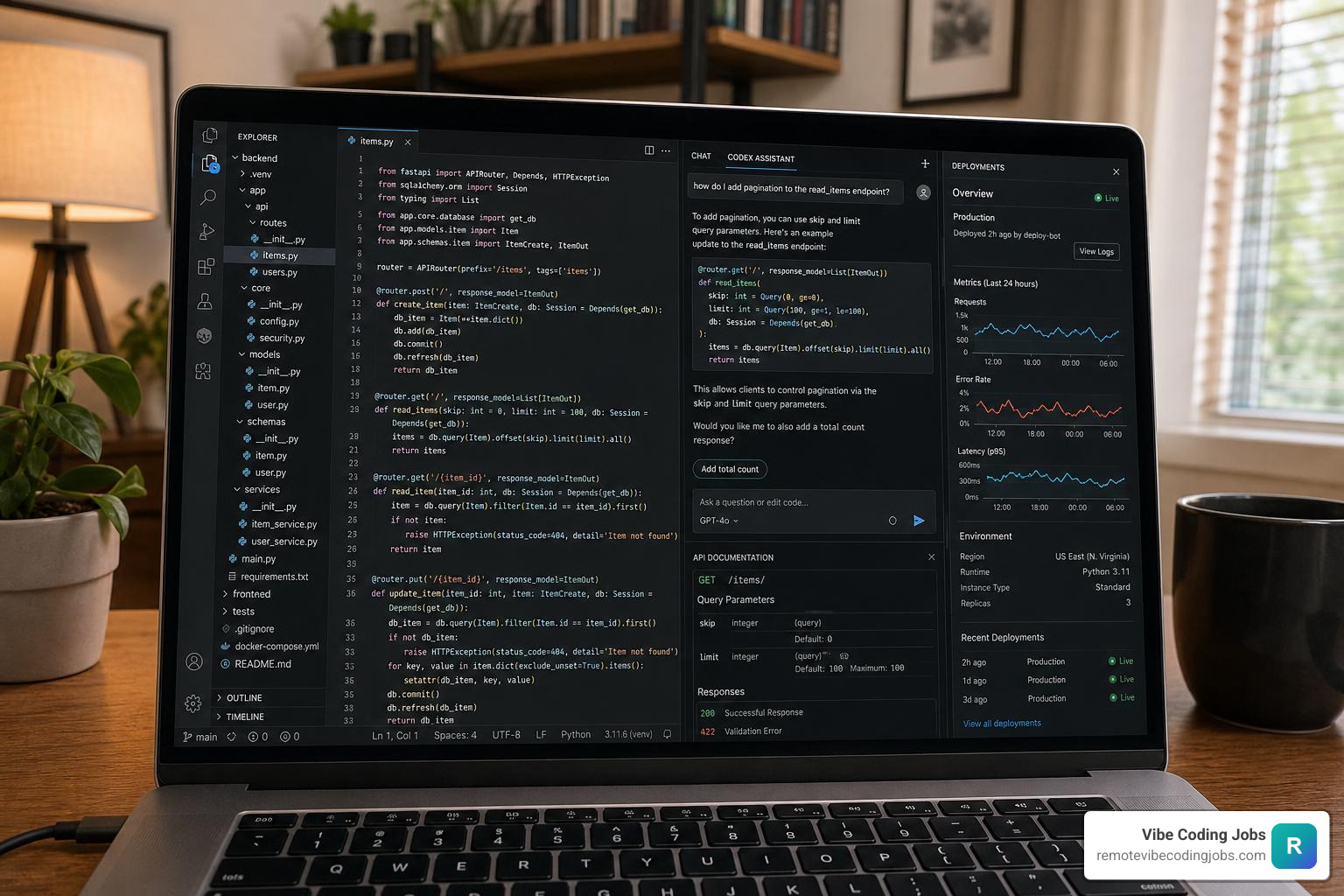
The “vibe stack” is the toolkit behind modern AI-assisted development. It includes your programming fundamentals, your AI coding tools, your automation platforms, and your async communication habits.
A strong vibe stack usually includes:
- A real programming language.
- A modern web framework.
- An AI-native editor or coding assistant.
- API integration skills.
- Deployment knowledge.
- Testing and debugging habits.
- Clear written communication.
For a deeper breakdown of AI tooling, see our guide to remote developer jobs and AI tools.
Core technical skills behind the AI layer
AI tools help you move faster, but employers still expect real technical skill.
Common technical requirements include:
- Python
- JavaScript
- TypeScript
- React
- Next.js
- Node.js
- FastAPI
- Firebase
- Postgres
- API integration
- Docker
- Cloud deployment basics
- Authentication and permissions
- Testing
- Debugging
- Code review
- Security basics
The key point: AI can help you generate code, but it cannot fully own production judgment for you.
You still need to understand:
- Whether the database schema makes sense.
- Whether an API call is secure.
- Whether generated code handles errors.
- Whether the app will scale.
- Whether user data is protected.
- Whether tests cover the risky parts.
In other words, the AI can hand you a chainsaw. You still need to know which tree you are cutting.
AI-assisted development tools employers keep naming
Across job postings, the most commonly named tools include:
- Cursor and Cursor Composer
- Claude and Claude Code
- Replit Agents
- GitHub Copilot
- GPT-4o
- Bolt
- Windsurf and Cascade
- v0
- Lovable
- OpenAI APIs
- Anthropic APIs
- Gemini APIs
Employers are not just asking, “Have you tried ChatGPT?” They want to know if you can use AI inside a real build workflow.
That means:
- Prompting an LLM to generate a first version.
- Asking the model to explain unfamiliar code.
- Using AI to debug errors.
- Creating small agents for repetitive tasks.
- Building RAG workflows for company knowledge.
- Reviewing AI output before merging.
- Keeping prompts, assumptions, and tradeoffs visible.
Some roles also ask for automation tools like n8n, Make, Zapier, Airtable, HubSpot, and Slack integrations. These are especially common in business automation, RevOps, marketing, and internal tooling roles.
Async communication habits that matter as much as code
In async-first teams, communication is part of the product.
You need to be good at:
- Written updates
- Loom walkthroughs
- Slack threads
- GitHub issues
- Pull request summaries
- Decision logs
- Async specs
- Changelogs
- README files
- Documentation
A simple async update might include:
- What I shipped
- What changed
- What is blocked
- What I need feedback on
- What I will do next
- Link to demo, PR, or Loom
Great async developers reduce uncertainty. They do not disappear into the forest for three days and return with “fixed stuff.”
If this is a growth area for you, read our guide to async-first remote developer communication.
Portfolio proof for async vibe developer jobs
For async vibe developer jobs, your portfolio may matter more than your degree, title, or perfectly formatted resume.
Employers want proof that you can ship.
Build portfolio projects like:
- AI customer support assistant: Connect an LLM to a knowledge base with retrieval, citations, and fallback behavior.
- Lead qualification bot: Score inbound leads, push results to a CRM, and trigger Slack notifications.
- Internal dashboard: Pull data from multiple APIs, summarize metrics with AI, and deploy securely.
- Workflow automation: Use n8n, Make, or Zapier to automate a repetitive business process and document the time saved.
- AI web scraper: Extract structured data, summarize results, and respect rate limits and legal constraints.
- Prompt-to-app prototype: Build a working MVP using v0, Bolt, Replit, or Cursor with a clear README explaining AI usage.
- RAG knowledge tool: Upload documents, query them with an LLM, and demonstrate retrieval quality.
For every project, include:
- GitHub repo
- Live demo
- Loom walkthrough
- README
- Setup instructions
- What AI tools you used
- What you manually reviewed
- Known limitations
That last part matters. Saying “AI built this” is less impressive than saying “AI generated the first draft, then I refactored auth, added tests, fixed edge cases, and deployed it.”
How companies hire and evaluate vibe coders
Hiring for vibe coding is becoming more portfolio-first and project-first.
Many companies care less about whether you can solve an abstract algorithm problem on a whiteboard and more about whether you can ship a useful tool quickly, explain your decisions, and work independently.
Some real hiring patterns include:
- Written application
- Short Loom intro
- Side project review
- 30-minute call
- Paid test project
- Async handoff exercise
- Technical discussion
- Fast offer process
This is good news if you are a builder. Less “reverse a linked list while someone watches” and more “show us the useful thing you made.”
Typical async vibe developer jobs interview loop
A common interview loop looks like this:
- Short written intro: Share what you have built, your tool stack, and why the role fits.
- 5-minute Loom: Walk through a project, explaining the problem, product, and tradeoffs.
- Intro call: A 30-minute discussion focused on motivation, autonomy, and communication.
- Technical conversation: Discuss architecture, review your AI workflow, and talk through debugging.
- Paid build challenge: Complete a small real-world task like an automation or prototype.
- Async handoff: Submit code, a README, a Loom, and notes explaining how to continue.
- Offer: Fast-moving AI teams often extend offers quickly for strong projects.
The best candidates make the evaluation easy. They show their work clearly and communicate like future teammates, not mysterious wizards.
What a strong vibe coding test project looks like
A strong test project is small, useful, and complete.
For example:
- Build a lead scoring tool that enriches inbound leads and posts a summary to Slack.
- Create a dashboard that pulls usage data and generates AI summaries.
- Build a mini internal assistant that answers questions from uploaded documents.
- Prototype a user-facing feature with authentication, database storage, and deployment.
A good submission includes:
- Working deployment
- Clean repo
- README
- Setup steps
- Short Loom walkthrough
- Tests for core logic
- Error handling
- Security notes
- Prompt logs or AI workflow notes
- Tradeoff explanation
Employers are looking for judgment. If the AI generated something risky, did you catch it? If requirements were vague, did you clarify assumptions? If you skipped something, did you explain why?
How employers define “vibe coding” in hiring
In hiring, vibe coding usually means:
- Natural language prompting
- AI orchestration
- Fast prototyping
- Tool fluency
- Debugging AI-generated code
- Product sense
- Maintainable output
- Autonomy
- Creativity
- Technical fundamentals
The best definition is not “coding by vibes only.” It is closer to:
“Using AI tools to move faster from problem to working software, while applying human judgment to architecture, quality, security, and product fit.”
That last part is the difference between a vibe coder and a chaos goblin with API credits.
Salaries, compensation, and industries hiring in 2026

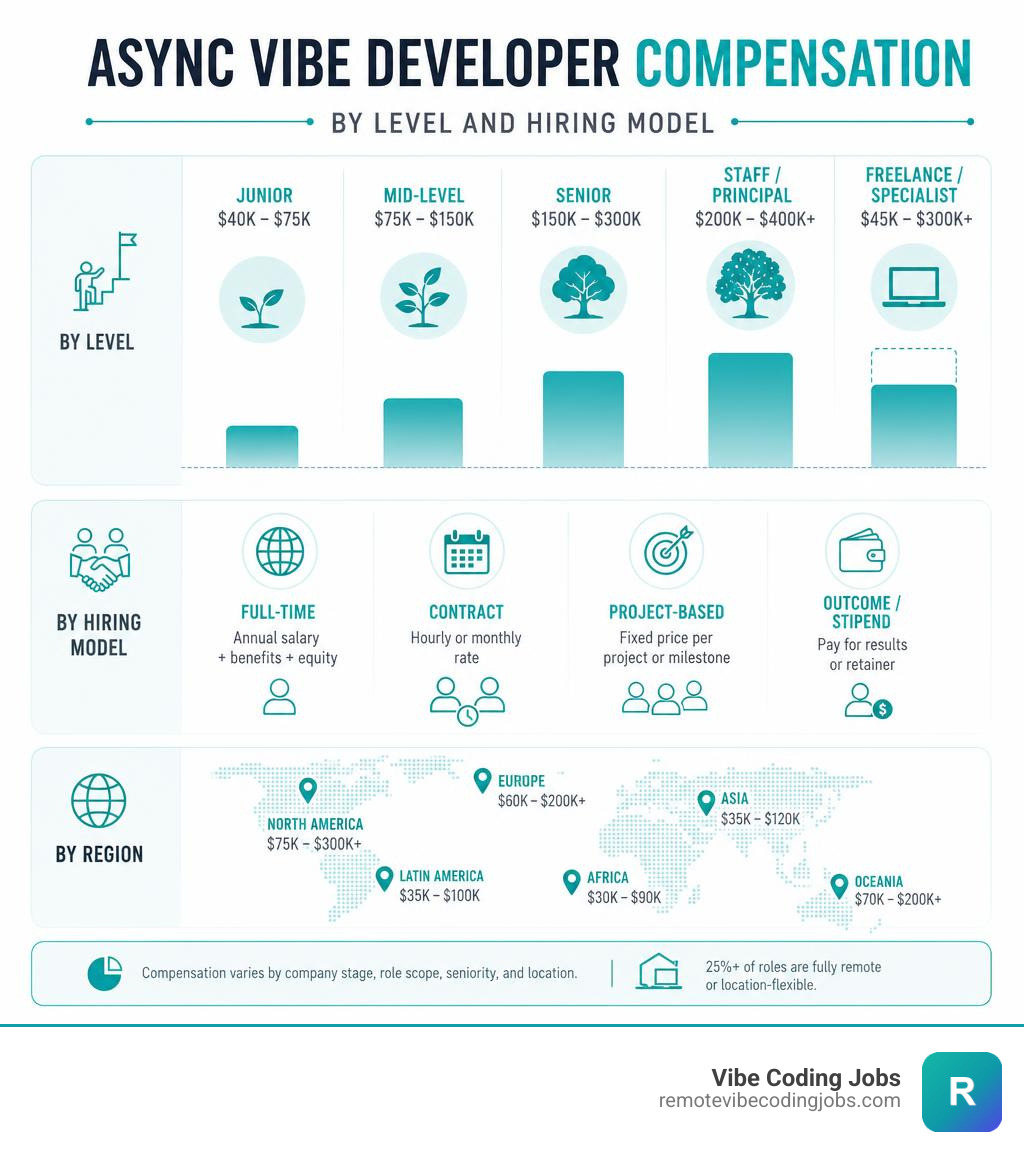
Compensation for async vibe developers varies widely because the category includes junior automation builders, mid-level full-stack developers, senior AI engineers, GTM engineers, and freelance specialists.
Based on current market patterns in May 2026:
- Entry-level and junior AI developer roles often range from around $40K to $75K.
- Broader vibe coding roles average around $45K to $300K.
- Senior AI engineering roles can reach $150K to $300K or more, often with equity.
- Freelance and contract roles may pay hourly, fixed-project, or stipend-based compensation.
Over 25% of vibe coding listings are fully remote or location-flexible, leading to varied compensation models including global bands, regional adjustments, or outcome-based contract pay.
Compensation by seniority and region
Below is a practical market summary. Exact pay depends on company stage, role scope, seniority, and whether compensation is location-adjusted.
| Level / role type | Typical compensation range | Notes |
|---|---|---|
| Junior AI developer / automation builder | $40K–$75K/year | Often portfolio-friendly; may include part-time or flexible roles |
| Mid-level full-stack vibe developer | $75K–$150K/year | Strong web stack, API integration, and AI tool fluency expected |
| Senior AI engineer / applied AI engineer | $150K–$300K/year | Often includes agentic workflows, architecture, production AI systems |
| GTM engineer / RevOps automation engineer | $80K–$180K/year | Mix of full-stack, data, CRM, sales systems, and AI workflows |
| Freelance vibe coder | Hourly or project-based | Pay varies by scope, speed, niche, and proof of shipped work |
| Global remote contractor | Wide range | Often adjusted by market, time zone overlap, and independence |
Benefits can include:
- Equity
- Paid time off
- Equipment budgets
- Flexible hours
- Health benefits
- Contractor stipends
- Performance bonuses
- Paid test projects
In async roles, compensation is increasingly tied to ownership. The more directly your work improves revenue, saves time, or ships product, the stronger your negotiating position.
Industries adopting async vibe development fastest
The fastest adopters are industries with repetitive workflows, lots of data, or pressure to ship faster.
We are seeing strong demand in:
- Healthcare
- Fintech
- EdTech
- E-commerce
- Marketing
- Sustainability
- Web3
- Media
- Streaming technology
- Logistics
- Real estate
- Travel
- Enterprise SaaS
- AI-native agencies
Why these industries?
Because vibe coding is useful wherever teams need:
- Internal tools
- Workflow automation
- Data dashboards
- AI assistants
- Customer support bots
- Content pipelines
- Sales automations
- Prototypes
- API integrations
A finance team may need Python automations. A marketing team may need AI content operations. A healthcare startup may need internal dashboards. An EdTech company may need AI-assisted learning tools.
The common thread: small teams want more output without adding layers of process.
Company types hiring vibe developers now
The companies most likely to hire vibe developers include:
- AI startups
- Profitable bootstrapped teams
- Remote-first agencies
- Internal automation teams
- RevOps teams
- Product-led SaaS companies
- Education platforms
- Async-first engineering organizations
- Founder-led teams
- Small product pods
These teams often want builders who can go from “we have a messy workflow” to “here is a working tool” without requiring a six-person committee and a ceremonial roadmap blessing.
For more market context, read our guide to remote vibe coding jobs and career market growth.
Our focus remains curated AI-assisted developer roles with async-first culture signals, ensuring you find teams that match your preferred way of working.
The day-to-day reality: workflow, ownership, risks, and the future
The day-to-day life of an async vibe developer is fast, flexible, and sometimes messy.
A typical day might include:
- Reading async updates.
- Reviewing a product problem.
- Prompting Claude or Cursor for implementation ideas.
- Building a prototype.
- Refactoring AI-generated code.
- Connecting APIs.
- Recording a Loom.
- Opening a pull request.
- Shipping a small fix.
- Updating docs.
- Testing a workflow with real users or teammates.
There are fewer meetings, but more responsibility. Nobody tells you exactly what to do every hour. For some, that is freedom; for others, a challenge.
Our guide to async-first workflow productivity goes deeper on this operating style.
Daily responsibilities in an async vibe developer role
Common responsibilities include:
- Building MVPs
- Creating prototypes
- Integrating APIs
- Writing and refining prompts
- Reviewing AI-generated code
- Deploying features
- Fixing bugs
- Writing documentation
- Automating workflows
- Improving internal tools
- Measuring outcomes
- Maintaining dashboards
- Supporting customer feedback loops
- Creating small AI agents
- Updating decision logs
You may work across frontend, backend, automation, data, and product. In smaller teams, “not my job” is not a winning phrase.
How rapid prototyping changes team structure and project management
Rapid prototyping changes how teams plan.
Instead of long documents, teams increasingly use functional demos. A prototype becomes the spec. Stakeholders react to something real rather than imagining a mockup.
This leads to:
- Smaller teams
- Fewer handoffs
- More founder-led priorities
- Direct communication with business owners
- Product-engineering overlap
- Faster feedback loops
- Ownership pods
- Async specs
- Demo-based planning
Some roles even report directly to founders or business leaders because the work is tied to revenue, operations, or customer experience.
Learn more in our guide to async-first developer roles and team structures.
Biggest risks of async vibe coding work
This style is powerful, but it has real risks.
The biggest challenges include:
- Burnout: Fast shipping can easily lead to constant shipping without boundaries.
- Unclear requirements: Async work relies on strong writing; vague goals lead to wasted effort.
- Over-reliance on AI: AI can generate confident nonsense, insecure code, or subtle bugs.
- Weak tests: Prioritizing speed over testing creates technical debt that becomes expensive later.
- Security gaps: AI-generated authentication, permissions, and data handling require careful human review.
- Context switching: Vibe roles often span product, backend, frontend, and automation rapidly.
- Isolation: Async remote work can feel lonely without intentional team connection.
- Scope creep: Small automation requests can quickly balloon into unmanageable tasks.
- Invisible work: Without clear documentation, your impact may go unnoticed.
- Lack of mentorship: Highly autonomous environments can be challenging for junior developers.
The fix is not to slow everything down forever. The fix is structure: clear docs, tests, prioritization, code review, and sustainable boundaries.
How traditional engineers can transition into vibe coding
If you come from traditional engineering, you already have an advantage: fundamentals.
To transition, build AI-assisted habits on top of those fundamentals:
- Master one AI tool: Start with Cursor, Claude, Replit, or Copilot to understand its strengths and limits.
- Rebuild a familiar project: Recreate an existing app with AI to see where it accelerates or blocks you.
- Build a prompt library: Save effective prompts for debugging, refactoring, testing, and architecture.
- Create automation projects: Build CRM workflows, dashboards, or scraping utilities to show practical value.
- Practice async writing: Write clear project updates, decision logs, and comprehensive README files.
- Record Loom walkthroughs: Learn to explain your technical decisions and product thinking in under five minutes.
- Maintain testing discipline: Ensure AI speed does not compromise code quality or security.
- Develop product thinking: Focus on how your technical solutions directly impact business outcomes.
- Document your workflow: Show employers how you collaborate with AI, rather than just presenting final code.
For communication habits, see our guide to async remote developer jobs and flexible communication.
What the future of async AI development looks like
The future of async AI development is not “developers disappear.” It is “developers manage more leverage.”
We expect more:
- Agentic IDEs
- Autonomous code agents
- Prompt-to-app workflows
- AI-native product teams
- Smaller engineering teams
- Faster MVP cycles
- Human review checkpoints
- AI product engineer roles
- Workflow automation roles
- Async-first hiring processes
- Evaluation based on shipped outcomes
The developer of the future may spend less time typing boilerplate and more time designing systems, supervising agents, validating output, protecting users, and deciding what should be built.
The best async vibe developers will be part engineer, part product thinker, part automation architect, and part “please stop me before I build another internal tool at midnight.”
Frequently Asked Questions about async vibe developer jobs
Are async vibe developer jobs only for senior engineers?
No. Async vibe developer jobs exist across experience levels, from junior AI developer roles to senior AI engineering positions.
That said, junior candidates need strong portfolio proof because many async teams are mentorship-light. If you have 0–2 years of experience, focus on:
- Shipped demos
- Clear READMEs
- Loom walkthroughs
- Small production projects
- Strong fundamentals
- Evidence of learning quickly
Senior candidates are expected to bring architecture, security, scalability, product judgment, and leadership.
Which AI coding tool should I learn first?
Start with one tool that helps you ship real projects.
Good first choices:
- Cursor for AI-native editing
- Claude for planning, debugging, and code review
- Replit for quick prototypes and hosted apps
- GitHub Copilot for inline coding help
Do not try to “collect” tools. Employers care less about your tool zoo and more about whether you can use AI to build, debug, test, and deploy useful software.
A practical path:
- Build a small app in Cursor.
- Use Claude to review architecture and generate tests.
- Deploy it.
- Record a Loom.
- Repeat with a harder project.
Do vibe coding roles still require real engineering fundamentals?
Yes. Absolutely. Loudly yes.
AI-assisted roles still require:
- Architecture
- Testing
- Security
- Scalability
- Maintainability
- Data modeling
- API design
- Debugging
- Code review
- Production ownership
AI makes weak fundamentals more dangerous because it lets you create more code faster. The best vibe developers use AI as leverage, not as a substitute for understanding.
Conclusion
Async vibe developer jobs are no longer a weird corner of the market. In May 2026, they are a real hiring category with hundreds of remote opportunities, strong compensation ranges, and demand across engineering, product, operations, RevOps, and automation.
The winning profile is simple:
- Use AI tools fluently.
- Keep your engineering fundamentals sharp.
- Communicate clearly async.
- Build and ship proof.
- Own outcomes.
- Avoid unnecessary meetings whenever possible, heroically.
At Vibe Coding Jobs, we curate daily listings for remote AI-assisted development roles at async-first companies. We filter by culture, tech stack, AI tools like Cursor and Claude, and remote work style so you can find roles that match how you actually want to work.
If you are ready for your next move, start with async-first remote developer jobs, grab our free playbook, and apply faster to roles built for modern lazy-but-productive developers.