
Remote Development Jobs Are Booming — Here’s What You Need to Know
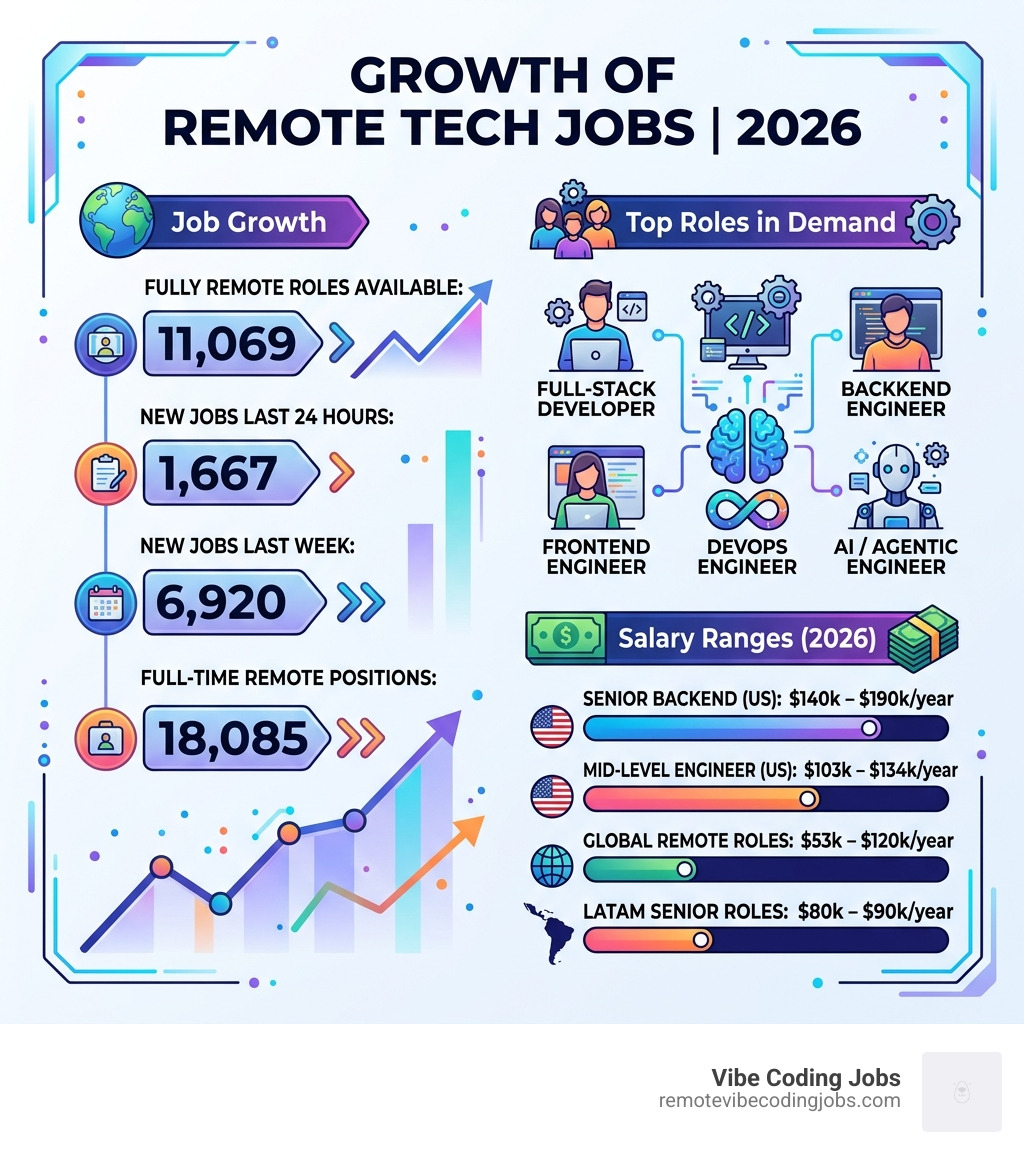
Remote development jobs are one of the fastest-growing career opportunities in tech right now. Here’s a quick snapshot of what’s available as of May 2026:
| Category | Numbers |
|---|---|
| Total remote developer jobs (US) | 20,000+ |
| Fully remote roles available | 11,069 |
| New jobs posted in the last 24 hours | 1,667 |
| New jobs posted in the last week | 6,920 |
| Full-time remote positions | 18,085 |
Top roles currently in demand:
- Full-Stack Developer
- Backend Engineer
- Frontend Engineer
- DevOps Engineer
- AI / Agentic Engineer
Salary ranges (2026):
- Senior Backend (US): $140k – $190k/year
- Mid-level Engineer (US): $103k – $134k/year
- Global remote roles: $53k – $120k/year
- LATAM senior roles: $80k – $90k/year
The market for remote developer work has never been more active. Companies across fintech, healthtech, real estate, and HR tech are hiring globally — and many now run fully async teams with no daily standups, flexible hours, and competitive salaries that rival on-site roles.
Whether you’re a senior engineer looking for a high-paying async role or a mid-level developer ready to go fully remote, there are more verified opportunities available today than at any point in the past.
One trend reshaping hiring in particular: the rise of AI-assisted development — sometimes called “vibe coding” — is creating entirely new job titles and pushing salaries higher for developers who can work fluently with tools like Cursor, Claude Code, and GitHub Copilot.
This guide breaks down where the best roles are, what they pay, what skills matter most, and how to apply effectively.
I’m RVCJ Editorial, the team behind Vibe Coding Jobs — we cover AI-assisted development, remote hiring trends, and practical job-search advice for developers navigating the remote development jobs market at async-first, AI-native companies. We’ve helped thousands of developers cut through the noise and find roles that actually match their stack and culture preferences.
The Current State of remote development jobs
As we navigate through May 2026, the landscape of software engineering has fundamentally shifted. We are no longer just talking about “working from home” on Fridays; we are looking at a globalized, digital-first workforce where location is becoming a secondary detail to skill and output.
The numbers are staggering. In the United States alone, there are over 20,000 developer listings, with 11,069 specifically tagged as remote. What is even more impressive is the velocity of the market. In just the past 24 hours, 1,667 new remote development jobs were posted. This isn’t a stagnant pool; it’s a rushing river of opportunity.

We’ve seen a massive surge in “async-first” cultures. These are companies that have realized daily standups at 9:00 AM EST don’t work when your lead engineer is in Warsaw and your designer is in Medellín. Instead, they rely on deep work, written documentation, and sophisticated CI/CD pipelines to keep the wheels turning. If you’re ready to skip the commute and join this movement, you can Browse Remote Development Jobs on Vibe Coding Jobs to see the latest curated listings.
High-Demand remote development jobs by Specialization
Not all roles are created equal in the remote world. While generalists are always valued, the 2026 market rewards specialization—especially in areas that support distributed infrastructure and AI integration.
- Full-Stack Developers: The “Swiss Army Knives” of the web. Companies love remote full-stackers because they can own a feature from the database to the UI, reducing the need for constant back-and-forth communication between teams.
- Backend Engineers: High demand remains for those who can build scalable, high-availability systems. We see a lot of Elixir, Node.js, and Go in these listings, often with a heavy focus on PostgreSQL and AWS serverless architectures.
- Frontend Engineers: With the rise of complex web apps, experts in React and Next.js who understand accessibility and performance are highly sought after.
- DevOps & Infrastructure: Since remote companies live and die by their cloud presence, DevOps engineers who can manage GitLab CI/CD pipelines and AWS environments are the unsung heroes of the remote world.
- AI Specialists & Agentic Engineers: This is the newest and hottest category. Companies are looking for developers who don’t just “know” AI, but can build “agentic workflows”—autonomous systems that use LLMs to solve business problems.
If you’re just starting out, don’t be discouraged. There are paths for everyone. Check out our guide on How to Land Your First Remote Job as a Developer (2024 Guide) to build your roadmap.
Where to Find the Best remote development jobs
Gone are the days when you could just refresh a single job board and find everything you need. To find the highest quality remote development jobs, you need a multi-pronged approach:
- Specialized AI and Vibe Coding Boards: Traditional boards are often cluttered with “hybrid” roles that aren’t actually remote. We specialize in aggregating roles that embrace the future of coding—AI-assisted development and async culture.
- Direct Company Portals: Many of the best remote-first companies (like Remote.com or Filevine) post directly to their own sites first.
- Developer Communities: Slack groups, Discord servers, and niche forums are where the “hidden” job market lives.
- LinkedIn and Aggregators: While broad, they are useful if you use the right filters (e.g., “Remote” + “Past 24 hours”).
Ready to stop searching and start applying? Find Your Next Remote Developer Role through our curated platform.
Salary Benchmarks and Benefits
One of the biggest questions we get is: “Will I make less money if I work remotely?” The answer in 2026 is a resounding no—provided you target the right markets. Many companies now use “global compensation strategies” that pay well above local rates, regardless of where you sit.
| Region | Senior Role (Annual USD) | Mid-Level Role (Annual USD) |
|---|---|---|
| United States | $140,000 – $190,000 | $103,000 – $134,000 |
| LATAM (Preferred) | $80,000 – $90,000 | $50,000 – $70,000 |
| Global Remote | $53,300 – $120,000 | $45,000 – $85,000 |
We are seeing a trend called “geo-arbitrage,” where developers live in lower-cost-of-living areas while earning salaries pegged to major tech hubs. For more details on how these numbers shift when you add AI skills into the mix, see our analysis on Vibe Coding Salary – Remote vs Onsite Growth.
Typical Benefits in Remote Tech
In 2026, a competitive salary is just the baseline. Because remote companies aren’t paying for expensive San Francisco office space, they often reinvest those savings into incredible employee perks:
- Unlimited PTO: A standard in high-trust, async environments.
- Stock Options: Getting a piece of the pie is common in VC-backed startups.
- Home Office Budget: Many companies provide $1,000+ to ensure your “vibe” is right (ergonomic chairs, 4K monitors, etc.).
- Parental Leave: We’ve seen many remote-first companies offer 16 weeks of paid parental leave.
- Learning & Development: Budgets for books, courses, and conferences are standard to keep your skills sharp.
To understand how these perks compare to traditional office life, read more about Remote Work Perks and Compensation Trends.
How to Land Your Next Role
Applying for remote development jobs is a different beast than interviewing for a local office job. You aren’t just being judged on your code; you’re being judged on your ability to communicate through a screen.

The process often involves:
- Portfolio Building: Your GitHub or personal site is your resume. Show, don’t just tell.
- Async Code Exercises: Instead of a high-pressure whiteboard session, many remote companies give you a “take-home” or an async exercise to complete on your own time.
- System Design: Especially for senior roles, you’ll need to explain how you’d build scalable architectures across distributed teams.
If you hate the stress of live coding, you’ll love our guide on Remote Coding Jobs No LeetCode – Easy Interview, Practical Skills.
Essential Tech Stacks for 2026
If you want to be competitive in the current market, these are the technologies that appear most frequently in 2026 job descriptions:
- Frontend: React, Next.js, and TypeScript are the industry standards.
- Backend: Node.js remains king, but Elixir (and the Phoenix framework) is seeing a huge surge for high-concurrency systems.
- Database: PostgreSQL is the go-to for almost every modern remote startup.
- Cloud/Infra: AWS (specifically Lambda and serverless) and GitLab for CI/CD are must-haves.
The Future: Vibe Coding and AI-Assisted Development
We can’t talk about remote development jobs in 2026 without talking about “vibe coding.” This isn’t just a buzzword; it’s a fundamental shift in how we build software. Vibe coding refers to the flow state where a developer acts more like an architect or a conductor, using AI tools to handle the “manual grind” of syntax.
At RemoteVibeCodingJobs, we see that developers using tools like Cursor, Claude Code, and GitHub Copilot are reporting 2x to 5x productivity gains. Companies are now explicitly hiring for “AI fluency.” They don’t want someone who spends six hours debugging a CSS centering issue; they want someone who can prompt an AI to fix it in seconds and spend those six hours on high-level system logic.
This shift toward “agentic workflows”—where AI agents handle planning, execution, and verification—is the new frontier. To stay ahead of the curve, check out our insights on AI Coding Jobs Market Trends & Growth.
Frequently Asked Questions about Remote Development
What are the geographic restrictions for remote jobs?
Even “fully remote” jobs can have restrictions. Some are US-only due to tax laws or security clearances. Others might be LATAM preferred to ensure time zone overlap with a North American team. Always check if a role is “Worldwide” or restricted to specific regions like Europe or Asia.
Are there entry-level remote developer opportunities?
Yes! While many remote roles lean toward senior levels because they require less “hand-holding,” there is a growing market for junior developers and interns who are “AI-native.” If you can show you’re 10x more productive using AI tools, you can bypass the traditional “years of experience” requirements. See our guide on Remote Coding Jobs – Get Hired Without Experience (2024 Guide).
How does the application process work?
Most remote companies follow a 5-to-7 step process:
- Recruiter Screening: A quick chat to check cultural fit.
- Async Exercise: A take-home project or code challenge.
- Technical Interview: Deep dive into your project and tech stack.
- Bar Raiser: An interview with someone outside your immediate team to ensure high standards.
- Executive/Founder Round: Final vibe check.
- Offer & Verification: Background and reference checks.
Conclusion
The era of the cubicle is over. Remote development jobs offer a level of freedom, flexibility, and compensation that was unimaginable a decade ago. By mastering the right tech stack, embracing AI-assisted “vibe coding,” and targeting async-first companies, you can build a career that fits your life—not the other way around.
The future of tech is remote, AI-powered, and waiting for you. Find Your Next AI Engineering Role today and join the movement.