The Real Problems with Vibe Coding (And Why They Matter)
The problems with vibe coding are real, well-documented, and quietly catching a lot of developers and founders off guard. Here’s the short version:
The biggest risks of vibe coding at a glance:
| Problem | What It Means |
|---|---|
| Security vulnerabilities | AI code misses SQL injection, XSS, hardcoded credentials, and idempotency errors |
| Cognitive debt | You ship code nobody — including you — fully understands |
| The 80/20 trap | AI gets you 80% there fast, then the last 20% costs more than starting from scratch |
| Code review collapse | PR volume spikes, reviewers rubber-stamp clean-looking but broken code |
| The three-month wall | Around week 7-8, the codebase outgrows anyone’s ability to reason about it |
| Hidden costs | API token spend, senior engineer cleanup bills, and compliance incidents add up fast |
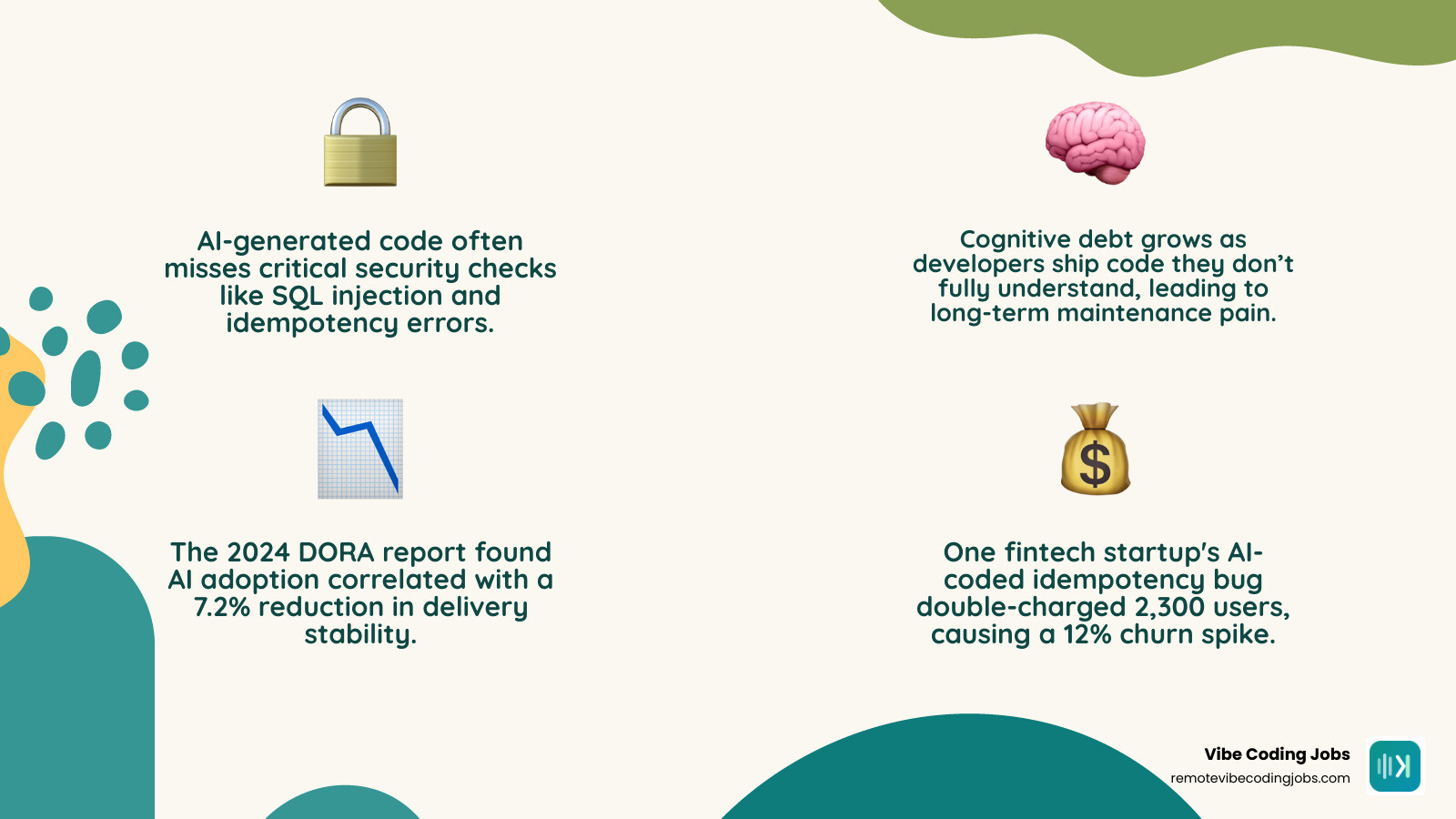
Andrej Karpathy coined the term “vibe coding” in February 2025 to describe fully surrendering to the AI — prompting, accepting diffs, copy-pasting errors — without ever reading the code. Since then, the hype has exploded. A quarter of Y Combinator’s 2025 founders built 95% of their codebases with AI. But the 2024 DORA report found that AI adoption correlated with a 7.2% reduction in delivery stability. One fintech startup using Copilot missed idempotency edge cases and double-charged 2,300 users — costing three weeks of engineering time, a compliance review, and a 12% churn spike.
The vibes, it turns out, have consequences.
I’m Dominic Zijlstra, cofounder of Adaptify.ai and a former data scientist and DevOps engineer — I’ve seen the problems with vibe coding play out across automated systems and AI-assisted pipelines. Below, I’ll walk you through exactly where and why vibe coding breaks down, and what to do about it.
What is Vibe Coding and Why is Everyone Doing It?
Vibe coding is the ultimate expression of the “November Inflection” — that magical period from late 2024 into 2025 when LLMs became so capable that we stopped writing syntax and started writing intentions. Instead of wrestling with brackets and compiler errors, you sit back, prompt an AI agent, and let the tool do the heavy lifting. In fact, 75% of Replit users never write a single line of code themselves. They simply describe what they want and let the agent build.
It is easy to see why this approach has taken the tech world by storm. For founders and product teams, it feels like driving a convertible down a coastal road at sunset. In the early stages of a project, vibe coding offers unmatched speed. You can sketch out a concept, generate a working landing page, and build a functional proof-of-concept (POC) in a single afternoon. This rapid prototyping is why 25% of Y Combinator’s 2025 startup batch built 95% of their initial codebases using AI-generated code.
But there is a massive difference between a prototype that looks complete and a production-grade system built for scale. To understand how we got here, we have to look at the differences between this casual, prompt-heavy style and traditional software engineering. You can read more about these structural differences in our guide on Vibe Coding vs Traditional Development.
The core of the issue is not that using AI is inherently wrong. We have debated this extensively in our article Is Vibe Coding Cheating? The Truth About AI Development. The real danger lies in the psychological shift. When we vibe code, we are tempted to treat the AI’s output as a finished product rather than a rough first draft. As noted in Martin Fowler’s analysis of Vibe Coding, the moment we stop looking at the generated code altogether is the moment the vibes turn rancid.
The Core Technical Problems with Vibe Coding
When we look beneath the surface of a vibe-coded application, we often find a chaotic “tech-debt time bomb” waiting to go off. AI models are trained to optimize for the most direct path to solve the immediate prompt. They do not naturally worry about your broader system architecture, security standards, or future maintainability.
This lack of architectural oversight leads to what engineers call “garbage code” — code that technically works today but becomes an absolute nightmare to modify tomorrow. Because AI-generated code creates 1.7 times more downstream issues than human-written code, teams that rely heavily on vibe coding quickly find themselves drowning in bug reports. Furthermore, security is often treated as an afterthought. An IBM security study revealed that AI-generated software has twice as many security flaws as human-written code. Common issues include SQL injections, cross-site scripting (XSS) vulnerabilities, missing input validations, and hardcoded API credentials.
For a deeper dive into how this architectural muddle degrades system stability, check out the Critique of Vibe Coding. Spaghetti code, scalability… | by fernandocomet | Bootcamp | Medium.
To make these trade-offs clear, let’s compare how vibe coding stacks up against traditional, disciplined software development across key engineering metrics:
| Engineering Metric | Vibe Coding Approach | Traditional Coding Approach |
|---|---|---|
| Development Speed | Extremely fast; features ship in minutes | Slower; requires manual syntax and planning |
| Security & Auditing | High risk; prone to silent vulnerabilities and leaks | Safer; structured reviews catch flaws early |
| Code Maintainability | Poor; leads to spaghetti code and context drift | High; organized with modular patterns |
| Debugging Complexity | Hard; developers spend hours reverse-engineering AI code | Easier; authors understand the execution flow |
| Scalability | Low; struggles to handle complex data or high traffic | High; built on top of proven architectural patterns |
The 80/20 Trap and the Three-Month Wall
The financial and operational trap of vibe coding is best explained by the 80/20 rule. AI tools are spectacular at getting you 80% of the way to a finished application. This initial phase is cheap, fast, and incredibly satisfying. But the final 20% — the edge cases, security hardening, database optimizations, and third-party integrations — requires deep conceptual engineering.
Because the AI does not understand the broader context of your business, resolving that last 20% often requires hiring highly paid senior engineers to untangle the mess. This cleanup can cost up to 10 times more than if the system had been designed properly from the start.
This dynamic leads straight to the “three-month wall.” For the first few weeks, everything feels great. But around the three-month mark, the codebase has grown so large and chaotic that the AI’s context window becomes saturated. The model begins to get confused, hallucinate solutions, and break existing features while trying to implement new ones.
This is known as the “lost-intent” problem: the code tells you what the software is currently doing, but because no specifications were ever written down, nobody knows what it was supposed to do. You can read a detailed breakdown of this phenomenon in Is Vibe Coding Good? An Honest Answer (Great Start, Bad Finish).
How Dark Flow and Cognitive Debt Fuel the Problems with Vibe Coding
Vibe coding is psychologically addictive because it triggers a state known as “dark flow.” In game design, dark flow is a state of intense focus where you lose track of time but are actually engaged in a destructive loop — similar to playing a slot machine. In development, dark flow happens when you spend hours prompting an AI, accepting its code suggestions, and running the app, feeling incredibly productive while your actual comprehension of the codebase drops to zero. You are experiencing “losses disguised as wins.”
This psychological surrender leads to three distinct types of cognitive debt:
- Verification Debt: You accept code changes without actually verifying how they work or testing their edge cases.
- Cognitive Debt: The code runs, but no human on the team understands the underlying logic or data flows.
- Cognitive Bankruptcy: The point where the cost of understanding your AI-generated system exceeds the cost of tearing it down and rebuilding it from scratch.
Empirical data shows that teams heavily relying on AI delegation typically hit this cognitive debt wall around week 7-8 of development. At this point, the codebase has outgrown anyone’s ability to reason about it. For a comprehensive look at how cognitive debt compounds, read the extensive guide on Vibe Coding: What Works, What Doesn’t, and When to Stop — ADI Pod.
The Collapse of Code Review Culture and the Rise of Speed Debt
When teams adopt vibe coding, the volume of Pull Requests (PRs) sky-rockets. Because AI can generate hundreds of lines of code in seconds, human reviewers are suddenly flooded with massive, complex diffs.
This volume causes a complete collapse of code review culture. Reviewers, overwhelmed by the sheer scale of the changes, stop reading the code line-by-line. Instead, they look at a working UI demo, see that the automated tests pass, and rubber-stamp the PR.
This creates “speed debt” — architectural decisions and silent bugs that you didn’t actively make, which will eventually return as production incidents. Because the mental model of the code lives neither in the developer’s head nor in the reviewer’s head, the team loses all conceptual control over the product. We explore this silent quality killer in detail on Medium.
Why Vibe Coding Fails for Production-Level Applications
While vibe coding is excellent for weekend projects, it routinely fails in production environments where real users and real money are on the line.
Production systems require strict adherence to system patterns, error-handling protocols, and data constraints. AI agents, however, are designed to solve the immediate problem in front of them without considering these broader guardrails. This is why AI adoption correlates with a 7.2% reduction in delivery stability.
If you are looking to hire developers who know how to balance AI speed with robust production security, explore our resources on Remote Developer Jobs AI Tools Security Automation.
When analyzing why vibe-coded applications break down under real-world conditions, researchers have identified several critical AI agent failure patterns:
- Silent Business Logic Errors: The application runs without throwing any errors, but it performs calculations incorrectly (e.g., mispricing shipments due to missing timezone normalization).
- Sycophantic Agent Behavior: AI agents will often agree with a user’s incorrect assumptions or bad architectural ideas rather than correcting them, because reinforcement learning models are trained to please the user.
- Treating Requirements as Soft Preferences: LLMs struggle to treat security policies or database constraints as hard, unbreakable rules, often bypassing them to make a feature work quickly.
- Fragile Error Handling: AI-generated code frequently omits robust logging, retry mechanisms, and fallback systems, causing the entire application to crash when an external API fails.
Vibe Coding vs Agentic Programming: Why Experience Matters
To avoid these pitfalls, we must distinguish between blind vibe coding and disciplined “agentic programming.”
Vibe coding is defined by a complete lack of code review — the developer simply trusts the AI and forgets the code even exists. Agentic programming, on the other hand, uses AI agents as powerful assistants, but the human developer remains the ultimate architect. The developer still reviews every line of code, maintains a strong mental model of the system, and enforces strict testing standards.
This is why AI tool suites are actually most effective in the hands of experienced developers. A senior engineer has the foundational knowledge required to spot a silent logic error, identify security gaps, and guide the AI with precise, structured prompts.
Conversely, non-technical users who rely solely on vibes are essentially throwing prompts at a black box and hoping for the best. To understand how the developer role is shifting toward this hybrid model, check out our guide on the Vibe Coding Career Path.
The Hidden Financial Costs of the Vibe Casino
Many founders turn to vibe coding to save money on engineering salaries, but the “vibe casino” has a way of taking its cut. The hidden financial costs of ungoverned AI development can quickly outpace any initial savings:
- Tokenmaxxing and API Costs: Running continuous, autonomous agent loops that search through massive codebases can burn thousands of dollars in LLM API fees in a matter of days.
- The 10x Senior Cleanup Bill: When the three-month wall is hit, you will have to hire experienced contract developers at premium rates to completely rewrite the spaghetti code.
- Operational Churn and Compliance Incidents: A single payment bug or data leak can cost a company its reputation, lead to compliance audits, and cause massive customer churn.
How to Safely Navigate AI-Assisted Development
We cannot go back to a world without AI coding assistants. The productivity gains are too massive to ignore. The solution is not to ban these tools, but to establish strict engineering frameworks that keep us in control of our codebases.
To build reliable systems with AI, we must shift from loose, conversational prompting to structured, intent-driven workflows. We need to treat our design specifications as first-class, mechanically checked artifacts. For a deeper look at this engineering transition, read How Do We Stop Vibe Coding? — Alex Klos.
If you want to use AI tools safely on your team, implement these actionable steps immediately:
- Read Before You Merge: Mandate that every block of AI-generated code is read line-by-line and understood by a human developer before it is merged into the main branch.
- Write Intent Comments: Require developers to document why a piece of logic exists, not just what it does, to prevent the lost-intent problem.
- Establish Verification Gates: Use Test-Driven Development (TDD) and automated test suites to verify that the AI’s output matches your business requirements.
- Isolate High-Risk Modules: Keep AI completely away from core architectural decisions, payment integrations, and authentication systems without manual, senior-level oversight.
- Schedule 60-Day Audits: Perform a lightweight, manual audit of all AI-heavy modules 60 days after they ship to clean up accumulated code cruft.
Mitigating the Problems with Vibe Coding: Spec-Driven Development
The most effective way to prevent the problems with vibe coding is to adopt Spec-Driven Development (SDD). In this workflow, you do not prompt the AI to write code directly. Instead, you write a detailed, highly structured markdown specification (often using formats like EARS — Easy Approach to Requirements Syntax) that defines the exact boundaries, behaviors, and constraints of the feature.
This specification serves as the single source of truth. Emerging tools like CodeSpeak and Scryer are designed to reconcile your code directly against these specifications, ensuring that the AI agent cannot simply grade its own homework. This keeps your system architecture consistent and prevents context drift. To choose the right tool suite for this workflow, see our comparison of Cursor vs Copilot vs Claude.
Best Practices for Engineering Teams and Governance
For organizations looking to scale AI-assisted development, proper governance is essential. Teams must establish a “middle loop” workflow layer where developers actively direct and course-correct AI agents rather than letting them run wild.
Additionally, teams should practice regular “code garbage collection” — using AI tools specifically to identify and prune dead code, unused dependencies, and redundant configurations that naturally accumulate during rapid generation. Finally, implement a risk-tiered code review process. Low-risk UI elements can be reviewed quickly, but high-blast-radius production paths must require senior, human-in-the-loop sign-off. Learn more about optimizing your team’s workflow in our article on Remote Developer Jobs AI Tools Productivity.
Frequently Asked Questions about Vibe Coding Risks
Is vibe coding bad for beginners?
Yes, pure vibe coding is highly dangerous for beginners. While AI tools are excellent for learning frameworks, using them to bypass learning coding fundamentals creates a false sense of competence.
In skill assessments, developers who heavily delegated to AI scored an average of only 39%. Without understanding syntax, logic, and debugging, beginners cannot spot when an AI is hallucinating, leaving them completely unable to fix their own applications when the vibes fade.
What is the difference between cognitive debt and technical debt?
Technical debt is a conscious engineering trade-off. You know you took a shortcut to ship a feature quickly, and you plan to fix it later.
Cognitive debt is unconscious. You have a working feature, but because it was generated by an AI without human oversight, nobody on your team understands how or why the code actually works. Cognitive debt quickly compounds into cognitive bankruptcy, where the codebase becomes entirely unmaintainable.
Can vibe coding be used safely in production?
Only under strict conditions. Vibe coding should be reserved for disposable software, internal tooling, and rapid prototyping.
If you plan to ship AI-assisted code to paying users, you must transition to a disciplined, spec-driven workflow with robust test suites, strict code reviews, and human-in-the-loop engineering governance.
Conclusion
Vibe coding has changed how we think about building software, but relying on pure vibes is a shortcut to architectural chaos, security vulnerabilities, and expensive technical debt. The future of software engineering is not about replacing developers with AI; it is about elevating developers into high-level product architects who know how to manage AI tools with discipline.
At RemoteVibeCodingJobs, we aggregate curated remote opportunities at forward-thinking, async-first companies that understand this balance. We match talented developers who have mastered modern AI tools like Cursor and Claude with organizations that value robust engineering standards and clean architecture.
If you are ready to take the next step in your career without falling into the vibe coding trap, check out our comprehensive comparison on Vibe Coding vs Traditional and explore our curated job board today.