
Why Becoming an AI Specialist Software Engineer Is One of the Best Career Moves You Can Make Right Now
An AI specialist software engineer is one of the fastest-growing and highest-paid roles in tech today. Here’s a quick snapshot of what the role involves and why it matters:
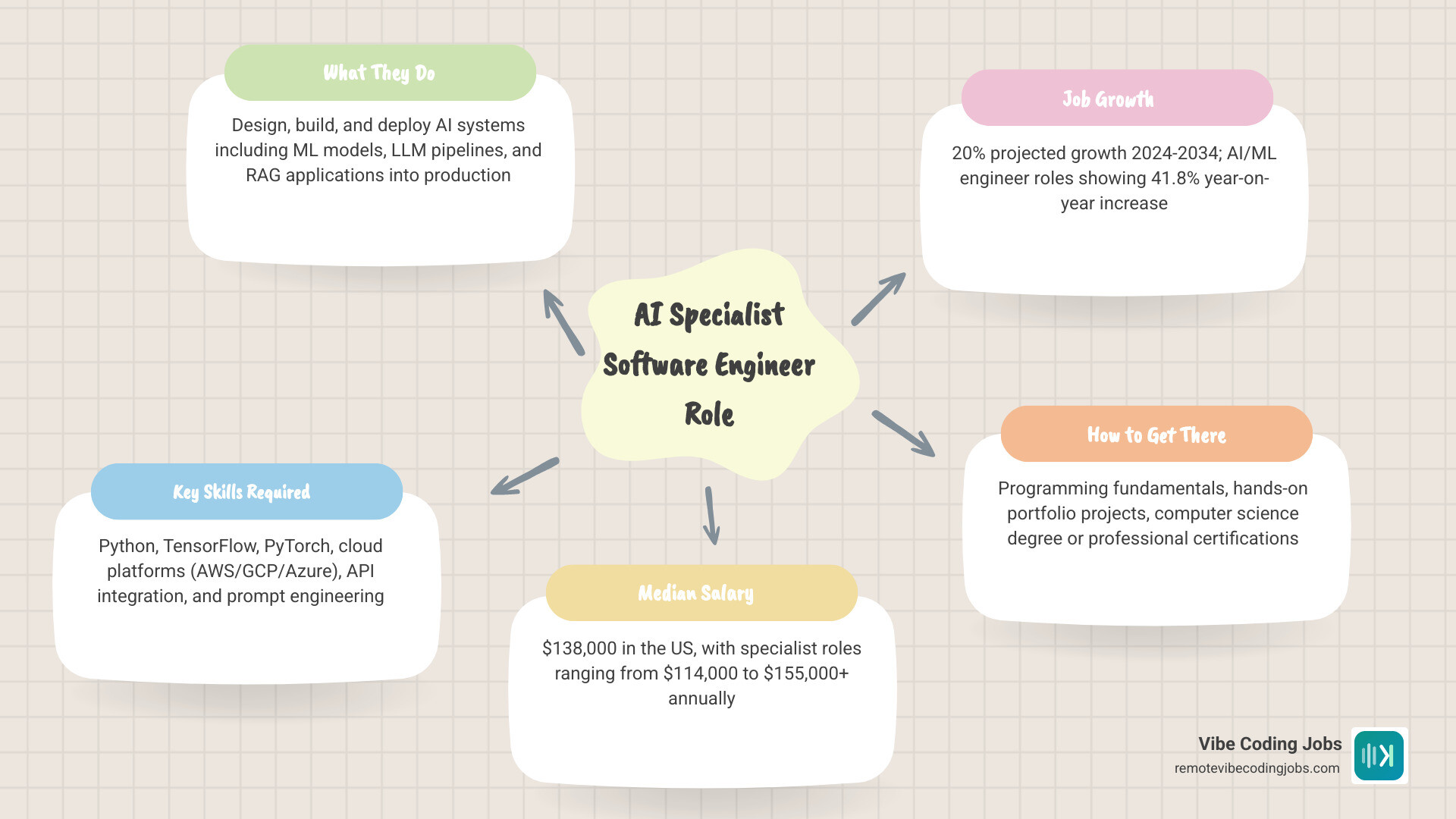
- What they do: Design, build, and deploy AI systems — including machine learning models, LLM pipelines, and RAG applications — into real-world production environments
- Key skills: Python, deep learning frameworks (TensorFlow, PyTorch), cloud platforms, API integration, and prompt engineering
- Median salary: $138,000 in the United States, with specialist roles ranging from $114,000 to $155,000+
- Job growth: Projected at 20% between 2024 and 2034 — with AI/ML engineer roles already showing a 41.8% year-on-year increase
- How to get there: A mix of programming fundamentals, hands-on projects, and either a computer science degree or a strong portfolio with professional certifications
The numbers are hard to ignore. AI could contribute up to $19.9 trillion to the global economy by 2030, and companies across every sector — from public transit to healthcare to non-profits — are actively hiring engineers who can turn AI from a prototype into a production system.
The catch? The role is genuinely demanding. It sits at the intersection of software development, data science, and machine learning engineering. It’s not just about knowing the tools — it’s about shipping systems that hold up under real traffic, real edge cases, and real cost constraints.
This guide walks you through everything you need to know: the core responsibilities, the technical skills, the training pathways, the portfolio projects that actually get you hired, and the salary and career trajectory you can expect.
I’m Dominic Zijlstra, co-founder of Adaptify.ai and former data scientist and DevOps engineer, and my hands-on experience building automated data systems is directly applicable to what it takes to succeed as an AI specialist software engineer today. Let’s get into it.
What is an AI Engineer and What Do They Do?
At its core, artificial intelligence engineering is the discipline of taking theoretical machine learning models and turning them into practical, scalable, and reliable software products. An AI engineer doesn’t just train a model in a Jupyter Notebook and call it a day; they build the infrastructure, APIs, and integration layers that allow that model to serve millions of users in real time.
In our day-to-day work, we see that AI engineers bridge the gap between pure data science and traditional software engineering. They write clean, maintainable code, set up robust deployment pipelines, and connect various systems together. Instead of building massive data sharing pipelines or training deep learning networks entirely from scratch, modern AI engineers focus heavily on extracting and pulling data, testing pre-trained machine learning models, and using API calls or embedded code to build functional applications.
With the rise of large language models (LLMs) and generative AI, the day-to-day workflow of an AI engineer has evolved. Today, it involves orchestrating complex workflows where multiple AI agents talk to each other, query vector databases, and call external tools to solve problems. To understand how this fits into the broader software landscape, you can read our deep dive on How AI is Transforming Remote Software Development.
Traditional Software Engineering vs. AI Specialist Software Engineer
While a traditional software engineer focuses on building user interfaces, managing relational databases, and writing business logic, an AI specialist software engineer works with a highly non-deterministic stack. In traditional programming, if you write if x == 5: do_something(), the outcome is entirely predictable. In AI engineering, you are dealing with probabilistic outputs—meaning the system’s behavior can change based on subtle differences in prompt phrasing, model versions, or retrieval context.
To illustrate these differences, we have mapped out the core distinctions between these two career paths:
| Feature | Traditional Software Engineer | AI Specialist Software Engineer |
|---|---|---|
| Primary Focus | Deterministic business logic, UI/UX, database management, and API design. | Probabilistic system design, LLM orchestration, model integration, and RAG systems. |
| Core Stack | React, Node.js, PostgreSQL, Java, C#, Go. | Python, PyTorch, LangChain, pgvector, Redis, vector databases. |
| Data Handling | Structured relational databases, CRUD operations. | Vector embeddings, unstructured document parsing, semantic search, and graph databases. |
| System Behavior | Highly predictable; bugs are usually caused by logical errors in code. | Non-deterministic; require evaluation frameworks, guardrails, and fallback strategies. |
| Key Challenge | Scaling database queries and managing complex state. | Controlling inference costs, minimizing latency, and preventing model hallucinations. |
Key Responsibilities of an AI Specialist Software Engineer
If you step into this role, your daily tasks will go far beyond writing basic prompts. You will be responsible for the entire lifecycle of an intelligent application. Here are the core responsibilities you will handle:
- Writing Clean, Production-Grade Code: You must apply software engineering principles like DRY (Don’t Repeat Yourself), SOLID, and test-driven development (TDD) to AI workflows. This ensures your code doesn’t turn into a tangled mess of hardcoded prompt strings.
- Orchestrating CI/CD Pipelines: AI systems need continuous integration and deployment pipelines that can handle model updates, compile evaluation datasets, and run automated regression tests to ensure system accuracy doesn’t drift.
- Infrastructure and FinOps Management: Running LLM queries at scale is expensive. You will design caching layers, route tasks to smaller models when appropriate, and set up circuit breakers to prevent runaway API costs.
- Statistical Analysis and Model Evaluation: You will use evaluation frameworks to continuously measure retrieval relevance, correctness, and groundedness of your AI outputs.
- API and Microservice Design: You will wrap complex AI workflows into clean, high-performance REST or WebSocket APIs (often using FastAPI or Next.js) so that other parts of the application can consume them easily.
For a broader look at how these responsibilities shape the job market, check out our guide on AI Coding Jobs: Remote Career Growth.
Ensuring Security, Governance, and Compliance in AI Solutions
One of the most critical—yet frequently overlooked—responsibilities of an AI specialist software engineer is securing the AI system. Because LLMs are designed to be flexible and conversational, they are highly vulnerable to unique security exploits.
To build secure, enterprise-grade AI solutions, we must implement several layers of defense:
- Prompt Injection Defense: We use a two-layer content security screening architecture. The first layer uses regex patterns (such as screening for typical attack phrases) to catch obvious injections, while the second layer utilizes a dedicated LLM moderation agent to evaluate the safety of the input before passing it to the core model.
- User Privacy & PII Filtering: Before sending any data to external LLM APIs (like OpenAI or Anthropic), we must programmatically strip out Personally Identifiable Information (PII) using specialized filtering libraries.
- Encrypted Key Management: To prevent API keys and secrets from leaking into LLM conversation logs, we keep keys strictly isolated using encrypted environment managers and secure parameter stores.
- Data Isolation in Multi-Tenant Systems: If you are building a SaaS platform where multiple companies use your AI, you must enforce row-level security (RLS) at the database layer to ensure Tenant A’s AI cannot retrieve Tenant B’s sensitive data.
Technical Skills Required to Become an AI Engineer
To transition into this field, you need a balanced mix of traditional software development skills and modern AI engineering techniques.
Here is the foundational tech stack you should master:
- Python & SQL: Python is the undisputed language of AI. You must be comfortable with asynchronous programming (using libraries like
asyncio) to handle concurrent API calls. Strong SQL skills are equally important for writing highly optimized queries to retrieve relational metadata. - Deep Learning Frameworks: While you may not write neural network layers from scratch daily, you must understand how frameworks like TensorFlow and PyTorch handle tensor operations, model weights, and inference.
- Containerization & Orchestration: Knowing how to package your AI applications into Docker containers and deploy them using Kubernetes or serverless cloud environments (like AWS Lambda or ECS) is essential for scalability.
- Cloud Infrastructure & IaC: Familiarity with cloud platforms (AWS, Azure, GCP) and Infrastructure as Code (IaC) tools like Terraform allows you to spin up secure, compliant AI environments automatically.
To learn more about how these skills translate into remote work opportunities, read our analysis of AI-Assisted Development Career Growth & Remote Roles.
Working with LLMs, RAG Systems, and Agentic Workflows
As generative AI has taken center stage, the core technical stack of an AI engineer has expanded to include specialized orchestration tools.
To build systems that can answer questions based on private company documents, you will design Retrieval-Augmented Generation (RAG) pipelines. Instead of sending a massive document directly to the LLM (which is slow and expensive), we chunk the document, convert those chunks into vector embeddings, and store them in a vector database like pgvector, Redis, or Pinecone.
To achieve high-quality retrieval in enterprise RAG systems, we use several advanced techniques:
- Hybrid Search: We merge dense vector search (which captures semantic meaning) with sparse keyword search (such as BM25) using a mathematical technique called Reciprocal Rank Fusion (RRF).
- LLM-Based Reranking: After retrieving the top 20 document chunks, we use a smaller, highly specialized reranking model to select the top 3 most relevant chunks before generating the final answer.
- Model Context Protocol (MCP): This open standard acts like a universal adapter, allowing AI models to securely connect to external databases, file systems, and tools without custom API glue code.
- Deterministic State Machines: For multi-step reasoning, we avoid unpredictable loops by using state-machine frameworks like LangGraph to define strict, auditable paths for our AI agents.
To see these principles in action, you can explore the portfolio of Zoltan Fabry – AI Engineer | Agent Orchestration & LLM Integration, who demonstrates how precise specifications and structured context architectures prevent multi-agent pipelines from breaking in production.
Educational Background and Training Pathways for AI Engineers
There is no single “correct” way to become an AI specialist software engineer. While having a bachelor’s or master’s degree in computer science, data science, or software engineering provides a solid foundation in algorithms and systems, the industry is rapidly shifting toward a skills-first hiring model.
If you do not have a formal degree, you can build a highly competitive profile by combining:
- Professional Certificates: Completing structured, hands-on certification programs from recognized cloud providers (like AWS Certified Machine Learning Specialty or Microsoft Certified: Azure AI Engineer Associate).
- Practice Assessments: Utilizing practice exams and hands-on labs to validate your skills under realistic constraints.
- A High-Quality Portfolio: Showing that you can build, secure, and deploy functional AI systems that solve real-world problems.
If you are just starting out, we highly recommend reading our guide on Entry-Level Remote AI Coding Jobs for Beginners to map out your learning journey.
Self-Paced Training vs. Instructor-Led Training
When acquiring these skills, you will generally choose between two primary learning formats:
- Self-Paced Training: This involves using online guided paths, video courses, and interactive documentation. The main advantage is complete flexibility—you can learn at your own pace while maintaining a full-time job. However, it requires immense self-discipline, and you can easily get stuck on complex architectural bugs without a mentor to guide you.
- Instructor-Led Training: This structured classroom format (either virtual or in-person) provides scheduled lectures, real-time feedback, and collaborative peer groups. It is highly effective for mastering complex topics like deep learning mathematics or advanced cloud deployment, though it is usually more expensive and less flexible.
We recommend a hybrid approach: start with self-paced courses to master programming fundamentals and basic LLM APIs, and then leverage structured bootcamps or mentor-led cohorts when learning to architect production-grade, multi-tenant AI systems.
Building a Portfolio to Demonstrate AI Engineering Expertise
In the competitive tech landscape of July 2026, a resume that simply lists “prompt engineering” is no longer enough to get you hired. Employers want to see that you can build robust systems that survive production traffic.
A production-ready AI portfolio should demonstrate that you understand:
- Latency Budgets: How to optimize your APIs to deliver real-time experiences (e.g., streaming tokens using Server-Sent Events or WebSockets).
- Inference Cost Control: Implementing multi-layer caching (such as Valkey for exact matches and semantic caching for conceptually similar queries) to reduce API costs by 40% or more.
- System Resilience: Setting up model-fallback circuit breakers so that if your primary LLM API goes down, the system automatically routes requests to a backup model to maintain 99.9% uptime.
A fantastic example of this “close-to-the-metal” engineering philosophy can be found on the portfolio of Sudarshan Kulkarni — Full-Stack AI Systems Engineer. His work showcases how to build ultra-low-latency voice pipelines and deterministic agentic systems using strict Pydantic schemas, avoiding heavy framework abstractions in favor of high-performance, production-ready architectures.
Real-World Projects Built by an AI Specialist Software Engineer
To make your portfolio stand out, focus on building complete, end-to-end applications rather than simple API wrappers. Here are some highly valued project ideas inspired by real-world implementations:
- An Enterprise Multi-Tenant Chatbot: Build a system that supports multiple isolated corporate tenants, using WebSockets for real-time streaming and semantic caching to keep costs low. You can reference Prakhar Kumar Singh – GenAI & ML Engineer to see how he scales multi-tenant systems to handle hundreds of concurrent enterprise users with 99.9% uptime.
- A Real-Time Voice Rehearsal Platform: Create an application using WebSockets and Voice Activity Detection (VAD) that allows users to converse with an AI. To see how to manage sub-300ms latency budgets and build composable agent frameworks with zero runtime dependencies, check out Haris Ahmed — AI Engineer & Full-Stack Software Engineer.
- A Clinical Summarization Pipeline: Build a secure, HIPAA-compliant tool that extracts structured medical data from unstructured doctor notes using domain-specific NLP models. For a deep dive into medical appeal letter automation and clinical AI pipelines, explore the work of Saravana — AI Engineer & Full-Stack Developer.
AI Engineer Salary, Job Outlook, and Career Paths
The demand for AI talent is at an all-time high, and the financial rewards reflect this. According to industry data, the median total salary for an AI engineer in the United States is $138,000. Even entry-to-mid-level roles in structured organizations offer highly competitive compensation, and specialized roles in rapidly scaling startups frequently exceed $150,000 annually.
This financial growth is backed by incredible job security. The US Bureau of Labor Statistics projects a 20% job growth for computer and information research scientists (including AI specialists) between 2024 and 2034, which is much faster than the average for all occupations. In fact, AI/ML engineering roles have shown a 41.8% year-on-year increase, making it one of the absolute safest bets for long-term career growth.
For a detailed breakdown of compensation trends, check out our comprehensive AI/ML Engineer Salary Guide.
Career Progression and Remote Opportunities
As you gain experience as an ai specialist software engineer, your career can progress along several exciting paths:
- Junior AI Engineer: Focuses on integrating existing LLM APIs, building basic RAG pipelines, and writing automated unit tests.
- Senior AI Systems Architect: Designs complex multi-agent workflows, optimizes token economics, manages database singletons to prevent memory leaks, and ensures enterprise-grade security compliance.
- Director of AI Engineering: Aligns AI capabilities with broader business strategies, manages engineering budgets, and establishes data governance policies across the entire organization.
Because AI development is digital-first and relies heavily on cloud infrastructure, it is exceptionally well-suited for remote work. Many of the fastest-growing startups and established enterprises operate on an async-first, remote-friendly model. To find companies that match your lifestyle and tech stack, explore our curated list of the Best Companies Hiring AI Developers Remotely.
Frequently Asked Questions about AI Specialist Software Engineers
What is the typical salary range for an AI specialist software engineer?
While the median salary in the US is $138,000, actual compensation varies based on your sector and experience. For example, in the public sector, the salary range for a Specialist Software Engineer – AI at the Metropolitan Transportation Authority (MTA) is $114,070 to $134,641. In contrast, private sector or specialized non-profit roles, such as the Software Engineer – AI/ML Specialist at Credential Engine, offer expected salary ranges of $135,000 to $155,000 annually.
To see active job listings and their exact salary ranges, you can check out a live Remote AI Software Engineer Job.
Do I need a master’s degree to become an AI engineer?
No, you do not need a master’s degree—or even a bachelor’s degree in computer science—to succeed in this field. While formal education is highly valued by traditional corporate employers, modern tech startups care far more about your practical skills, your understanding of system architecture, and your ability to ship working software. A strong portfolio filled with functional, secure, and cost-optimized AI applications will easily open doors.
If you are looking to break into the field through versatile, hands-on roles, take a look at this Remote VA Web Developer & AI Specialist Job as an example of how companies value practical execution over formal credentials.
What are the most common failure patterns in production AI systems?
AI systems fail in very different ways compared to traditional software. The six most common failure patterns we see in production include:
- Context Window Pollution: Passing too much irrelevant data to the LLM, causing it to lose track of the core instruction.
- Spec Drift: AI agents taking system specifications too literally or drifting away from the original goal over multi-step conversations.
- Cascading Failures: One agent generating a slightly malformed output that breaks the parser of the next agent in the pipeline.
- Agreeing with Bad Data: The model accepting incorrect user input as absolute truth and generating flawed logic based on it.
- Wrong Tool Selection: An agent calling an incorrect API tool because the tool’s description was ambiguous.
- Plausible-but-Wrong Outputs (Hallucinations): The model generating highly confident, grammatically perfect answers that are factually incorrect.
To prevent these failures, production systems must utilize strict Pydantic schema validation, model-fallback circuit breakers, and automated evaluation frameworks to catch errors before they reach the user.
Conclusion
Becoming an ai specialist software engineer is one of the most exciting, intellectually stimulating, and financially rewarding career paths available in July 2026. By bridging the gap between traditional software development and probabilistic AI workflows, you can build systems that don’t just look impressive in a demo, but actually survive the pressures of real-world production traffic.
At Vibe Coding Jobs, we believe that the future of software development belongs to those who treat AI as a force multiplier. We curate and aggregate the best remote “vibe coding” and AI engineering jobs at async-first companies that value clean code, modern AI tools, and autonomous execution.
Ready to take the next step in your career?