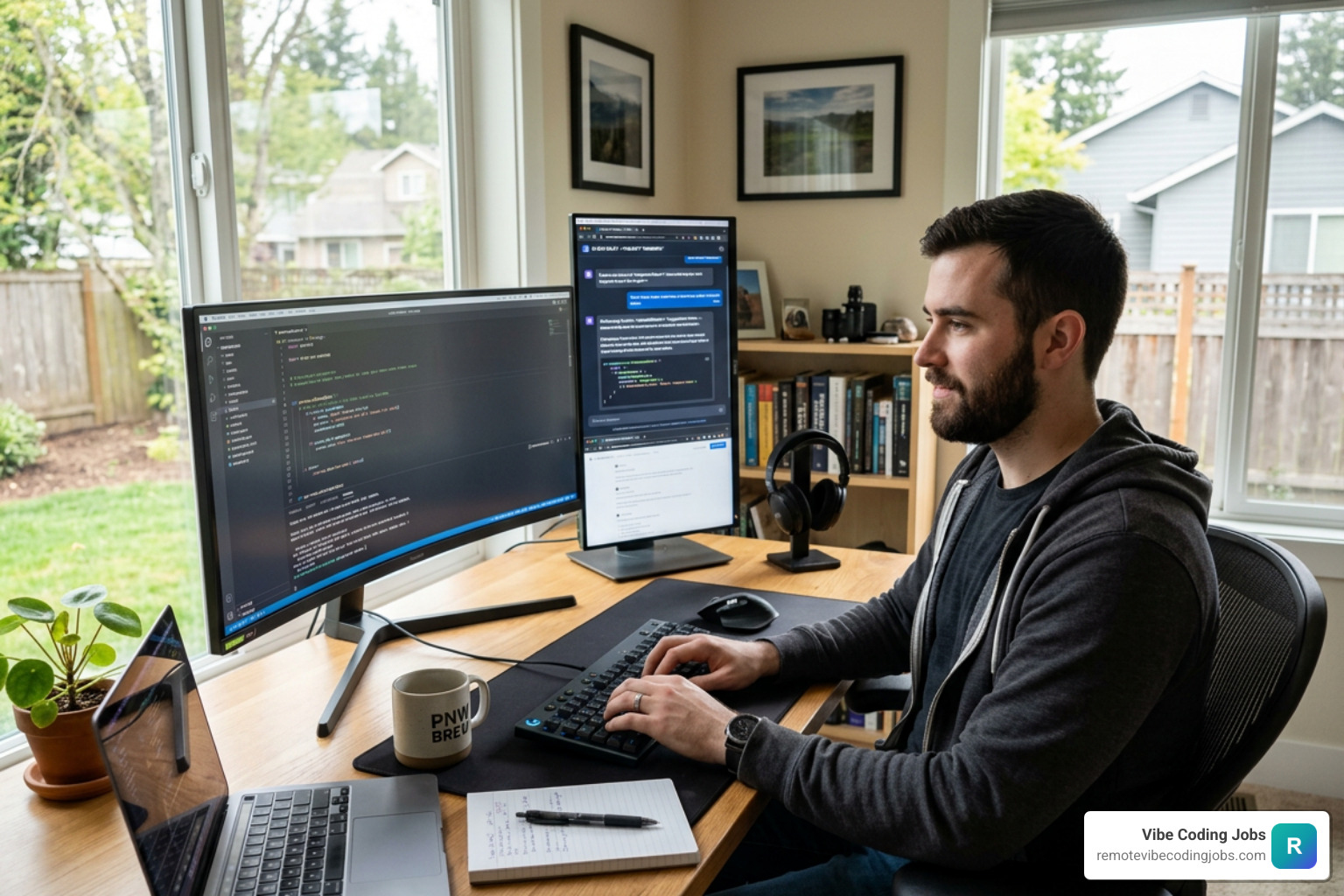
The Quiet Revolution Reshaping How AI Teams Work
Remote async AI jobs are fully remote positions — in AI training, model evaluation, RLHF feedback, and AI-assisted engineering — where you work on your own schedule, without real-time meetings or fixed hours.
Here’s a quick snapshot of what they look like in practice:
| Feature | Remote Async AI Job |
|---|---|
| Location | Fully remote, work from anywhere |
| Schedule | Flexible, no fixed hours or standups |
| Role types | AI trainer, ML researcher, quality analyst, AI engineer |
| Employment type | Mostly 1099 contractor, some full-time |
| Pay range | $30–$70/hr for most technical roles |
| Communication | Written, asynchronous — Slack, docs, tickets |
| Hours | 15–40+ hrs/week depending on project |
Something significant is happening in the AI job market — and most job boards haven’t caught up yet.
As of June 2026, there are over 600 async job listings in the United States alone, with more than half of those being fully remote. The demand is real, and it’s growing fast. AI labs need human experts to train models, evaluate outputs, and build the infrastructure that powers the next generation of intelligent systems — and they need people who can do it without being tied to a 9-to-5 calendar.
This isn’t just a niche trend. It’s a structural shift in how AI development gets done.
I’m RVCJ Editorial, the team behind Remote Vibe Coding Jobs, where we cover AI-assisted development, async work culture, and remote async AI jobs for engineers building with tools like Cursor, Claude, and Copilot. We’ve analyzed hundreds of live job postings and hiring trends so you can cut through the noise and find roles that actually fit.
What Are Remote Async AI Jobs?
At their core, remote async ai jobs are professional opportunities within the artificial intelligence ecosystem designed around an asynchronous-first communication model. Unlike traditional remote roles that still force you into endless Zoom standups and daily syncs, these roles are built entirely around independent execution. You are evaluated on your output, your code, and your written documentation, not your physical presence in a digital meeting room.
The day-to-day workflow typically revolves around activities like Reinforcement Learning from Human Feedback (RLHF), model evaluation, LLM training, and automated code generation review. For background on the training method behind many of these workflows, see Reinforcement learning from human feedback. Instead of sitting through meetings to explain what you did yesterday and what you are doing today, you communicate using structured tickets, pull requests, and detailed written feedback.
This structure enables a state of deep focus productivity that is almost impossible to find in standard corporate environments. Because your teammates are often spread across continents and time zones, companies rely heavily on written asynchronous communication.
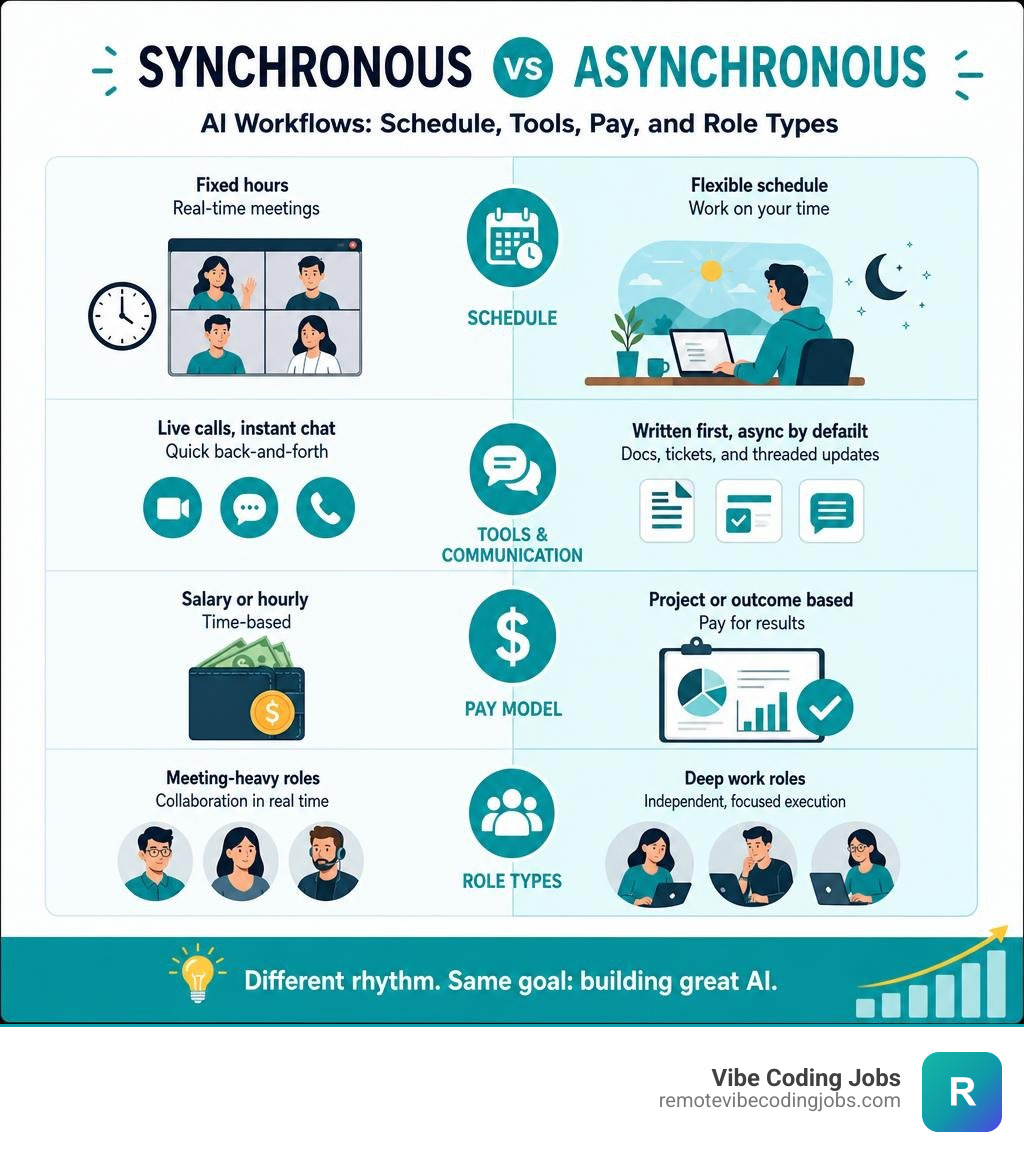
To help clarify the differences, let’s look at how these roles compare to traditional remote jobs:
| Operational Dimension | Traditional Remote Roles | Remote Async AI Jobs |
|---|---|---|
| Primary Communication | Synchronous (Zoom, Slack huddles, Google Meet) | Asynchronous (GitHub, Notion, Linear, Loom) |
| Schedule Structure | Core hours (e.g., 9 AM to 5 PM in a specific timezone) | 100% flexible (work 2 hours in the morning, 4 at night) |
| Performance Metric | Hours logged, meeting participation, sprint velocity | Quality of code reviews, model feedback, and output |
| Geographic Limits | Limited to specific states or countries for payroll | Highly global, often utilizing contractor models |
| Meeting Overhead | High (daily standups, retro, planning, refinement) | Extremely low to zero (monthly or project-based syncs) |
The Shift to Async-First AI Development
The explosion of generative AI has fundamentally changed the speed of software development. We have entered the era of vibe coding — a practice where engineers act as directors and editors of AI-generated code rather than manual syntax writers. In this environment, waiting for a synchronous meeting to make a decision slows down progress.
By embracing a flexible culture, AI companies can ship software and train models around the clock. Because developers use AI-assisted tools to automate the tedious parts of coding, they can focus their cognitive energy on systems-level thinking, prompt engineering, and architectural design. This shift has made async-first development the dominant operational strategy for leading AI labs and startups alike.
Key Roles and Platforms for Remote Async AI Jobs
The demand for async talent is reflected in the numbers. Out of 600 total async positions listed on major platforms in the United States, 329 are fully remote. Furthermore, 492 of these listings are full-time positions, and 355 of them target mid-to-senior level professionals. Interestingly, companies like MCI are leading the charge, accounting for 111 of these active listings.
If you are looking to break into this space, you don’t have to rely on generic job search sites. Highly specialized platforms have emerged to connect talent with these unique opportunities. For those who want a highly curated experience focused on companies that actually respect your time, checking out Async First Companies Hiring Developers Find Your Dream Remote Job is a fantastic starting point.
Remote Async AI Jobs for Engineers and Researchers
For software engineers and machine learning professionals, remote async ai jobs offer some of the most intellectually stimulating work in tech. One of the most common roles is training large language models (LLMs) to write production-grade code.
In these roles, you aren’t just writing apps; you are reviewing code snippets generated by AI, refactoring them for security and performance, and explaining exactly why one approach is superior to another. This expert feedback is injected directly into the RLHF pipeline, converting your engineering insights into reward signals that tune the model.
If you have a background in Python, you are in high demand. You can explore remote Python jobs or read through our Remote Python Developer Jobs 2026 Your Ultimate Guide to see how these training roles are structured.
For academic and research-focused minds, machine learning researcher positions offer global access to cutting-edge deep learning projects, allowing you to design algorithms and evaluate models from anywhere in the world.
Non-Engineering Remote Async AI Jobs and Quality Analysis
You do not need to be a senior backend engineer to secure a remote async AI position. There is a massive parallel market for quality analysts, technical consultants, and prompt engineers who evaluate model capabilities outside of raw code generation.
For instance, roles in AI quality analysis focus on evaluating personalization features for advanced consumer models (such as Gemini). In this type of role, you design creative, multi-turn conversational prompts based on real-life scenarios, evaluate the grounding and integration of the model’s responses, and write structured rationales explaining your evaluations.
Similarly, technical consultant roles bridge the gap between engineering and product evaluation. These consultants write evaluation rubrics, debug agent traces, and stress-test autonomous AI systems to ensure they perform reliably in real-world environments.
Essential Skills and Tools for Asynchronous AI Work
Success in an asynchronous environment requires a different toolkit than traditional in-office or synchronous remote roles. You aren’t just relying on your technical knowledge; your tooling and documentation workflow must be top-tier.
The modern async AI developer relies heavily on next-generation IDEs and AI-agentic tools. Tools like Cursor and Claude are no longer optional add-ons; they are core to the development workflow. Standard frameworks like Astro, Next.js, and React are used to build the interfaces that interact with these AI systems.
Mastering these tools offers incredible productivity benefits, enabling a single developer to accomplish what used to require an entire team. To understand how these tools are changing the hiring landscape, you can read about the overall vibe coding market growth.
To stay competitive, developers must understand how to integrate these tools into their daily workflows. We recommend exploring resources on:
Mastering Vibe Coding and AI-Assisted Workflows
Vibe coding is the ultimate expression of async-first development. Instead of getting bogged down in syntax errors and boilerplate setup, engineers use natural language to direct AI agents to build, test, and deploy software.

This approach requires strong systems thinking. You must know how to structure prompts, when to trust the AI’s output, and when to manually step in and override the code. For a deeper look at how this impacts developers at different stages of their careers, check out Remote Developer Jobs AI Tools Junior Senior.
Navigating the Challenges and Benefits of Async AI Roles
While the flexibility of remote async AI jobs is unmatched, this way of working is not without its hurdles. It is important to weigh both sides before diving in.
For a comprehensive breakdown, you can read our guide on remote work pros and cons. In short, the benefits include complete control over your schedule, zero commute times, and the ability to work from anywhere in the world.
However, the challenges are real:
- Isolation: Without daily watercooler chat or live meetings, you must actively seek out community.
- Privacy Trade-offs: Some platforms require you to install time-tracking software that takes automatic screenshots of your desktop to verify your hours.
- High Autonomy Required: If you struggle with self-motivation or need constant management, the low-oversight nature of async work can be difficult to manage.
Compensation, Hours, and Contractor Logistics
The financial structure of remote async ai jobs is highly flexible. Many of these roles are set up as 1099 independent contractor agreements rather than traditional W-2 employment. This means you are responsible for your own taxes and equipment, but it also gives you the freedom to work for multiple platforms simultaneously.
Hourly rates generally range from $30 to $70 per hour, depending on your technical expertise and the complexity of the project. Payments are frequently processed on a weekly basis through digital payment platforms like PayPal, Stripe, or AirTM.
Hours are typically flexible but project-dependent. Some roles require a minimum commitment of 15 hours per week, while others allow you to scale up to 40+ hours when project volumes are high. To see how these rates align with standard industry benchmarks, check out our analysis of salary expectations.
How to Land and Succeed in Remote Async AI Roles
Because these companies operate asynchronously, their hiring processes look very different from traditional tech companies. You won’t find many multi-stage whiteboard interviews here. Instead, hiring is often automated and performance-based.
- Automated Assessments: Many platforms use automated coding or evaluation tests to pre-screen candidates. If you can pass the practical assessment, you are in.
- AI Recruiters: Don’t be surprised if your first screening is conducted by an AI recruiter. Treat these interactions with the same professionalism as a human interview—speak clearly, answer technical questions directly, and ensure your setup is clean.
- Resume Optimization: Tailor your resume to highlight your experience with specific AI tools, prompt engineering, and your ability to work independently.
- Alternative Assessments: Many of these roles favor practical skill demonstrations over academic credentials. You can read more about how to navigate these no LeetCode assessments.
To plan your long-term trajectory in this rapidly changing market, consult our career path guide.
Frequently Asked Questions about Remote Async AI Jobs
What is the average pay for remote async AI jobs?
For technical roles like AI code training (Python, Ruby) or system evaluation, the pay typically ranges from $30 to $70 per hour. Non-technical roles, such as basic data annotation or general content feedback, usually range from $15 to $25 per hour. For a complete market overview, see our detailed guide on salary expectations in 2026.
Do I need a computer science degree to work in async AI training?
No. While senior engineering roles require strong programming instincts, many AI evaluation and training positions prioritize practical skills, analytical thinking, and writing quality over formal degrees. You can prove your capabilities by showcasing practical skills projects in your application.
How do companies track hours in asynchronous AI roles?
Tracking methods vary. Some platforms rely on trust-based task completion and deliverables, while others require the use of specialized time-tracking software that records active hours and takes periodic desktop screenshots to ensure data security and task focus.
Conclusion
The landscape of work has fundamentally shifted. Remote async AI jobs offer a level of freedom, focus, and flexibility that was unimaginable a decade ago. By letting go of the traditional 9-to-5 meeting culture and leaning into AI-assisted workflows, you can build a highly lucrative career on your own terms.
If you are ready to stop syncing and start building, we are here to help. Explore our curated list of opportunities and discover the async-first remote developer jobs benefits waiting for you on Remote Vibe Coding Jobs today.