
Remote Work Has Changed What “Tech Stack” Actually Means
Tech stack remote coding is no longer just about picking the right programming language. It now includes every tool you use to write, ship, collaborate, and communicate — from your AI code editor to your async project board.
Here’s a quick breakdown of what a modern remote tech stack looks like in 2026:
| Layer | Top Choices |
|---|---|
| Languages | JavaScript/TypeScript, Python, Go |
| Frameworks | Next.js, React, Node.js, Django |
| AI Coding Tools | Cursor, Claude Code, GitHub Copilot |
| Cloud/Deploy | Vercel, Railway, AWS |
| Version Control | GitHub |
| Collaboration | Slack, Loom, Linear, Figma |
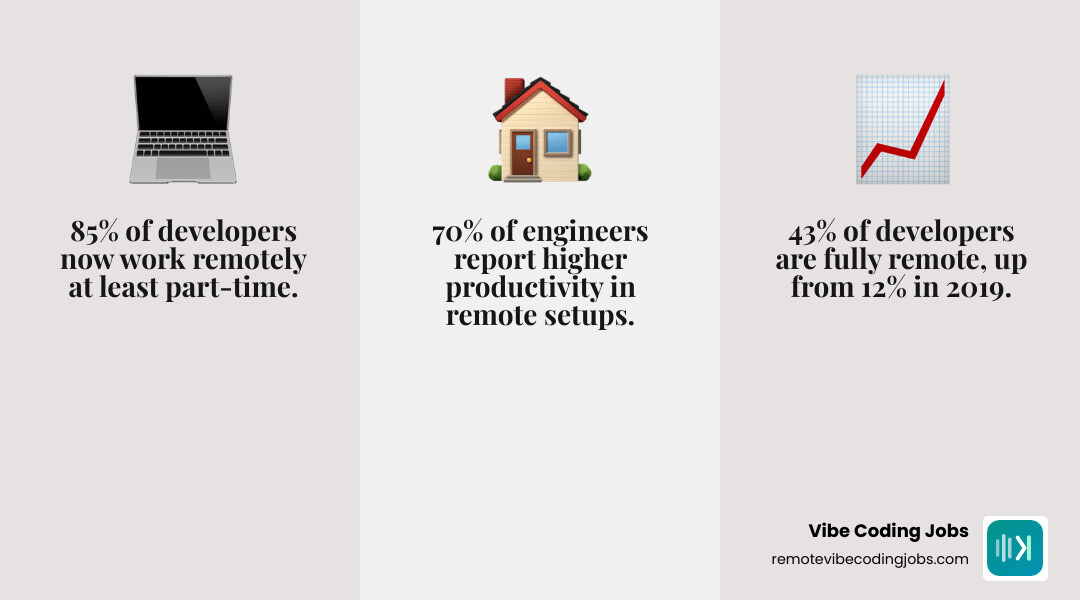
The numbers back this up. Today, 85% of developers work remotely at least part-time, and 43% are fully remote — up from just 12% in 2019. And 70% of engineers say remote work makes them more productive than working in an office.
The shift isn’t just about where you work. It’s about how your tools fit together when your team is spread across time zones and you never have a hallway conversation again.
AI has accelerated this change fast. Tools like Cursor and Claude Code now let developers build full-stack apps in hours, not days. Entire job categories — “vibe coder,” “AI-native developer,” “agentic engineer” — didn’t exist five years ago. They’re in job listings today.
If you’re trying to break into remote tech, or level up in it, the stack you choose signals more than your skill set. It signals how you work.
The RVCJ Editorial team at Remote Vibe Coding Jobs covers AI-assisted development, async hiring trends, and career guidance for developers building with tools like Cursor, Claude, and Copilot — with a direct focus on tech stack remote coding for distributed, AI-first teams. In this guide, we break down exactly which stacks are dominating remote job listings, which AI tools are reshaping workflows, and how to position yourself to get hired.
Defining the Modern Tech Stack for Remote Coding
A tech stack is essentially the combination of programming languages, frameworks, and tools used to build and maintain a software application. However, for those of us in the remote world, it’s much more than that. It’s our digital office. In 2026, a solid tech stack remote coding setup must prioritize ease of collaboration, scalability, and security.
When teams aren’t in the same room, the friction of a bad tool choice is magnified. Companies like Slack have famously moved their entire Remote Development at Slack workflow to the cloud to eliminate the “it works on my machine” excuse. By using remote development environments (like AWS EC2 instances), they’ve reduced onboarding from hours to minutes.
For the modern “vibe coder,” the stack is about achieving a flow state. We look for tools that support an async-first culture—where you don’t need a meeting to explain your code because your Remote Developer Tools Stack 2026 does the talking for you. This includes performance optimization and flexibility, ensuring that whether you’re coding from a beach in Bali or a home office in Auckland, your output remains top-tier. Before committing to a role, we often recommend a Tools/Vibe Check to see if a company’s culture truly supports these modern, AI-augmented workflows.
Top Programming Languages and Frameworks for 2026
The landscape of tech stack remote coding is currently dominated by a few heavy hitters that offer the best balance of speed, safety, and community support.
- JavaScript & TypeScript: JavaScript remains the king of the web, used by over 60% of developers. However, TypeScript is now the industry standard for remote teams. It provides the “guardrails” needed when you’re collaborating asynchronously. If you’re looking for stability and high demand, becoming a Remote Jobs/Typescript Developer is one of the safest bets you can make.
- Python: Appearing in nearly 34% of remote listings, Python is the backbone of the AI revolution. From data science to backend automation, its simplicity makes it a favorite for rapid prototyping. The Salaries/Python Engineer data reflects this, with high compensation for those who can bridge the gap between traditional backend work and AI implementation.
- Next.js: This is the framework we see most often on job boards like We Work Remotely. It’s the go-to for full-stack developers because it handles both the frontend and backend seamlessly. If you’re a Remote Jobs/Nextjs Developer, you’re essentially a one-person army capable of shipping production-ready apps.
- Go & Rust: These are the “performance” picks. Go is widely used for cloud-native development and infrastructure, while Rust is gaining massive traction in Web3 and systems programming due to its memory safety. You can explore the latest trends in our Top Programming Languages Vibe Coding 2026 report.
Full-Stack Dominance in Tech Stack Remote Coding
In the remote job market, “Full-Stack” is often shorthand for “Versatile.” Employers love full-stack developers because they understand the entire project lifecycle, which reduces the need for constant back-and-forth communication.
Using a stack like Next.js paired with Node.js allows for High-Vibe Full-Stack Roles where you can own a feature from the database schema to the UI component. We’ve seen that Building AI-Native Apps Remotely is significantly faster when using these unified stacks.
The Salaries/Full Stack Developer average sits around $112,000, but “vibe coders” who use AI to 10x their output are often commanding much higher rates in Remote Jobs/Fullstack Developer positions.
Specialized Mobile and AI Roles
While full-stack is popular, specialization still pays. Mobile development remains a massive sector for remote work. Whether you are a Remote Jobs/Mobile Developer focusing on cross-platform tools or a specialized Remote Jobs/Ios Developer or Remote Jobs/Android Developer, the demand for high-quality handheld experiences is constant.
Additionally, the rise of “Agentic AI” has created a surge in Remote Jobs/Machine Learning Engineer roles. These positions often require a blend of Python proficiency and an understanding of LLM orchestration. Check out the Salaries/Mobile Developer page to see how these specialized roles compare in the current market.
AI-Powered “Vibe Coding” Tools and Infrastructure

This is where the “vibe” in Vibe Coding Jobs comes from. We are currently in the era of AI-assisted development, where the developer acts more like an architect or a conductor than a typist.
- Cursor: This is currently our top-recommended IDE. It’s a fork of VS Code that integrates AI (Claude and GPT-4) directly into the core experience. It doesn’t just autocomplete; it understands your entire codebase. You can find more details on our Tools/Cursor Ai page.
- Claude Code: A powerful command-line tool that can actually execute tasks, run tests, and fix bugs autonomously. It’s a game-changer for Best Ai Coding Tools Vibe Coders 2026.
- v0: Created by Vercel, tools/v0 allows you to generate UI components just by describing them. It bridges the gap between design and React code instantly.
These tools enable “agentic workflows,” where you can describe a feature and let the AI scaffold the files, install dependencies, and write the initial logic. For a deeper dive, check out our Best Ai Coding Tools 2026 guide.
Traditional Coding vs. Vibe Coding Productivity
| Task | Traditional Coding | Vibe Coding (AI-Assisted) |
|---|---|---|
| Scaffolding a Monorepo | 45-60 minutes | 3-5 minutes |
| Writing Unit Tests | 30 minutes | 2 minutes |
| Debugging Complex Logic | 2 hours | 15 minutes |
| UI Component Creation | 1 hour | 5 minutes |
Essential Infrastructure for a Tech Stack Remote Coding Workflow
To support these high-speed workflows, your infrastructure needs to be just as agile. Remote teams are moving away from complex manual server management and toward “invisible” infrastructure.
- Deployment: Vercel is the gold standard for frontend, while Railway has become the go-to for backend services and databases. They offer “git push to deploy” workflows that are essential for remote teams.
- DevOps: Even in a vibe coding world, we need Remote Jobs/Devops Engineer specialists to manage Docker containers and Kubernetes clusters for scale.
- Version Control: GitHub is the undisputed home of remote code. Its PR review workflows and GitHub Actions for CI/CD are the heartbeat of async teams.
You can find a full list of Must Have Vibe Coding Tools on our blog, or use our Optimizing Your Specialist Tech Stack tool to see if your current setup is ready for a remote role.
Collaboration and Project Management for Async Teams
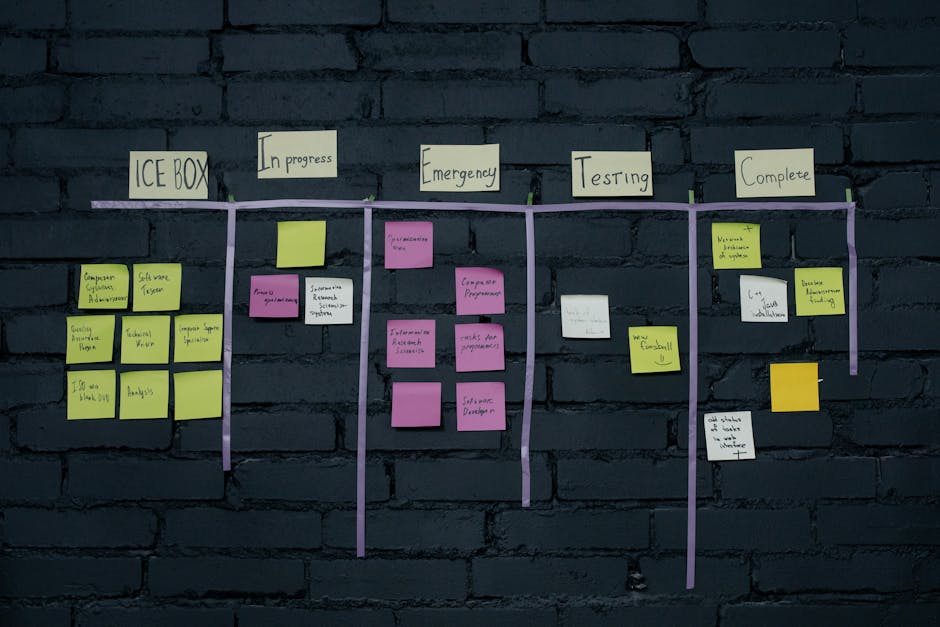
In a remote-first engineering team, communication is the most important part of the tech stack remote coding. If communication breaks down, the best code in the world won’t save the project.
- Slack: It’s unavoidable, but the best teams use it asynchronously. This means aggressive notification management and using threads to keep conversations organized.
- Loom: A 3-minute video walkthrough of a bug or a new feature can save a 15-minute meeting. It’s the ultimate tool for “showing, not just telling.”
- Linear: This has replaced Jira for most modern tech startups. It’s fast, keyboard-driven, and designed for teams that want to spend time shipping, not managing tickets.
- Figma: Essential even for developers. With “Dev Mode,” developers can inspect CSS, export assets, and see exactly what needs to be built without needing a meeting with a designer.
The key to success here is transparency. Every decision should be documented so that someone waking up in a different time zone can understand the “why” behind a code change. If you want to see how fast your team is actually moving, try our Tools/Vibe Coding Speed Test.
Frequently Asked Questions about Remote Tech Stacks
Which tech stack is best for remote beginners in 2026?
We recommend starting with the “Modern Web Stack”: TypeScript, React, and Next.js. These are the most frequently requested skills in remote job listings. Pair this with a basic understanding of Python for AI integration. Learning to be a Remote Jobs/React Developer provides a solid foundation, while exploring Remote Jobs/Vue Developer or Remote Jobs/Django Developer can help you find niche opportunities in established startups.
How do AI tools like Cursor impact remote developer salaries?
AI tools are a productivity multiplier, not a replacement. Developers who master “prompt engineering” and AI orchestration are seeing their value skyrocket. Senior AI-first roles are currently paying in the $150,000-$250,000 range because these individuals can do the work of three traditional developers. Check the Salaries/Typescript Developer page to see how AI fluency is pushing these numbers upward.
What are the most common interview assessments for remote roles?
Expect a multi-stage process:
- Take-home assignments: These are standard for remote roles to see how you work independently.
- Live coding: Often done via a shared IDE like Cursor to see your “vibe” and how you use AI tools.
- System design: To test your high-level architectural thinking.
- Collaboration checks: To see if you can communicate effectively in Slack or via Loom.
You can use our Tech Stack Analyzer to prepare your profile for these assessments.
Conclusion
The era of manual boilerplate and endless meetings is ending. In 2026, the most successful remote developers are those who embrace an AI-native, async-first culture. By mastering a modern tech stack remote coding—one that combines powerful languages like TypeScript and Python with cutting-edge tools like Cursor and Claude—you aren’t just keeping up; you’re leading the charge.
At Vibe Coding Jobs, we believe that your “vibe”—your ability to architect solutions and move fast with AI—is your greatest career asset. Whether you’re looking for your first remote role or your next senior position, the right stack is your ticket to location freedom and professional fulfillment.
Ready to find your next role? Browse the latest Remote Vibe Coding Jobs and join the community of developers building the future, one prompt at a time.