
What Is a Vibe Coder? Definition and Origins
What is a vibe coder is one of the fastest-growing questions in developer communities right now — and for good reason.
A vibe coder is someone who builds real software by describing what they want in plain English, letting AI generate the code, and steering the output through feedback rather than writing syntax by hand.
Here’s the quick version:
| Vibe Coder | |
|---|---|
| Primary skill | Prompting, product thinking, debugging judgment |
| Main tools | Cursor, Claude, GitHub Copilot, Lovable, Bolt |
| Who uses it | Founders, developers, PMs, indie hackers |
| Best for | MVPs, prototypes, micro-SaaS, internal tools |
| Not ideal for | Unreviewed production code, regulated data systems |
The term was coined by AI researcher Andrej Karpathy in February 2025. He described a workflow where you “fully give in to the vibes” — describing problems to an AI and accepting the output without reading every line of code. The idea spread fast. Within weeks, Reddit threads, TikTok videos, and X posts were flooded with developers sharing their experiences. By the end of 2025, Collins Dictionary named “vibe coding” its Word of the Year.
By July 2026, it’s no longer a fringe experiment. A quarter of startups in Y Combinator’s Winter 2025 batch had codebases that were 95% AI-generated. The debate has shifted from “is this real?” to “is this safe?” — and the answers are complicated.
I’m Di Su, a software engineer with over 10 years of experience in web development and scalable systems, and I’ve spent considerable time working at the intersection of technical execution and product growth — exactly the space where understanding what is a vibe coder matters most for developers navigating today’s AI-assisted job market.
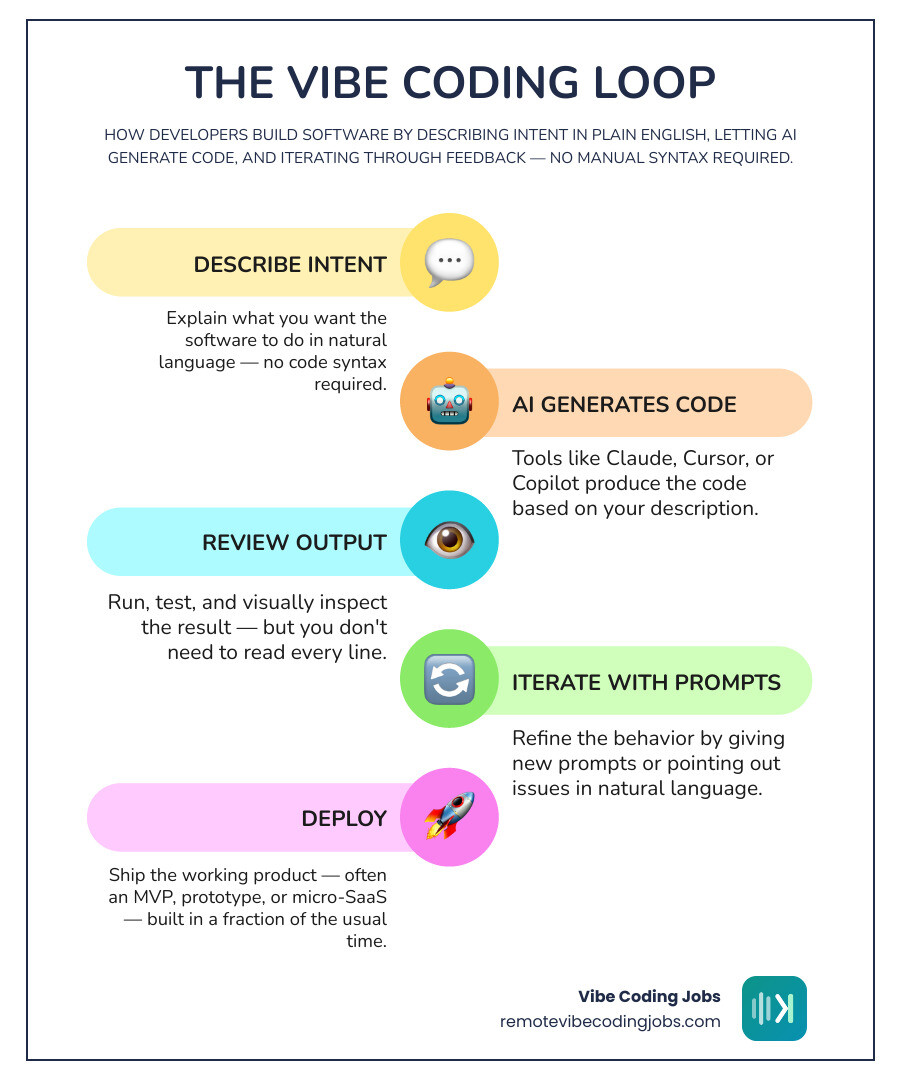
To truly understand what a vibe coder is, we have to look at how software development is shifting from manual syntax construction to intent-driven delegation.
For decades, programming required learning highly specific languages, managing memory, and debugging missing semicolons. A vibe coder bypasses this syntax layer entirely. Instead of writing code line-by-line, they act as a director. They describe the application’s goals, user experience, and logic in natural language, and let an artificial intelligence agent build the underlying files.
This trend is a major milestone in Vibe coding . It represents the ultimate shift toward natural language as the highest level of programming abstraction. It marks a transition where the bottleneck of software engineering is no longer how fast you can type code, but how clearly you can think and design. If you want a deeper look at this paradigm shift, check out our comprehensive guide on What is Vibe Coding?.
The Origin of the Term and How It Took Over Reddit
The term “vibe coding” was born on February 2, 2025, when computer scientist Andrej Karpathy (co-founder of OpenAI and former Tesla AI lead) posted about his weekend projects. He admitted that he was coding entirely by “vibes”—asking the AI for the “dumbest things,” like decreasing sidebar padding, simply because he was too lazy to find the CSS file himself. He described the process as “forgetting that the code even exists.”
The post immediately went viral. On Reddit, communities like r/vibecoder and r/LocalLLaMA exploded with users sharing how they built fully functional web apps in a single afternoon. TikTok and YouTube creators quickly hopped on the trend, showing off micro-SaaS tools built from a single prompt.
By March 2025, Merriam-Webster listed “vibe coding” as a trending slang expression. By the end of that year, Collins English Dictionary named it the 2025 Word of the Year. It became a cultural phenomenon because it democratized software creation, allowing non-technical founders, product managers, and hobbyists to build real, revenue-generating products without a computer science degree. For a closer look at the tools vibe coders use to ship these products, read What Is a Vibe Coder? Definition, Tools & What They Build .
Pure Vibe Coding vs. Responsible AI-Assisted Development
As the trend matured into 2026, a clear dividing line emerged between “pure” vibe coding and responsible AI-assisted development.
- Pure Vibe Coding: This is the “fully give in to the vibes” approach. The builder relies entirely on the AI’s output, blindly clicking “Accept All” on code suggestions without reviewing the diffs or understanding the underlying logic. It is highly efficient for rapid prototyping, hackathons, and personal “software for one” projects, but incredibly risky for professional software.
- Responsible AI-Assisted Development: In this workflow, the developer uses the LLM as an incredibly fast typing assistant. They outsource repetitive boilerplate, nested JSON structures, and basic file paths to the AI, but they maintain strict human oversight. They review every line of generated code, run manual security checks, and ensure the architectural logic is sound.
As open-source developer Simon Willison famously argued, if you thoroughly review, test, and understand every line of AI-generated code, you aren’t just vibe coding anymore—you are using an LLM as a highly sophisticated typing assistant. To explore how these two approaches stack up in professional environments, see our detailed breakdown of Vibe Coding vs Traditional Coding.
Vibe Coding vs. Traditional Software Engineering
The rise of the vibe coder has created a fascinating divide in the tech industry. Traditional software engineering is analytical, precise, and syntactically rigid. Vibe coding, on the other hand, is conversational, experimental, and outcome-oriented.
Here is how the two approaches compare across core development vectors:
| Feature | Traditional Software Engineering | Vibe Coding |
|---|---|---|
| Primary Interface | IDE, syntax-specific code editors | Natural language chat, agentic dashboards |
| Bottleneck | Syntax mastery, manual debugging, boilerplate | Context engineering, design taste, logic verification |
| Speed to MVP | Weeks to months | Hours to days |
| Code Quality | High (human-designed and refactored) | Variable (prone to duplication and bloat) |
| Security | Audited, structured validation | Prone to “security debt” and hidden flaws |
| Scalability | Built-in architectural planning | Requires manual refactoring as it grows |
For a deeper analysis of how these roles are shifting in the modern job market, explore Vibe Coding vs Traditional Software Engineering: Key Differences.
How to Transition and What Is a Vibe Coder Workflow
Transitioning from a traditional developer to an effective vibe coder is not about forgetting how to code; it is about learning how to delegate. The workflow shifts from typing syntax to managing an iterative feedback loop.
Here is what a typical vibe coding workflow looks like in practice:
- Define Intent and Context: You write a highly detailed prompt describing what you want to build. This requires “context engineering”—providing the AI with business logic, architectural constraints, preferred tech stacks, and operational parameters.
- Generate the Scaffold: The AI engine generates the initial database schemas, backend APIs, and frontend components.
- Deploy and Test (“Vibe Deploying”): You launch the application immediately to a serverless platform (like Vercel or Cloud Run) with a single click or prompt, bypassing traditional DevOps bottlenecks.
- Iterative Refinement: You interact with the app, spot bugs or UI inconsistencies, and feed those errors or requests back to the AI. “Make the jump mechanics more floaty,” or “Fix this database timeout error.”
- Validation: You manually review the critical files (like authentication or payment handling) to ensure security and correctness before finalizing.
If you are ready to build your first app using this modern approach, check out our step-by-step tutorial: How to Vibe Code a Full-Stack App: A Developer’s Guide.
The Core Toolstack: Cursor, Claude, and Copilot
Vibe coders rely on a specialized suite of AI-native tools designed to handle multi-file reasoning and workspace memory. Unlike older code autocompletes, these tools understand the context of your entire repository.
- Cursor: The undisputed favorite IDE of the vibe coding community. It allows developers to chat directly with their codebase, auto-generate edits across multiple files, and feed terminal errors back into the AI with a single keystroke.
- Claude (specifically Claude 3.5 Sonnet): Widely considered the most capable model for code generation, logic reasoning, and debugging. Its “Artifacts” feature allows builders to preview frontend designs in real-time right next to the chat window.
- GitHub Copilot: Still a powerhouse for inline autocomplete, helping developers quickly fill out nested JSON structures, repetitive HTML, and routine test suites without losing flow state.
- Integrated App Builders (Bolt.new, Lovable, Zoer): These platforms combine AI code generation, database provisioning (like Supabase), and instant deployment into a single interface, allowing users to go from prompt to live full-stack app in minutes.
To learn how to configure these tools for maximum efficiency, check out our guide on Vibe Coder Tools: Copilot, Cursor.
The Benefits and Risks of Vibe Coding
Like any technology, vibe coding is a double-edged sword. It offers unprecedented leverage for solo builders, but it can introduce massive liabilities if used carelessly in enterprise environments. For a balanced look at this reality, see What Is a Vibe Coder? Definition, Identity & Tools | VibeOrigin .
Why Vibe Coding Requires Experienced Developers to Be Effective
There is a common industry myth that AI-assisted coding tools make traditional programming knowledge obsolete. In reality, the exact opposite is true: vibe coding requires stronger raw engineering and debugging fundamentals to be truly effective.
This comes down to the 80/20 rule of AI code generation. AI agents are incredibly good at getting an application to 80% completion in a matter of minutes. However, the remaining 20% of the work—fixing logic errors, handling edge cases, integrating APIs, and securing data—takes 80% of the total project time.
AI coding agents are often described as brilliant senior developers who are “on drugs and have random dementia.” They can write complex algorithms in seconds, but then make bizarre, simple mistakes like deleting a production database or forgetting a basic variable definition.
Without deep engineering judgment, a non-technical builder cannot spot these hallucinations. In fact, a randomized controlled trial by METR showed that using early-2025 AI tools actually increased task completion times by 19% for experienced open-source developers working on mature, complex repositories, because they spent so much time debugging and correcting AI errors. To read more about what a professional vibe coder’s day actually looks like, check out What Does a Vibe Coder Actually Do? | TechCerted .
The Security Trap and Code Quality Concerns
When developers blindly trust AI output, they fall directly into the “security trap.” Generative AI models are trained on public code repositories, which means they frequently replicate historical security flaws, outdated libraries, and poor architectural patterns.
According to research from major security firms:
- AI co-authored code contains approximately 1.7 times more major issues compared to human-written code.
- Security vulnerabilities are 2.74 times higher in AI-generated code.
- Misconfigurations (such as open database ports or permissive API routes) are 75% more common in AI-assisted codebases.
- AI-assisted commits expose secrets (like API keys and private tokens) at a rate of 3.2%, compared to just 1.5% for human-only commits.
A stark real-world example of this occurred when researchers audited 1,645 web applications created by an AI app-building platform. They discovered that 170 of those applications had critical security vulnerabilities that allowed personal user information to be accessed by anyone on the internet.
Common AI security flaws to watch out for include:
- Exposed Secrets: Hardcoded API keys, passwords, or database credentials left in the source code.
- SQL Injection: AI failing to parameterize database queries, allowing malicious users to manipulate the database.
- Broken Authentication: Weak JSON Web Token (JWT) verification or flawed login logic.
- Dependency Bloat: AI importing outdated, vulnerable, or non-existent npm/pip packages (package hallucination).
The ‘Vibe Slop’ Crisis and Its Industry Impact
The rapid, unchecked adoption of vibe coding has led to what senior engineers are calling the “vibe slop” crisis. Because AI tools make code incredibly cheap to produce, codebases are expanding at an unsustainable rate without proper structural design.
A comprehensive study by GitClear analyzing over 211 million lines of code highlighted this exact trend:
- The volume of code refactoring (restructuring existing code to improve readability and maintainability) dropped from 25% of changed lines in 2021 to under 10% by 2024.
- Meanwhile, code duplication increased approximately four times in volume over the same period.
Instead of writing clean, reusable helper functions, AI tools tend to write repetitive, verbose code blocks to solve immediate problems. This results in massive, bloated file structures that are incredibly difficult for humans to read, maintain, or scale. Many industry experts predict a massive wave of technical debt over the next 12 to 18 months, forcing companies to hire expensive human consultants to completely rebuild broken, AI-generated codebases. To understand how game developers and indie creators are navigating these code limits, check out ⚡ Unpack What Does Vibe Coding Mean (Indie Game Dev 2026) | Sorceress Blog | Sorceress .
The Impact on Junior Developers and the Job Market
The vibe coding revolution has severely disrupted the traditional tech career path. Many companies, under the false assumption that AI can completely replace entry-level talent, have aggressively cut junior developer roles.
This has created a dangerous “knowledge pipeline gap.” If companies do not hire junior developers, how will those developers gain the real-world experience needed to become the senior engineers of tomorrow? If the next generation of builders grows up relying entirely on AI to write their code, the industry risks losing deep, foundational knowledge of computer science.
However, the job market in 2026 is starting to adjust. Forward-thinking companies are no longer looking for developers who reject AI, nor are they looking for pure vibe coders who don’t understand their own code. They are hiring AI-augmented product engineers—professionals who combine rapid AI prototyping with traditional engineering judgment. At RemoteVibeCodingJobs, we specialize in connecting these highly skilled developers with async-first, remote companies that value high-leverage workflows. To plan your next career step, read our guide on the Vibe Coding Remote Jobs Career Path.
How Vibe Coding Kills Open-Source Software Maintainers
The open-source software ecosystem has borne the brunt of the vibe coding backlash. Because AI tools make it effortless to generate code, open-source repositories have been flooded with low-quality, AI-generated pull requests—a phenomenon maintainers refer to as GitHub’s “Eternal September.”
Hobbyists and pure vibe coders frequently run their code through an AI, generate a pull request to a major open-source library, and leave it to the human maintainers to figure out why it doesn’t work. One frustrated developer went as far as opening a GitHub issue titled “Please Do Not Vibe Fuck Up This Software” after a flood of AI-assisted commits broke a widely used file backup utility.
Furthermore, vibe coding tends to homogenize software development. Because LLMs are trained on historical data, they heavily favor large, established libraries (like React or Express) while completely ignoring newer, more efficient open-source projects. This starves innovative new libraries of adoption, slowing down the natural evolution of the software ecosystem.
Frequently Asked Questions about Vibe Coding
As vibe coding continues to reshape the tech landscape, developers and founders alike have plenty of questions about its long-term viability.
FAQ 1: Do you need to know how to code to be a vibe coder?
No, you do not need a formal computer science degree to start vibe coding, but technical literacy is absolutely mandatory.
While AI can handle the initial syntax and scaffolding, you must understand software fundamentals to guide the AI effectively. You need to know how databases connect to backends, how APIs handle requests, and how to read basic error logs. Without this baseline knowledge, you will not be able to debug the application when the AI inevitably hallucinates or gets stuck in an infinite loop.
FAQ 2: Is vibe coding safe for production applications?
In its “pure” form—accepting and deploying AI-generated code without review—vibe coding is highly unsafe for production environments.
It introduces severe security debt, performance bottlenecks, and architectural flaws. However, vibe coding is highly effective for production if it is treated as a collaborative process: using AI to generate the initial drafts, followed by rigorous human code review, automated security scanning, and comprehensive testing.
FAQ 3: What is the difference between vibe coding and no-code tools?
The primary difference lies in flexibility and the underlying output:
- No-Code Tools: Use visual, drag-and-drop interfaces (like Bubble or Webflow) with fixed, pre-built templates. You are entirely confined to the features the platform supports.
- Vibe Coding: Uses natural language to generate real, custom source code (JavaScript, Python, SQL, etc.). This gives you unlimited flexibility, as you can export, host, and modify the raw code anywhere you want.
Conclusion
Vibe coding is not a temporary hype cycle; it is a permanent structural shift in how software is created. It collapses the barrier between having an idea and shipping a working product, allowing solo founders to build revenue-generating micro-SaaS tools in a weekend.
However, as we navigate the landscape of 2026, the industry is realizing that the “vibe” only works if you have been coding long enough to spot what is broken. The most successful developers of this era are not pure vibe coders, nor are they traditional purists—they are hybrid engineers who use AI as a force multiplier while maintaining rigorous engineering standards.
If you are a high-leverage developer who knows how to balance AI speed with structural integrity, we want to help you find your next role. At RemoteVibeCodingJobs, we curate daily listings from top async-first companies looking for AI-assisted development experts.
Ready to take the next step? Compare the workflows in detail with our guide on Vibe Coding vs Traditional Software Engineering, explore our active job board, and download our free playbook to supercharge your remote career today!