
Remote Entry AI Coder Jobs Are Booming — Here’s What You Need to Know
Landing a remote entry AI coder job in 2026 is more achievable than most beginners realize. Hundreds of openings are posted every week — and many don’t require a computer science degree or years of experience.
Here’s a quick snapshot of what to expect:
| Factor | Details |
|---|---|
| Average entry salary | $54,650/year |
| Hourly range | $17.50 (data annotation) to $40+ (technical evaluation) |
| Experience required | None to minimal — skills and assessments matter more |
| Common roles | Data annotator, AI chatbot trainer, coding evaluator, vibe coder |
| Contract type | Mostly flexible, project-based or contract work |
| Top tools to know | Cursor, Claude, GitHub Copilot, Python, TypeScript |
The AI development landscape has shifted fast. Traditional software roles focused on writing every line of code by hand. Today’s entry-level AI roles are different — they center on guiding, evaluating, and improving AI systems. That opens the door for people who are analytical and tech-curious, even if they’re not seasoned engineers yet.
Consider this: one platform reports that a new father was picking up coding tasks during his child’s naps, staying current with tech trends while working entirely on his own schedule. That kind of flexibility is becoming the norm, not the exception.
I’m RVCJ Editorial, the team behind Vibe Coding Jobs — we cover AI-assisted development, remote hiring trends, and career guidance for developers building with tools like Cursor, Claude, and Copilot, including everything related to breaking into remote entry AI coder roles. In this guide, we’ll walk you through exactly what these jobs involve, what they pay, and how to land one.
Remote entry ai coder helpful reading:
Defining the Remote Entry AI Coder Role in 2026

By May 2026, the term “coder” has undergone a massive transformation. A remote entry AI coder is no longer someone who just memorizes syntax and grinds LeetCode. Instead, these roles focus on the intersection of human logic and machine intelligence.
In the current market, companies are moving away from traditional “junior” roles that require months of hand-holding and toward Remote Entry Level AI Coding Opportunities where beginners use AI agents to multiply their output from day one. This shift is often called “vibe coding” or AI-first development. It’s an approach where you describe the “vibe” or intent of a feature, and the AI handles the implementation.
At RemoteVibeCodingJobs, we see this trend daily. Companies aren’t just looking for people who can write code; they want people who can manage the AI that writes code. This is a massive opportunity for beginners who are comfortable with future trends in AI coding.
How AI-Native Roles Differ from Traditional Software Engineering
The primary difference lies in the workflow. Traditional software engineering is “manual-first.” You write a line, you test it, you fix a typo, you move to the next line.
AI-native roles are “intent-first.” As a remote entry AI coder, your job is to:
- Prompt Engineering: Crafting precise instructions for AI agents like Claude or Codex.
- System Architecture: Thinking about how different parts of an app fit together, rather than just the syntax of a single function.
- Verification: Reading AI-generated code to ensure it meets security and quality standards.
Instead of typing 100 lines of code, you might write a 5-line prompt, review the 100 lines the AI generates, and then use a tool like Enter Code to run autonomous tests. For a deeper dive, check out our guide to entry-level AI roles and expectations.
Typical Tasks for a Remote Entry AI Coder
What does a typical Tuesday look like for someone in this role? It’s often a mix of creative problem-solving and technical oversight.
- Data Annotation & Task Creation: You might create expert rubrics or “prompts” to train general AI agents. This involves taking a complex problem—like a GitHub Pull Request—and turning it into a task that an AI can learn from.
- Technical Evaluation: You’ll act as the “human in the loop,” grading AI responses for accuracy, safety, and efficiency.
- Agent Debugging: Using tools like GitHub – always-coder to monitor remote terminal sessions and nudge AI agents when they get stuck in a loop.
- Rapid Prototyping: Building “MVPs” (Minimum Viable Products) in days rather than weeks by leveraging agentic platforms like Qoder.
You can explore more about these entry-level opportunities to see which task type fits your current skill set.
Essential Skills and Qualifications for Beginners

You don’t need a PhD to be a remote entry AI coder, but you do need a specific “stack” of skills. The bar for entry has shifted from “knowing how to build everything” to “knowing how to verify everything.”
Technical Foundations vs. AI Tool Proficiency
We often tell our community that you should start with the basics of HTML, CSS, and JavaScript or Python. Why? Because if the AI generates a bug, you need enough logic to spot it. However, your most valuable skill in 2026 is AI Tool Proficiency.
To land a job, you should be comfortable with:
- AI Code Editors: Like Cursor or Windsurf, which provide context-aware suggestions.
- Agentic Platforms: Tools that don’t just suggest code but actually run it and fix errors autonomously.
- Remote Access Tools: Understanding how to use RemoteAI or Remote Codetrol to manage coding sessions from any device.
Our Vibe Coding with AI: A Beginner’s Practical Guide breaks down exactly how to build your first project using this modern stack. For more on what companies are specifically looking for, see our Remote AI Developer Job Requirements.
Onboarding and Training for the Remote Entry AI Coder
One of the best things about the remote entry AI coder market is the availability of self-service training. Platforms like Stellar AI or Mindrift often provide comprehensive onboarding materials.
The process usually looks like this:
- Skill-Match Test: A short assessment to see if you can follow instructions and spot errors in code.
- Onboarding Modules: Learning the specific rubrics and safety standards of the company.
- Trial Projects: Working on small, paid tasks to prove your reliability.
Check out these AI coding jobs for beginners to find companies that offer structured onboarding for those just starting out.
Salary Expectations and Career Growth in AI-Native Development
Money matters, and in the AI space, the ceiling is incredibly high. Even as a beginner, you are entering a field where “productivity multipliers” (AI tools) allow you to command higher rates than traditional juniors.
The average salary for a remote entry AI coder is approximately $54,650 per year. However, this varies wildly based on the specific type of work you do.
| Role Type | Typical Hourly Rate | Annualized (Approx.) |
|---|---|---|
| Data Annotation (General) | $17.50 – $25.00 | $36k – $52k |
| Technical Coding Evaluator | $25.00 – $45.00 | $52k – $93k |
| Junior AI-First Developer | $35.00 – $50.00 | $70k – $100k |
| Specialized AI Trainer (Python/SQL) | Up to $90.00 | $180k+ |
For a more detailed breakdown, refer to our Vibe Coding Salary Guide for Entry Level Roles.
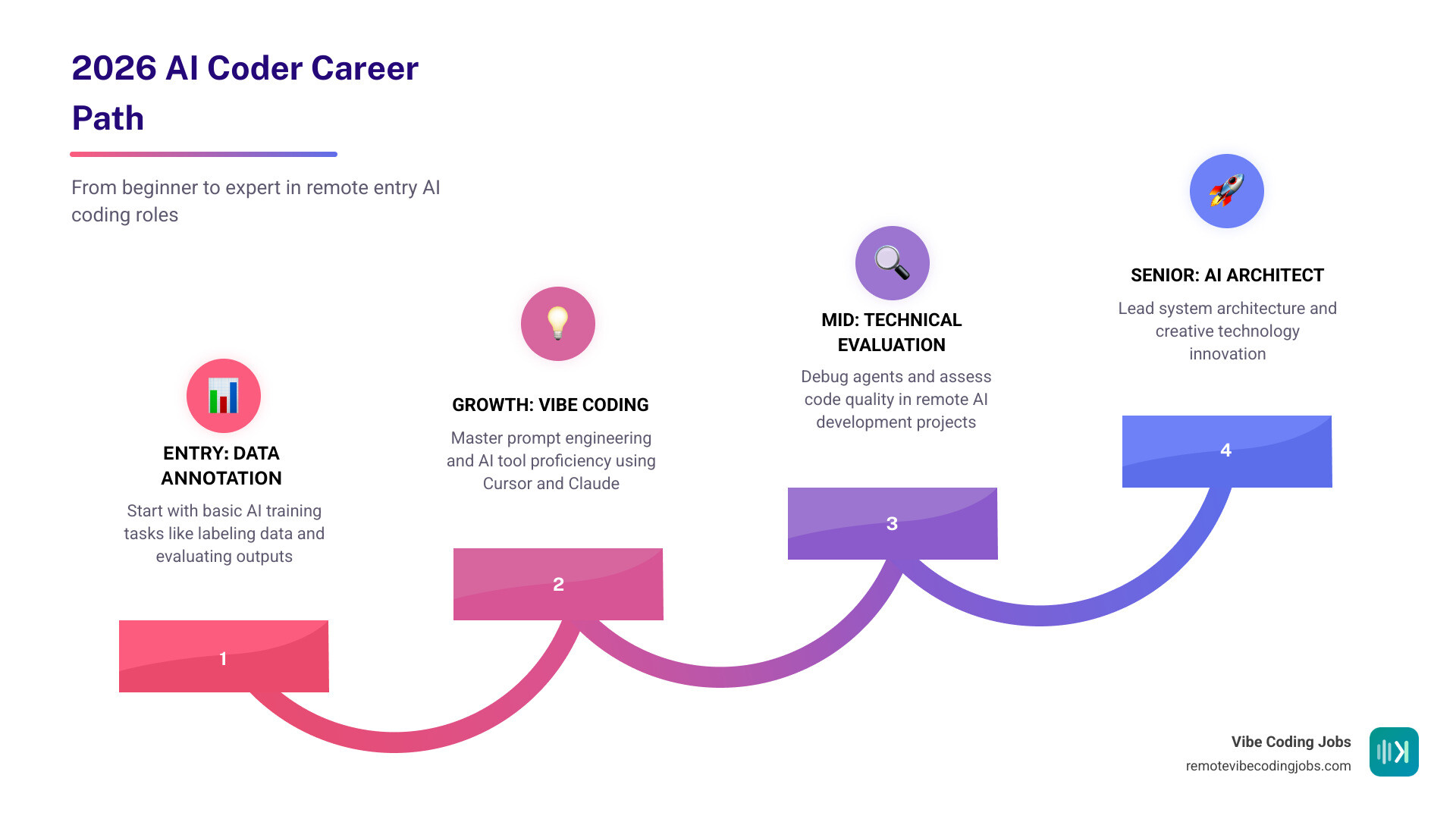
Advancing from Entry-Level to Senior AI Architect
The career path for a remote entry AI coder is faster than traditional software engineering. Because you are learning to architect systems rather than just write syntax, you can often move from “Junior” to “Mid-level” in 12–18 months.
- Entry-Level (0-1 years): Focus on annotation, evaluation, and building simple features with AI.
- AI-First Developer (1-2 years): Managing complex workflows, earning $70,000–$100,000.
- Product Engineer (2-4 years): Using AI to build entire products from scratch, earning $100,000–$150,000.
- Senior AI Architect (5+ years): Designing the infrastructure that AI agents use, with salaries reaching $150,000–$250,000+.
Stay updated on these market trends to ensure your skills stay ahead of the curve.
Top Platforms to Find Remote Entry-Level Opportunities
Finding a job is about knowing where to look. General job boards like Indeed or LinkedIn can be noisy. For remote entry AI coder roles, you want platforms that understand “async-first” culture and AI-native workflows.
We recommend starting with these resources:
- RemoteVibeCodingJobs: We aggregate the best “vibe coding” roles, specifically filtering for companies that embrace tools like Cursor and Claude.
- NoDesk Remote AI Jobs: A great place for general remote AI roles.
- Indeed Flexible AI Jobs: Good for finding high-volume data annotation roles.
- How to Land Remote AI Jobs Guide: A helpful external resource for application tips.
Navigating Junior and Internship Listings
When looking for junior level remote jobs, don’t just look for the title “Software Engineer.” Look for titles like “AI Trainer,” “Technical Evaluator,” or “Junior Agentic Engineer.”
For example, a Junior AI Software Engineer position might value your ability to use coder/vscode-coder to manage remote workspaces over your ability to write a sorting algorithm by hand.
Overcoming Challenges and Maximizing Benefits
Working as a remote entry AI coder isn’t without its hurdles. You need to be disciplined.
The Challenges:
- Hallucination Management: AI makes mistakes. You must develop a “trust but verify” mindset.
- Async Communication: In a remote role, your writing skills are just as important as your coding skills. You need to explain why an AI’s output was wrong.
- Isolation: Working from home can be lonely. We recommend joining communities (like ours!) to stay connected.
The Benefits:
- Unmatched Flexibility: As long as the tasks get done, many companies don’t care when you work.
- Rapid Learning: You are essentially getting paid to learn the most important technology of the decade.
- Location Independence: Whether you’re traveling in Portugal or coding during a child’s nap, the world is your office.
Learn more about landing your first remote job to navigate these challenges successfully.
Frequently Asked Questions about Remote AI Coding
Do I need a computer science degree to start?
No. While a degree can help, many remote entry AI coder roles prioritize your ability to pass a skill-match test and your portfolio of AI-assisted projects. Practical proof of work often beats a diploma in this field.
What are the best AI tools for beginners in 2026?
The top tools currently are Cursor (the gold standard for AI code editing), Claude 3.5/4 (for reasoning and logic), and Qoder (for agentic task delivery). Learning to use these in combination is your “secret weapon.”
Are remote AI coding roles usually full-time or contract-based?
Many entry-level roles start as flexible, project-based contracts. This allows you to work for multiple companies or fit work around your life. However, as you gain experience, full-time “AI-First Developer” roles with benefits become much more common.
Conclusion
The era of the remote entry AI coder is here, and it is the most accessible path into tech we have ever seen. By focusing on “vibe coding,” mastering AI tools, and building a portfolio of agent-assisted projects, you can bypass years of traditional schooling and jump straight into a high-growth career.
At RemoteVibeCodingJobs, we are committed to helping you navigate this new world. Whether you are looking for remote entry-level opportunities or want to level up your existing skills, we have the resources to help you succeed.
Ready to start? Secure your next role at RemoteVibeCodingJobs today and join the future of software development.